K-shaped Differentiation Takes Shape, Home Appliance Stock Competition Enters Deep Waters
 05/14 2026
 535
535
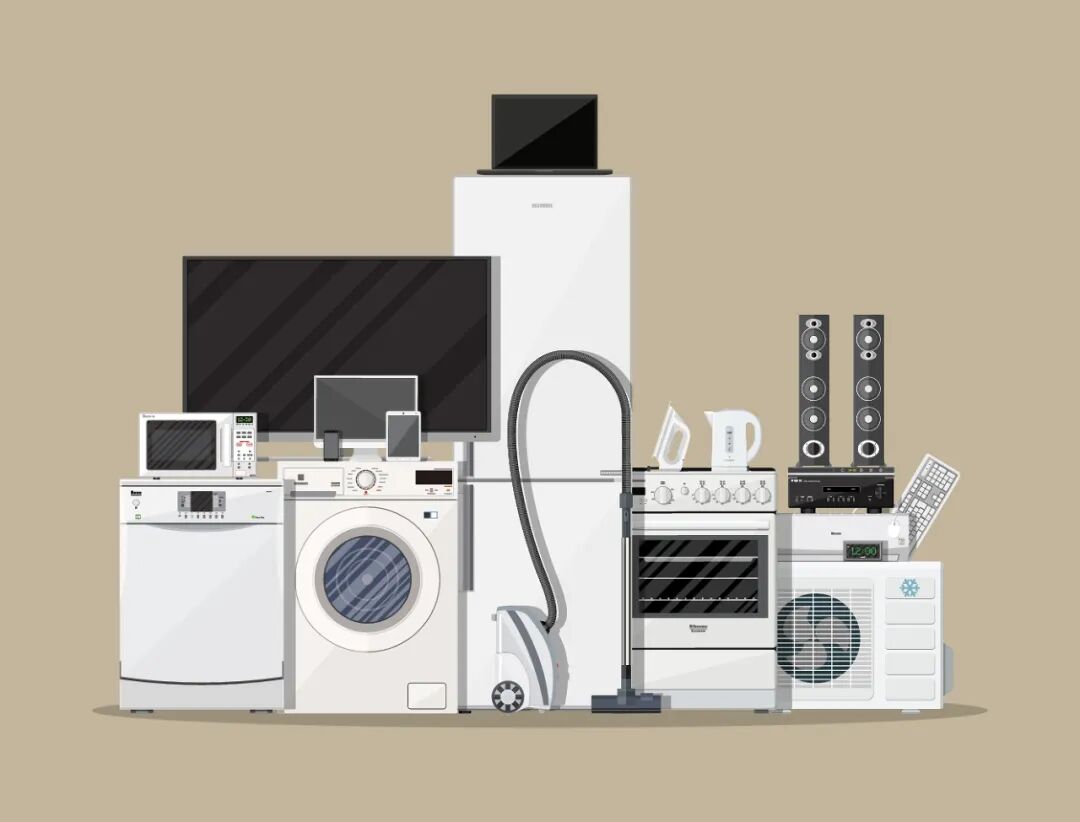
China's home appliance industry has bid farewell to the inclusive growth cycle.
Authoritative data shows that in 2025, both China's home appliance retail and export scales experienced year-on-year declines. The superposition of multiple pressures, including real estate adjustments, rising raw material costs, and price war intensification, has propelled the industry into an extreme K-shaped differentiation pattern.
Leading companies such as Midea and Haier have broken through against the odds through globalization and high-end positioning, while mid-tier firms have collectively fallen into the trap of revenue growth without profit increases. Small and medium brands are facing accelerated exits, revealing the brutality of stock competition in the industry.

K-shaped Differentiation Pattern Takes Shape
In 2025, core operational data in the home appliance industry faced collective pressure throughout the year, becoming more pronounced in the second half.
Data from All View Cloud (AVC) shows that the annual retail market size for domestic home appliances (excluding 3C) reached RMB 893.1 billion, down 4.3% year-on-year. The industry's contraction intensified in the second half, with Q4 retail sales experiencing an expanded year-on-year decline, showcasing a significant "high at the beginning, low at the end" trend.
The export sector also faced pressure. Data from the General Administration of Customs shows that China's home appliance exports reached RMB 688.85 billion, down 3.3% year-on-year. Weak global demand, high trade barriers, and exchange rate fluctuations compressed profit margins for export companies.
The continued real estate adjustment directly impacted the home appliance industry. Data from the National Bureau of Statistics shows that in 2025, the sales area of newly built commercial housing nationwide reached 881.01 million square meters, down 8.7% year-on-year. This directly impacted demand for kitchen appliances and built-in home appliances highly correlated with new home renovations, with annual retail sales of kitchen and bathroom appliances down 8.5% year-on-year.
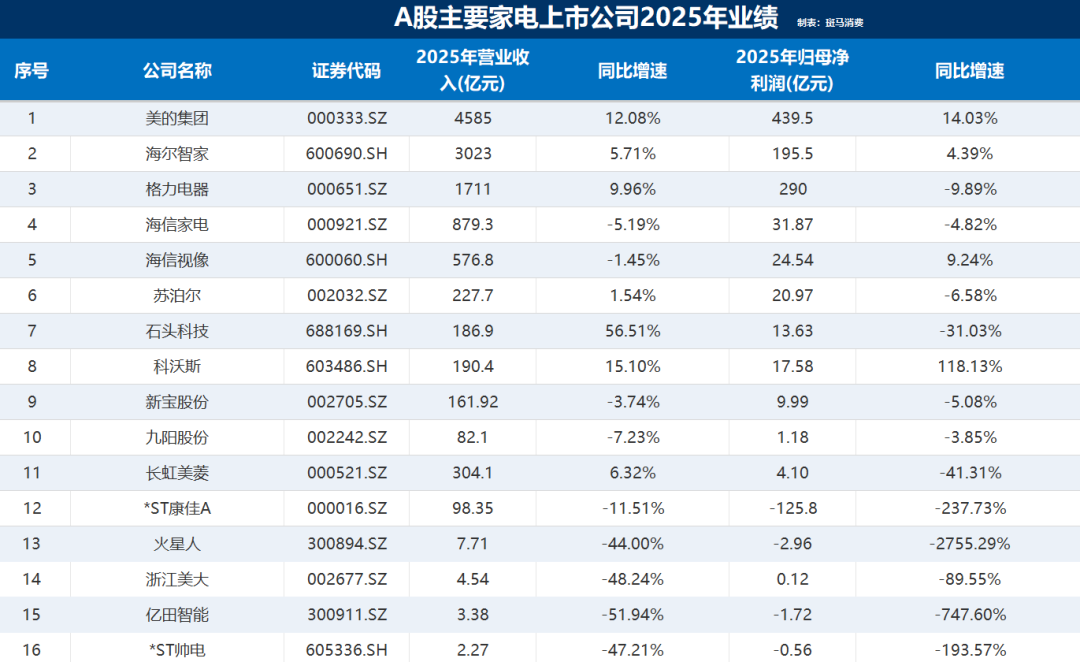
The 2025 annual reports have been fully disclosed, revealing the performance landscape of major A-share home appliance listed companies. The overall picture shows a pronounced "Matthew effect" and an intensifying differentiation pattern.
From a performance perspective, approximately 60% of listed companies saw a year-on-year decline in net profit attributable to shareholders, with "revenue growth without profit increases" becoming a widespread phenomenon. Among the leading companies, Midea Group and Haier Smart Home achieved both revenue and profit growth, with combined revenue exceeding RMB 760 billion, dominating the industry.
Differentiation among mid-tier firms intensified. Changhong Meiling and Supor saw slight revenue growth but declining net profits, while Hisense Home Appliances experienced declines in both revenue and profit. Small and medium brands faced even greater challenges, with multiple companies like Shenzhen Konka A falling into losses and some small and medium manufacturers in niche segments accelerating their exits.
The K-shaped pattern of "the strong getting stronger, the weak getting weaker" officially took shape in 2025.
The Gap Continues to Widen
The essence of K-shaped differentiation lies in the gap in core competitiveness among enterprises. The against the trend growth of leading companies reflects their strong risk resistance built through long-term strategies.
Midea Group (000333.SZ) has long focused on globalization and diversification, which played a significant role during industry cycles. In 2025, its overseas revenue reached RMB 197.9 billion, up 16% year-on-year, accounting for 42.93% of total revenue, effectively offsetting domestic market pressures. Its ToB business became another growth engine, with annual revenue reaching RMB 122.8 billion, up 17.5% year-on-year. Among them, the building technology business grew by 25.72%, serving as a key support for navigating the cycle.
Haier Smart Home (600690.SH) has forged its own path with high-end positioning and overseas localization. Its high-end brand Casarte maintained rapid growth, becoming one of the main profit sources. Overseas revenue accounted for over 50% again, with a localized research, production, and sales system effectively avoiding tariff and geopolitical risks.
Cost control ability is another trump card for leading companies. In 2025, copper and aluminum prices surged significantly. As a key raw material for air conditioners, this directly drove up manufacturing costs for companies.
Research from Founder Securities points out that leading companies, by virtue of their industry chain influence and brand pricing power, can more stably maintain gross profit margins, while small and medium enterprises can only bear the brunt of cost pressures.
As one of the three major white goods giants, Gree Electric Appliances (000651.SZ) faced performance pressures in 2025, becoming a typical example of slowed growth and the need to break through in the leading camp . Annual report data shows that in 2025, Gree Electric Appliances achieved total operating revenue of RMB 171.1 billion, down 9.96% year-on-year; net profit attributable to shareholders was RMB 29 billion, down 9.89% year-on-year.
Its consumer appliances segment, which includes air conditioners, generated RMB 133.1 billion in revenue, down 10.43% year-on-year. Affected by industry price wars and impact from new players, both domestic and export sales declined. Domestic sales revenue was RMB 126.4 billion, down 10.67% year-on-year, while export sales revenue was RMB 27.375 billion, down 2.93% year-on-year.
Even so, as a leading air conditioner brand, Gree maintained resilient profitability. In 2025, its overall gross profit margin reached 29.81%, with domestic sales gross profit margin at 34.52% and export gross profit margin at 24.54%, both slightly higher than the previous year.
It should be noted that Gree Electric Appliances' diversified businesses have not yet formed strong support. Although its smart equipment segment grew by 60.51% year-on-year, its revenue scale was only RMB 681 million, insufficient to offset the downward pressure on its core business.
In Q1 2026, Gree Electric Appliances' performance showed significant recovery, with operating revenue reaching RMB 43.08 billion, up 3.46% year-on-year; net profit attributable to shareholders was RMB 6.082 billion, up 3.01% year-on-year. Both revenue and profit returned to growth trajectories, signaling a recovery.

"Revenue growth without profit increases" is a common pain point for mid-tier firms. Changhong Meiling achieved RMB 30.41 billion in revenue in 2025, up 6.32% year-on-year, but net profit attributable to shareholders was only RMB 410 million, down 41.31% year-on-year. Supor saw a slight 1.54% increase in revenue to RMB 22.77 billion, but net profit declined by 6.58% year-on-year. Roborock pursued "volume at the expense of price," with annual revenue surging by 56.51% year-on-year to RMB 18.69 billion, but net profit plummeting by over 31%.
In such a market environment, small and medium brands are facing increasing difficulties. Zhang Jianfeng, Secretary-General of the China Home Appliance Commercial Association, pointed out that compared to leading companies, small and medium enterprises lack brand recognition and scale; compared to lower-end products, they lack cost-effectiveness advantages and cannot withstand the dimensionality-reducing attacks from leading companies. Coupled with the three major pressures of rising raw material costs, price war intensification, and overseas tariff barriers, they can only accelerate their exits.
Product category differentiation has further intensified the industry's fragmented situation . White goods have maintained resilience supported by leading companies, with annual revenue growing by 4.42% year-on-year. Black goods demand remained relatively stable, with high-end products like Mini LED and laser TVs supporting average prices. Hisense and TCL also achieved growth in overseas shipments. Kitchen and bathroom appliances experienced overall negative growth, becoming one of the worst-performing categories of the year. Small home appliances showed clear structural differentiation, with cleaning appliances like robot vacuums growing by 11.3% year-on-year, while traditional, homogeneous small home appliances remained sluggish.

The Beginning of Industry Reshuffling
The K-shaped differentiation in the home appliance industry in 2025 is not a short-term market fluctuation but a result of the industry entering the deep waters of stock competition. This pattern is likely to persist for a long time to come.
Research from Founder Securities predicts that industry concentration will continue to rise in the future, with the CR4 for air conditioners, refrigerators, and washing machines expected to exceed 85%. The exit of small and medium brands will accelerate. The industry's growth logic has shifted from "scale expansion" to "value enhancement."
High-end positioning, intelligence, green development, and globalization will become the core competitiveness for companies to navigate through cycles. Industry data shows that in 2025, the proportion of first-tier energy-efficient home appliances exceeded 60%. Midea and Haier's photovoltaic air conditioners and heat pump water heaters achieved significant growth. Smart home appliances command a 20%-30% price premium, becoming a core source of gross profit. These trends will further intensify in 2026.
Policy guidance is also adjusting. The trade-in policy in 2025 saw a significant weakening of its effects in the second half. This year, the policy will undergo iterations, with subsidies extending from traditional major appliances to smart home appliances, small home appliances, and health-oriented home appliances. Subsidy standards will also tilt towards lower-tier markets and elderly consumer groups, while increasing support for corporate R&D and innovation. This means that most policy dividends will go to leading companies with technology and scale.
Facing the new market environment, companies at different tiers need to find their own paths based on their characteristics.
Leading companies should focus on "quality and efficiency improvements," continuously deepening their core businesses, increasing R&D investment, and consolidating their industrial chain advantages while responding to uncertainties in overseas markets.
Mid-tier firms need to identify differentiated segments and avoid direct competition with leading companies. For these firms, failure to quickly break through brand, technology, and supply chain bottlenecks will result in direct pressure from leading companies.
The path for small and medium brands lies in niche markets. Areas like cleaning appliances, health-oriented home appliances, and age-friendly home appliances still have market space. Focusing resources on a single niche category and building strong competitiveness in core products is the only way to survive through precise positioning.
In the long run, the activation of the real estate stock market, improvements in living quality, and the advancement of the rent-and-purchase parallel system will bring structural opportunities to the home appliance industry. The demand for stock home renovations and refurbishments continues to release, with long-term demand for high-end home appliances, smart home appliances, and whole-home smart solutions remaining strong. These represent new growth points for the industry. The rent-and-purchase parallel system will also drive demand for lightweight, standardized, and cost-effective home appliances, opening up new market space for companies.
K-shaped differentiation is essentially the beginning of a reshuffling in the home appliance industry. As competition continues to intensify, the industry will gradually form a clear pattern of "leading companies dominating, mid-tier firms breaking through, and small and medium firms focusing on niches." Under differentiation, some will exit while others break through—this is an inevitable part of the industry's value reconstruction.
-
![]()
Samsung Home Appliances Exit China: 34-Year Journey from Market Dominance to 0.38% Share—What’s the State of Domestic Brand Advancement?
-
"Vanishing Profits" – Peering Through Q1 Earnings of Listed Automakers, Who’s Quietly Fortifying Their Defenses?
-
![]()
Is VLA Dead? This Company Wants to Equip Robots with 'Physical Intuition' Using VLOA
-
![]()
The Valuation Logic of AI Companies Needs a Complete Update in the DAA Era
-
![]()
AI Revenue Accounts for Over 30% for the First Time! Alibaba's Financial Report Sends Strong Signal
-
![]()
The Sports Camera and Recording Glasses Market Booms Amid Universal Content Creation Surge
-
![]()
Crush San Francisco! Qingdao Stages a Comeback to Become the World's Top City with 9.9 RMB Driverless Vehicles and an 'Energy Island': Neolix, 9D Tech, White Rhino, Cainiao, Didi, Huolala—Who Will Hav
-
![]()
Xiaomi Releases Autonomous Driving Model Xiaomi OneVL: How Does It Tackle the "Reasoning" Dilemma?