Google Unveils Googlebook: The Mouse Evolves into an AI Portal, Yet Ecosystem Gaps Persist as the Major Challenge
 05/15 2026
 533
533
Could Googlebook Become the PC World's 'Android'?
Googlebook has arrived.
This product, lauded as "one of Google's most significant hardware initiatives" and embodying Google's aspirations for the future PC ecosystem, has finally made its grand entrance.
Some might question, hasn't Google already ventured into laptops? Aren't Chromebooks already on the market? To some extent, that's correct. Chromebooks, in essence, are not true computers; they are merely browser-based devices with basic PC functionalities. This is why, after all these years, they have only managed to make a mark in the budget and educational sectors, struggling to penetrate the broader consumer PC market.
Given Chrome OS's limited capabilities, it naturally falls short in supporting a comprehensive PC ecosystem. Hence, the pivotal shift with Googlebook is the adoption of an entirely new system—centered around Gemini Intelligence, integrating the Android app ecosystem, Chrome browsing experience, cross-device collaboration, and AI interaction capabilities.
Of course, you could simply refer to it as a "native AI system."
"Native"—what a delightful term.
Let's stop calling it a Chromebook; this time, Google aims to redefine the PC.
Can Googlebook succeed? From Xiaolei's perspective, the likelihood of success is significantly higher than that of Chromebook. After all, Google has high hopes for it and is committed to fundamentally rebuilding the system.
In Googlebook's ecosystem, Xiaolei finds the Magic Pointer feature particularly captivating. Essentially, it transforms the mouse pointer from a mere clicking tool into an AI activator. Users can point to a date in an email, and the system will assist in scheduling; they can also select furniture and room images, and AI will generate matching designs.
In simpler terms, it serves as an indicator, informing AI which "elements" in the area require attention. Beyond "modifying and optimizing," it can also "create something from nothing." In Google's demonstration, the Magic Pointer hovered over a blank space, and users could directly instruct AI via voice to generate desktop widgets in that area, with fully customizable content, such as organizing travel plans or unread emails.

Image Source: Google; Production: Leitech
These capabilities may not sound entirely novel. For instance, Windows has Copilot, macOS boasts the promising Apple Intelligence, and on mobile devices, features like circle selection, summarization, translation, and screen recognition have emerged.
However, Googlebook's distinction lies in its approach to AI integration. Rather than treating AI as a standalone app or sidebar feature, it strives to embed AI into fundamental interaction layers, such as the mouse, desktop, widgets, file management, and phone connectivity. This is the most significant divergence between Googlebook and traditional Windows PCs and Macs.
Essentially, Google aims to create an AI terminal that leverages the Android and Google service ecosystems, transforming the PC into a more proactive, personalized, data-driven, and cross-device AI terminal.
Or, to put it another way, Googlebook isn't merely copying Windows or Mac; it's attempting to redefine the PC interface. Previously, users would power on their computers to locate files, open software, and switch between browser tabs, with the system responding to each click.
Google envisions a future where, upon turning on Googlebook, users can directly instruct the system on their intentions, and the system will then mobilize apps, web pages, files, and phone resources to accomplish the task.
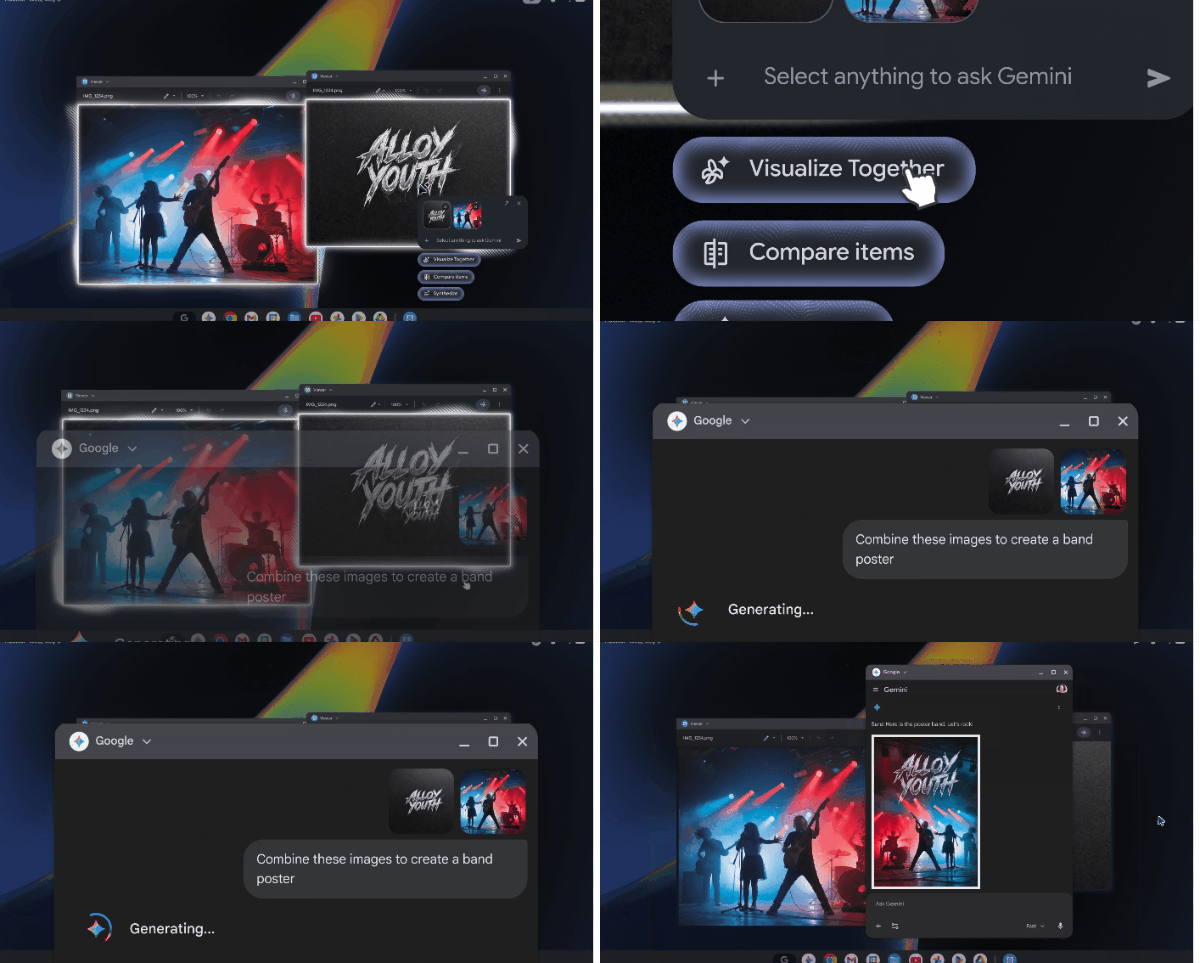
Image Source: Google; Production: Leitech
This is also Google's strategy to potentially outmaneuver Windows and Mac. After all, the ecosystem advantages of Windows and Mac are formidable. For users, without a disruptive experience, newcomers have little chance of carving out a niche in this market.
The AI PC War Has Finally Escalated to the System Level
Viewing Googlebook as a mere updated version of Chromebook would be a misconception. Chromebook is essentially a cloud-based product that caters to educational and light office markets through low hardware costs. Even Google has acknowledged that PCs are transitioning from "operating systems" to "intelligent systems," necessitating a reevaluation of the laptop's future.
Moreover, despite Chromebook's substantial market presence, it has never truly infiltrated the high-performance mainstream PC market. It can only fulfill basic work requirements and has failed to breach the ecosystem barriers of Windows and Mac.
The transformation with Googlebook is that it's no longer just a "cheaper, lighter cloud computer" but aims to become a new product that seamlessly integrates Android apps, the Chrome browser, and Gemini AI, coupled with high-performance hardware.
At least in terms of hardware, it's no longer inferior.
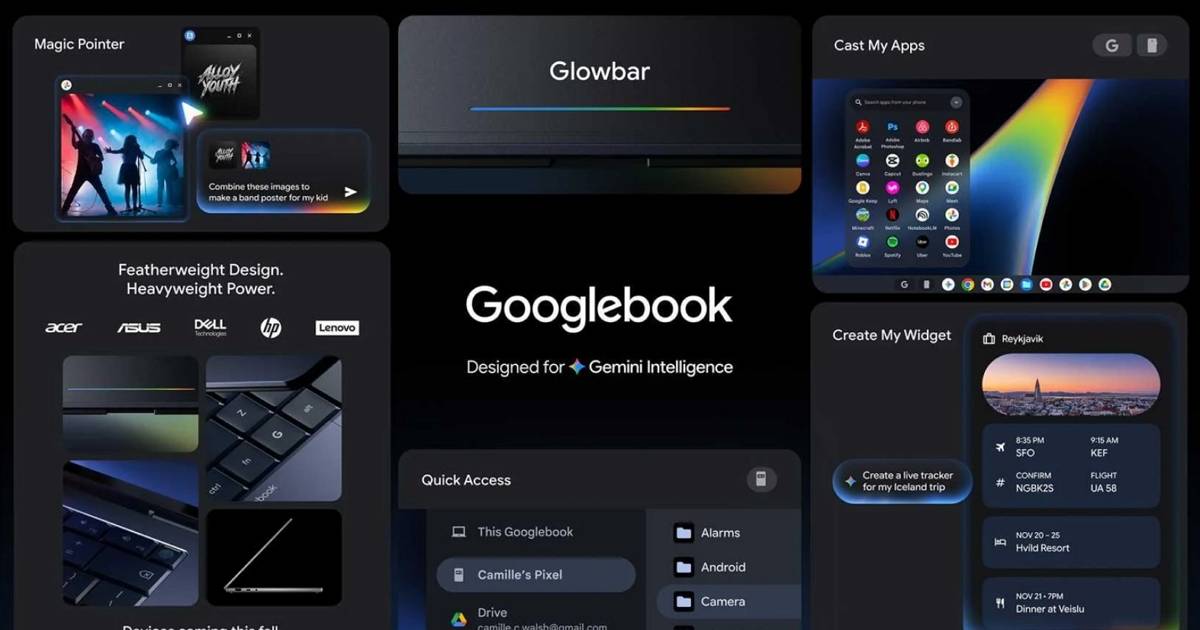
Image Source: Google
Furthermore, PC performance is increasingly crucial in the AI era. For privacy, as well as for pre-task allocation and inference, on-device chips require sufficient AI performance to ensure the smooth and stable operation of AI functions. To this end, Google has collaborated with Intel, and the two companies will develop Googlebook based on the new generation of Core processors. Subsequently, Qualcomm also announced its participation, meaning that both x86 and Arm hardware camps are on board from the outset.
This step is vital because the issue with Chromebook in the past wasn't its complete uselessness but rather users' difficulty in relying on it as their primary productivity computer. If Googlebook aims to penetrate the mainstream PC market, it can't solely rely on low prices and browsers; it must provide users with a comprehensive experience in terms of performance, ecosystem, and AI.
The future competition in AI PCs isn't primarily about who pre-installs more assistants but about who can make AI truly comprehend the files, apps, tasks, and user intentions within the system.
Chinese PC manufacturers are also moving in this direction. For example, Honor launched YOYO Claw and stated that it would first be available on MagicBook notebooks. By directly embedding the Claw tool into the system, Honor hopes to transform the PC from a mere tool into a "companion" and emphasizes that, based on Intel's powerful on-device computing power, it can significantly reduce Claw's operating costs and ensure instant AI responsiveness on the PC.
It's evident that Googlebook isn't the only manufacturer thinking and acting along these lines. Windows manufacturers entered the AI PC market earlier and aspire to do more, but they are constrained by Windows system updates and cannot overhaul everything as Google can.
However, Windows is also evolving. Windows Copilot Runtime (an AI kernel module) has been released, marking Windows' most significant architectural change at the kernel level in nearly a decade. Project Hudson Valley and CorePC, on the other hand, point directly to the next generation of Windows—a brand-new system built around "AI."
As for Mac, it's currently the most agile player. The unified memory of the M-series chips gives it an edge in the AI ecosystem and has also handled most of the initial and subsequent traffic for OpenClaw. It's just that Apple Intelligence hasn't been impressive enough; otherwise, its market share could have risen even further.
So, Googlebook can confidently declare: I'm not alone!
The Real Question Google Must Answer: Why Choose You?
Since Google isn't the only manufacturer venturing into native AI PCs, the most pressing question facing Googlebook becomes clear—why should I choose you?
Why should users abandon mature, product-rich, and user-heavy Windows and Mac for Googlebook? Just because it can run Android apps? That's akin to saying everyone has a phone. After watching Googlebook's launch, I still couldn't discern what new problems it solves.
I opt for Windows because it boasts a vast array of professional software and game adaptations; I choose Mac because it unifies performance, battery life, and ecosystem workflows. So, what does Googlebook offer? If it merely tells users "I have Gemini," that's insufficient to persuade them to abandon the other two familiar systems.
In short, Googlebook must demonstrate that it's not just "capable of using AI" but "superior because of AI."
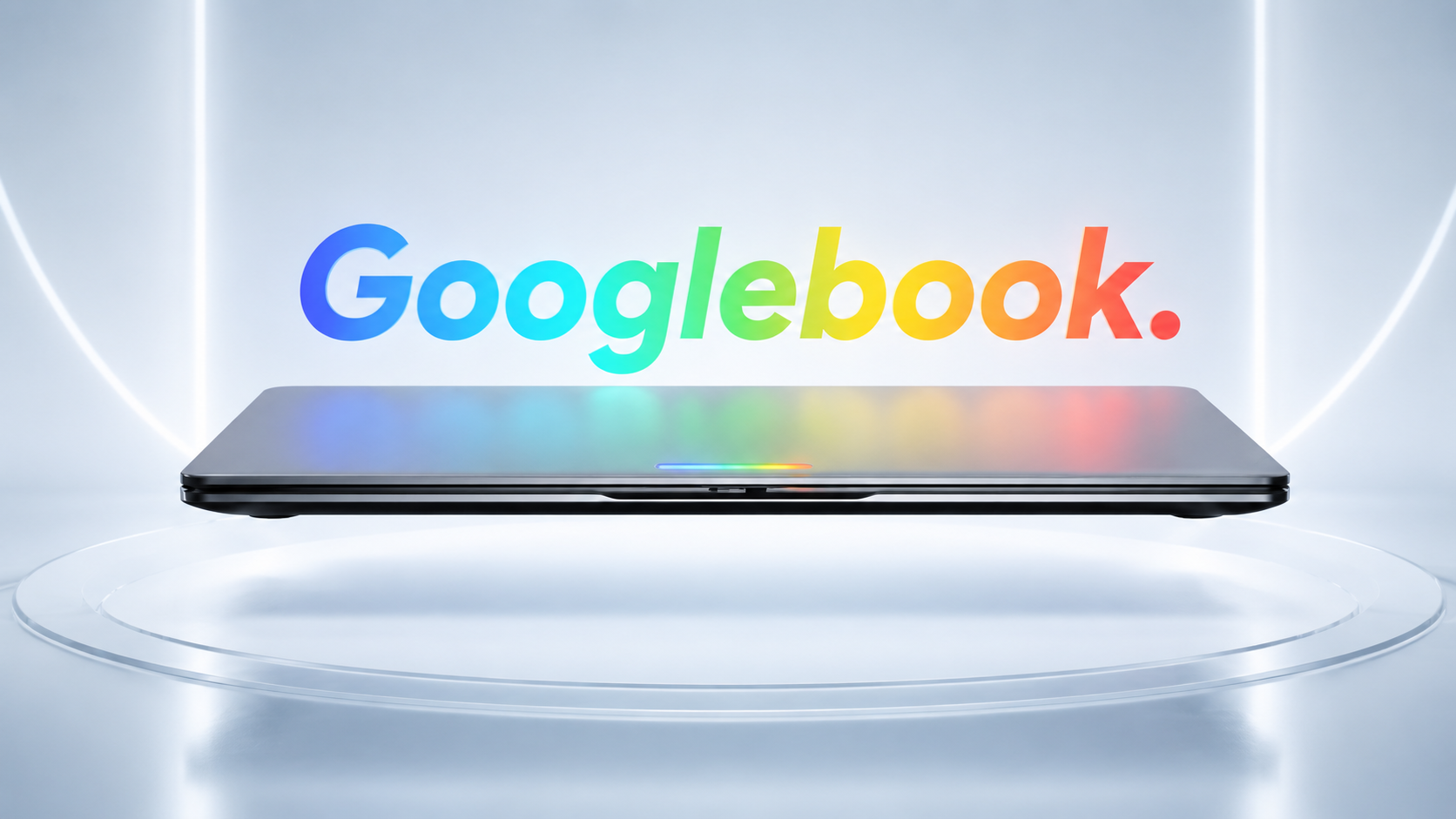
Image Source: Leitech Production
From an industry standpoint, Googlebook's most significant value at present is signaling to the entire industry: if you don't act swiftly, challengers are on the horizon. It shifts everyone's focus from "computing power performance" to "system experience" through a set of meticulously designed demo videos.
From a user's perspective, it's challenging to perceive the difference between 4 TOPS and 40 TOPS of computing power solely from text. But when Googlebook demonstrates Magic Pointer, you understand: "Ah, that's how it works." That's the disparity between practical application and textual parameters.
I've witnessed similar scenarios frequently in the PC industry. You can expound on the AI performance of the RTX 5090 until you're hoarse, but often it's in vain. However, when you generate a realistic bikini beauty picture in a few seconds, your friend will grasp it immediately.
Demonstrations and practical scenarios are more persuasive than any text.
So now, the ball is back in Windows and Mac's court, and it's their turn to enlighten users about the kind of "AI experience" they'll offer in the future.
Regardless, Googlebook's arrival has at least injected fresh discourse into the PC market. As for whether it can represent Google's foray into the mainstream PC market, Xiaolei's view is: it's still early days.
Source: Leitech
Images in this article come from: 123RF Royalty-Free Image Library
-
Ofilm Teams Up with ADSensE to Propel Large-Scale Deployment of All-Solid-State LiDAR Powered by ADS6311 Chip!
-
![]()
Loss of 2.5 Billion Yet Facing Strong Demand for Shares? Another Battle for Control of Lianchuang Electronics
-
![]()
Huawei’s Enjoy Series Flies Off the Shelves, Prompting Xiaomi to Double Down on Budget Smartphones
-
![]()
Beijing Hyundai's Top Executive Criticizes Industry Disorder: Certain Brands Treat Customers as Beta Testers
-
![]()
The domestic mobile phone market has declined for five consecutive quarters! Huawei defies the trend with significant growth: maintains its top market share
-
Annual Revenue Surpasses 3 Billion: An Automotive Trim 'Little Giant' Makes Its Debut on the Beijing Stock Exchange
-
![]()
The Space Force Wants to Spend $30 Billion on Rocket Launches: Is Trump Doubling Down, and Is SpaceX the Big Winner?
-
![]()
Going Crazy! One out of Every Three Plug-in Hybrids Sold in Europe is a Chinese Vehicle