Market Disparity: Domestic OLED TVs Hold Less Than 10% Share, with Two Korean Giants Leading the Pack
 06/10 2026
 492
492
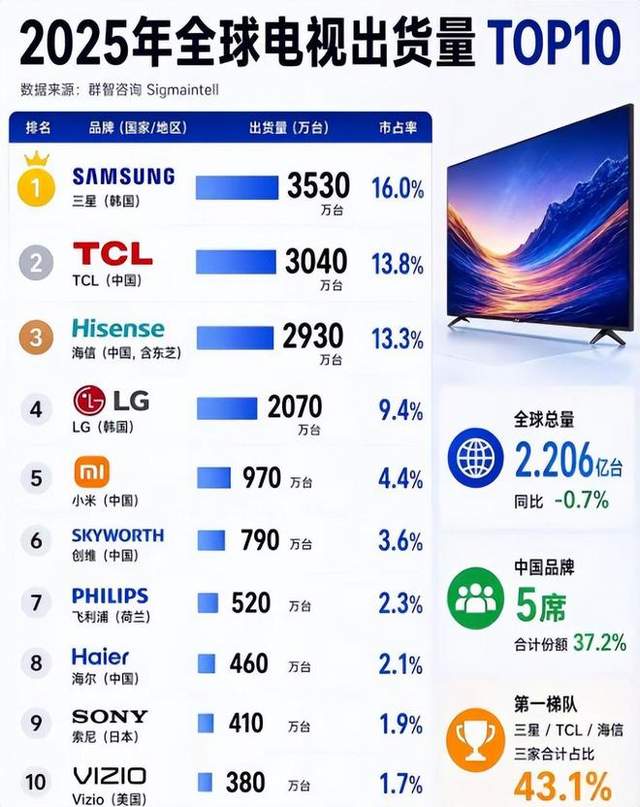
It's widely acknowledged that Chinese companies are steadily gaining ground in the large-screen TV market. Among the top 10 global players, six hail from China, collectively commanding around 70% of the worldwide market share.
At present, only Samsung and LG remain formidable contenders against Chinese firms, while other Japanese brands have seen their influence wane. American and European brands, meanwhile, lag even further behind in terms of competitiveness.
However, it's crucial to recognize that in the premium OLED TV segment, Chinese companies still command a relatively modest market share, with Samsung and LG collectively controlling over 85% of the global market.
Data from Omdia reveals that global OLED TV shipments hit 1.5 million units in the first quarter, with LG once again leading the pack with 760,000 units and a 50.5% market share.
Samsung followed closely with 536,000 units shipped, capturing approximately 35.7% of the market.
Sony trailed with a market share of around 5%-6%, while Chinese brands like Hisense, TCL, and Xiaomi collectively held less than 10% of the market.
Clearly, in the high-end OLED TV arena, Samsung and LG currently reign supreme, holding a combined market share exceeding 85%.
Why do Chinese companies outperform Samsung and LG in LCD TVs but fall short in OLED TVs?
On one hand, LG enjoys a near-monopoly on large-screen OLED panels. Brands like Hisense, TCL, and Xiaomi predominantly rely on LG for OLED panels for their TVs, giving LG a significant edge.
Secondly, both Samsung and LG ventured into the OLED TV market much earlier than their Chinese counterparts. Chinese companies only recently entered the fray, while LG and others have been active for a considerably longer period, granting them a first-mover advantage.
Moreover, OLED TV sales are predominantly concentrated in developed regions such as Europe and the United States, where LG and Samsung enjoy higher brand recognition. Many Chinese companies face certain barriers in these markets and naturally struggle to compete effectively.
Taking the first quarter as an illustration, LG secured a 52.8% share in North America, 49% in Europe, 52.7% in the Middle East and Africa, and 56.3% in Latin America. Samsung held virtually all the remaining shares. These figures clearly demonstrate that in the premium segment of foreign markets, LG and Samsung are more widely recognized.
However, given the trajectory of Chinese companies' development, once they fully commit to the OLED sector, they are likely to leverage their price advantages to outpace foreign competitors. Thus, it's only a matter of time before the same scenario unfolds in the OLED market.
Of course, achieving this objective also necessitates efforts from the domestic supply chain. After all, the screen is the core component of OLED TVs. Currently, domestic OLED screens perform admirably in smaller sizes but still trail LG in larger formats. If domestic OLED technology fails to keep pace, surpassing Samsung and LG will remain a formidable challenge.
-
![]()
The Success of AITO Underscores Seres' Need for Saido AIVA
-
![]()
Apple's Cook Takes Final Bow: Siri Reimagined, Gemini Steps In, But Capital Markets Remain Unconvinced
-
![]()
Apple’s Cook Bids Adieu: Siri Reinvented, Gemini Joins the Fray, But Are Capital Markets Unimpressed?
-
![]()
Breaking into the AI Computing Power and Low-Altitude Economy Sectors! Tongya Technology Heads for Hong Kong IPO: Tripling Revenue in Three Years, Third in Global Market Share, with Matrix Partners Ch
-
![]()
Will ByteDance’s Collaboration with Saido Follow Huawei’s Footsteps?
-
![]()
Revenue Surges 50-Fold: Q1 Earnings Match Annual Profit, This Year's Hottest Business Revealed
-
![]()
Cook’s Gourd Holds No Magic Cure for Apple’s AI Woes
-
![]()
Stellantis Presents a Catalyst, Propelling Chinese Automobiles Towards Global Supremacy