Apple’s Cook Bids Adieu: Siri Reinvented, Gemini Joins the Fray, But Are Capital Markets Unimpressed?
 06/10 2026
 455
455
Apple Intelligence Receives a Comprehensive Overhaul, with OS Advancing to Version 27 Across the Board

Author|Yezi
Click to Listen to the Podcast Version of This Article
In the early hours of June 9, Beijing time, Apple CEO Tim Cook took his final bow on the stage of the Worldwide Developers Conference (WWDC) as the company’s helm. This event, tinged with a sense of “farewell” by the outside world, concluded not with sentimentality or surprise, but with a pragmatic software update. Apple submitted a long-overdue answer in the generative AI race, arriving two years late.
From iOS 27 to macOS 27, from a completely revamped Siri AI to Apple Intelligence permeating the entire system, Apple declared throughout the event: it is no longer absent from the AI era.
However, the capital markets responded with a decline in stock price during trading hours, ultimately closing down by about 1.9%. This mixed market sentiment reflects Apple’s true standing in the AI competition: it is not redefining the industry but is rather systematically catching up.

Siri AI Finally Makes Its Debut: From Voice Assistant to System-Level Agent
The most significant announcement at this WWDC was undoubtedly the complete rebuild of Siri. Apple officially dubbed it “Siri AI.” No longer a pop-up voice assistant, it debuts as an independent app, with its interaction interface fully aligned with mainstream AI chatbots.
The revamped Siri AI boasts three core capabilities: cross-app operation, screen perception, and personal context understanding. Live demonstrations revealed that users could directly ask Siri to find specific photos taken during a trip and share them with contacts without opening the Photos app. After taking a photo of a restaurant bill, Siri could identify the amount and split the bill evenly, all without switching between multiple apps.
On iPhone models equipped with the Dynamic Island, Siri’s wake-up animation is seamlessly integrated into the Dynamic Island area, and the chat interface can be directly invoked by swiping down from the middle of the screen.
What shook the industry even more was the choice at the technical architecture level. Apple’s Senior Vice President of Software Engineering, Craig Federighi, announced at the event that Apple has entered into a deep collaboration with Google, incorporating Google’s Gemini large model technology at the foundation of the new Apple Intelligence. This marks the first time Apple has leveraged an external company for its core AI capabilities, revealing its shortcomings in independently building ultra-large-scale cloud model capabilities.
Apple emphasized that, even with the introduction of external models, its privacy-first principle remains intact: the vast majority of computations are completed on the device, while complex tasks run through Apple’s Private Cloud Compute framework, with data used solely for processing user requests and not stored or used for third-party model training. According to media reports, Apple pays approximately $1 billion annually for this collaboration, though the company has not confirmed this figure.
This decision marks a departure from Apple’s narrative tradition of trying to reduce its reliance on Google over the past decade. Since removing Google Maps and launching its own mapping service with iOS 6 in 2012, Apple has consistently emphasized full-stack self-research. However, in the AI era, facing the rapid progress of OpenAI and Google in large models, Apple has chosen a more pragmatic strategy: leveraging external model capabilities while safeguarding system entry points, privacy boundaries, and user experience.

AI Capabilities Fully Integrated, But Mostly Catching Up on Shortcomings
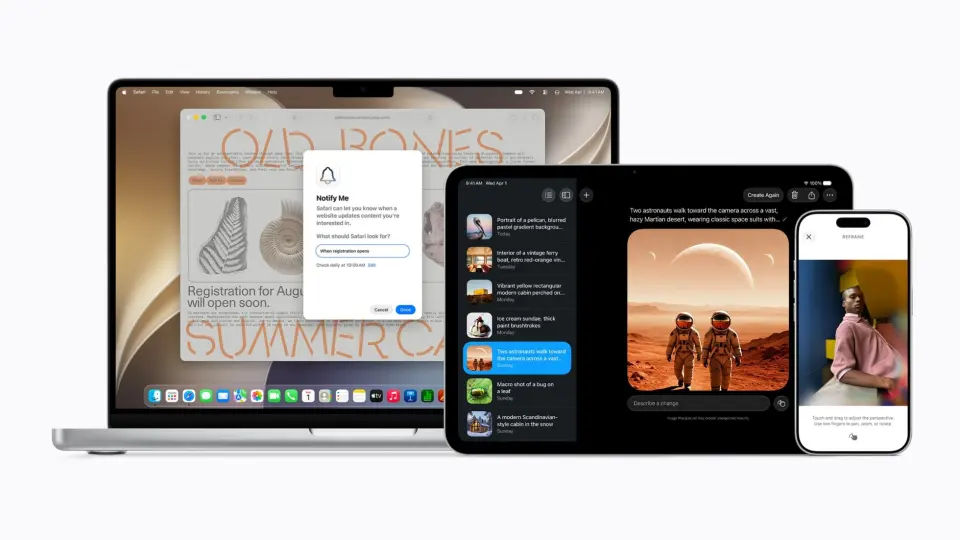
In addition to Siri’s rebuild, Apple has also seamlessly integrated AI capabilities into its operating system. The Photos app introduces three new professional AI tools: Extend (Smart Expansion) automatically pushes the boundaries of photos outward; Reframe (Spatial Reconstruction) allows users to change photo composition by holding and dragging the subject; the CleanUp (Removal) function has been significantly rebuilt, resolving previous issues with incomplete object removal. Additionally, a new natural language photo editing capability has been added, allowing users to modify parts of images through voice commands.
Safari browser, through Apple Intelligence, can automatically organize tabs by content type and frequency of use and can monitor webpage updates, actively notifying users when page content changes. The Shortcuts app has also been reshaped by AI, allowing users to describe their needs in natural language, with the system automatically generating corresponding shortcuts without the need for manual module assembly.
The Camera app introduces a “Siri Mode” for quickly invoking Apple Visual Intelligence functions, such as identifying plants, translating text, reading nutrition labels, and capturing contact information from business cards. On the Mac side, Visual Intelligence allows users to circle selections on the screen for direct image-text recognition and search.
A noteworthy detail is that Apple has also, for the first time, allowed users to set third-party AI services like ChatGPT and Claude as their default response engines, achieving so-called “model freedom.” This open stance further confirms Apple’s strategic shift in the AI race, no longer attempting to control everything but instead using its ecological integration capabilities as its core competitiveness.
However, market analysis generally believes that most of the functions announced this time were promises made two years ago when Apple Intelligence was first released, equivalent to completing “catch-up” work rather than introducing disruptive products beyond market expectations. Compared to the lead established by OpenAI and Google, Apple is still in a chasing position.

iOS 27: A “Snow Leopard”-Style Pragmatic Evolution
The core development philosophy of iOS 27 (internal codename Rave) is defined by Apple as “Snow Leopard”-style, focusing not on piling up flashy new features but on optimizing full-chain system performance and enhancing underlying stability. Apple claims to have streamlined redundant code, reducing memory usage by 20% and extending daily battery life by 1 to 2 hours. App launch speeds on iPhone and iPad have increased by up to 30%, photo display speeds in the gallery have improved by 70%, and AirDrop speeds have increased by 80%.
In terms of compatibility, iOS 27 supports all devices running iOS 26, making it the iOS major update with the broadest device coverage to date. However, full Apple Intelligence and Siri AI are only supported on iPhone 15 Pro series and later models, iPads, and Macs equipped with M1 or later chips.
The most significant change in macOS 27 “Golden Gate” is that the system will cease support for Intel-based Mac computers, only compatible with devices equipped with M1 or newer Apple-designed chips. This marks the conclusion of the six-year Apple Silicon transition, with Intel Macs officially becoming a thing of the past.

Child Safety and Parental Controls: The Business Logic of Strengthening the Family Ecosystem
Another notable change at this WWDC was Apple’s extensive introduction of children’s and family safety strategies. iOS 27 and macOS 27 introduce new child accounts and enhanced parental control features.
Parents can easily create child accounts, with the App Store defaulting to a purchase and browsing confirmation mechanism for users under 13. The system has upgraded time quota management, supporting fine-grained control over app usage rights by time period. iMessage and Safari have added real-time detection of explicit content.
Apple has also introduced new APIs requiring all apps to adapt to age-appropriate privacy protection experiences. New time limits and official recommendations for gaming, social, and other apps have been added, allowing parents to flexibly adjust “time quotas” and ensure their children stay focused during school hours by setting app availability schedules.
This is not just a routine security update. From a business perspective, it helps Apple strengthen its family ecosystem—when a family’s life is bound to the Apple ecosystem, the cost of switching to another phone brand becomes higher. Apple is not just looking to lock in a single user but an entire family.

Chinese Mainland Market: AI Functions Temporarily Unavailable
For Chinese users, this event brought disappointing news.
Federighi explicitly stated that in the Chinese mainland, due to the need to comply with regulatory requirements and advance relevant compliance work, Apple Intelligence will not be available for the time being. The Siri AI beta test version will debut this fall only in the U.S. market, with the EU also temporarily excluded due to unresolved regulatory plans.
This means that domestic Apple users will be unable to experience the core AI functions announced this time for a considerable period. This has also created the awkward reality on Chinese internet platforms where “overseas users upgrade AI, while domestic users upgrade UI” this year.
This regional “AI ecosystem temperature difference” poses a direct challenge to Apple’s commercial prospects in China. As domestic large models like Qwen and DeepSeek accelerate their penetration into the smartphone ecosystem and move toward Agent implementation, the iPhone’s appeal in the high-end market, lacking core AI capabilities, faces the risk of erosion.

Market Reaction Subdued: Apple's AI Still Faces Three Major Challenges
The capital markets reacted lukewarmly to this AI answer. Before the event, Apple's stock price once rose nearly 3.3%, but as the announcements progressed, gains gradually narrowed and turned negative, ultimately closing down by about 1.9%. After-hours trading saw continued declines.
Analysis suggests that the market's indifference stems from three aspects: first, some functions are still in the Beta stage, with the new Siri not opening for testing until this fall, still some distance from large-scale commercialization;
second, compared to competitors, the level of innovation is limited, with many functions—such as AI assistants, visual recognition, and writing tools—already available in products like Google's Gemini and ChatGPT;
third, global expansion is constrained by regulations, making it difficult for Apple's AI ecosystem to achieve simultaneous global expansion in the short term.
For Cook, this event marks his last WWDC in an 11-year tenure as CEO. As planned, Cook will officially step down on September 1, succeeded by Senior Vice President of Hardware Engineering John Ternus.
In his closing remarks, Cook said, “Looking back on my years as CEO, events like this are among the most brilliant moments. Seeing what you've created with the tools we provide reminds me time and again that imagination knows no bounds.”
Industry views point out that the significance of WWDC 2026 for Apple lies in finally completing the foundational framework of its AI ecosystem, fully integrating AI capabilities into its hardware and software systems.
However, over the next year, the actual user experience of Siri AI, the global rollout speed of Apple Intelligence, and the progress of developer ecosystem construction will ultimately determine the success or failure of Apple's AI catch-up. Apple may not need to own the strongest model, but it cannot allow others' AI to become the first entry point on iPhones and all its hardware products—this is perhaps the core strategic proposition Cook has left for his successor.
THE END
Copyright and Disclaimer
1. Content Copyright: Except for quoted public data, policies, and cases, this article is original. Professional data is sourced from authorized databases and government websites, with cases compiled from real events.
2. Image Licensing: Some images in this article are owned or officially licensed, with others generated by AI; for network images without clear copyright, ownership remains with the original authors, and any infringement will be removed upon notification.
3. Republication Guidelines: Unauthorized republication is prohibited; republication must retain the full source and author.
4. Liability Disclaimer: This article is a commercial figure observation and industry commentary compiled by the author based on public information, for reference only, and does not constitute professional advice. Risks arising from use are borne by the user. Xinzhidongneng reserves the final interpretation rights to this article.
-
![]()
"Shaking Hands" with WeChat's AI Ecosystem: Didi Paints a New Vision for AI
-
![]()
The Battle of Instant Retail: Does Huawei Want Meituan to Win?
-
![]()
The Success of AITO Underscores Seres' Need for Saido AIVA
-
![]()
Apple's Cook Takes Final Bow: Siri Reimagined, Gemini Steps In, But Capital Markets Remain Unconvinced
-
![]()
Apple’s Cook Bids Adieu: Siri Reinvented, Gemini Joins the Fray, But Are Capital Markets Unimpressed?
-
![]()
Breaking into the AI Computing Power and Low-Altitude Economy Sectors! Tongya Technology Heads for Hong Kong IPO: Tripling Revenue in Three Years, Third in Global Market Share, with Matrix Partners Ch
-
![]()
Will ByteDance’s Collaboration with Saido Follow Huawei’s Footsteps?
-
![]()
Revenue Surges 50-Fold: Q1 Earnings Match Annual Profit, This Year's Hottest Business Revealed