Cook's Gourd Holds No Magic Cure for Apple's AI Woes
 06/12 2026
 346
346

When Will Apple's AI Transformation Keep Pace with Global Trends?
Written by | Zhao Weiwei
Early hype initially drove up Apple's stock price. However, with no definitive launch date for the official version of Apple Intelligence, which has been delayed by two years, the company is expected to roll out a 'beta' version this September. Notably, China and the EU will be excluded from the initial launch regions, falling short of user expectations.
The 2026 Apple Worldwide Developers Conference ended with Apple's stock plummeting nearly 2%, marking its largest single-day drop in three weeks—a direct consequence of the aforementioned issues.
"As long as privacy is prioritized, I don't mind if Siri's development lags. If I want a faster experience, I'll switch to Android and surrender all my personal data to Google," read a popular comment under a related Wall Street Journal article.
But users quickly pointed out: Apple has forged a cooperation agreement with Google, and the next-generation Siri will be built on Google's Gemini model and cloud technology. Advanced Siri requests will be routed to Google's cloud servers, meaning Apple's privacy protection system cannot circumvent Google.
The crux of the argument: "Google pays Apple $20 billion annually just for default search engine placement. This underscores the value of user data to Google—if Apple could truly safeguard privacy completely, why would Google keep paying this fee?"
Such sentiments reflect the disappointment of many Apple users, who question not just technical shortcomings but also a trust crisis between the two parties.
Although Apple emphasized at the event that "Privacy in AI is non-negotiable," the new-generation Siri is a collaborative effort between Apple and Google. Apple licenses the Gemini model and constructs its own model on this foundation.
The 2026 Apple Worldwide Developers Conference also marked Cook's final appearance as CEO. Under his leadership, Apple transformed into the world's most profitable consumer electronics giant, with services constructing an unassailable competitive moat.
Yet this empire has been sluggish in responding to today's AI wave, necessitating reliance on a rival's model to build its AI system.
John Ternus, who rose through the ranks developing the Mac and iPhone, succeeds Cook as Apple's CEO. Faced with software and AI barriers erected by competitors like Google, Microsoft, and Meta, Ternus must address the unfinished question left by Cook: When will Apple's AI transformation align with the global industry's pace?
1. Paving the Way for the Delayed Siri
Siri AI is Apple's newly enhanced voice assistant, operating on the new Apple Intelligence platform co-developed by Apple and Google.
It boasts a fresh look and voice, with a Siri bubble appearing at the top of the screen. Users can customize Siri's expression and speech speed. Siri gains screen awareness, reading current interface content and providing contextual answers, while also integrating image editing and writing assistance tools. Related functions support multi-device synchronization, with interaction records stored in the new Siri AI app.
The latest iOS 27 system on mobile devices allows users to activate Siri by swiping down from the Dynamic Island; the camera app introduces a "Siri Mode" to identify objects in real-time and display relevant information.
On Mac computers, the most significant change integrates Siri directly into the Spotlight search bar.
Users can pose questions directly in the search bar or select specific files to query without summoning a separate assistant interface. Like iOS 27, macOS 27 introduces liquid glass transparency sliders, narrows window corner radii, and restores colored sidebar icons.
Notably, upgrades to Apple's built-in browser further incorporate AI capabilities.
For instance, the new AI tab management feature automatically categorizes all open web pages by theme. The "Notify Me" function enables users to have Safari monitor webpage changes, such as alerting them when a restocked product they follow becomes available. Additionally, users can describe their needs in natural language to have Safari directly generate browser extensions.
For Apple, AI's deeper value lies in its cross-app integration capabilities.
For example, the Messages app will proactively recommend shareable photos based on conversation content; the call interface automatically displays relevant information like flight confirmation codes; Mail adds intelligent content suggestions and supports natural language scheduling synced to the calendar. System shortcuts now allow natural language creation, while Image Playground gains composition adjustment and stronger "distraction removal" capabilities, supporting AI-level secondary photo editing.
Of course, Apple continues to cater to all users, not just AI enthusiasts. For younger users, Apple has optimized parental control features, a key concern for many parents.
Apple has systematically redesigned the child account system, enabling parents to precisely select allowed apps and content for their children and require authorization before opening new websites. The Screen Time menu interface has also been redesigned with clearer operation paths to help parents manage their children's device usage more efficiently.
Clearly, Apple's system-level transformations are paving the way for the upcoming Siri AI.
2. iPhone 16 Users Feel Betrayed
This marked Cook's final appearance as CEO on Apple's WWDC stage.
He did not summarize his tenure with data but stated, "Creating the world's best products and enriching people's lives has always been our mission. It has been my lifelong honor to work with such creative partners and integrate technology into daily life."
In contrast, the event was criticized as "the most disappointing WWDC ever."
"I've followed Apple's events since the early 2010s, and this is by far the worst," said one user on the loyal Apple forum macrumors, recalling incidents from two years prior.
At the 2024 WWDC, Siri's onstage demo ran on pre-recorded video, not real-time operation on actual devices. Even the Siri team hadn't seen a properly functioning version internally. Apple later faced a class-action lawsuit for false advertising and settled out of court for $250 million in 2025.
Two years later, where do users criticize Apple's new Siri?
Comments on Reddit reflect the sentiments of many Apple users. One comment with hundreds of upvotes read, "I'm really disappointed. My iPhone 16 Pro Max can't run the most powerful on-device Foundation Model."
The iPhone 16 Pro Max, Apple's flagship model launched in September 2024, was marketed on its AI capabilities, claiming the iPhone 16 as the first device tailored for Apple Intelligence.
A year and a half later, Apple's AI features have yet to fully materialize. While this model can use Siri AI online, it cannot adapt to Apple's most powerful on-device model.
On-device models run AI directly on the phone's chip without internet connectivity, keeping all data on the device—a key privacy advantage for Apple. Running Apple's most powerful on-device model requires 12GB of memory, a hardware threshold currently met only by the iPhone Air (12GB) and iPhone 17 Pro/17 Pro Max (12GB).
In other words, users who bought the iPhone 16 and iPhone 17 standard models for AI capabilities now feel betrayed by Apple, excluded from the top-tier AI experience.
This raises a critical issue for Apple: Its AI promises are eroding user trust. How will the brand fulfill its consumer commitments? How can Apple's product replacement cycles align with AI technological iteration speeds and its promises to users?
Apple sells current hardware with next-gen AI imagination, but reality catches up, raising hardware thresholds to the following generation.
3. Cook Hasn't Answered Yet
"If I were Ternus, I'd let Cook swallow all this and make my grand entrance next year."
This viewpoint, circulating on U.S. tech forums, leans toward conspiracy theory but indirectly confirms Ternus's absence from this WWDC stage. Rumors suggest Apple's new CEO will host September's iPhone 18 event—his true debut.
For Cook, the AI battle has been one of compromise.
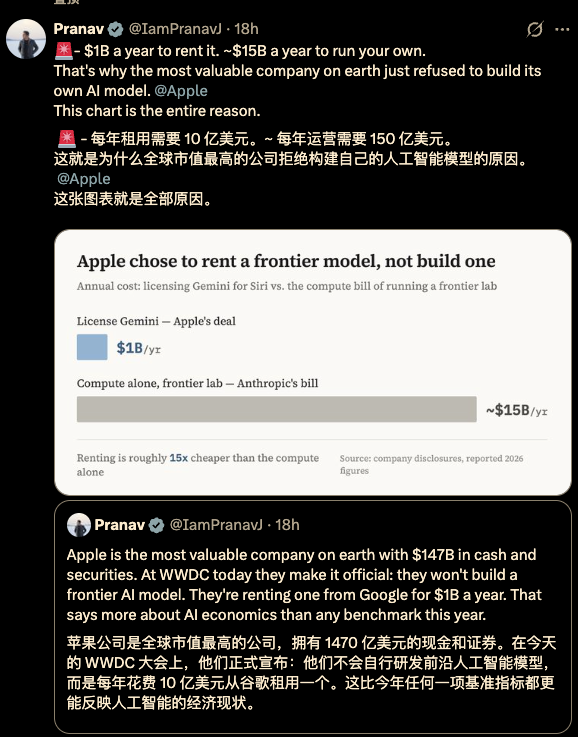
Foreign media previously calculated that Apple's multi-year licensing agreement with Google utilizes a customized Google Gemini model (about 1.2 trillion parameters) to support Siri's advanced cloud functions, costing around $1 billion annually. Of course, Apple also pays separate computing costs.
For comparison: In May 2026, SpaceX filed IPO documents revealing Anthropic's partnership with xAI, spending $1.25 billion monthly to rent over 220,000 NVIDIA GPUs at Colossus data center—totaling $15 billion annually.
Thus, in the AI race, Cook prioritized cost: avoiding the large model arms race, Apple spends $1 billion annually to rent Google's model rather than investing $15 billion in self-developed models like Anthropic. Currently, the comprehensive cost of building cutting-edge large models far exceeds leasing models, with a clear gap.
Apple and Google have now jointly built five models, divided into on-device and cloud categories. One on-device model, AFM 3 Core, is a major upgrade to the 3 billion-parameter general model, with significantly improved comprehensive capabilities.
The AFM 3 Core Advanced is currently Apple's most powerful on-device model, natively supporting multimodal inputs like images and voice. It not only offers more natural voice interactions but also higher speech recognition accuracy. With 20 billion parameters, it uses a sparse architecture, activating 1-4 billion parameters based on actual demand, ensuring excellent operational efficiency and deep optimization for Apple's flagship chips.
On the private cloud, Apple offers three models, promising user data will not be retained or shared with anyone, including Apple itself:
1. AFM 3 Cloud: The primary cloud model, balancing speed, efficiency, and comprehensive performance;
2. ADM 3 Cloud (Image Model): Focuses on image generation and editing, enabling advanced retouching and creative image creation;
3. AFM 3 Cloud Pro: The most powerful cloud model, designed for high-difficulty scenarios like complex intelligent operations and deep logical reasoning.
Among them, AFM 3 Cloud Pro deploys on Google Cloud's NVIDIA GPU clusters, with Google's highest involvement.
When Apple users invoke AFM 3 Cloud Pro for Siri functions, Apple's privacy system remains active: data is desensitized before transmission, and agreements explicitly prohibit Google from using it for model training, though computations rely on Google's infrastructure.
It's as if Apple built an AI skyscraper with Apple security guards, cameras, and locks—but the steel comes from Google, and the most expensive penthouse sits on Google's foundation.
This building represents the empire legacy Cook left Ternus: a reality reflecting Apple's late and slow AI infrastructure investment, yet also a phased achievement, as Apple now has a defensive position in the AI battle, even if co-built with a rival.
The unresolved AI issues from Cook's tenure now sit on Ternus's desk. This AI-era narrative has just begun—it must keep pace with the world, but its author has changed.
Reviewed by | Chen Qiulin
END
-
![]()
Apple Shareholders Paid $230 Billion in 'Make-Up Exam Fees' for Apple's AI
-
![]()
Oracle Plummets? The Irreparable Flaws Beyond AI Infrastructure - 'High Interest, High Debt + Stagnant Software'
-
![]()
Oracle Plummets? The Irreparable Damage That AI Infrastructure Can't Fix—'High Interest, High Debt + Failing Software'
-
![]()
The Largest IPO in History Is on the Horizon: Why SpaceX Justifies a $1.75 Trillion Valuation
-
![]()
Cook's Gourd Holds No Magic Cure for Apple's AI Woes
-
![]()
Uber Exhausts Annual AI Budget in Just Four Months: Why Can't Even Uber Sustain AI Token Costs?
-
Unitree Goes Public, Ushering in an Era of Capital Frenzy for Robots?
-
![]()
In-Depth Exploration of the Physical AI Industry Ecosystem