The Next Frontier for Refrigerators: Ingredient Management, Not Just Specs
 06/15 2026
 486
486
The refrigerator market's competitive landscape is evolving from a focus on lab-tested specifications to real-world experiences in home kitchens.
In February 2026, the Human-Computer Interaction and Health Computing Research Team at Northeastern University unveiled their research direction: "Relational Appliances."
Their attention is not fixed on the technological advancements of refrigerators themselves but rather on a more relatable, everyday dilemma: how individuals decide "what to eat" in their kitchens.
The refrigerator door swings open countless times daily. Decisions about meal choices, restocking needs, milk levels, fruit freshness, and meat quality are often made in a flash.

In many homes, refrigerators are not just appliances; they're frequently glanced at, almost unconsciously.
The research team's primary goal is to encourage people to utilize the ingredients they already possess more effectively. The crux of the issue isn't that refrigerators need to be smarter; rather, they lack a deep understanding of users' genuine needs, leading to premature waste.
Refrigerators' true impact lies beyond their cooling capabilities.
From an industry perspective, refrigerators have continuously improved: colder temperatures, enhanced stability, and increased energy efficiency. Yet, at the household level, their influence is more nuanced: whether food is actually consumed.
Much waste doesn't occur at the moment of disposal but is predetermined long before. For instance, strawberries begin to darken and lose moisture; greens wilt rapidly; meat doesn't suddenly spoil but gradually loses its peak freshness.
Many households adhere to routine behaviors: they believe they have "enough for a week" when shopping, but any disruption to this rhythm leads to ingredients being continuously pushed to the back. Some ingredients don't spoil but miss their prime consumption window.
The EU REFRESH project (2015-2019), a transnational food waste research initiative funded by the EU's "Horizon 2020" and led by Wageningen University, highlights that household food waste stems from the cumulative effects of procurement, storage, and cooking, rather than a single step.
The refrigerator sits at the center of this process but traditionally hasn't been involved in either procurement or consumption. It was merely a storage unit.
Now, some products are beginning to incorporate refrigerators into the decision-making process regarding "how food is used," but this hasn't yet become an industry-wide standard.
The industry is transforming, but not uniformly.
Examining corporate actions reveals divergent paths:
Haier is pioneering ingredient management. From whole-space preservation to magnetic control freshness, its focus has shifted from mere temperature control to the actual state of the ingredients.
Samsung is taking a different approach (Family Hub / AI Vision Inside). Its emphasis isn't on extending freshness but on enhancing "visibility." Inventory recognition, ingredient tracking, and expiration alerts add an informational layer.
LG ThinQ (a smart home interconnection platform) leans towards a system-level logic. It doesn't emphasize the refrigerator's centrality but integrates devices within the kitchen network.
Bosch VitaFresh (a temperature and humidity preservation system) continues along the traditional path, prioritizing stable temperature and humidity control without delving into "ingredient management."
The industry hasn't collectively embraced ingredient management.
At first glance, it may seem like the industry is uniformly moving towards "ingredient management." However, the reality is more fragmented.
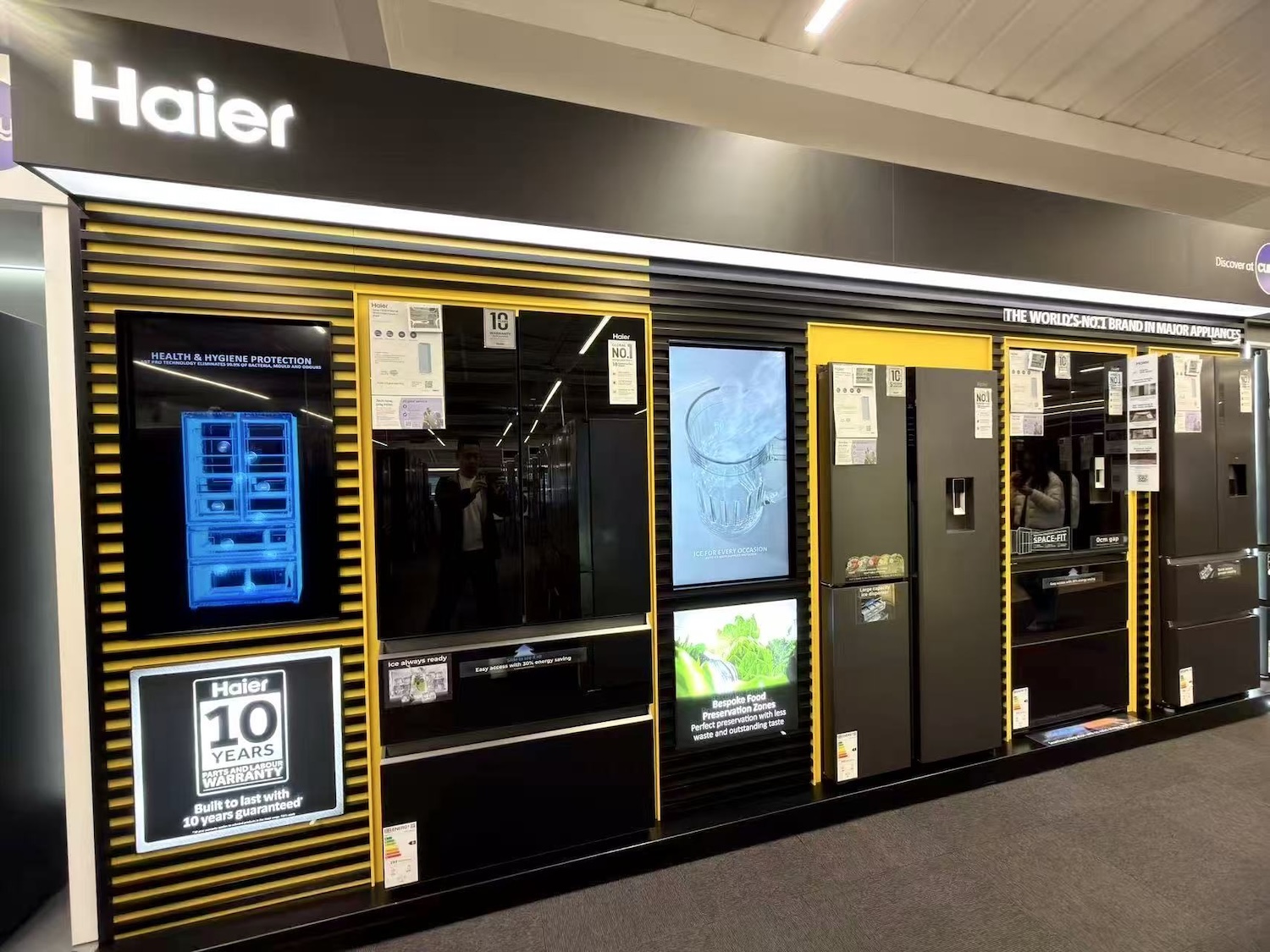
Haier is framing the problem, Samsung is bridging information gaps, LG is fostering system connections, and Bosch is maintaining its original course.
These four approaches are not aligned. The so-called "shift from specifications to ingredient management" is more of a retrospective observation than an industry-wide consensus.
The prevailing reality is that specifications remain central to how most refrigerators are perceived, but ingredient management has emerged as a new direction in certain brands and usage scenarios.
Specifications won't vanish, but they're no longer the sole criterion for evaluation. Whether fruits are still edible, meat has spoiled, or vegetables have gone to waste are becoming new benchmarks.
The refrigerator industry's changes represent not just an upgrade but a differentiation. The ultimate competition no longer revolves around a single standard:
The state of food in the refrigerator is the new battleground.
-
![]()
Tencent Backs Another Robot IPO Despite Over 1 Billion Yuan in Cumulative Losses
-
![]()
AI Leads the Way, Cars Follow Suit: How AIVA's Visionary Slogan Unlocks New Horizons
-
![]()
Final Verdict: 2026 China Automotive Chongqing Forum Takes a High-End Stance and Highlights Core Issues
-
![]()
DingTalk Leadership Overhaul: Wu Zhao's 'Triumphs and Trials,' Chen Yusen's 'Challenge'
-
Challenges Loom for Amazon and Meta's Free Cash Flow: Is There an AI Bubble?
-
![]()
With Zhang Xiaolong Leading the Charge, Can WeChat’s AI Agent Secure Another Win?
-
![]()
Li Shufu's Lesson in 'Abstract' Thinking: With Speed Dividends Peaking, What Will Drive China's Auto Industry Through the Next Two Decades?
-
![]()
World’s Pioneering! Automated Production Line for Million-Scale Volume Holographic Waveguides Launched in Tianjin