Apple's Pro Models in China Likely to Surpass 9,000 Yuan: Chinese Smartphone Brands Face Intense Price War with No Retreat
 06/26 2026
 504
504
Author | Shuyan
For More Financial Information | BT Finance Data Pass
The main text is 2,641 words long and is estimated to take 9 minutes to read.
On June 25, 2026, Apple initiated a round of global price hikes for multiple hardware products, including Mac and iPad, with increases of up to $300. This marks the company's largest global price adjustment in recent years. Three days earlier, on June 22, CEO Tim Cook had made it clear: due to memory chip shortages, price increases across Apple's product lineup were now unavoidable. For Chinese smartphone makers already engaged in fierce competition, the opponent's price hikes might have seemed like a brief respite. However, the real challenge began at this very moment: whether Huawei, Xiaomi, OPPO, vivo, and Honor could seize the limited pricing leeway left by Apple.
1. Apple is the last to succumb to pressure

In the consumer electronics industry, Apple has traditionally been the most resilient to cost increases. Leveraging its supply chain influence, advance stockpiling, and long-term price locks, it has absorbed several rounds of memory price hikes in the past. Cook described the current supply crisis as a 'flood of a century,' admitting he had never witnessed such a situation in his over 40-year career. When even Apple admits it can no longer hold the line, it signals that this round of cost pressures has penetrated the entire industry.
The root of the pressure lies in memory chips. Over the past year, Google, Microsoft, Meta, and Amazon have aggressively expanded AI data centers, driving explosive demand for high-bandwidth memory (HBM). The three major memory giants—Samsung, SK Hynix, and Micron—have concentrated their capacity on HBM and high-margin server memory, squeezing production of consumer-grade LPDDR5X and NAND flash. According to Guancha.cn, contract prices for consumer-grade LPDDR5X and NAND surged nearly 80% quarter-on-quarter in Q1 2026, with some specifications rising by 90%. Sigmaintell predicts that traditional DRAM contract prices will rise another 58-63% quarter-on-quarter in Q2, while NAND will increase by 70-75%. As a result, memory components now account for over 20% of smartphone material costs, up from 10-15% previously, and even exceed 40% in some mid-range models.
2. Disputes arise over the magnitude of price hikes
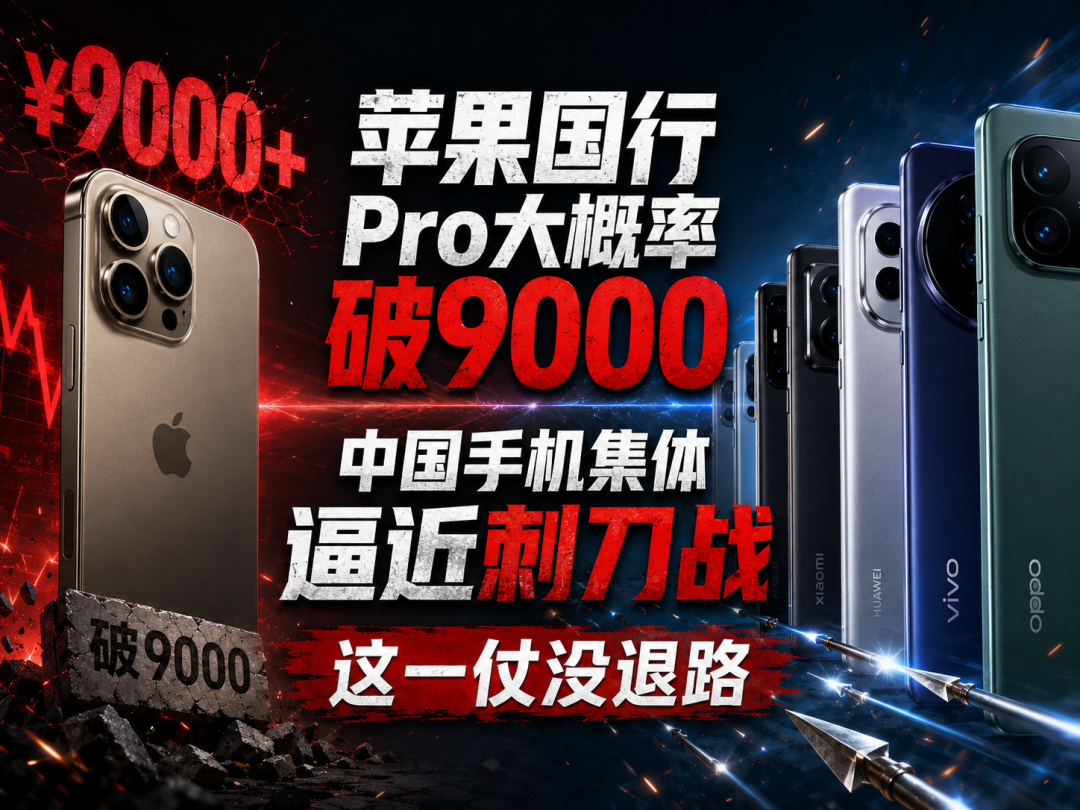
The extent of Apple's price hikes remains a contentious issue. Note that the next-generation iPhone 18 series has not yet been released, and the following iPhone prices are estimates from research institutions, not Apple's official pricing, provided for reference only. The aggressive camp, represented by The Wall Street Journal and TechInsights, argues that if Apple wants to maintain its current profit margins, the soaring costs of memory and flash storage alone would require raising the iPhone 18 Pro's starting price by about $270 (approximately 1,820 yuan), from $1,099 to $1,299—an 18.2% increase. This suggests the China-exclusive Pro version will likely surpass 9,000 yuan.
The moderate camp, led by JPMorgan, estimates the iPhone 18 Pro series will see only a $50-100 (4.55-9.1%) increase. They argue Apple will offset memory price hikes by replacing Qualcomm's baseband chips with its in-house solution and cutting costs elsewhere. The fourfold discrepancy between the two camps underscores that the '20% increase' is not set in stone but rather a pessimistic projection for a phone that has not yet launched. What is certain is the direction: the global price adjustments implemented on June 25 are a fact. iPhone, Mac, iPad, and Apple Watch prices have all risen, and Apple's Q2 2026 financial report shows a still-high gross margin of 43.2%, well above the industry average.
3. Chinese smartphone brands raise prices first, without respite
Shifting focus back to Chinese brands, the narrative of 'Apple raises prices, Chinese brands breathe easy' proves untenable from the outset. Memory price hikes are industry-wide. If Apple, with its stronger bargaining power, cannot withstand them, Chinese manufacturers—with weaker negotiating positions and heavy reliance on external suppliers for high-end chips and screens—face even greater pressure. In fact, Chinese brands did not wait for Apple; they acted first. According to MyDrivers, citing blogger 'Dingjiao Digital,' multiple mainstream domestic brands completed their first round of price increases in March 2026, with a second round underway, involving all major manufacturers and expected price hikes of 200-800 yuan.
The demand ceiling continues to lower. In May 2026, IDC revised its full-year global smartphone shipment forecast downward to 1.09 billion units, a 13.9% year-on-year decline—one of its most pessimistic projections ever. TrendForce was even harsher, forecasting 1.051 billion units, a roughly 16.2% drop. Counterpoint estimated a nearly 14% decline, the lowest since 2013, with consumer replacement cycles extending beyond 36 months. With costs rising and markets shrinking, Chinese manufacturers no longer face a choice of 'whether to raise prices' but a survival dilemma of 'whether raising prices will retain customers and whether not raising prices will ensure survival.'
4. The bayonet fight hinges on irreplaceability
Why does Apple leave only a narrow opening? Because the size and duration of this window depend not on competitors' pricing but on whether Chinese products can justify those price points. The iPhone 17 series already offered a lesson: by upgrading the standard model with a high-refresh-rate screen without raising prices, Apple dominated the 6,000-8,000 yuan price segment, suppressing most Chinese high-end models. Now, with Apple voluntarily raising prices, it has lifted the ceiling for this price range, but the resulting space must be filled by Chinese manufacturers through genuine innovation.
Huawei's comeback has proven that Chinese brands can break into the high-end market, but other brands must still deliver truly irreplaceable value in imaging, chips, systems, and ecosystems. A more specific battleground lies in foldable screens. According to IDC, global foldable smartphone shipments reached 20.6 million units in 2025, with China accounting for nearly half. Multiple Android models have already iterated to their fourth or fifth generation, while Apple's first foldable device is just entering the market, with rumors suggesting a starting price of 14,999 yuan for the China-exclusive iPhone Ultra. Counterpoint argues that Apple's entry will reshape the foldable market, but this presents a critical opportunity for Chinese brands to establish early dominance, offset mid-range price wars, and boost profits. With Apple raising prices and initial supply of high-end foldables tight, Chinese foldable screens have a temporary window. Whether they can defend this space depends on product strength.
More noteworthy is the flip side of this price hike trend in China's A-share market. Rising memory costs benefit upstream memory and module manufacturers. Companies like Yangtze Memory, GigaDevice, and Longsys see their bargaining power rise alongside industry prosperity. Here's a speculation for readers: when memory shifts from a 'minor cost component' to a 'load-bearing wall' determining device pricing, whoever controls memory autonomy holds the ace in the next round of smartphone price wars. For ordinary consumers, the most direct impact will be higher entry barriers for flagship phones in the second half of 2026. Leveraging trade-in subsidies, extended installment plans, or clearing old models before new launches are practical ways to mitigate the impact of price hikes.
The cutthroat Chinese smartphone market has never awaited opponents' kindness but instead confronts an ever-narrower path to survival. Whether brands can extract premium pricing and ascend to the high end depends not on Cook's keynotes but on the labs of every Chinese manufacturer.
Disclaimer: The iPhone 18 series prices and increases mentioned herein are estimates from research institutions, not Apple's official pricing, and are subject to official confirmation. Memory prices and shipment forecasts are sourced from Guancha.cn, Sigmaintell, IDC, TrendForce, Counterpoint, JPMorgan, and other public data. Mentioned listed companies are for industry analysis only and do not constitute investment advice. Market risks exist; decisions should be made cautiously.
This article is an original work by BT Finance and may not be used, reproduced, disseminated, or adapted without permission. Infringement will result in legal action.

The views expressed in this article are the author's own. For questions or feedback, please leave a comment directly in the comments section.
-
![]()
ByteDance, DJI, and Xiaohongshu Secure Top Three Positions Among China’s Fastest-Growing Unicorns
-
Tesla's in-car voice system in China is finally learning to 'understand human language'
-
![]()
Foreigners Are Amazed: Chinese Electric Vehicle Drive Systems Unveil Innovative 'Poses'
-
![]()
700,000 Brothers and the Future of Robots: Behind JD.com's 'Nirvana Plan'
-
![]()
Zhipu's Trillion-Dollar Valuation: A New Chapter for China's AI
-
![]()
Is Laifen, a 'Dyson Alternative' on the Rise, Now Ensnared by the 'Alternative Curse'?
-
![]()
Beyond Patents: Insta360 and DJI Compete in Retail
-
![]()
Piercing Through Industry Chaos: The Curtain Rises on Compliance for Autonomous Driving