Apple AI Clears Regulatory Hurdle, But Faces Uphill Battle in China
 07/16 2026
 336
336
Apple AI Trails Huawei's Doubao by 2.5 Years in Market Penetration
Author|Qingyun
Editor|Xiaobai
Cover Image|Generated by AI
Produced by|Qiangdiao Next
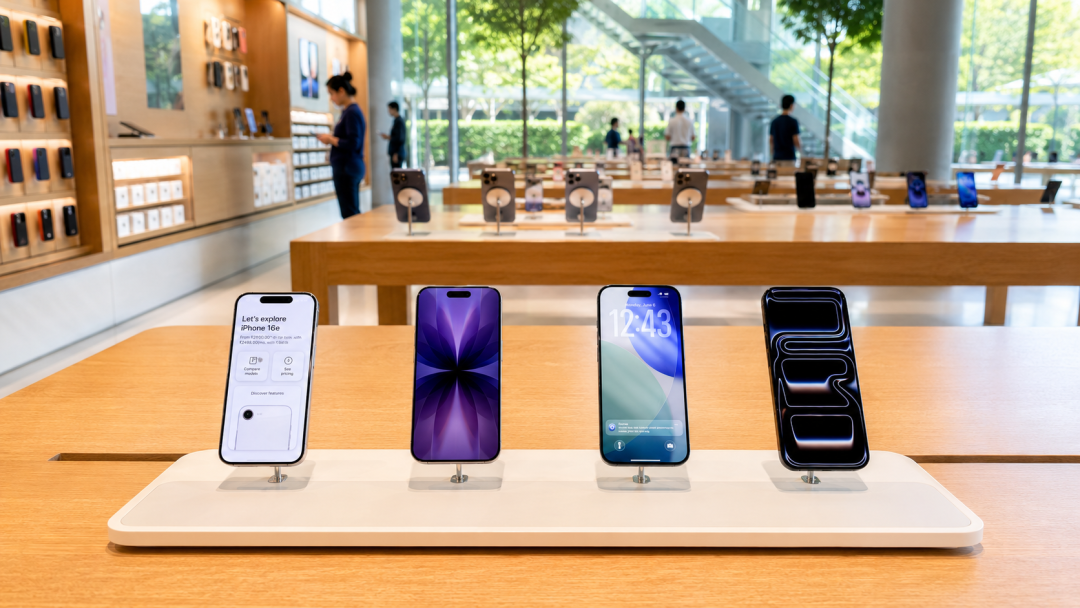
Apple's long-awaited Apple Intelligence (Apple AI) has finally secured regulatory approval to enter the Chinese market.
On July 15, China's Cyberspace Administration released a new batch of approvals for on-device generative AI services, with seven products making the cut: Apple Intelligence, Huawei's Xiaoyi AI, OPPO's AndesGPT, vivo's BlueHeart On-Device Large Model, Xiaomi's Surge AI, Samsung Galaxy AI, and Nubia's Doubao Mobile Large Model.
Alibaba confirmed its Qianwen LLM will power the Chinese version of Apple Intelligence, handling text/image understanding and content generation. However, Qianwen isn't Apple's sole AI partner in China. The tech giant is also collaborating with Baidu for AI-powered search capabilities and Siri voice assistant upgrades.
This creates a clear division of labor: Qianwen handles generative AI tasks while Baidu manages search and Siri functionality. Notably, Baidu has been Apple's Siri search provider in mainland China for years.
Approval ≠ Market Readiness
While regulatory clearance addresses compliance requirements, Apple Intelligence still faces significant challenges. Reports indicate some of its image recognition capabilities currently rely on Google's reverse image search - a service unavailable in mainland China. This technical dependency requires localization, meaning Apple still has substantial engineering work ahead.
More critically, Apple faces not just domestic smartphone makers like Huawei and OPPO (which already enjoy much higher on-device AI penetration), but also native AI applications like Doubao and DeepSeek, as well as super apps WeChat and Alipay - all competing to become the next-generation service gateway.
01. This May Be an Outdated Version of Siri
Apple first unveiled Apple Intelligence at WWDC24 in June 2024 with basic AI capabilities including text rewriting, content summarization, image generation, and cross-app operations.
At WWDC 2026, Apple revealed a completely revamped Siri (internally called Siri AI) powered by a new model developed with Google (derived from Gemini). This new Siri can understand on-screen content, remember recent conversations, and perform multi-step tasks like email composition, photo browsing, and itinerary organization - positioning itself as the ultimate service gateway.
However, Apple SVP Craig Federighi clarified that these advanced Siri capabilities wouldn't reach Chinese users soon due to pending regulatory approvals. The version likely approved now appears to be the "basic" model from two years ago, while Apple's "next-generation" offerings remain in regulatory limbo.
02. On-Device AI Becomes a Battleground
According to QuestMobile's "2026 Mid-Year AI Application Market Development Insight Report," as of June 2026:
- Monthly active users (MAU) for smartphone makers' AI apps reached 755 million, surpassing native AI apps' 499 million
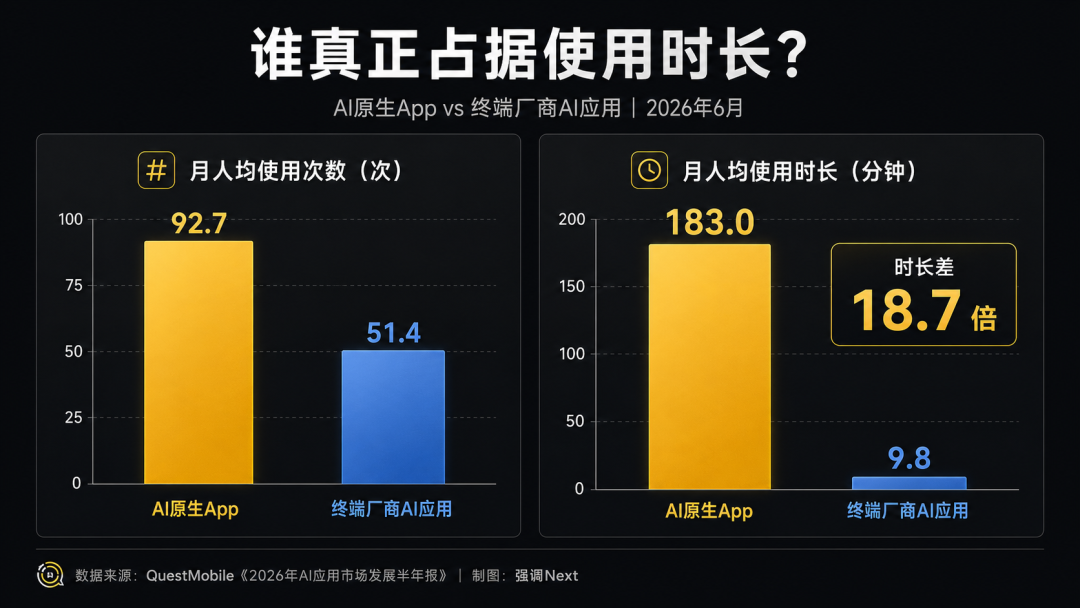
- However, smartphone AI apps averaged just 51.4 uses and 9.8 minutes per month per user, compared to native AI apps' 92.7 uses and 183 minutes

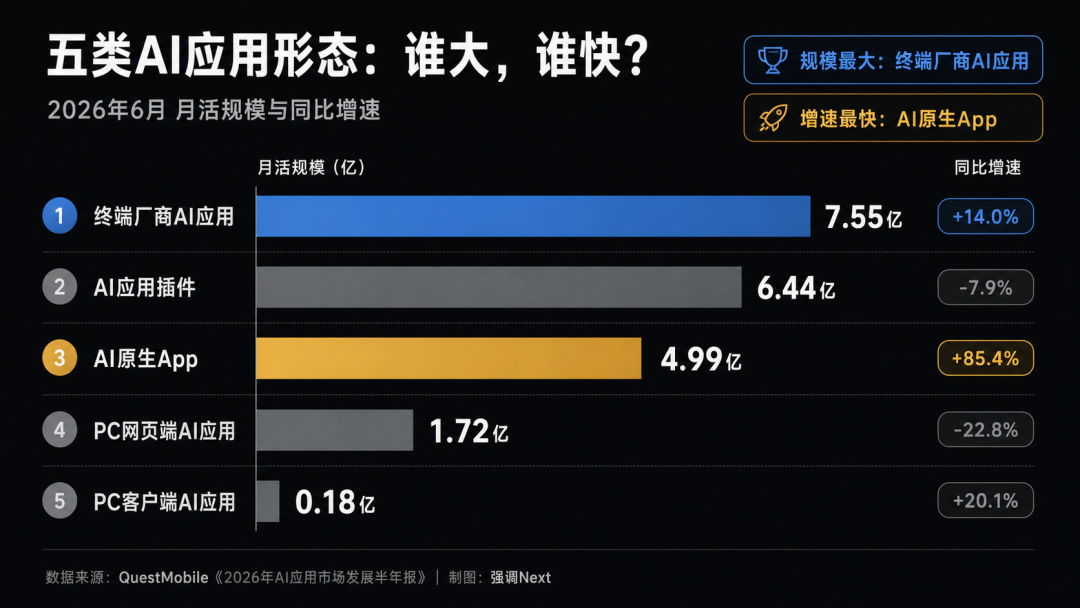
This reveals that while smartphone AI assistants achieve scale through pre-installation, native apps like Doubao (382M MAU), Qianwen (167M), and DeepSeek (130M) handle more complex tasks and sustained usage.
The gap becomes more pronounced when comparing individual smartphone assistants. In June 2026:
- Siri had just 17.8% penetration among iPhone users, compared to Xiaomi's Super Xiaoi (74.4%), OPPO's Xiaobu Assistant (70.8%), and Honor's YOYO (63.1%)
- Siri's MAU (48M) was about 1/8th of Doubao's
- Siri averaged just 3.8 uses and 1.5 minutes per month per user (down 15.5% and 15.9% YoY), while Xiaomi's Super Xiaoi averaged 29 uses and 7.7 minutes
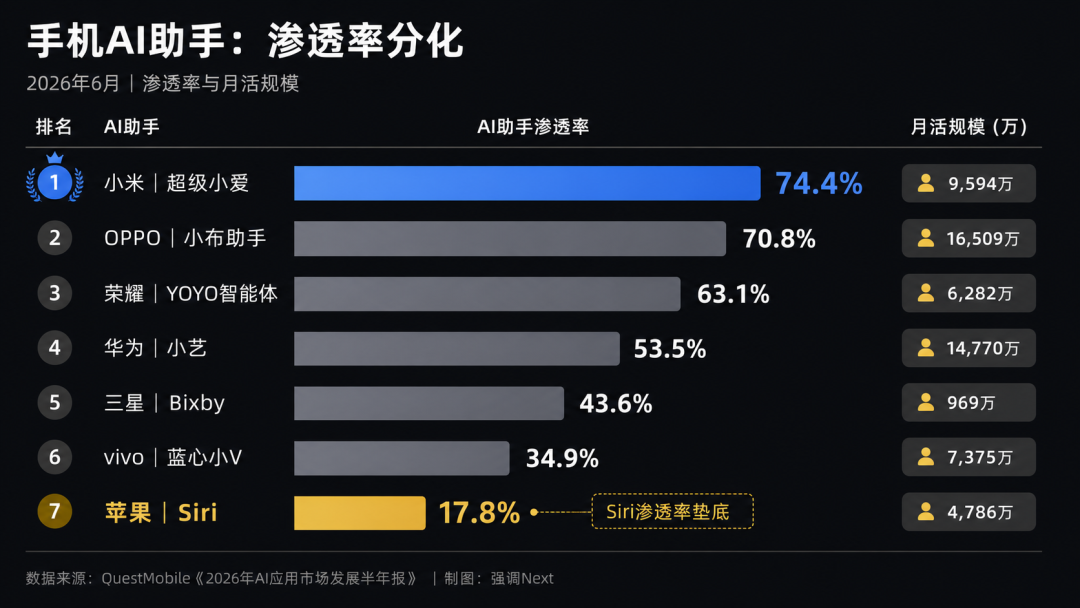
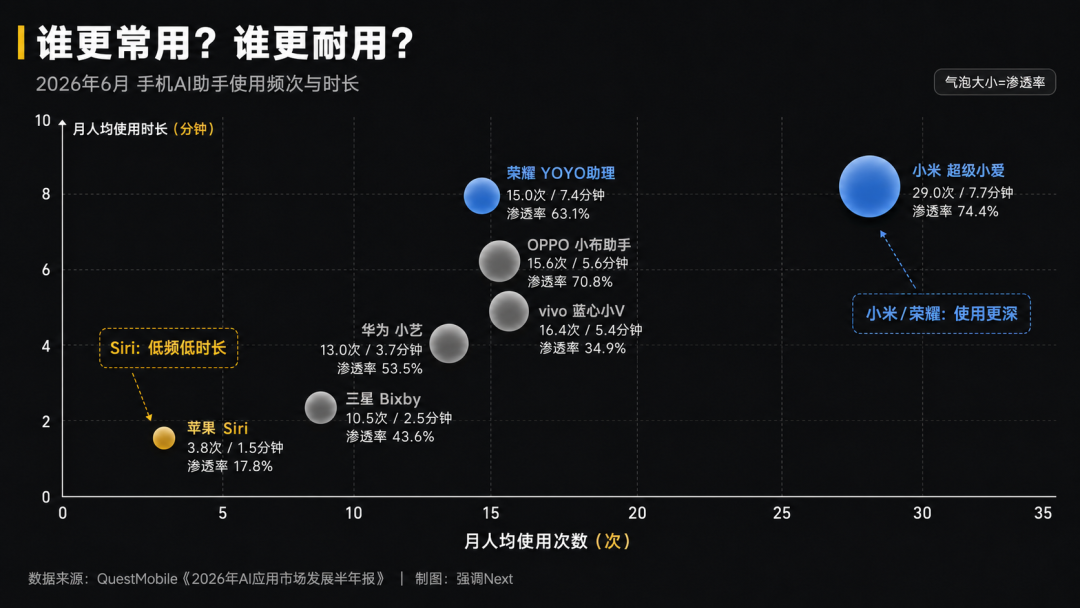
Apple must first catch up with domestic smartphone makers before challenging third-party AI apps. These statistics refer to traditional Siri, not the new Siri AI yet available in China. Apple isn't facing certain failure, but must overcome a low baseline where installation doesn't guarantee engagement.
For Apple, this isn't just about AI assistant utility but long-term strategy. While iPhones traditionally relied on the home screen and App Store as entry points, AI agents may shift this to natural language instructions. The first AI to capture user intent will control task distribution.
Apple's concern isn't Siri losing to chatbots, but third-party agents like Doubao becoming iPhone's default entry points. Apple Intelligence aims to maintain iOS's control layer.
03. AI Agent Smartphone Competition Intensifies
On July 17, Nubia will debut its "world's first AI agent smartphone" at the Shanghai World Artificial Intelligence Conference, featuring its Doubao Mobile Assistant (also approved in this batch).
However, claiming "world's first" is easier said than done. StepFun simultaneously launched its STEPX terminal brand with the same claim, suggesting at least one company prioritizes PR over substance.
Major manufacturers have already made progress:
- Huawei's HarmonyOS 7 introduced an "Agent-Affinitive System Architecture" that breaks apps into callable Skills
- Xiaomi's miclaw (in beta) can invoke 50+ system tools for tasks like reading messages, creating calendars, and checking weather
- OPPO and vivo launched Xiaobu Claw and Xiaov Claw frameworks focusing on screen understanding
- WeChat opened its A2A protocol with Huawei, Honor, and Xiaomi, allowing mobile assistants to hand tasks to WeChat agents
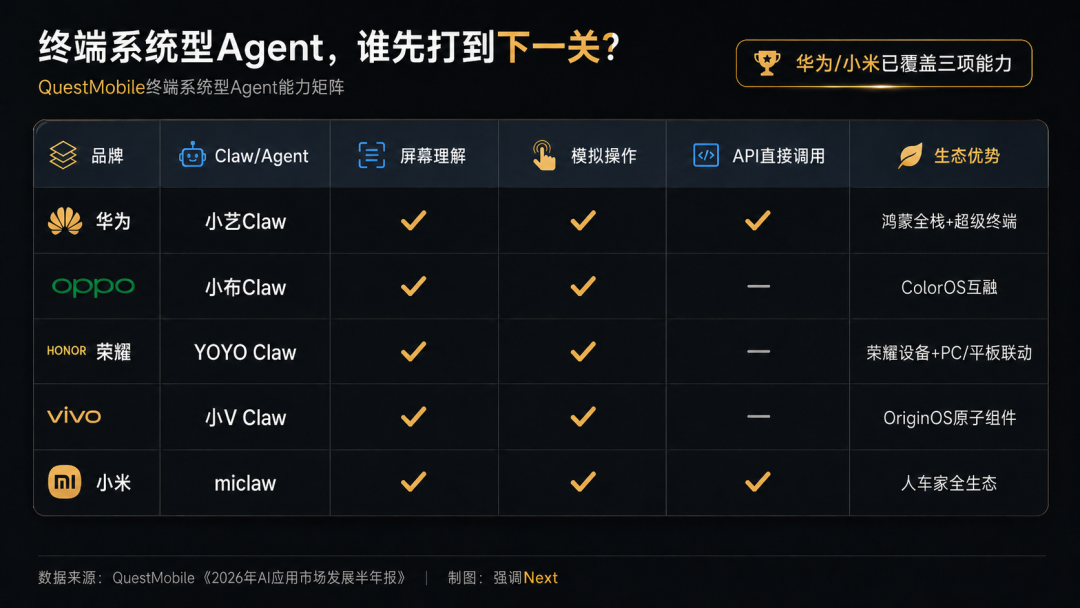
Yet challenges remain. Media tests of seven mobile agents (including Doubao Mobile Assistant, Zhipu, Honor, Huawei, Xiaomi, OPPO, and vivo) showed just 20% success rate across 70 tasks, with 39% failing after initiation and 24% downgrading to Q&A.
The core issue is permissions. These agents typically require 100+ permissions covering sensitive areas like system control and private data access. Most rely on accessibility permissions to "read the screen," raising security and stability concerns.
QuestMobile distinguishes between MCP (connection capability) and Skill (task completion). Domestic manufacturers have advanced to "doing things for users," but Apple's new Siri AI faces similar challenges in China regarding model strength and service integration.
Data shows Qianwen trails Doubao and DeepSeek in user base and engagement, reflecting user preferences. Even if AI accurately identifies intent, it can't unilaterally decide which apps (Taobao, WeChat, etc.) to open. Alibaba, Tencent, ByteDance, and Meituan are unlikely to cede control easily.
Apple's leverage lies in its user base quality and scale. Alibaba's 7%+ after-hours stock surge reflects this partnership potential. Apple may need to concede benefits in future collaborations to access these services - the true strategic prize.
Xiaomi, in contrast, saw a 21.7% YoY decline - the worst among mainstream manufacturers.

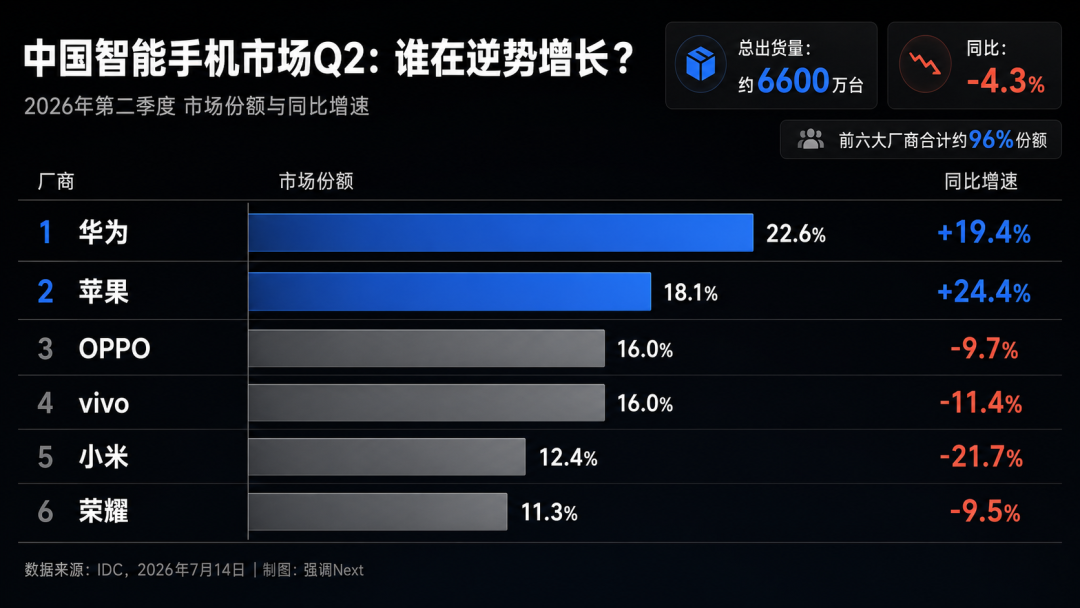
After memory chip price hikes, Huawei and Apple maintained stable pricing with targeted promotions, becoming rare "stable-price" brands. Apple's China strategy currently hinges on "not raising prices while others do" - unrelated to Siri's intelligence.
This underscores why Apple must urgently address AI gaps. If the iPhone 18 series raises prices this fall, "price stability" gains won't last. Incremental hardware upgrades (screens, cameras, chips) no longer drive device sales alone. Apple Intelligence must provide compelling reasons to upgrade.
From a long-term perspective, Apple competes for more than device sales. If users entrust needs to intelligent agents instead of opening apps manually, the mobile gateway will shift from home screens to intent understanding. Apple must prevent this gateway from falling to Doubao, WeChat, or other agents.
This approval gives Apple a market entry ticket. Next, it must integrate with local accounts, transactions, payments, and services while proving sustained user value.
The same applies to all "intelligent agent phone" claims. Whether Nubia or StepFun wins the "world's first" title matters less than whether initial users stay for the experience. A "first" that fails to retain users becomes mere investor storytelling.
- END -
-
![]()
The Dead End of GoPro: Unveiling the Decisive Factors in DJI and Insta360's Competition
-
![]()
The Dead End for GoPro: Unveiling the Key to Victory in DJI and Insta360's Competition
-
DeepSeek Targets A-share IPO Amid RMB 480 Billion Valuation Debate
-
![]()
WPS Meitu XiuXiu: The Threat to Its Market Position from AI Large Models
-
![]()
After Seres Reports Losses, What Is the Capital Market Really Worried About?
-
![]()
Honor, Stepfun, and Nubia Vie for 'Pioneering' Status: The Fierce Contest Among AI-Powered Smartphones
-
![]()
Glory, Stepfun, and Nubia Vie for the Pioneering Position: AI-Powered Smartphones Engage in Intense Competition
-
![]()
Apple AI Gains Approval but Faces Outdated Challenges