Half-Year Report | Global TV OEM Market Sees Slight 0.3% Growth in H1 2026; Expected to Decline in H2, Full-Year Drop of 1.1%, Ending Four-Year Growth Cycle
 07/27 2026
 342
342
This article contains approximately 3000 words and will take about 10 minutes to read. It is recommended to bookmark or selectively read specific sections.
According to the report
The market continued the positive growth trend in the first half of the year since 2023, but the growth momentum continued to weaken, with the growth rate narrowing year by year until it was nearly flat this year.
From a quarterly perspective, the market showed a pattern of 'Q1 growth, Q2 decline, strong start, weak finish.' In the first quarter, shipments reached 25.204 million units, a year-on-year increase of 3.8%, marking the sixth consecutive year of growth in the first quarter. This was primarily due to the clear expectation of rising upstream storage and panel costs at the beginning of the year, leading brands to concentrate on Pre (pre-stocking) inventory. Additionally, the stable tariff environment in North America and early release of overseas event orders collectively supported and boosted market sentiment in the first quarter.
In the second quarter, the market reversed, with shipments of 28.064 million units, a year-on-year decline of 2.7%. The core reasons include: the pre-stocking in the first quarter depleted some subsequent demand, compounded by the conclusion of domestic and international promotional events such as 618 and the World Cup, resulting in lower-than-expected terminal sales. At the same time, the continuous pressure of rising raw material costs, such as storage, led brands to adopt more conservative stocking strategies, weakening industry order demand and ultimately dragging down shipment volumes in the second quarter from growth to decline. This also directly compressed the overall growth of the OEM market in the first half of the year, nearly stalling growth.
Quarterly Shipment Volume Changes in the Global TV OEM Market (2024-2026)
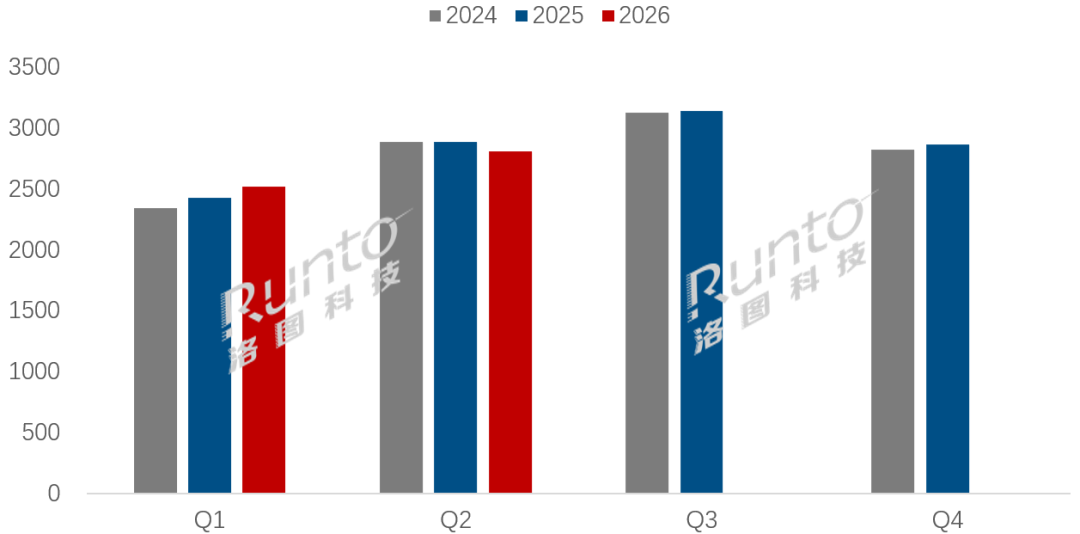
Data Source: Runto, Unit: 10,000 units
Runto temporarily categorizes TV OEM factories into two types: ① Professional ODM factories: Business operations are relatively independent of TV brand operations. ② Brand-owned factories: Includes Changhong, Konka, Skyworth, and Hisense.
In the first half of 2026, among all TV OEM factories, five manufacturers had total shipments exceeding 5 million units, an increase of two compared to the same period last year. These are: four professional OEM factories—MOKA, TPV, AMTC, BOE VT—and the brand-owned factory Changhong OEM.
I. Professional TV ODM OEM Factory Landscape:
Top 10 Dynamic Index Composition Adjustment; Clustering Effect Becomes More Pronounced; MOKA Retains Top Spot, TPV Grows Over 40%
Runto has long used the dynamic index composition of the top 10 professional ODM factories to quickly reflect the overall health of the OEM market.
Previously, the tail-end factory Innolux, which was included in the Top 10 statistics, had shipments of less than 200,000 units in the first half of the year, a significant decline in scale. Based on the current situation and trends, Runto has excluded Innolux from the Top 10 professional ODM factory statistical pool this year and included SQY (Qiyue).
According to Runto data, in the first half of 2026, based on the adjusted statistical scope, the combined shipments of the Top 10 professional ODM OEM factories (excluding the four brand-owned factories) accounted for 75.7% of the global OEM market, an increase of 2.8 percentage points compared to the same period last year.
At the same time, there was differentiation among the ten professional ODM OEM factories: four saw growth, while six experienced declines. Among the four growing factories, TPV, BOE VT, and Express Luck all saw increases of over 10%, with TPV exceeding 40%, becoming the industry's top grower in the first half of the year.
--MOKA shipped 7.59 million units in the first half of the year, retaining the global top spot. Although this represents a year-on-year decline of 7.3%, it still leads the second-place manufacturer by approximately 1.8 million units. Monthly shipments in the first half remained above 1 million units, maintaining strong momentum. At the customer level, MOKA steadily serves leading brands such as Xiaomi, Samsung, and LGE, superposition (combined with) orders from its group's own brand TCL, resulting in a stable core order structure and strong resistance to industry fluctuations. At the production capacity level, in addition to domestic bases, overseas factories in Vietnam and Mexico have well-established production capacity layouts, fully adapting to overseas orders and delivery; relying on vertical supply chain advantages, its cost control capabilities are also industry-leading.
--TPV shipped approximately 5.8 million units in the first half of the year, a significant year-on-year increase of 47.8%, ranking first in the industry for growth. Its ranking among all OEM factories and professional OEM factories rose from seventh and sixth in 2025 to third and second, respectively, nearly on par with Changhong OEM. Its performance growth mainly came from its own brands Philips and AOC. Affected by outsourcing strategies, the combined OEM shipments of these two brands through TPV increased significantly by 95.7% year-on-year in the first half, with their shipment share rising from 41.7% in the first half of last year to 55.2%. Additionally, overseas key customers Element, BestBuy, Vizio, Sony, and Roku, as well as domestic customers Skyworth and Huawei, all performed relatively well in terms of year-on-year shipment changes.
--AMTC shipped 5.64 million units in the first half of the year, a year-on-year increase of 7.8%, ranking third among professional OEM factories. AMTC's overseas layout continues to materialize, with a new production line utilizing Jiangsu Litong Electronics' factory in Tijuana, Mexico, commencing operations in the first half of the year, currently in the ramp-up phase with a designed capacity of 3.5 million units. Combined with the mature annual capacity of 11 million units at its Vietnam factory, the company has ample overall manufacturing capacity reserves, effectively undertake overseas centralized stocking orders for the FIFA World Cup in the U.S., Canada, and Mexico, as well as Amazon Prime Day in the first half of the year, supporting steady overall shipment growth.
--BOE VT shipped 5.38 million units in the first half of the year, a year-on-year increase of 12.6%, ranking fourth among professional OEM factories. In terms of customers, major overseas customers Vizio, BestBuy, and FUNAI, as well as domestic customers Hisense and Huawei, performed well in shipments in the first half; however, shipments to Xiaomi, LGE, and Sony saw varying degrees of decline. In terms of production capacity, VT also has a global factory layout. In 2026, its three major factories in Hefei, China, Vietnam, and Mexico will achieve comprehensive and balanced development, with further increased capacity at the Mexico factory. The annual production volume of all three factories will reach 5 million units, continuously enhancing competitiveness in overseas markets, particularly North America.
--KTC shipped 4.22 million units in the first half of the year, ranking fifth among professional OEM factories, a slight year-on-year decline of 3.7%.
--Express Luck shipped 4.14 million units in the first half of the year, ranking sixth among professional OEM factories, a year-on-year increase of 11.9%. Express Luck has deep roots in the European market, and the FIFA World Cup effectively drove stocking demand in the European region in the first half of the year, leading to increased orders.
--HKC shipped approximately 3.4 million units in the first half of the year, a year-on-year decline of 3.5%, ranking seventh among professional OEM factories. HKC's overall OEM business operates relatively smoothly, leveraging multi-site production capacity and synergies with group panel production, combined with a high-quality and balanced customer structure both domestically and internationally, providing strong resistance to fluctuations. Next, its competitiveness in specific sizes is expected to further expand its customer base and increase scale, with a long-term goal comparable to panel manufacturers BOE and TCL. In July, HKC adjusted the organizational structure of its complete machine (complete machine) business, merging TV, monitor, and commercial display divisions into a unified terminal BU.
--Foxconn shipped 1.95 million units in the first half of the year, ranking eighth among professional OEM factories, a significant year-on-year decline of 20.2%. Restricted by a single customer structure and the continuous decline in sales of its core customers, the company's TV OEM business is under significant pressure. In June, the joint venture between its key customer Sony and TCL began organizational structure construction, with formal operations expected to commence in April next year. Subsequently, Foxconn's orders under Sony may face uncertainties, with a high risk of business decline.
--JPE and SQY shipped less than 1.5 million units and 1 million units, respectively, in the first half of the year, ranking ninth and tenth.
Global Professional TV ODM Factory Shipment Rankings in H1 2026
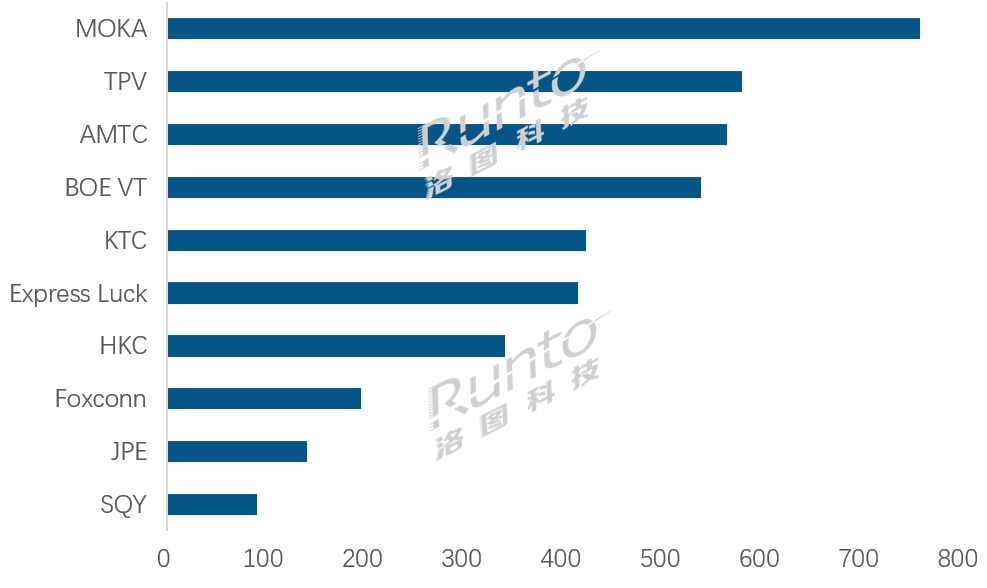
Data Source: Runto, Unit: 10,000 units
Note: Excludes the four brand-owned factories of Changhong, Konka, Skyworth, and Hisense
Additionally, Innolux, which was excluded from the Top 10 statistical pool this year, had shipments of only 170,000 units in the first half of the year, a significant year-on-year decline of 79.3%.
II. Chinese TV Brand-Owned Factory Landscape:
Overall Underperformance; Changhong Holds Steady, Ranks Second in the Industry
For brand-owned factories, the combined total shipment volume of the four major factories—Changhong, Skyworth, Konka, and Hisense—was approximately 11.78 million units in the first half of the year, a year-on-year decline of 5.7%, underperforming the overall market; their combined market share was 22.1%, a year-on-year decline of 1.4 percentage points.
Specifically, Changhong OEM shipped approximately 5.83 million units, accounting for about half of the total shipments of the four major factories, remaining roughly flat year-on-year with a slight increase of 0.1%; it ranked second in shipments among all OEM factories. In the first half of the year, affected by weak domestic market demand, its domestic sales orders declined; however, overseas market orders maintained steady growth. In terms of production capacity layout, Changhong's TV factory in Tijuana, Mexico, invested and constructed through leasing an industrial park in a light asset mode, is expected to commence operations in 2026 with a planned annual capacity of approximately 500,000 units, but no capacity supply was formed in the first half of the year.
Additionally, Skyworth OEM shipped approximately 3.45 million units, a year-on-year decline of 6.9%; Konka OEM shipped approximately 2 million units, a significant year-on-year decline of 20.3%; Hisense OEM shipped approximately 500,000 units, a year-on-year increase of 10.3%.
III. Global TV ODM Market Outlook:
Full-Year Total Volume to Decline by 1.1%, Ending Four Consecutive Years of Growth
From the demand side, the domestic TV market is expected to remain sluggish in the second half of the year. Runto predicts that in the second half of the year, domestic TV shipments in China will decline by 6.7% year-on-year to 15.173 million units; the total shipment volume for the full year is expected to be 30.120 million units, a year-on-year decline of 8.4%, marking a new low in market scale for at least 17 years since 2010.
At the global market level, in the first half of the year, global TV brand shipments remained stable overall, with a year-on-year increase of 2.7%, driven by the FIFA World Cup. However, Runto believes that in the second half of the year, cost and demand pressures will significantly increase, with the shipment momentum of small to medium-sized mass-market models weakening quarter by quarter. It is predicted that the total shipment volume for the full year will decline to 205 million units, a year-on-year decline of 0.9%.
Returning to the OEM market, the weakening demand in the complete machine terminal market and the sustained high costs of upstream raw materials will continue to suppress the sentiment of the global TV OEM market.
Runto predicts that in the second half of 2026, the shipment volume of the global TV OEM market will decline by 2.3% year-on-year; the total OEM shipment volume for the full year will decline by 1.1% compared to 2025, to 112 million units, ending four consecutive years of growth.
-
![]()
DeepSeek v4’s Official Release is Still Pending, but Kimi k3 is Already Giving Open AI a Run for Its Money
-
![]()
Why is Kimi in a hurry to go public after K3?
-
![]()
Penetration Rate Surpasses 60%: Are Traditional Fuel Vehicles ‘Aging’ While New Energy Vehicles Evolve Too Swiftly?
-
One Article to Grasp the Key Aspects of Ctrip's Monopoly Investigation
-
[Insight] Miniature Fiber Optic Spectrometers Have a Wide Range of Application Fields, with Jingfei Technology as a Leading Enterprise
-
![]()
Half-Year Report | Global TV OEM Market Sees Slight 0.3% Growth in H1 2026; Expected to Decline in H2, Full-Year Drop of 1.1%, Ending Four-Year Growth Cycle
-
![]()
JD's AI Bet: 700,000 'Brothers' and a Supply Chain Worth Hundreds of Billions
-
![]()
AI Smartphone War: The Endgame is a World Without AI Phones