Penetration Rate Surpasses 60%: Are Traditional Fuel Vehicles ‘Aging’ While New Energy Vehicles Evolve Too Swiftly?
 07/27 2026
 398
398
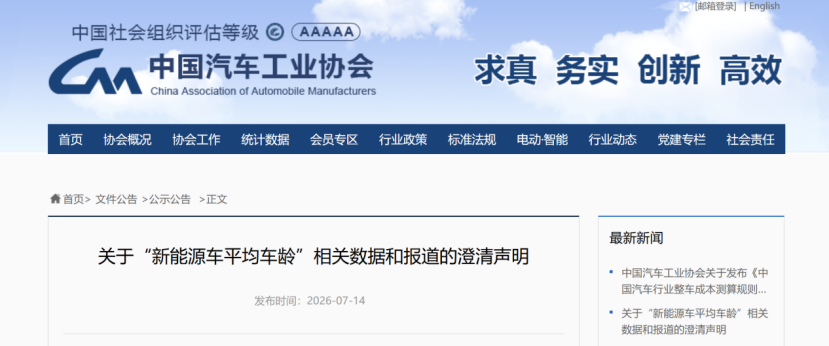
A recent set of data regarding the composition of vehicle ownership has ignited widespread debate both within and beyond the automotive sector. Preliminary estimates from the China Passenger Car Association reveal that the retail penetration rate of new energy passenger vehicles soared to 64.5% in July, indicating that over six out of every ten newly sold vehicles were new energy models. Concurrently, data on the existing market is equally noteworthy. Reports citing an automotive aftermarket report, jointly issued by the China Association of Automobile Manufacturers and Hejun Consulting, reveal that the average age of domestic fuel-powered passenger vehicles stands at 8.2 years, whereas that of new energy passenger vehicles is merely 1.8 years. In response to potential misinterpretations, the Aftermarket Branch of the China Association of Automobile Manufacturers subsequently issued a clarifying statement, emphasizing that 'average age of in-use vehicles' ≠ 'vehicle replacement cycle' ≠ 'average vehicle lifespan'.
From the perspective of penetration rate trends, the adoption rate of new energy vehicles in China has far outstripped industry expectations. As we entered 2026, the monthly penetration rate has continued to climb, stabilizing above 60% in the first half of the year. In just six years, new energy vehicles have transitioned from the market periphery to an absolute mainstream, with sales volume surging more than tenfold. The vast majority of new energy vehicles currently on the road are new cars sold within the past two to three years, naturally skewing the existing vehicle structure towards a younger age bracket.
▍Average Vehicle Age: Unveiling the True Meaning of Existing Vehicle Structure
Understanding vehicle age data necessitates distinguishing between three distinct concepts: the average age of in-use vehicles, vehicle replacement cycles, and vehicle lifespans. These three metrics possess entirely different statistical scopes and objectives and should not be conflated.
The average age of in-use vehicles denotes the average time elapsed since new vehicles were sold among the existing fleet, akin to the average age of a population rather than its average lifespan. This metric reflects the average manufacturing date of all active vehicles at a given point in time, gauging the age structure of the existing market. As a burgeoning category, new energy vehicles have witnessed rapid sales growth in recent years, with new additions continuously diluting the average age of the existing fleet, resulting in a naturally lower average age.
The vehicle replacement cycle pertains to the average interval between a vehicle's purchase and its proactive replacement by the owner. Data from the China Automobile Dealers Association indicates that the mainstream replacement cycle for new energy vehicles spans 3 to 5 years, while that for fuel vehicles remains steady at 6 to 8 years. Several factors contribute to the shorter replacement cycle for new energy vehicles: the rapid iteration of battery, electric drive, and intelligent driving technologies far outpaces that of fuel vehicles, with models introduced two to three years ago already exhibiting significant technological gaps in range, computing power, and charging capabilities; coupled with manufacturer replacement incentives, owners are inclined to sell their vehicles while they still retain reasonable residual value.

The average vehicle lifespan refers to the average number of years a vehicle is utilized from sale to scrappage. Currently, there is no authoritative data on the complete lifecycle of new energy vehicles in the industry, as their large-scale adoption in China has only occurred over the past five to six years, and vehicles have not yet entered a peak scrappage phase. Based on existing data, it can be inferred that the actual lifespan of new energy vehicles will not be significantly shorter than that of fuel vehicles. The degradation cycle of the battery, electric drive, and electronic control systems typically exceeds eight years, and most automakers offer battery warranties of 8 years or 150,000 kilometers.
Changes on the supply side further corroborate the speed of this transition. Among the over 100 new models launched in 2026, only around ten are pure fuel vehicles, accounting for less than 10% of the total. Major automakers continue to shift their R&D resources towards new energy vehicles, with the most pronounced changes occurring among domestic brands, where new energy penetration has exceeded 80%, and fuel models are gradually being phased out of their main product lines. The market trajectory of joint-venture brands differs significantly, with new energy penetration remaining low and a wide range of fuel models still available. This structural adjustment on the supply side will continue to reshape the age composition of the existing market in the coming years.
Policy is also expediting this process. In 2026, detailed rules for vehicle trade-in subsidies were formally implemented, with national subsidies for fuel vehicles fully phased out and only some regions retaining trade-in subsidies for models with engine displacements of 2.0 liters or less. New energy vehicles, meanwhile, will continue to benefit from a 50% purchase tax reduction until the end of 2027, supplemented by local subsidies, creating multiple layers of incentives. The differing policy orientations further propel new vehicle consumption towards new energy vehicles, causing the replacement rate of fuel vehicles to continue decelerating and their average age to keep rising.
▍Aftermarket and Consumer Logic Amidst Diverging Vehicle Ages
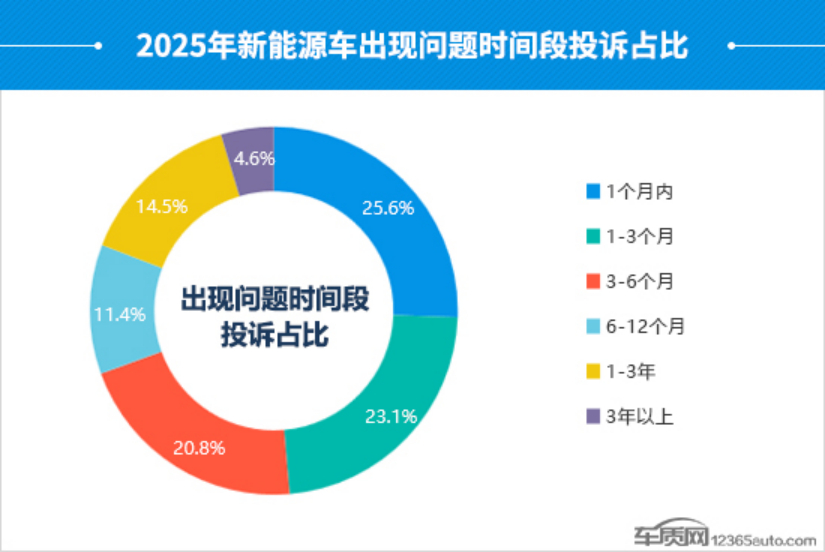
Differences in vehicle age structure are directly mirrored in complaint data. Annual complaint data from CheZhi.com reveals that in 2025, complaints about new energy vehicles were notably concentrated among new cars: nearly 70% of issues arose within six months of purchase, and over 60% of complaints involved vehicles with less than 10,000 kilometers on the odometer. This aligns with the structure of the new energy vehicle fleet, where 90% of vehicles are 1 to 3 years old—most in-use vehicles are still in their early usage stages, so complaints naturally skew towards new cars. This does not inherently signify quality issues.
However, two sets of year-over-year data suggest that base effects do not fully explain the trend: the proportion of complaints within six months of purchase increased by more than 11 percentage points year-over-year, while the proportion within 10,000 kilometers rose by 10.4 percentage points. Against the backdrop of the new energy vehicle fleet gradually 'aging' each year, the concentration of complaints among new cars has increased rather than decreased, indicating that fault onset is genuinely occurring earlier—problems are emerging sooner than in previous years. This aligns with the industry characteristic that software-related faults, which are more prevalent with higher intelligent configuration adoption rates, tend to surface shortly after delivery. In other words, the 'newness' of new energy vehicles applies not only to their fleet composition but also to the nature of their issues.
Further analysis of complaint content reveals that issues with new energy vehicles in their early usage stages concentrate in two areas: first, faults related to electronic components and intelligent systems, including infotainment system lag, black screens, and abnormal auxiliary driving functions. These issues are often tied to software compatibility and system iterations and can typically be improved through OTA updates. Second, manufacturing process and assembly quality issues, such as body rattles, poor sealing, and loose interior trim.
In contrast, the fault distribution of fuel vehicles presents entirely different characteristics. With higher average ages, fuel vehicles experience more faults related to mechanical wear and aging components, such as engine leaks, transmission jerking, suspension rattles, and aging chassis rubber components. These issues typically emerge gradually after 3 to 5 years of use, with their likelihood increasing as vehicle age rises. Consequently, the maintenance and repair needs of fuel vehicles exhibit rigid growth characteristics, with higher repair frequencies and costs as vehicle age increases. In contrast, most new energy vehicles are still within their new car warranty periods, and large-scale aging-related repair demands have not yet materialized.
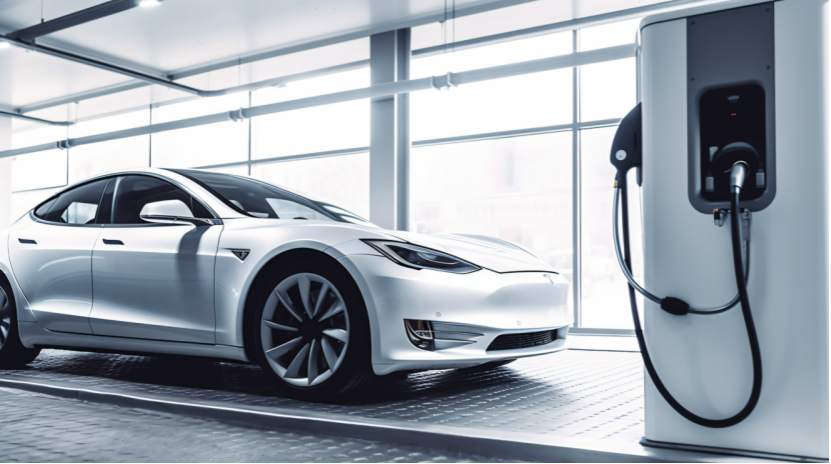
A particularly unique issue is battery degradation. Unlike mechanical faults in fuel vehicles, which are often accompanied by immediately perceptible phenomena such as unusual noises or vibrations, battery degradation occurs internally within the cells but manifests externally as easily perceptible daily usage issues, such as reduced range, slower charging, and limited power at low battery levels. The difference lies in the fact that fuel vehicle faults tend to be 'sudden and localized,' whereas battery degradation is 'gradual and systemic.' Owners can easily perceive that 'the range is not as good as when the car was new' but find it difficult to pinpoint the root cause as precisely as they would for a mechanical fault.
2026 is regarded by the industry as the inaugural year of mass production for semi-solid-state batteries, with products from companies such as Dongfeng, Sunwoda, and Gotion High-Tech gradually being installed in vehicles, offering improved energy density and cycle life. Battery technology iterations continue to reshape the aging curve of new energy vehicles.
Against this backdrop, new energy vehicle owners tend to sell their vehicles while they still retain reasonable residual value, further shortening their actual ownership periods. Currently, the iteration speed of battery, electric drive, and intelligent driving technologies far outpaces that of fuel vehicles, with models introduced two to three years ago already exhibiting significant technological gaps in range, computing power, and charging capabilities. Coupled with replacement incentives, owner replacement cycles have notably shortened. Data from the China Automobile Dealers Association indicates that the mainstream replacement cycle for new energy vehicles is 3 to 5 years, while that for fuel vehicles remains stable at 6 to 8 years.
However, the aftermarket landscapes for fuel and new energy vehicles are not static. Some industry experts point out that this phase of rapid iteration aligns with the development patterns of emerging industries. As the sector matures, the pace of technological upgrades is expected to gradually decelerate. Certain core technologies in new energy vehicles, such as battery reliability and infotainment system smoothness, have already become more mature and stable. As new energy penetration rates stabilize and technology platforms mature, the gap in vehicle ages between the two segments may narrow in the future.
Layout 丨 Yang Shuo Image sources: China Association of Automobile Manufacturers, CheZhi.com, Qianku.com
-
![]()
DeepSeek v4’s Official Release is Still Pending, but Kimi k3 is Already Giving Open AI a Run for Its Money
-
![]()
Why is Kimi in a hurry to go public after K3?
-
![]()
Penetration Rate Surpasses 60%: Are Traditional Fuel Vehicles ‘Aging’ While New Energy Vehicles Evolve Too Swiftly?
-
One Article to Grasp the Key Aspects of Ctrip's Monopoly Investigation
-
[Insight] Miniature Fiber Optic Spectrometers Have a Wide Range of Application Fields, with Jingfei Technology as a Leading Enterprise
-
![]()
Half-Year Report | Global TV OEM Market Sees Slight 0.3% Growth in H1 2026; Expected to Decline in H2, Full-Year Drop of 1.1%, Ending Four-Year Growth Cycle
-
![]()
JD's AI Bet: 700,000 'Brothers' and a Supply Chain Worth Hundreds of Billions
-
![]()
AI Smartphone War: The Endgame is a World Without AI Phones