Honor’s Ambition Demands More Than a Gimbal-Equipped Phone
 08/13 2026
 551
551
Honor’s Ascent Ambitions
Author | He Jian
Editor | Zhang Wen
Cover | Internet
After over six months of anticipation, Honor has finally unveiled its self-styled “robot phone”—the Robot Phone—marking its first morphologically innovative smartphone under Li Jian’s leadership. This move reflects Honor’s ambition to elevate its brand status. Starting at 9,999 yuan, the Robot Phone falls slightly short of market expectations but remains Honor’s most expensive model to date.
Unlike traditional candy-bar smartphones or foldable devices, the Honor Robot Phone features a four-degree-of-freedom gimbal system, enabling its rear camera to operate via this mechanism. Strip away the “robot” branding, and it essentially merges a gimbal-stabilized camera with a smartphone form factor.
However, this innovation comes with a trade-off: significant weight. The Robot Phone tips the scales at 248 grams, far heavier than competing models. For comparison, Honor’s foldable Magic V6 weighs just 220 grams.
Gimbal cameras have emerged as a major innovation in consumer electronics in recent years. DJI revolutionized the category with its Pocket series, with the previous generation, Pocket 3, surpassing 10 million units in cumulative sales and generating 20 billion yuan in revenue. Since last year, domestic smartphone makers have rushed to develop gimbal-equipped products. Besides Honor, OPPO, Vivo, and Xiaomi have also entered the fray.
The rationale is clear. The smartphone market has stagnated for years, and while manufacturers have pushed foldable devices, they have failed to reverse the overall decline. Amid rising memory costs this year, smartphone makers have been forced to raise prices, with global shipments expected to fall further.
Most Android vendors are seeing sales declines, with Honor’s drop particularly pronounced. In 2025, the company fell out of the top five in mainland China’s smartphone market share for the first time and has yet to recover.
Honor CEO Li Jian revealed after the Robot Phone launch that the company’s global sales grew 9% and revenue 11% in the first half of the year. The Chinese market performed well in Q1 but faced challenges in Q2, though he remained “generally satisfied.”
Counterpoint Research data shows a 2% YoY decline in China’s smartphone shipments in Q2 2026. Except for Huawei and Apple, which maintained growth through their dominance in the premium market, OPPO, Vivo, Xiaomi, and Honor all saw declines. Honor’s market share stood at around 11%, ranking last among the six major brands.
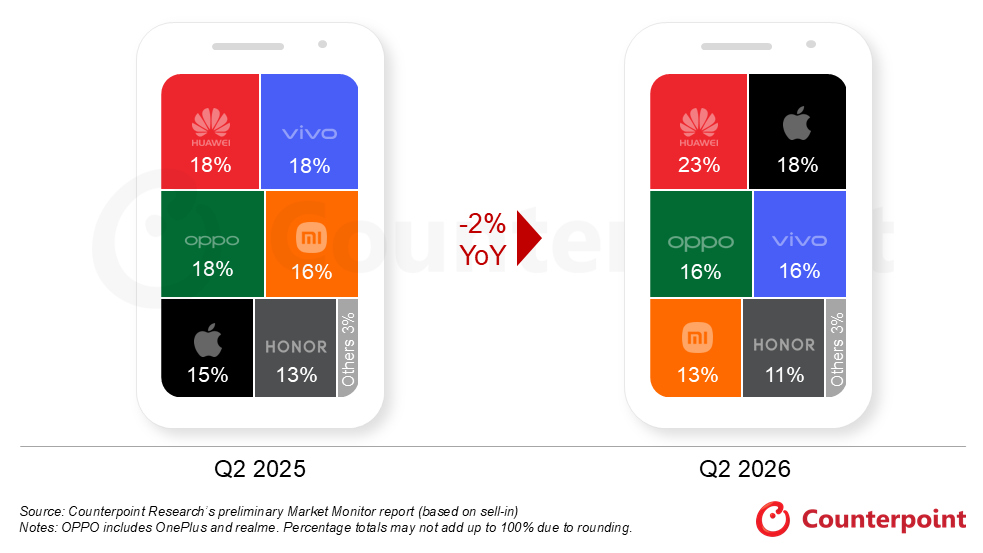
Counterpoint Data
Li Jian described Honor’s current state as “an eagle preparing to take off amid a raging storm.” Echoing his consistent strategic rhetoric, he claimed Honor is “breaking through against the odds and emerging renewed amid adversity.” He said the company faces two converging forces: external downward pressure from soaring memory prices and internal upward momentum from strategic adjustments across all fronts.
Since taking over as CEO from Zhao Ming in January 2025, Li Jian has initiated sweeping organizational and structural reforms, replacing much of the middle and upper management. He repositioned Honor as an AI terminal ecosystem company and, just three months into his tenure, unveiled the “Alpha Strategy,” pledging to invest over $10 billion in building an AI terminal ecosystem over the next five years.
The Robot Phone represents the first product under Li Jian’s “Alpha Strategy.” In his words, “The first step of the Alpha Strategy is to create an intelligent smartphone.” He believes the gimbal not only showcases Honor’s imaging capabilities but also its AI prowess, as it enables numerous human-machine interactions.
At the launch event, Honor demonstrated various physical AI interactions with the Robot Phone, mostly achieved through gesture and voice control of the gimbal, with some demonstrations bordering on theatrics. For instance, having the gimbal follow on-screen TikTok dance moves—essentially just swaying back and forth—or placing the phone on a tabletop robot to perform a “reverse parking” maneuver. It appeared more like a desktop ornament than a handheld smartphone.
As for the system-level AI capabilities demonstrated by Honor, the effects were similar to those of most AI-branded smartphones on the market, offering nothing particularly novel.
The gimbal’s primary utility remains in imaging. With it, the Robot Phone’s rear camera can pivot freely in four directions, automatically tracking subjects and adjusting composition during live streams or video recording, while also mitigating some handheld shake.
Compared to mature gimbal camera products, the Robot Phone’s pricing is uncompetitive. The two configurations are priced at 9,999 yuan and 12,999 yuan, respectively. In contrast, DJI’s newly released Pocket 4P starts at just 3,799 yuan, and Insta360’s Luna at 3,999 yuan—both outperforming the Robot Phone in imaging capabilities.
As a conceptual experiment, the Robot Phone is unlikely to become a mass-market hit. Its greater significance, perhaps, lies in marking the beginning of Honor’s premium branding journey, as Li Jian suggested.
Honor was once seen as a Huawei alternative and struggled to differentiate itself from Xiaomi and OV. Its AI edge was later largely overshadowed by Doubao Phone. Nevertheless, the Robot Phone injects some much-needed freshness into the stagnant smartphone market and reflects Li Jian’s resolve to innovate after taking the helm at Honor.
However, it is unlikely to alleviate Honor’s current sales woes. Priced in the ten-thousand-yuan range, it is ill-suited for significant sales breakthroughs, as domestic Android manufacturers rely more on mid-to-low-end models to drive volume. Yet, under soaring memory costs, these models have been hit harder, forcing manufacturers to raise prices substantially, placing greater sales pressure on them than on premium-focused brands like Huawei and Apple. In the first half of this year, Honor raised prices for its volume models, the X70, 500, and WIN RT, by around 300 yuan each.
Amid external sales pressures and soaring internal costs, Honor’s path to going public has been fraught with twists. Honor initially completed its IPO counseling registration in June 2025, with market expectations pointing to a March 2026 completion. However, updates were scarce, fueling speculation. Shanghai Securities News previously reported that Honor held an internal employee shareholding meeting in May to deny rumors of an IPO halt.
Not until July 15 this year did CITIC Securities officially disclose its “Report on the Progress of Counseling for Honor’s Initial Public Offering and Listing (Phase III).” The report cited unresolved issues regarding the direction of fundraising investments. On July 31, CITIC Securities released its fourth-phase counseling report, covering the period from April 1 to June 30 this year, stating that the counseling process for Honor’s IPO was still ongoing.
Li Jian aims to restore Honor’s premium market positioning through AI, but this will not be easy. Considering Apple’s planned launch of its first foldable iPhone later this year, Honor may face further market share erosion in the premium segment. Its ascent will likely encounter even greater uncertainties.

© All rights reserved by Shanshang. No reproduction without authorization.
-
Trend丨Space Brain Deployment Accelerates: Digital Space No.1 Validates ‘Intelligent Satellite Autonomy’
-
Hot Topic | SpaceX Partners with NVIDIA AI Architecture, Paving the Way for New Growth in Space Computing
-
Bilibili's Capital Narrative: Meeting Market Expectations but Losing Its Own Identity
-
![]()
China Mobile Reports 538 Billion Yuan in Revenue for First Half of the Year, with 5G Subscribers Surpassing 687 Million
-
![]()
Domestic Wi-Fi Chips Usher in Prime Era
-
![]()
HONOR Unveils Robot Phone, Yet AI-Driven Smartphones Still Await Market Breakthrough
-
![]()
Jiemei Technology Splurges 915 Million Yuan, Making a Bold Move into Optical Ultra-Precision Equipment
-
![]()
Intensifying Investment in Advanced Coating Equipment: Landun Optoelectronics Aims to Secure Majority Stake in Lanchuang Technology