Domestic Wi-Fi Chips Usher in Prime Era
 08/13 2026
 403
403
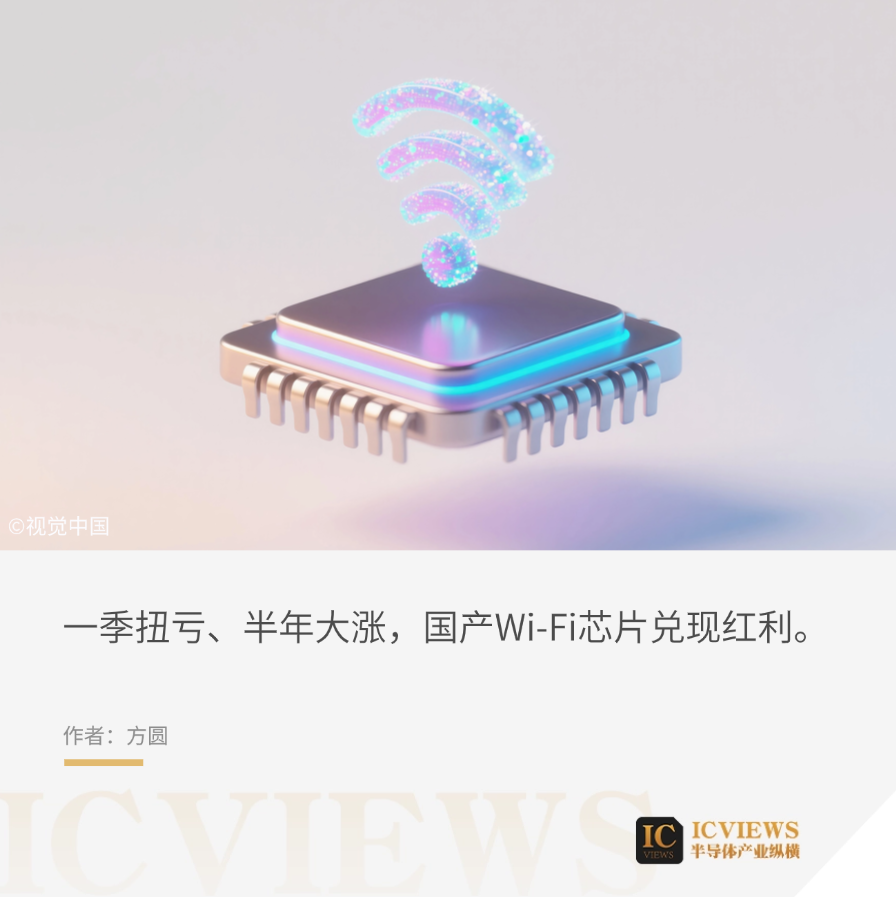
In 2026, domestic Wi-Fi chip manufacturers are collectively delivering their best-ever performance: Beken Corp. saw its net profit attributable to the parent company surge nearly 150% to 176% in the first half, while ASR Microelectronics is projected to turn a profit of RMB 85 million, reversing year-on-year losses. Espressif Systems' revenue exceeded RMB 800 million in a single quarter for the first time in Q2.
This is not just Individual enterprises (individual companies' exceptional performance) but a systemic realization after years of technological accumulation in the industry. Although Wi-Fi chips represent just a niche segment within wireless connectivity, they underpin vast demand spanning smart homes to industrial IoT, low-altitude economies, and AI terminals. Their growth trajectory often mirrors structural shifts across the entire semiconductor sector.
01
Wi-Fi Manufacturers Reap Harvest Season
If 2025 was a year of accumulation for domestic Wi-Fi chip manufacturers, 2026 undoubtedly marks full realization. Semi-annual reports and earnings previews from multiple listed companies reveal a clear common thread: earlier R&D investments entering Large scale harvest period (large-scale harvest phase).
Beken Corp. exemplifies this performance surge. The company projects H1 2026 revenue of RMB 620-640 million, up 65-70% YoY, with net profit attributable to the parent company reaching RMB 48-53 million, a nearly 150-176% YoY increase. The core driver lies in its Wi-Fi 6 MCU and Edge AI chips, developed through earlier R&D efforts, entering full-scale mass production for downstream mainstream clients. Its strategic shift from "connectivity" to "connectivity + end-side intelligence" positions Beken favorably amid IoT-AI convergence trends.
ASR Microelectronics' turnaround holds symbolic significance. The company projects H1 2026 revenue of RMB 2.45 billion (+29% YoY) and net profit of RMB 85 million, reversing last year's RMB 245 million loss. Improvement stems from rising penetration of cellular baseband chips (+23% YoY revenue) and explosive growth (+157% YoY) in AI application-specific chip customization services, creating new revenue streams. ASR's profitability signals that domestic Wi-Fi and communication chip firms, after prolonged R&D phases, are establishing sustainable profit models.
As the global leader in Wi-Fi MCU market share, Espressif Systems reported H1 revenue of RMB 1.481 billion (+18.88% YoY) and net profit of RMB 334 million (+27.93% YoY). More notably, its gross margin reached 49.32%, up 4.12 percentage points YoY, reflecting optimized product mixes and enhanced product differentiation as the IoT sector transitions from "connectivity-driven" to "functionality-driven" phases. Espressif ranks first globally in Wi-Fi MCU shipments and fifth in the overall Wi-Fi market.
In Wi-Fi RF front-end (FEM), CanSemi also delivered standout results. The company reported 2025 revenue of RMB 683 million, with core Wi-Fi FEM business growing 26.95% YoY and Wi-Fi 7 products accounting for over 50% of revenue. By Q1 2026, revenue reached RMB 182 million (+34.8% YoY), with net profit of RMB 4.875 million, achieving profitability. Wi-Fi 7 series products now drive over 50% of revenue.
Additionally, Amlogic saw H1 2026 revenue soar to RMB 4.391 billion (+31.85% YoY) and net profit of RMB 608 million (+22.44% YoY). Its W-series Wi-Fi 6 chip business sustained momentum, with Q2 shipments surging. Wireless connectivity chips have become a key growth driver. Goke Microelectronics' IoT chip series generated RMB 128 million in H1 2025 revenue, up 251.37% YoY.
This performance surge occurs against a backdrop of global Wi-Fi chip market prosperity. Market data shows the 2024 Wi-Fi 6/6E chipset market valued at ~USD 39.03 billion, projected to reach USD 107.4 billion by 2033. The global Wi-Fi chipset market reached ~USD 21-24 billion in 2025, expected to expand at a mid-single-digit CAGR through 2026-2034. China represents the fastest-growing region globally, with 11%+ CAGR projected for 2026-2030.
02
From Wi-Fi 6 to Wi-Fi 8
The fundamental driver of Wi-Fi chip industry prosperity lies in generational shifts of technical standards. Each standard upgrade compels chip manufacturers to redesign products and customers to replace devices, unlocking tremendous market increment (incremental demand).
Wi-Fi 6 remains the current market mainstream. Since its 2019 certification launch, its precise alignment with rigid demands—balancing performance and cost—has made it the preferred choice for households and SMEs. With theoretical peak speeds of 9.6Gbps, OFDMA, and 8-stream MU-MIMO support, Wi-Fi 6 ensures smooth multi-device connectivity with latency controlled at 10-30ms. This mature, stable platform has nurtured fertile ground for domestic players like Beken, Espressif, and Amlogic.
Wi-Fi 7, the next-gen standard, delivers theoretical peak speeds of 46.1Gbps, supporting 320MHz ultra-wide channels and 4096-QAM modulation with latency as low as 1-5ms. However, three core challenges hinder Wi-Fi 7 adoption: spectrum constraints (domestic 6GHz bands prioritized for mobile communications), immature terminal ecosystems (<10% of phones/PCs support Wi-Fi 7), and high costs (2-3x Wi-Fi 6 chip/module prices). Wi-Fi 6 will dominate for 2-3 more years.
Wi-Fi 8's arrival commands greater attention. In January 2026, MediaTek unveiled its Filogic 8000-series Wi-Fi 8 platform at CES 2026. Broadcom followed with industry-first Wi-Fi 8 router integration chips (BCM6772/BCM6774/BCM6776), now sampling to clients like ASUS. Qualcomm also launched its first Wi-Fi 8-capable chip. Domestic players like CanSemi plan Wi-Fi 8-compliant core product launches in 2026.
Wi-Fi 8's key improvements over Wi-Fi 7 focus not on peak speeds but reliability, coverage, and concurrency efficiency in high-density, long-distance scenarios. Through multi-AP coordination, dynamic resource scheduling, and enhanced link design, Wi-Fi 8 can double actual throughput, reduce P99 latency to 1/6th of Wi-Fi 7, and double IoT coverage range. While Wi-Fi 7 addresses "speed," Wi-Fi 8 tackles "stability."
03
Breakthroughs in High-End Wi-Fi Chips: Domestic Full-Chain Efforts
By market share, Counterpoint Research data shows Broadcom leading Wi-Fi 6/6E/7 markets (24%), followed by Qualcomm (19%) and MediaTek (13%).
These giants pursue distinct strategies. Broadcom's strength lies in its "full-stack autonomy"—from RF front-end and baseband processing to switch chips and SoC cores, it independently develops nearly all critical components, targeting premium markets with clients like Apple. Most high-end wireless routers and enterprise APs globally use Broadcom chips. Qualcomm epitomizes ecosystem orchestration, integrating AI processing, Mesh networking, and carrier-grade management into its Wi-Fi platforms, deeply coupling with Snapdragon for mobile and offering end-to-end carrier capabilities for networks. MediaTek leverages its massive smartphone market presence, supplemented by AIoT and networking markets.
Across the broader Wi-Fi ecosystem, Cisco, Broadcom, Qualcomm, HPE, and MediaTek rank top five (~41.4% combined share). Realtek dominates PC/consumer electronics Wi-Fi, while Intel holds sway in laptops and platform integration. The top six chip design firms command ~63% market share. Note that Top manufacturers (leading players') market share calculations vary—some use Wi-Fi 6/6E/7 segments, others broader Wi-Fi ecosystems—but Broadcom, Qualcomm, and MediaTek consistently rank top.
Amid this global giant-dominated landscape, Chinese firms are accelerating pursuits across multiple dimensions.
In IoT Wi-Fi MCU niche, Chinese companies have transitioned from followers to leaders. Espressif Systems ranks first globally in Wi-Fi MCU shipments and fifth overall (behind MediaTek, Qualcomm, Realtek, Broadcom). TSR data shows Espressif commanding 35.2% of the global Wi-Fi MCU market for years. Beken also holds significant IoT Wi-Fi share; together, they control ~80% of the IoT Wi-Fi MCU market.
In higher-barrier data transmission Wi-Fi markets, particularly Wi-Fi AP (Access Point) chips, Wuqi Microelectronics succeeded after years of R&D, developing RISC-V-based Wi-Fi 6 AP chips rivaling international mainstream products. As one of the few Chinese firms with independent IP and mass production capabilities, its Wi-Fi 6 AP chips passed NMCC certification and China Mobile chip inventory reviews, with small-batch shipments to ZTE Micro and Changhong. Wuqi's STAR Market IPO, seeking RMB 1.619 billion, was accepted in June 2026. Sutong Semiconductor's Wi-Fi 6/6E AP chipset achieves 3000Mbps max theoretical data rates, passing rigorous system-level certifications from leading Chinese service providers.
In Wi-Fi STA (Station) chips, Wuqi covers Wi-Fi 4-6 full series, shipping over 100 million units in 2025. Aic Semiconductor's Wi-Fi 6 chip represents China's first mass-produced, certified Wi-Fi 6 solution and the only domestic Wi-Fi/Bluetooth chip passing Microsoft WHQL and AEC-Q100 automotive certifications, adopted by Dongfeng, FAW, Chery, and other automakers.
In Wi-Fi RF front-end (FEM), domestic achievements shine. CanSemi offers a complete product lineup from Wi-Fi 5 to Wi-Fi 7 FEM. Its 2025 Wi-Fi FEM revenue reached RMB 638 million (+26.95% YoY), with Wi-Fi 7 series accounting for over 50% of revenue—the core growth engine. Notably, it initiated Wi-Fi 8 FEM pre-R&D in 2025, with multiple Wi-Fi 8 products now sampling to international mainstream Wi-Fi host chip vendors like Qualcomm, Broadcom, and MediaTek for technical alignment and reference design certification.
04
AI Integration, IoT Expansion, and Emerging Frontiers
The convergence of AI and edge computing, IoT's deepening penetration, and emerging scenarios like low-altitude economies and vehicle networking collectively outline Wi-Fi chip industry growth trajectories.
Edge AI's explosion demands higher wireless connectivity requirements: faster data rates, lower latency, and stronger multi-device concurrency. Beken's Edge AI chips have entered mass production; Espressif advances R&D on Wi-Fi 7 and 12nm RISC-V edge AI chips; CanSemi asserts that as Wi-Fi 7 and Wi-Fi 8 technologies proliferate, its FEM products will evolve from "connectivity enablers" to "AI experience enhancers." AI-Wi-Fi fusion will continuously drive chip upgrades from the demand side.
Meanwhile, IoT is transitioning from connectivity-driven to functionality-driven phases. TSR projects global wireless connectivity chip shipments to exceed 15 billion units/year by 2032. Penetration across smart homes, industrial automation, energy management, and smart agriculture will sustain Wi-Fi chip demand. Texin Semiconductor's mass production of the world's first Wi-Fi HaLow chip, with annual output value estimated at >RMB 500 million, exemplifies IoT's long-tail demand.
Emerging frontiers also warrant attention. Low-altitude economies typify this shift—CCID Consulting projects China's 2025 low-altitude economy market to exceed RMB 850 billion, potentially reaching trillion-level in 2026, with UAV-specific RF chip markets growing at 20-30% CAGR. CanSemi's UAV-targeted RF front-end chips have secured bulk orders from leading clients. V2X's Scale demand (scaled demand) for dedicated wireless communication chips represents another key growth vector. These emerging sectors will provide differentiated growth spaces for Wi-Fi chip firms.
Challenges persist. Domestic Wi-Fi 6 FEM markets face razor-thin margins amid intense competition, frequent product iterations, and price wars. Rising R&D costs and client demands for one-stop solutions may eliminate SMEs in the Wi-Fi 8 era. Meanwhile, potential tariff framework shifts risk global supply chain reconfigurations. Maintaining competitiveness through technological iteration and seizing initiative amid global changes remain critical tasks for every domestic Wi-Fi chip manufacturer.
Looking back, the collective surge of domestic Wi-Fi chips in this round is not much of a surprise. Research and development investments must eventually pay off, and technological accumulations must eventually be released; this is dictated by industrial laws. The door to Wi-Fi 8 is slowly opening, and the era of AI and the Internet of Everything is accelerating its arrival. The track of Wi-Fi chips is wide and long enough. Success requires more than just luck. The story of domestic Wi-Fi chips has just entered its most exciting chapter.
-
Trend丨Space Brain Deployment Accelerates: Digital Space No.1 Validates ‘Intelligent Satellite Autonomy’
-
Hot Topic | SpaceX Partners with NVIDIA AI Architecture, Paving the Way for New Growth in Space Computing
-
Bilibili's Capital Narrative: Meeting Market Expectations but Losing Its Own Identity
-
![]()
China Mobile Reports 538 Billion Yuan in Revenue for First Half of the Year, with 5G Subscribers Surpassing 687 Million
-
![]()
Domestic Wi-Fi Chips Usher in Prime Era
-
![]()
HONOR Unveils Robot Phone, Yet AI-Driven Smartphones Still Await Market Breakthrough
-
![]()
Jiemei Technology Splurges 915 Million Yuan, Making a Bold Move into Optical Ultra-Precision Equipment
-
![]()
Intensifying Investment in Advanced Coating Equipment: Landun Optoelectronics Aims to Secure Majority Stake in Lanchuang Technology