The Evolution of Home Routers: From Wired Sharing to Smart Scenario Adaptation; A Tripartite Oligopoly Emerges in the Market
 01/20 2026
 667
667
At the CES 2026 showcase earlier this year, industry giants such as ASUS and TP-Link unveiled their cutting-edge WiFi 8 router concept products. Meanwhile, chip giants Broadcom and MediaTek simultaneously rolled out their supporting WiFi 8 chip solutions.
This development clearly signals that home routers are constantly evolving towards higher speeds, lower latency, and broader connectivity capabilities, consistently pushing the technological envelope of the industry.
As hardware devices specifically designed for home network environments, the core value of home routers lies in efficiently distributing and intelligently managing broadband network connections. This ultimately enables multiple wired or wireless devices to share the same internet access, providing fundamental support for home network usage.
Technological Evolution: Multi-Stage Iteration Fuels Functional Upgrades in Home Routers
The technological advancement of home routers has not been an overnight success but has undergone multiple iterations. Driven by both market demand and technological innovation, it has achieved a leapfrog upgrade from basic functionality to intelligence and scenario-based adaptability.
Technological Foundation: The Dawn of Modern Router Technology
In 1984, Cisco introduced the first multi-protocol router, a groundbreaking innovation that successfully resolved compatibility issues between different networks and paved the way for interconnection among heterogeneous networks.
Key Transformation: From Wired to Wireless, Ushering in the Home Wireless Network Era
As home network demands continued to surge, single wired connections could no longer meet the needs of multiple devices connecting simultaneously. Routers gradually shed their wired dependency. By the late 1990s, home routers had completed a crucial transition from wired to wireless. Wireless routers completely broke free from the constraints of cables, making home network usage more flexible and convenient, and officially ushering in the home wireless network era.
Intelligent Upgrade: From a Standalone Device to an Intelligent Control Hub
Further upgrades in home network application demands gave rise to the concept of smart routers, propelling the industry into a new stage of intelligent upgrades. During this process, internet companies like Xiaomi leveraged their ecological advantages to enter the market, creating a differentiated competitive landscape alongside traditional brands like TP-Link and Huawei. Together, they drove the transformation of routers from mere network connection devices to home intelligent control hubs, accelerating the widespread adoption of intelligence across the industry and making remote management, device interconnection, and other intelligent features standard in home routers.
Explosive Growth Phase: Accelerated Technological Iteration, Scenario-Based, and Customization as New Frontiers
After laying the technological and market groundwork for intelligent transformation, the router industry entered an explosive phase of technological iteration, with scenario-based and customization approaches emerging as new industry directions.
Technological Level: WiFi 5 achieved gigabit speed breakthroughs, enabling smoother home high-definition video streaming and large file transfers. WiFi 6 focused on enhancing multi-device concurrent efficiency, effectively resolving latency issues during simultaneous connections of multiple devices. WiFi 7, through channel aggregation technology, achieved dual optimization of ultra-high speed and low latency, meeting the demanding network requirements of scenarios like e-sports and VR. The integration of StarFlash technology further expanded wireless connectivity capabilities. At the product level, brands accurately identified the needs of different user groups, creating gaming routers for gamers with low latency and high stability; routers for whole-home smart users with enhanced interconnection capabilities for various smart devices; and distributed routers for large homes and villas, achieving seamless whole-home coverage through multi-device networking.
Development Journey: Four Distinct Stages with Clear Characteristics
The development journey of home routers can be clearly divided into four stages, each presenting distinct characteristics in terms of technology, product form, functional features, and representative companies:
Development Journey of Home Routers
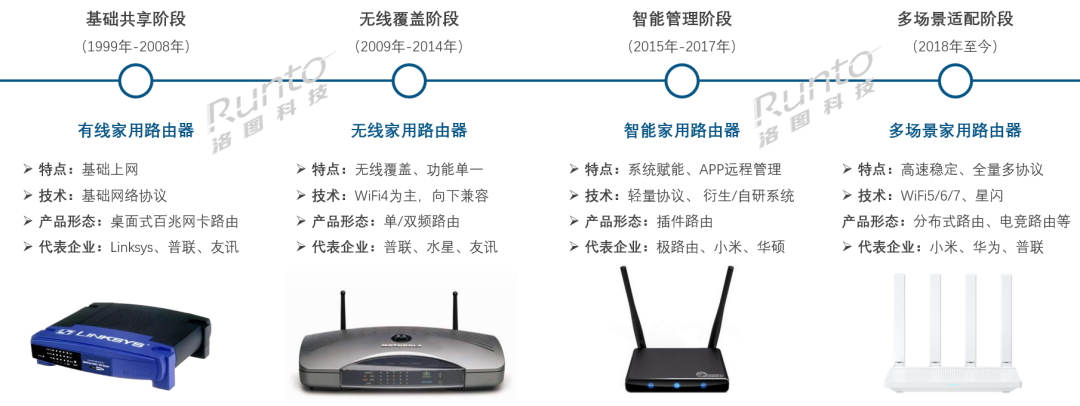 Source: RUNTO
Brand Competition: A Stable Oligopoly Emerges, with Three Camps Offering Distinct Advantages
China's home router market exhibits significant concentration, with an oligopolistic brand structure taking shape. Brands from different camps occupy respective market shares based on their unique advantages.
High Market Concentration, with Leading Brands Dominating
Taking the online market as an example, four major brands—Xiaomi, Huawei, TP-Link, and ZTE—have formed a highly concentrated competitive landscape. According to RUNTO's online data, in 2025, these four brands accounted for a combined sales share of 89.7% on traditional mainstream e-commerce platforms. This fully demonstrates the dominant position of leading brands in the market, posing significant barriers for new entrants.
Sales Share of Top 5 Brands on China's Mainstream E-Commerce Platforms for Routers in 2025
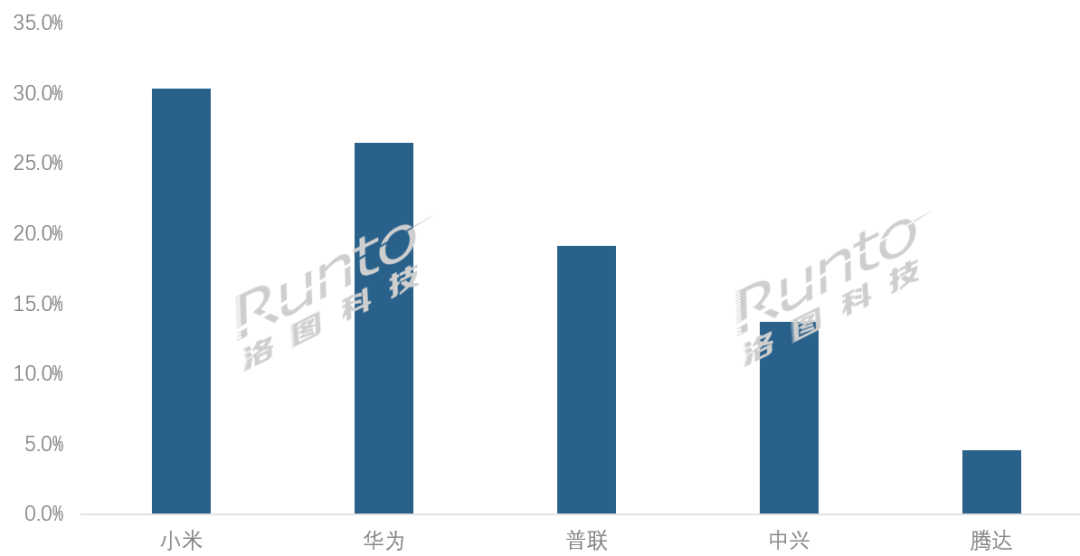
Data Source: RUNTO Traditional Mainstream E-Commerce Data (Unit: %)
Three Clear Camps with Distinct Differentiated Advantages
The current brand landscape in China's home router industry can be clearly divided into three camps, each leveraging different core advantages to compete in the market.
First Camp: Traditional Hardware Brands, Represented by TP-Link. These brands initially focused on the consumer market and, over the years, have built extensive product lines to cater to users with varying price points and needs. They also possess mature and stable supply chain systems, giving them clear advantages in product quality control and cost management. Take TP-Link's Dadao series routers as an example; equipped with new pixel antennas and EasyMesh networking technology, they effectively enhance signal penetration and network stability, further solidifying their market position in the traditional hardware sector.
Second Camp: Technology-Oriented Brands, Represented by Huawei and ZTE. These brands initially focused on the operator or enterprise communication sectors, accumulating deep technological R&D capabilities, and later expanded into the consumer market leveraging their technological strengths.
Huawei: Currently promoting products like the Q7 Lingxiao series, which feature built-in StarFlash gateways and self-developed AI antenna algorithms, supporting simultaneous compatibility with StarFlash, Bluetooth, and WiFi connection protocols. This not only enhances the interconnection efficiency of smart home devices but also expands signal coverage and improves anti-interference capabilities. ZTE: Currently focusing on products like the Xuntian series, which incorporate self-developed 10-core dual-engine chips and Xuntian intelligent five-antenna systems. Through coordinated hardware and software optimization, they significantly enhance signal penetration, network stability, and adaptability to future broadband demands.
Third Camp: Internet Crossover Brands, Represented by Xiaomi. Leveraging its comprehensive IoT ecosystem, Xiaomi has positioned routers as the connection core for home IoT devices. Its current flagship product, the BE6500 Pro, is equipped with a Qualcomm 4-core processor and multi-antenna intelligent networking capabilities. It not only integrates seamlessly with the Mi Home ecosystem but also features IoT priority channel technology, effectively improving multi-device carrying capacity, whole-home signal coverage, and smart device response efficiency.
Industry Summary and Future Outlook
China's home router market has developed distinct core characteristics: (1) Continuous acceleration of technological iteration, from WiFi 4 to WiFi 8, from wired to wireless and then to intelligent, with technological innovation consistently driving product upgrades; (2) Stabilization of the brand competitive landscape, with three camps each excelling in their respective areas and leading brands dominating the market; (3) Prominence of scenario-based and customization trends, with products more closely aligned with user personalized needs; (4) Further enhancement of product intelligence through the integration of AI technology.
For leading brands, in future competition over existing market share, they need to consolidate their core advantages while continuously innovating around user scenario-based demands, deepening the integration of AI technology and products. Simultaneously, they should strengthen ecological collaboration, promoting deeper integration between routers and smart home, e-sports, audio-visual, and other fields, accelerating product iteration speeds to further solidify their leading positions in the market.
-
The RTX 3060 Makes a Comeback Amid a Mix of Old and New Hardware, Making 2026 the Worst Year for the PC Industry
-
![]()
Zhang Yiming Achieves Jack Ma's 'Dream': Douyin Surpasses 1 Billion Monthly Active Users First!
-
The Complete Decline of Fuel-Powered Vehicles! Only One Model in July's Top 10 Sales
-
![]()
What Are the Three World Models in BYD's HyWorldVLA: Pixel-Level, Latent Space, and Hybrid?
-
Raking in 23.7 Billion Yuan in Just Half a Year! Has Foxconn Industrial Internet Turned a New Leaf?
-
Offline Competition Among Big Companies for Customers: The Battle for Desktop Access with Office Agents
-
![]()
Starting at 3199 yuan, the REDMI K100 series has been launched, making me start to worry for the Xiaomi 18
-
![]()
Xiaomi's MiMo Stages a Two-Year Comeback to Top Global Inference Volume Rankings