Learning from WeChat: Musk’s $44 Billion Acquisition and the Quest for a Super App
 04/16 2026
 666
666
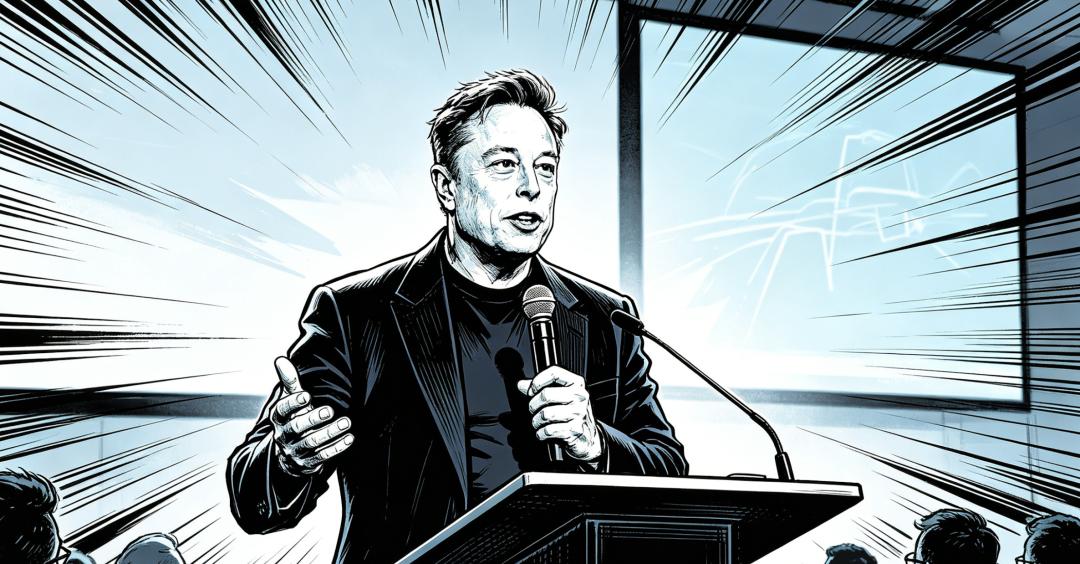
In just two days, Musk’s latest innovation, XChat, will make its official debut on the Apple App Store, opening its doors to users worldwide.
This standalone instant messaging app prioritizes end-to-end encryption, an ad-free experience, and zero user data tracking. It also boasts unique features like screenshot prevention.
Moreover, XChat seamlessly integrates Musk’s xAI’s Grok large language model into its chat interface, enabling users to instantly summon AI for content summarization, file processing, or itinerary planning.
Meanwhile, X’s digital payment system is in its early testing phase.
From Musk’s $44 billion acquisition of Twitter in 2022 and its rebranding as X, to the launch of the AI assistant Grok, the advancement of X Payments, and now the official rollout of XChat, every move aligns with a singular vision: crafting a “WeChat-style” super app ecosystem.
The fusion of “communication + payment” represents the cornerstone of Musk’s super app ambition.
I. Is XChat a Remedial Step for the $44 Billion Acquisition?
In October 2022, Musk acquired Twitter for $44 billion and immediately laid out a grand plan in internal meetings: transforming the social platform into a super app that integrates communication, payments, and lifestyle services.
However, over three years later, the path to realizing this vision has proven far more challenging than anticipated.
A year ago, Musk publicly admitted, “X’s user growth has plateaued, revenue is underwhelming, and the platform is barely breaking even.”
Financially, X’s revenue has nosedived since Musk took the helm. In 2021, Twitter, as an independent publicly traded company, generated $5.1 billion in revenue. By 2024, this figure had plummeted to approximately $2.5 billion, marking a more than 50% decline over three years.
In 2025, X’s revenue saw a slight rebound, reaching about $2.9 billion for the full year—the first year of growth since the acquisition. Even so, it remained 35% below its pre-acquisition peak.
Specifically, X’s advertising revenue accounted for roughly 68% of total revenue in 2025, or approximately $2.26 billion. In contrast, Meta’s advertising revenue surpassed $30 billion during the same period.
The subscription business has also fallen short of Musk’s lofty expectations. Initial investor projections called for 69 million paying users by 2025. In reality, X Premium’s three-tiered paid services had fewer than 2 million global paying users in 2025, generating annual subscription revenue of only about $200 million.
Analysts argue that large-scale freemium conversion hinges on a paid product that offers tangible, recurring value. Clearly, X has yet to deliver such an offering.
More critically, the $12 billion acquisition debt remains a crushing financial burden for X, with high-interest expenses continuously eroding its already thin profits.
The user battlefield is equally challenging. Similarweb data reveals that in the first half of January 2026, Meta’s Threads boasted 143 million daily active users globally on mobile, while X had only 126 million. Threads saw a 37.8% year-over-year increase, while X declined by 11.9%.
On desktop, X still leads with about 150 million daily visits, but this advantage is shrinking. X’s daily active users in the U.S. have nearly halved compared to a year ago.
Against this backdrop, XChat’s standalone release carries significant weight. It suggests that Musk’s “super app” strategy has evolved from “feature stacking” to “ecosystem infrastructure building.” Instead of cramming new features into the main X app, Musk is launching a pure encrypted communication tool first, following WeChat’s blueprint of building on communication to foster strong trust-based relationships before gradually integrating payments, AI, and lifestyle services.
Strategically, this is a targeted “remedial course.”
WeChat’s success trajectory is clear: it leveraged free SMS and voice calls as high-frequency entry points to cultivate acquaintance-based relationship chains, then integrated payments to close the commercial loop, and finally fortified its ecosystem with Mini Programs and later Video Accounts.
Musk clearly recognizes the value of this model. The combination of XChat + X Money is widely viewed as the first serious attempt to replicate WeChat’s formula in Western markets.
II. Can It Become the Next WeChat?
Clear logic does not guarantee seamless execution. WeChat’s ascent benefited from a unique historical window: it emerged during China’s mobile internet transition from feature phones to smartphones, when the competitive landscape for communication tools was still fluid.
XChat, however, faces a far more complex reality today.
First is the fundamental difference in product DNA.
WeChat has always been a pure communication tool, nurturing strong trust-based “acquaintance + semi-acquaintance” relationship chains. When users add WeChat contacts, they willingly open up their private lives. This robust relationship chain serves as the fertile ground for growing payments, Mini Programs, and lifestyle services.
X, in contrast, is essentially a content plaza. Its relationship chains are weak connections between opinion leaders and fans. Users flock to X for views, information, and public discussions, not private life sharing.
Even as a standalone communication app, XChat’s initial user growth will heavily rely on diverting X’s 500 million monthly active users. This means XChat’s early relationship chains will likely remain extensions of X’s social graph—a “weak connection” communication tool.
Thus, the absence of strong acquaintance relationships is the first genetic hurdle XChat faces in replicating WeChat’s path.
Second is the starkly different competitive landscape.
When WeChat rose to prominence, China’s communication market was nearly a blue ocean. Its only serious competitor was QQ, which, like WeChat, was owned by Tencent, creating differentiation and complementarity rather than zero-sum competition.
XChat, however, faces a far crueler reality.
WhatsApp already boasts over 3 billion monthly active users, with a network effect barrier that is nearly unshakable. Telegram offers rich features and a large community, heavily overlapping with XChat in functionality. Signal has built strong trust among privacy-focused users.
In this hyper-saturated communication tool market, XChat’s path to breakthrough will be arduous.
More subtly, XChat is launching first on iOS, with no immediate plans for an Android version. Some analysts believe this may be a deliberate strategy to avoid direct competition with WhatsApp, whose core users are concentrated on Android. Meanwhile, iOS holds a 55% market share in the U.S., where X’s users are also concentrated.
This competitive strategy is clever but also suggests that XChat lacks the confidence to confront WhatsApp head-on.
Finally is the challenge of shifting user mindset.
WeChat’s success owes much to Chinese users’ habit of “one app for everything.” This mindset formed in a unique social context: China’s mobile internet leapfrogged from feature phones to smartphones, rapidly cultivating super app usage habits.
In Western markets, however, users have long embraced a multi-app division of labor. They socialize on X, communicate on WhatsApp, pay on Venmo or CashApp, travel on Uber, and order food on DoorDash—each scenario has its dedicated app. Users have no strong demand for integration and are naturally wary of putting all their eggs in one basket.
This mindset gap means that even if XChat perfectly replicates WeChat’s features, users may not migrate. The cost of changing user habits is far higher than copying product functions.
-
![]()
Proposed to Raise 955 Million Yuan through Private Placement! Huicheng Vacuum Boosts Localization of Ultra-Precision Optical Coating Equipment
-
![]()
Cash Flow Soars 13-Fold! What Major Strategic Move is Wuhan Five Square Optoelectronics Planning?
-
![]()
Leaked Design of vivo X500: Reverts to Circular Camera Module in Top-Left Corner, Pays Homage to Classic X90 Aesthetic
-
![]()
DeepSeek Shows Signs of Foraying into Code Agents, Launches WeChat Official Account Focused on Harness
-
![]()
Auto Companies Deny Claims That ‘Cooperation with Huawei Is Non-Essential’, as Huawei Transforms into a ‘Public Platform’
-
![]()
Starship to Independently 'Return to the Launch Tower': SpaceX's Ambitions Extend Beyond Rocket Building to Dominating Space Transportation
-
![]()
Starship Set to Independently 'Return to the Launch Tower': SpaceX is Revolutionizing Space Transportation, Not Just Building Rockets
-
![]()
Anthropic and OpenAI Face Off Against Deepseek