Douyin E-Commerce’s ‘Dividend Shift’: Identifying the Committed Players, the Testers, and What Financial Reports Unveil
 05/15 2026
 521
521

Douyin e-commerce is quietly undergoing a transformation.
Back in 2020, everyone was buzzing about the “golden opportunity.” Douyin e-commerce’s Gross Merchandise Volume (GMV) soared threefold within a year, and early adopters who dared to invest reaped substantial growth dividends. Fast forward five years, the platform’s monthly active users have surged to nearly 800 million, with shelf-based GMV now contributing nearly half of the total. Users are now proactively searching, comparing prices, and browsing stores, propelling Douyin from a mere traffic distribution hub to a full-fledged consumer operations platform.
This evolution has sparked two contrasting narratives.
On one hand, the sentiment that “profiting on Douyin is becoming increasingly challenging” has gained momentum, prompting many merchants to reevaluate the platform’s business potential. On the other hand, during the 2025 financial reporting season, a cohort of listed companies with significant investments in Douyin delivered stellar performances:
- Maogeping’s online revenue surpassed offline revenue for the first time, securing the top spot in domestic cosmetics during Douyin Mall’s 3·8, 6·18, and Double 11 sales events.
- Lianhua Holdings’ online channel revenue skyrocketed by 109.96% year-on-year, with its soy sauce products consistently topping Douyin’s condiment sales charts.
- Zhangxiaoquan’s net profit attributable to shareholders surged by 119.87% year-on-year, fueled by enhanced live streaming and content operations on Douyin.
- Royomom’s net profit attributable to shareholders reached RMB 194 million, up 84.03% year-on-year, with Douyin channel sales exceeding RMB 1.5 billion, accounting for nearly 45% of total sales.
Why such a stark divergence in experiences on the same platform?
The answer lies in the evolution of Douyin e-commerce’s competitive dynamics. As the platform transitions from a traffic dividend phase to an operational capability phase, success no longer hinges solely on entry timing or ad spend. Merchants must now rethink their product strategies, traffic acquisition, and overall platform approach. The companies that have thrived are those that have transformed Douyin from a mere traffic source into an operational stronghold.
1. From “Traffic Platform” to “Operational Platform”
Around 2020, Douyin was in a high-growth phase, where traffic dividends outweighed operational capabilities.
That year, leveraging its rich short-form video content and algorithmic recommendations, Douyin’s interest-based e-commerce rapidly expanded, with annual GMV exceeding RMB 500 billion, more than tripling year-on-year. For many merchants, early entry meant a chance to swiftly boost sales. As the saying goes, “A pig can fly if it catches the wind.”
But today’s Douyin has undergone a complete transformation.
In September of the previous year, Douyin revealed that its shelf-based GMV grew by 49% year-on-year over the past year, outpacing the platform’s overall GMV growth of 34%. Shelf-based e-commerce now accounts for nearly half of the total.
What does this signify? Users are no longer making impulse purchases while browsing; instead, they are actively searching, comparing prices, reading store reviews, and seeking discounts before making a purchase.
From content consumption to search, live streaming to shelves, and seeding to repurchasing, consumers now complete their entire shopping journey within a single app. The platform has evolved from a traffic distributor to a consumer operations hub.
Consequently, merchants’ operational logic on Douyin has also undergone a change.
Organizationally, relying solely on outsourcing to Multi-Channel Networks (MCNs) is no longer sufficient.
Many listed companies now establish their own Douyin e-commerce teams. For instance, since 2020, Royomom has accelerated its Douyin布局 (strategic deployment), establishing a 300+ member content team, over 30 self-operated live streaming studios, and signing more than 200 influencers. This essentially internalizes the capability to consistently produce content that drives sales.
In 2025, Royomom’s Douyin channel sales reached RMB 1.538 billion, accounting for 44.9% of total sales. Total revenue hit RMB 3.432 billion, up 94.35% year-on-year, with net profit attributable to shareholders reaching RMB 194 million, up 84.03% year-on-year.
Product strategy is also evolving.
In the past, merchants entering Douyin would often flood their live streaming studios with hundreds of Stock Keeping Units (SKUs) from their offline inventory. Shanghai Jahwa took a contrasting approach, focusing resources on a single product—“Big White Clay”—and promoting it through influencer channels. This strategy generated over RMB 200 million in annual GMV for the product.
Moreover, a hit product boosted the entire store’s traffic and drove sales of other products. In 2025, Shanghai Jahwa’s revenue reached RMB 6.317 billion, up 11.25% year-on-year, with net profit attributable to shareholders at RMB 268 million.
Content strategies have shifted from hard selling to brand building.
Marubi Biology’s custom short drama *Invisible Lover* avoided direct product promotion, instead building emotional connections through storytelling to drive high conversion rates in live streaming. This “content as business” logic ensures transactions occur after users identify with the brand. In 2025, Marubi Biology’s net profit attributable to shareholders reached RMB 247 million.
Markets once questioned whether Douyin was “all hype and no profit.” However, the 2025 financial reports of listed companies with significant investments in Douyin provide a resounding rebuttal with hard data.
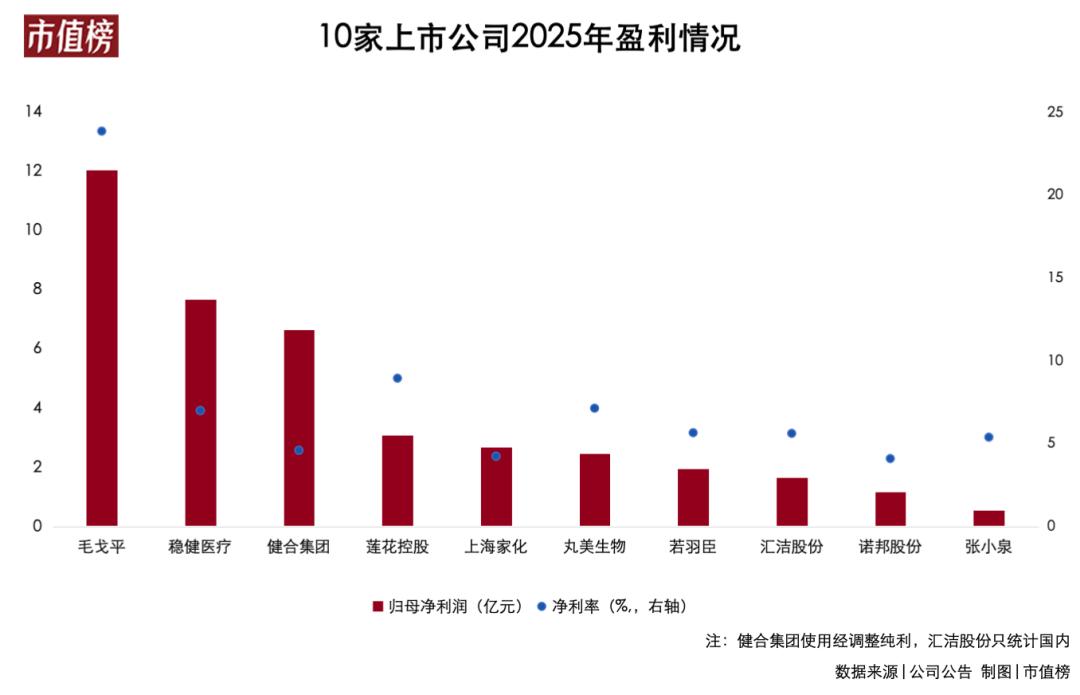
Whether it’s Lianhua Holdings, whose online channel revenue doubled, Maogeping, whose online revenue surpassed offline for the first time, or Zhangxiaoquan, which doubled its net profit, these giants spanning beauty, food, household goods, and apparel share a common trait: they no longer view Douyin as merely a supplementary traffic source but as an independent, long-term operational channel worth saturating with investment.
This strategic shift enabled these companies to maintain profitability and unlock a second growth curve in 2025, even as traffic dividends faded.
2. Why Have Time-Honored Brands Outperformed?
Among the 10 listed companies, one detail stands out: the highest profit growth came from two time-honored brands. Lianhua Holdings, a soy sauce producer, saw net profit grow 52.59% year-on-year, while Zhangxiaoquan, a kitchen knife maker, achieved 119.87% year-on-year growth.
This outcome defies conventional wisdom. Time-honored brands are often perceived as slow to adapt, burdened by aging brands and rigid channels. How did they thrive on Douyin?
To understand, we must examine their strategies.
Lianhua Holdings offers dozens of product categories and hundreds of SKUs, including monosodium glutamate, soy sauce, and cooking wine. While monosodium glutamate is its flagship product, it focused on promoting soy sauce—a single, visually compelling product—on Douyin.
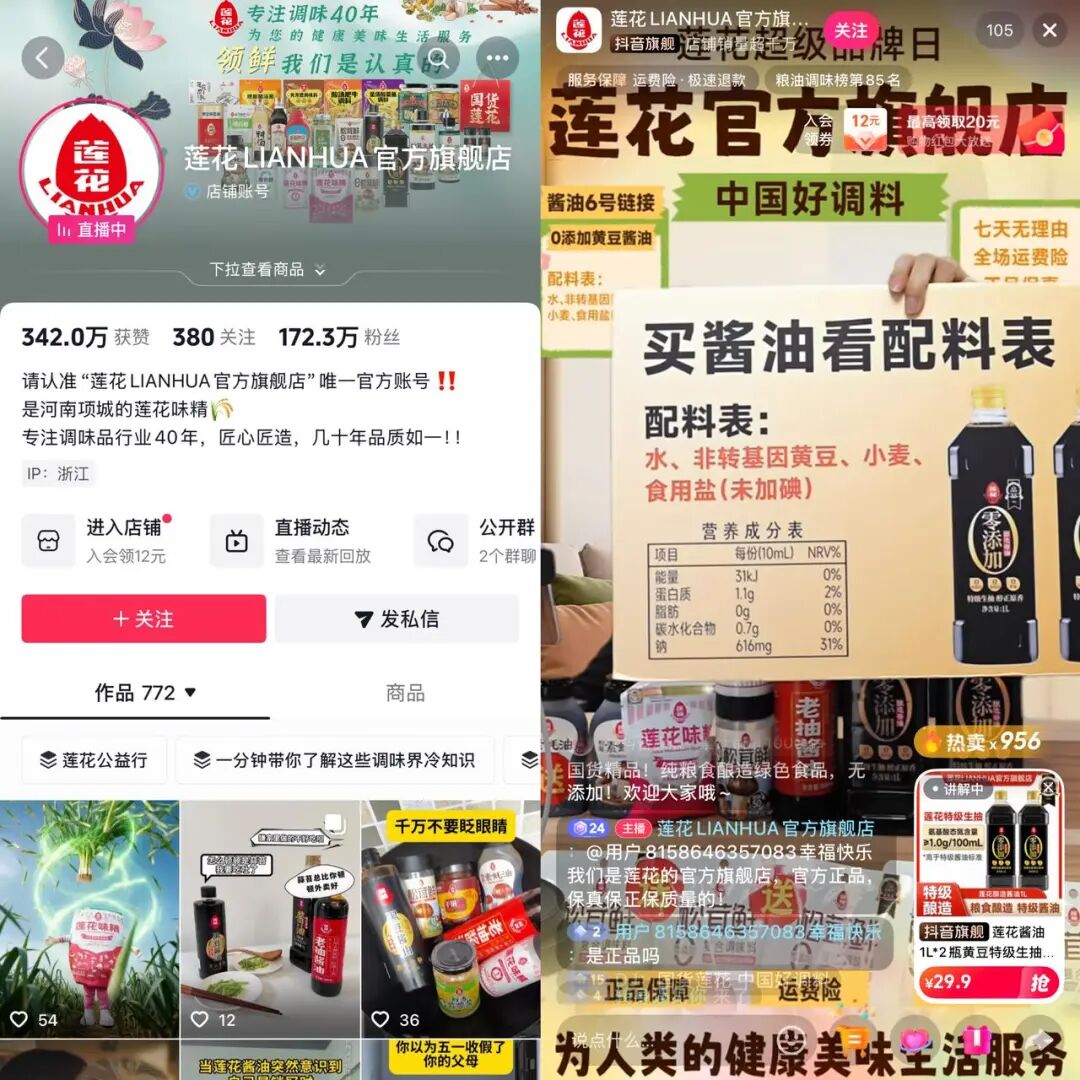
Why soy sauce? Its visual appeal—a few drops instantly brighten a dish’s color—makes it ideal for 15-second videos that convert viewers from “this looks good” to “I’ll buy it.”
Lianhua’s soy sauce products repeatedly topped Douyin’s condiment sales charts. Users came for soy sauce but often bought other products like mushroom seasoning, cooking wine, and monosodium glutamate, demonstrating how a hit product can drive store-wide sales. This isn’t about selling whatever is popular but redefining product strategy through Douyin’s content logic.
Zhangxiaoquan took a different approach but shared the same underlying logic. Kitchen knives are durable goods with high price points, long repurchase cycles, and rational decision-making. Relying solely on influencers shouting “this is great!” or self-operated live streaming wasn’t enough.
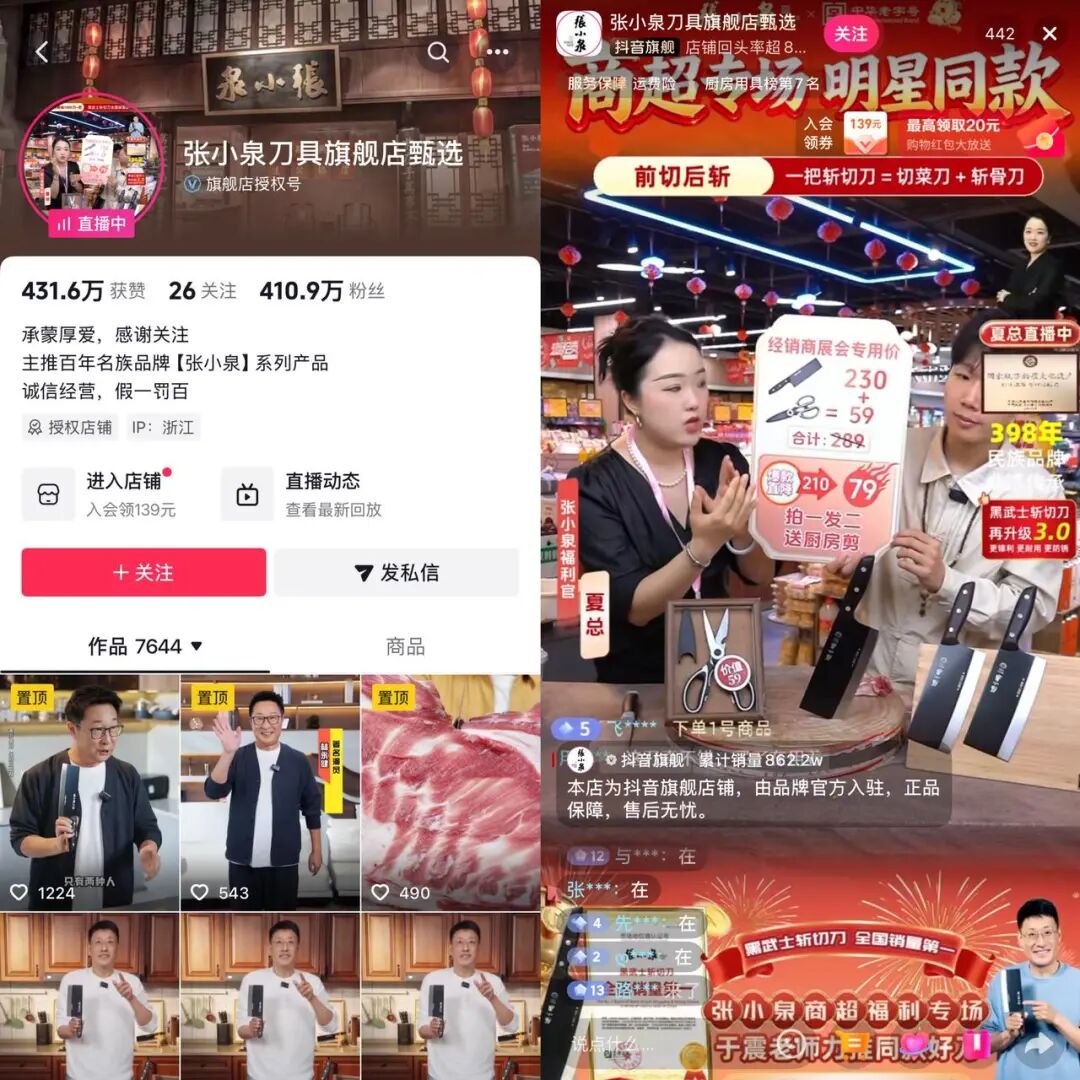
Zhangxiaoquan’s solution was a dual-track model combining influencer distribution and branded self-broadcasting. Influencers in home and cooking niches used Zhangxiaoquan knives to slice tomatoes and chop bones, showcasing the products’ performance in seconds. Meanwhile, the brand’s live streaming studio provided professional explanations of steel materials, usage differences, and after-sales care, creating a seamless path from seeding to conversion. These two tracks worked in tandem, turning Douyin into a sustainable growth channel.
Strategy is just the surface; the deeper shift was redefining themselves through content.
Time-honored brands entering Douyin often make the mistake of flaunting their history as a burden. Lianhua and Zhangxiaoquan avoided this.
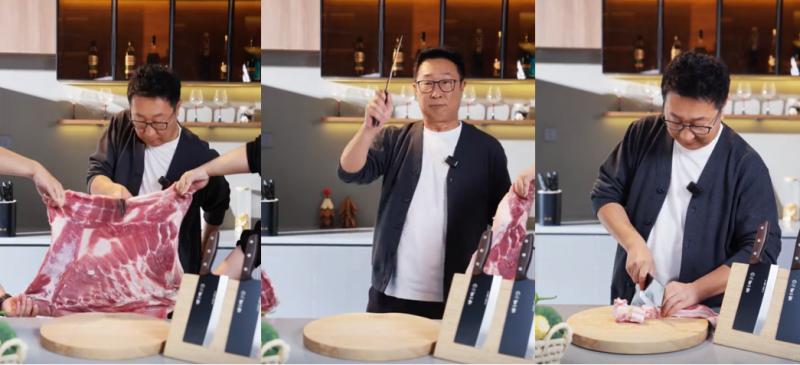
Zhangxiaoquan’s *Kitchen Essentials Explained* series popularized science-based (here, “explained” is kept for clarity) red kitchen tools like red scissors, Damascus steel knives, and bone-chopping knives, framing product sales as kitchen lifestyle education. Later, collaborations with actors Lin Yongjian and Liu Mintao demonstrated products in real-life scenarios, making content itself a precursor to transactions.
Lianhua’s logic was similar. Its soy sauce products dominated Douyin’s condiment sales charts not through price cuts but by consistently materializing its image as a healthy, trustworthy time-honored brand through content.
Both companies rebuilt relationships with consumers through content rather than using Douyin as a discount sales channel.
Traditionally, time-honored brands defined themselves through centuries-old craftsmanship and generational heritage—narratives that lack resonance in the short-video era. On Douyin, they replaced “what we are” with “what value we offer you,” turning their “age” from a historical burden into a quality credential repeatedly validated through content. This is their fundamental divergence from traffic-focused players, who rely on short-term conversions. These brands used content as fertile ground to regrow themselves on Douyin.
3. What Can Ordinary Merchants Learn?
The financial reports of these listed companies offer ordinary merchants a new operational blueprint.
In recent years, many merchants entering Douyin have prioritized traffic acquisition, Return on Investment (ROI) optimization, and boosting live streaming metrics. However, the companies that have truly achieved profitability suggest that Douyin e-commerce requires rethinking products, traffic, and the platform itself before focusing on ad spend.
First, rethink products.
In traditional e-commerce, merchants define products based on functionality, price, margins, and supply chain capabilities. On Douyin, products must first be “shareable content.”
Lianhua and Zhangxiaoquan redesigned how their products appear on camera.
Why does soy sauce sell well on Douyin? Its color and kitchen usage are naturally suited to short videos. Why do knives convert quickly? Users can instantly grasp their sharpness and durability.
These cases offer ordinary merchants a crucial insight: before launching on Douyin, film your product with a smartphone. Can it help a stranger go from “what is this?” to “I need this?” in 15 seconds? This often matters more than ad spend.
Second, rethink traffic.
Many merchants once viewed traffic itself as a core competitive edge. However, brands now realize traffic amplifies content but doesn’t generate it. If content lacks memorability, professionalism, or personality, even high traffic rarely translates to sustainable business.
This is why brands increasingly emphasize professionalization and Intellectual Property (IP) development.
Maogeping uses its founder’s IP to teach makeup techniques, Zhangxiaoquan builds expertise through kitchen content, and Marubi reinforces brand personality via short dramas and “CEO IPs.” These strategies create content moats that withstand algorithmic changes.
Once users perceive a brand as more professional or trustworthy, it generates long-term returns.
Most importantly, merchants must rethink Douyin itself—a point often overlooked.
Many brands approach Douyin tentatively, starting with a small team and scaling only if successful. However, thriving companies typically invest heavily from the outset.
Zhangxiaoquan’s financial report explicitly states, “We increased live streaming and content operations on emerging e-commerce channels like Douyin, concentrating resources on key products.” Lianhua Holdings also mentioned in its report sustained expansion on interest-based platforms like Douyin.
To some extent, commitment itself is a competitive advantage.
As the platform matures, a trial-and-error approach rarely yields results. Investment intensity shapes organizational capabilities, which ultimately determine operational efficiency.
The deeper shift is that companies now redefine Douyin from a traffic channel to an operational base.
For years, industry discussions about Douyin centered on traffic. Today, the critical questions are: Who excels at content creation? User operations? Building long-term brand relationships?
-
![]()
Proposed to Raise 955 Million Yuan through Private Placement! Huicheng Vacuum Boosts Localization of Ultra-Precision Optical Coating Equipment
-
![]()
Cash Flow Soars 13-Fold! What Major Strategic Move is Wuhan Five Square Optoelectronics Planning?
-
![]()
Leaked Design of vivo X500: Reverts to Circular Camera Module in Top-Left Corner, Pays Homage to Classic X90 Aesthetic
-
![]()
DeepSeek Shows Signs of Foraying into Code Agents, Launches WeChat Official Account Focused on Harness
-
![]()
Auto Companies Deny Claims That ‘Cooperation with Huawei Is Non-Essential’, as Huawei Transforms into a ‘Public Platform’
-
![]()
Starship to Independently 'Return to the Launch Tower': SpaceX's Ambitions Extend Beyond Rocket Building to Dominating Space Transportation
-
![]()
Starship Set to Independently 'Return to the Launch Tower': SpaceX is Revolutionizing Space Transportation, Not Just Building Rockets
-
![]()
Anthropic and OpenAI Face Off Against Deepseek