Rebuilding a Pinduoduo in Three Years: Temu Encounters Overseas Regulatory Challenges
 05/18 2026
 650
650
Author/Qingfu
Editor/Jiajia
Recently, Temu has been slapped with a multi-million-dollar fine in Europe:
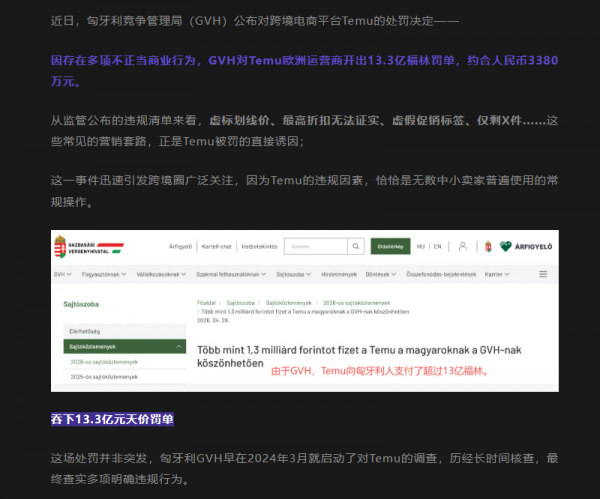
The Hungarian Competition Authority has determined that Temu engaged in multiple unfair business practices that misled consumers in the Hungarian market, resulting in a total penalty exceeding RMB 28.4 million. In response, Temu acknowledged the violations, waived its right to appeal, and pledged to implement a comprehensive consumer protection compliance program.
In reality, this is merely a snapshot of the penalties Temu has faced from overseas regulatory bodies. Since the latter half of 2025, Temu has been subjected to numerous investigations and penalties in markets such as the EU, South Korea, and the United States, all centered around one issue: Temu's deceptive promotional tactics.
Indeed, a retrospective look at Temu's development history reveals that low product prices, coupled with the creation of a consumer perception of affordability, have been pivotal in Temu's ascent. This strategy has enabled overseas consumers to swiftly associate Temu with cost-effectiveness and value.
However, as its scale has expanded, the potent tool of "creating a perception of low prices" has started to backfire on Temu.
[1] Regulatory Crisis Amidst Rapid Growth
"Over the past few years, Temu has achieved remarkable scale at a pace that has even surprised Pinduoduo... I believe that within the next three years, there will be an opportunity to replicate another Pinduoduo," Zhao Jiazhen, Co-Chairman of Pinduoduo, confidently stated at the annual shareholder meeting in late December 2025. He believed that with the aid of overseas markets, Pinduoduo was experiencing a second wave of growth.
Zhao's confidence was not unfounded:
In terms of user scale and transaction volume, by October 2025, Temu's global downloads had surpassed 1.2 billion, with overseas monthly active users nearing 550 million, approximately 70% of Amazon's. In 2025, Temu accounted for 24% of the total annual parcel volume, tying with Amazon for the top spot;
In terms of market share, Temu's business spanned 97 countries worldwide. It ranked second in cross-border fashion e-commerce in markets such as Europe, Brazil, and Japan; in the U.S. market, with a transaction volume of $22 billion, Temu surpassed TikTok Shop and Walmart, ranking third after only Amazon and eBay.
 (Source: Xinhua News Agency)
More significantly, considering the timeline—Temu was launched in September 2022—it means that in less than four years, Temu has evolved into an e-commerce behemoth capable of rivaling Amazon.
While forging ahead and looking to the future, Temu is also grappling with an overseas regulatory crisis:
In the European market, in addition to Hungary, Poland fined Temu €1 million in January for "failing to display the lowest price within 30 days and exaggerating discounts." The EU is also investigating Temu under the Digital Services Act (DSA) for issues such as illegal goods and addictive design. If found guilty, the EU could impose a fine of up to 6% of Temu's global annual revenue;
In the East Asian market, South Korea's antitrust agency and personal information protection agency fined Temu ₩357 million and ₩1.4 billion in May and June 2025, respectively, for "violating the Fair Advertising Management Act" and the "Personal Information Protection Act";
In North America, in March 2026, Temu faced a class-action lawsuit alleging that it significantly inflated prices under the guise of tariffs, suspected of charging consumers a "tariff premium";
Why has Temu, which has performed exceptionally well, suddenly faced investigations from overseas regulatory agencies in the latter half of 2025? Through research, Siku Finance discovered that investigations by countries such as South Korea and Hungary all point to one issue: Temu's practice of misleading consumers through low-price promotions.
[2] Repercussions from the Low-Price Perception
Why has Temu become an e-commerce giant on par with Amazon in just three to four years?
Some attribute Temu's success to the overflow of China's manufacturing capabilities, while others credit Pinduoduo's replication of domestic social fission tactics abroad. However, for consumers who vote with their wallets, the primary reason is low prices, which manifest in two ways:
One is "low prices" in terms of data. It is understood that product prices in the same category on Amazon are one-third to even double those on Temu. This discrepancy is primarily due to the differing operational logics of the two platforms.
According to a research report by Zheshang Securities, Amazon's recommendation algorithm emphasizes product display rather than "low price priority." Temu, on the other hand, employs a "bidding system," where weekly bidding occurs for the same products. If multiple sellers offer the same product, the platform selects the lowest-priced option.
The difference in recommendation algorithms compels merchants on Temu to compete on price for traffic. A report by DT Business Insight mentioned that a product costing $20 would sell for over $30 on Amazon, but on Temu, it could only sell for just over $20, with thin profit margins.
Research data from Guosen Securities also underscores this disparity: In core categories such as sports and outdoors, digital electronics, and home furnishings, the average price of fully managed products on Temu is only 58% of Amazon's, while semi-managed products are 66% of Amazon's.
The other is the "low price" perception created by Temu, which is also the main reason for its overseas lawsuits.
Compared to Amazon's relatively clean e-commerce page, Temu appears cluttered, dominated by various limited-time promotional messages, such as low inventory alerts like "Only 3 left," countdown timers like "Limited-time offer, only 2 hours left," behavioral prompts like "xx people are browsing, xx people have purchased," and the use of crossed-out price tags to create an impression of price reductions...
 (Source: Cross-Border E-Commerce Headlines)
While these promotional activities are considered commonplace in China, they face issues such as information distortion and misleading consumer purchases abroad.
For instance, in the Hungarian Competition Authority's decision to fine Temu RMB 28.4 million, it directly stated that Temu advertised large discounts like "95% off" but marked products as promotional when there were no actual discounts; promotional countdowns and loss alerts were used to create psychological pressure on consumers to make purchases...
The EU's investigation into whether Temu violates the Digital Services Act also focuses on whether Temu employs addictive design.
This raises the question: Why would Temu take such risks when it has already established a brand image of "low prices and great value" overseas?
[3] Urgent Need for Transformation from Low-Price Competition
"Many Chinese-made products are of high quality and reasonable prices, making them competitive in the international market. Why not leverage our strengths and go global together?" Whenever recalling why Temu was launched, with the U.S. as its first stop, Zhao Jiazhen always proudly states his belief in the hardcore strength of Chinese manufacturing—high-quality products at low prices.
Indeed, relying on Temu's price competition mechanism and its "low-price promotion perception" among consumers, Temu has achieved a remarkable feat in China's internet companies going global over the past four years—it took only 15 months for Temu to reach $10 billion in transaction volume, while TikTok took 24 months, Shopee took 36 months, and SHEIN took 96 months to achieve the same milestone.
However, for Temu, the perception created by low prices and low-price marketing is now backfiring on this rapidly rising industry giant, not only through investigations and penalties from overseas regulatory agencies but also affecting the platform, merchants, and consumers.
At the platform level, over-reliance on the "bidding system" and limited-time promotional strategies has made Temu's business model increasingly fragile. In 2025, with the U.S. canceling tax exemptions for parcels under $800, making direct air shipping unviable, Temu's website traffic plummeted by 55% in April; the EU's €150 tax exemption policy will also end in July 2026, which will be another major blow to Temu.
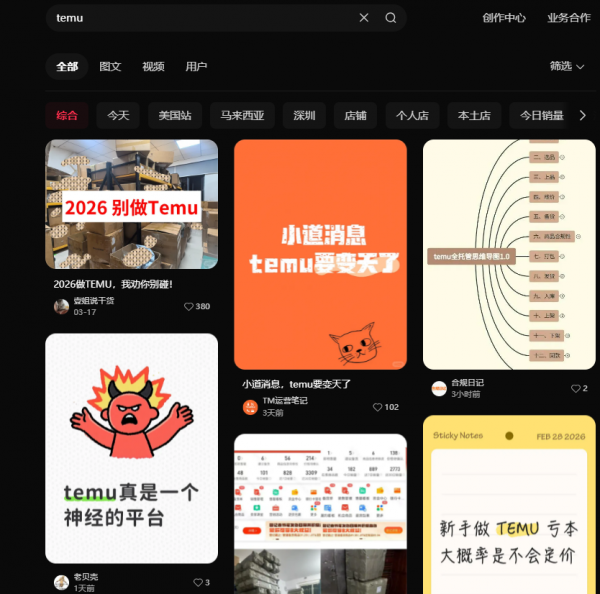
At the merchant level, Temu's bidding system is far from friendly to many sellers looking to open shops, as it forces them into a price comparison race. Some users on Xiaohongshu have stated that Temu is not profitable, and the only sellers who can make money are those with their own factories who can compensate for low unit profits through global sales volume.
 (Source: Xiaohongshu)
However, for domestic factories aiming to build brands, pursue design, and innovate, Temu's low-price model is not the optimal solution for their operations.
In other words, while Temu has swiftly opened up overseas markets with its "low-price perception" strategy, it has also sown the seeds of compliance risks, merchant dissatisfaction, and eroded consumer trust.
To truly become a global e-commerce giant, Temu may need to shift from "creating low prices" to "creating value"—finding a healthier and more sustainable growth logic beyond just pricing.
From rapid expansion to frequent penalties, Temu's overseas journey now stands at a critical juncture. There is no denying that it has reshaped the global e-commerce landscape in just four years through extreme low prices and precise marketing, bringing "Made in China" into the lives of millions of overseas consumers in a novel way. However, the flip side of the coin is that its over-reliance on "creating a perception of low prices" is triggering a triple backlash from regulators, merchants, and consumers.
For Temu and Chinese manufacturing, a transformation is imperative—from "competing on price" to "competing on value," from "attracting attention" to "retaining hearts." Only in this way can Temu, Chinese factory sellers, and Chinese manufacturing embark on a track of healthy and sustainable growth.
END
-
![]()
Proposed to Raise 955 Million Yuan through Private Placement! Huicheng Vacuum Boosts Localization of Ultra-Precision Optical Coating Equipment
-
![]()
Cash Flow Soars 13-Fold! What Major Strategic Move is Wuhan Five Square Optoelectronics Planning?
-
![]()
Leaked Design of vivo X500: Reverts to Circular Camera Module in Top-Left Corner, Pays Homage to Classic X90 Aesthetic
-
![]()
DeepSeek Shows Signs of Foraying into Code Agents, Launches WeChat Official Account Focused on Harness
-
![]()
Auto Companies Deny Claims That ‘Cooperation with Huawei Is Non-Essential’, as Huawei Transforms into a ‘Public Platform’
-
![]()
Starship to Independently 'Return to the Launch Tower': SpaceX's Ambitions Extend Beyond Rocket Building to Dominating Space Transportation
-
![]()
Starship Set to Independently 'Return to the Launch Tower': SpaceX is Revolutionizing Space Transportation, Not Just Building Rockets
-
![]()
Anthropic and OpenAI Face Off Against Deepseek