Monthly Double Building Purchases for 3.8 Billion: Is Duan Yongping Still in Sync with Pinduoduo?
 07/13 2026
 421
421
With Capability Comes Acquisition: We'll Buy You a Whole Street
Is Pinduoduo Covertly Making Significant Moves?
On July 9, Cailian Press reported that Pinduoduo had acquired the entire DBS Bank Tower in Shanghai's Lujiazui area for approximately 3.3 billion yuan, utilizing self-financed funds. This 19-story, Grade A office building, boasting a gross floor area of around 46,000 square meters, is nestled among foreign banks, law firms, and major international institutions, providing a fertile ecosystem for Pinduoduo's overseas business expansion.
This marks Pinduoduo's second major building purchase within a month. In June, the company invested 500 million yuan to acquire a 12-story office building in Xiong'an New Area's Power Construction Zhihui City. Together, these transactions amount to approximately 3.8 billion yuan, all paid for with self-financed funds. As of the end of the first quarter of 2026, Pinduoduo's cash, cash equivalents, and short-term investments totaled 436.1 billion yuan, with the 3.8 billion yuan building purchases representing less than 1% of its reserves.
An e-commerce company known for its 11-year history of 'asset-light, full-leasing' operations has suddenly embarked on two major property acquisitions within a month, signaling significant upcoming strategic moves.
Earlier in May, renowned investor Duan Yongping increased his stake in Pinduoduo from 7.48% to 10.09% in the first quarter of 2026, purchasing an additional 8.2116 million shares with a market value of approximately 2.018 billion USD.
When queried by netizens about whether Pinduoduo's valuation was severely underestimated, Duan Yongping responded succinctly on Snowball: 'Does my opinion really matter?'
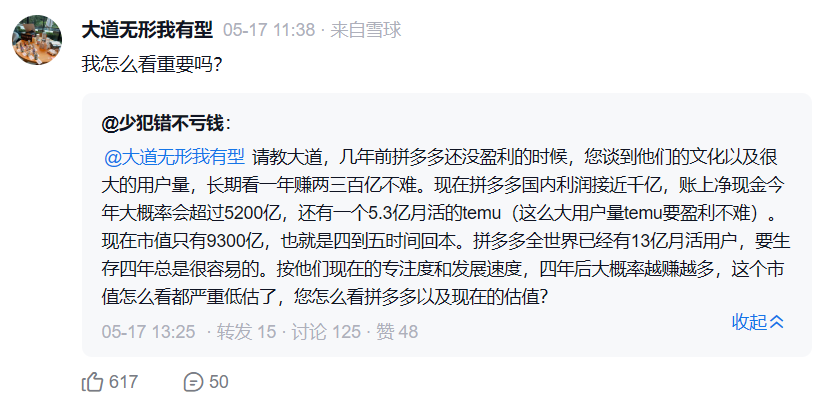
A 'heavy-ifying' Pinduoduo and a 'buying-more-as-it-drops' Duan Yongping—these two narratives converged in mid-2026. Understanding where the 3.8 billion yuan was invested may unveil the hidden judgment in Duan Yongping's rhetorical question.
01
Front Office in Pudong, Back Office in Xiong'an
Pinduoduo's association with the DBS Bank Tower predates the acquisition announcement.
In November 2025, Pinduoduo's Temu merchant recruitment and logistics teams had already moved into the building under a leasing arrangement. Four months later, on February 3, 2026, Pinduoduo officially registered 'Shanghai Xinpinmu Pudong E-commerce Co., Ltd.' in Pudong with a registered capital of 5 billion yuan, located on the 5th floor of the DBS Bank Tower at 1318 Lujiazui Ring Road.
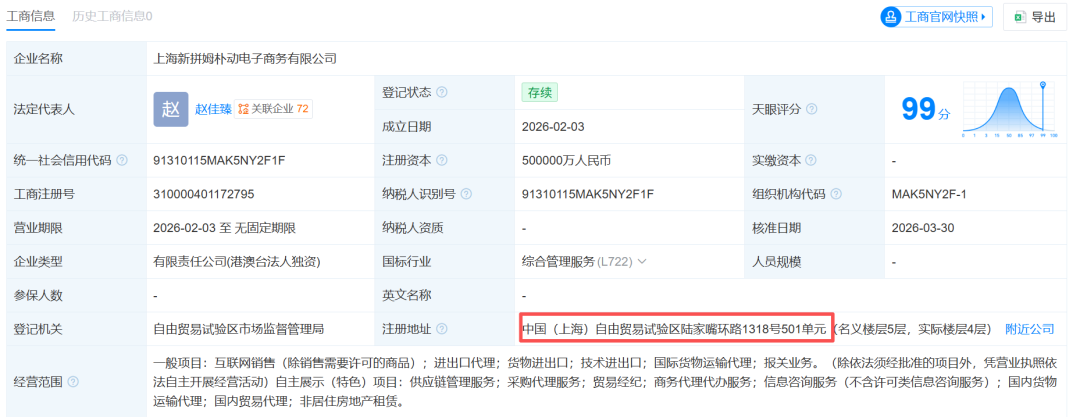
This new entity is no ordinary business. On March 25, 2026, Pinduoduo officially unveiled 'Xinpinmu' while releasing its 2025 financial report—a global self-operated brand platform integrating Pinduoduo and Temu's supply chain resources. With an initial cash injection of 15 billion yuan and plans to invest 100 billion yuan over the next three years, it aims to comprehensively cover domestic industrial belts, cultivate self-operated brands, and launch a full-chain solution for brand internationalization.
The two 'Xinpinmu' specialized companies—Shanghai Xinpinmu Hongqiao (with a registered capital of 10 billion yuan, located in Changning) and Shanghai Xinpinmu Pudong (with a registered capital of 5 billion yuan, located in Pudong)—are both legally represented by Zhao Jiazhen, co-founder of Pinduoduo.
In essence, before officially purchasing the building, Pinduoduo had already established the core strategic business—the global operations entity of Xinpinmu—in the DBS Bank Tower.
In May 2026, Pinduoduo officially set up Pinduoduo Information Technology Services (Xiong'an) Co., Ltd., with an initial cash injection of 500 million yuan, focusing on big data processing, digital operations and maintenance, cloud platform services, and other businesses. By June 30, the Xiong'an company had already employed over 600 people. On June 21, Pinduoduo signed an agreement with Power Construction Corporation of China to purchase a 12-story office building in its entirety.
The sequence of 'people arrive first, building purchased later' defies the past expansion logic of internet companies, which typically involved 'securing land first, then filling it with people.' Pinduoduo is not acquiring idle office space but securing physical carriers for already operational business units.
This reflects the rapid expansion of Pinduoduo's business volume. Since its launch in 2022, Temu's business has expanded to over 90 countries worldwide. In the first quarter of 2026, Pinduoduo's transaction service revenue reached 56.3 billion yuan, a 20% year-over-year increase, surpassing online marketing revenue for the first time to become the largest revenue source.
The functions of cross-border business compliance, settlement, merchant recruitment, and logistics have become increasingly complex, and the demand for centralized physical space can no longer be met by scattered leasing.
Lujiazui gathers the Chinese headquarters of nearly all foreign banks, leading cross-border law firms, and international payment and settlement platforms. For Temu and Xinpinmu, which are accelerating global expansion, a wide range of core external collaborations—from cross-border fund settlements to overseas compliance filings, from international business negotiations to supply chain finance connections—can be completed within the Lujiazui area.
The layout in Xiong'an follows a different rationale. The Xiong'an company does not engage in e-commerce transactions but focuses on big data processing, cloud platforms, digital operations and maintenance, platform compliance reviews, and technology outsourcing services. This represents a future-oriented technological advantage. In the current era where AI is reshaping the underlying logic of e-commerce, data processing and algorithmic capabilities are becoming core variables in platform competition.
As a national pilot zone for innovative development of the digital economy, Xiong'an's policy dividends and industrial clustering effects provide Pinduoduo's technological middle platform with strategic depth distinct from that of Shanghai.
The two building purchases—one pointing to the expansion of global front-end business and the other to the accumulation of digital back-end capabilities—represent the acquisition of two strategic pivot points for 3.8 billion yuan.
02
Opening Pandora's Box Amidst Uncertainty
Pinduoduo boasts over 400 billion yuan in cash and short-term investments. The 3.8 billion yuan spent on building purchases is merely a drop in the bucket. Therefore, the more pertinent question than 'can it afford to spend' is 'why now?'
Since its inception, Pinduoduo has been renowned for its 'asset-light' model. Its main offices in Jin Hongqiao International Center, Yifeng Center, Crystal Plaza Hongqiao, and other properties were all leased. As of the third quarter of 2025, fixed assets accounted for less than 5% of Pinduoduo's total assets.
The shift from 'leasing' to 'purchasing' is often interpreted as a judgment on asset appreciation or a consideration of rental costs. However, for Pinduoduo, a more plausible explanation might be that when business scale reaches a certain point, the management costs and coordination inefficiencies brought about by scattered leasing exceed the capital occupation costs of owning the property.
Temu's global merchant recruitment, logistics, and compliance teams, Xinpinmu's brand incubation and supply chain management teams, and Pinduoduo's main site's technology and operations middle platform—these business units were previously scattered across multiple leased sites, and the physical separation itself represented a loss of efficiency.
The entirely self-owned DBS Bank Tower is likely to become the core office space for Temu's global operations and Xinpinmu's global self-operated brands, centrally hosting functions such as cross-border supply chain, overseas compliance, international finance and taxation, cross-border payments, and global brand merchant recruitment.
The entire office building in Xiong'an hosts the technology middle platform and digital operations and maintenance functions. The two buildings, with two distinct functions, in two cities, adhere to a single logic—using the centralization of physical space to offset the fragmentation caused by business expansion. Building purchases are not investment behaviors but natural extensions of business operations.
Shifting our gaze beyond Pinduoduo to the broader landscape:
In the first half of 2026, the transaction volume of large-scale assets in Shanghai increased by 47% year-over-year, with eight transactions exceeding 1 billion yuan. Tech companies such as ByteDance and JD.com have successively acquired land to build headquarters campuses. The collective 'land and building purchases' by tech companies are becoming a prominent trend in the 2026 commercial real estate market, with Pinduoduo serving as a quintessential example of this wave.
This wave of 'building purchase fever' reflects the broader transition of Chinese internet companies from 'traffic-driven' to 'efficiency-driven' models.
Over the past decade, the core assets of internet companies have been users, data, and algorithms—intangible assets that do not require physical carriers. However, when a company's business penetrates from online to offline supply chains, extends from domestic to global compliance, and delves from a platform model into brand self-operation, physical space is no longer a cost burden but an efficiency tool.
When Duan Yongping significantly increased his stake in Pinduoduo in the first quarter of 2026, it coincided with a period when Pinduoduo's stock price was under pressure, and market opinions were divided on its growth prospects. Pinduoduo's first-quarter report showed revenue of 106.2 billion yuan, a year-over-year increase of 11%; net profit attributable to ordinary shareholders was 12.5 billion yuan, a year-over-year decrease of 15%. The profit decline was mainly due to continued investments in the '100 Billion Support Plan' and supply chain reinforcement.
He liquidated his position in Alibaba but increased his stake in Pinduoduo, an action that itself reflects his judgment on the long-term competitiveness of the two e-commerce companies.
Pinduoduo spent 3.8 billion yuan on building purchases in a month, while Duan Yongping spent 2 billion USD to increase his stake in a quarter. These two actions reflect the same judgment: the company is transitioning from 'light' to 'heavy,' and this 'heaviness' is precisely the infrastructure for the next stage of growth.
Duan Yongping also commented on 'Xinpinmu' on Snowball, saying, 'This is Costco. It might be quite formidable in ten years.' Comparing Pinduoduo's brand self-operation business to Costco's private brand Kirkland, this analogy points not to current scale but to the long-term value of supply chain integration capabilities and brand premium.
Of course, the asset-heavy model also entails new risks. Real estate is far less liquid than cash, and the cyclical fluctuations in asset prices will be directly reflected on the balance sheet. Whether the 100 billion yuan investment in Xinpinmu can successfully incubate competitive self-operated brands and whether Temu's global expansion can continue amid increasingly complex international regulatory environments remain uncertain.
But at least for now, Pinduoduo is using its self-financed funds, at the cost of less than 1% of its cash reserves, to purchase two physical anchors for its globalization strategy and technological middle platform strategy. Meanwhile, Duan Yongping, in his usual manner, has silently increased his stake and maintained a low profile, offering his response.
'Does my opinion really matter?' This statement might imply: Whether I am optimistic or not, you can already see it from my position.
- END -
-
![]()
Even Li Auto Is Facing Challenges. Can Xiaomi Make a Mark in the Extended-Range Hybrid Vehicle Market?
-
![]()
Surplus Capacity Leasing vs. Aggressive Expansion: Is Meta's 'Dual Strategy' a Deliberate Move?
-
![]()
German Business Leaders Contemplate 'Embracing the 996 Culture,' While Chinese Auto Workers Simply Aspire to Clock Out On Time
-
Graduating with a Violin Serenade in a Luobo Kuaipao, Enjoying Yunba Rides, and Watching Football with Milu: Shenzhen's Seamless Integration of Driverless Cars into Daily Life
-
![]()
Shenzhen Unveils 331 Nighttime Autonomous Vehicle Routes in Three Months: Even Logistics Embrace Off-Peak Operations in the Vibrant City
-
![]()
Why Did the Lingguang App Lose Its Competitive Edge? A Strong Hand Played Poorly
-
![]()
Monthly Double Building Purchases for 3.8 Billion: Is Duan Yongping Still in Sync with Pinduoduo?
-
![]()
Tesla FSD’s China Debut: How Orbbec’s ‘AI Eyes’ Are Revolutionizing Intelligent Driving and Robotics