German Business Leaders Contemplate 'Embracing the 996 Culture,' While Chinese Auto Workers Simply Aspire to Clock Out On Time
 07/13 2026
 370
370

Lead
Introduction
Two contrasting desires highlight the vastly different workplace challenges faced by the Chinese and German automotive industries.
Once a global standard-bearer for manufacturing efficiency, German automotive firms are now struggling amidst plummeting sales and profits. With no external avenues to alleviate pressure, German automakers are experiencing internal turmoil, which has finally surfaced among frontline automotive workers.
Recently, a surge of news has emerged detailing German automakers' implementation of layoffs, salary reductions, extended working hours, and the subsequent resistance from workers and unions.
Previously, rumors circulated that Volkswagen planned to extend layoffs to 100,000 employees while shutting down four German factories. BMW was reported to be planning a 5% reduction in its global workforce by the end of the year. The latest news reveals that Porsche intends to lay off an additional 4,000 employees in Germany, while German unions are joining workers in large-scale protests against Mercedes-Benz management's proposal to extend working hours to 40 hours per week.
The automotive sector is not alone; Germany's entire manufacturing industry is under cyclical pressure. A survey of 1,000 companies by Horváth & Partners and Germany's Handelsblatt indicated that 60% of companies anticipate continued layoffs in Germany over the next four years. In 2026 alone, up to 100,000 industrial jobs could vanish, primarily in the automotive, mechanical engineering, and construction sectors.
Amidst this backdrop of widespread pressure, a highly controversial public opinion trend has emerged in Germany. Süddeutsche Zeitung reported that with the economic downturn, some entrepreneurs are questioning whether the current 40-hour workweek is outdated. In the fierce global market competition, should Germany emulate the 'Chinese speed'?

Ironically, on the other side of the globe, Chinese workers, entrenched in a high-intensity work environment, yearn for Germany's relaxed workplace ecosystem. Some Chinese netizens claim that even if it means leaving their homeland and enduring 'unappetizing German food,' they would trade it for 28 days of paid vacation and fewer weekly working hours each year.
Two contrasting desires highlight the vastly different workplace challenges faced by the Chinese and German automotive industries.
01 German Business Owners Eye '996' Amid High Wages and Short Working Hours for Workers
Once upon a time, German automotive workers enjoyed top-tier workplace benefits and work rhythms globally. In previous international comparisons of annual working hours, Germany ranked among the lowest, while leading in leisure time.
Take Porsche's factory workers as an example. In 2013, Porsche, at the pinnacle of its success, sold 162,000 vehicles globally, setting a new record. Its operating profit surged from €5.879 billion the previous year to €14.3 billion, with net profit soaring to €2.579 billion, making it the envy of the industry.
Amidst this backdrop of soaring market success, Porsche proactively optimized its working hour system to alleviate employee stress. In September of that year, the 3,500 employees at the Stuttgart-Zuffenhausen factory saw their weekly working hours reduced from 35 to 34.5, with a formal implementation of a 34-hour workweek in December, all while maintaining full salaries.
Fewer working hours and stable high salaries were the hallmarks of the strong profitability and confidence of German luxury car brands at the time.
Thirteen years later, the industry landscape has dramatically shifted. With a significant market sales contraction, Porsche's operating pressure has surged. By 2025, sales profits of this former 'profit cow' plummeted from €5.64 billion to €413 million.
At the Stuttgart-Zuffenhausen factory again, layoffs became the main theme. After finalizing 3,900 layoffs, Porsche planned to lay off an additional 4,000 employees to cut costs and stabilize operations.
Equally surprising to the outside world was the high salaries of Porsche employees. Under shareholder scrutiny, Porsche was compelled for the first time in its history to disclose its highly confidential internal employee salary structure.
It is understood that out of 23,000 employees, over 9,000 had taxable gross incomes exceeding €100,000 (approximately RMB 777,000) in 2025, accounting for nearly 40%. Even frontline assembly/production workers in the factory had an average annual salary of €58,000. All of this was built on a 35-hour workweek.
Similar dilemmas also plague Mercedes-Benz. Data shows that Mercedes-Benz's net profit in the first quarter fell by 17% year-on-year, making cost reduction and efficiency improvement a core demand for the company's survival. In addition to layoffs and suspending employee bonuses, Mercedes-Benz has focused its cost-cutting efforts on working hour reforms.
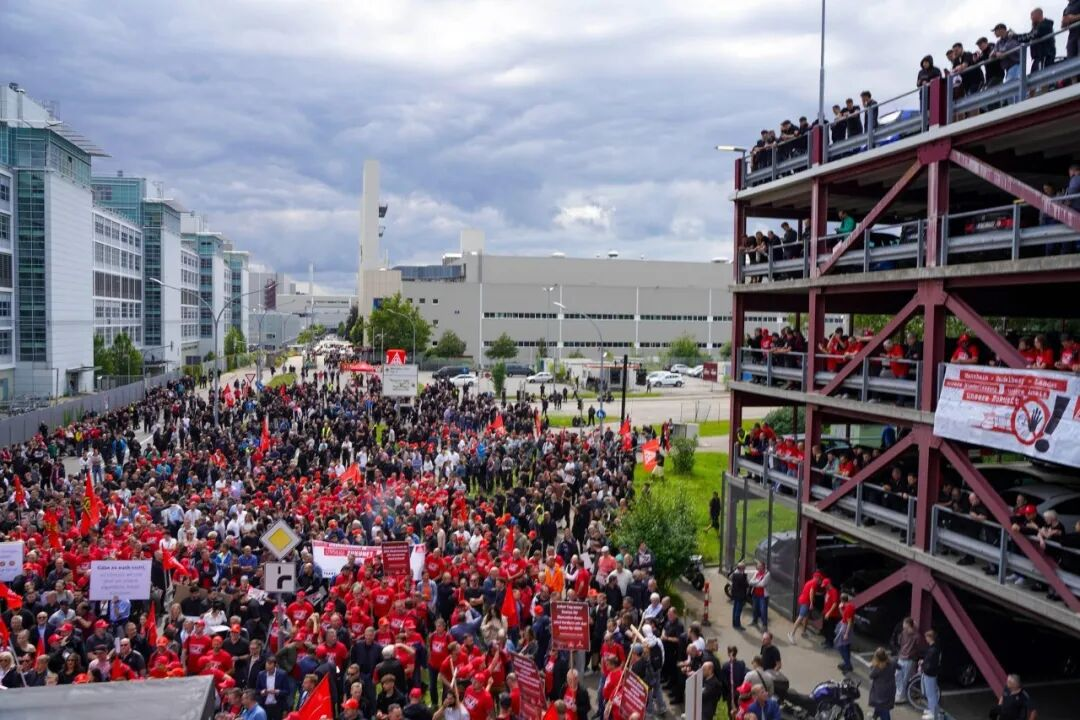
Previously, Mercedes-Benz management hoped to unpaidly extend the original 35-hour workweek for some workers to 40 hours to reduce costs and improve efficiency. Unsurprisingly, this reform, which touched upon employees' core interests, sparked strong protests. Large-scale protests erupted simultaneously at multiple Mercedes-Benz factories in Germany, with tens of thousands of workers, united with unions, taking to the streets to firmly resist the measure of unpaid extended working hours.
Not just leading automakers; to extend workers' working hours, some German entrepreneurs have forcibly linked the pressures faced by German manufacturing to the rise of Chinese manufacturing, attributing it to working hours.
They argue that the core advantage of China's manufacturing rise lies in ultra-long working hours, rapid response, and high-frequency innovation. They question whether the 40-hour workweek is outdated and express a desire to learn from the so-called 'Chinese speed.' Under this one-sided perception, some business leaders view China's '996' work model as a competitive advantage, seeing Germans' emphasis on vacations and quality of life as a burden. They believe that only by working like the Chinese can Germany regain its economic competitiveness.
02 The Most Fundamental Aspiration of Domestic 'Workers'
Data indicates that the average weekly working hours of employees in Chinese enterprises are indeed longer. After nine years of continuous growth, the average weekly working hours in China finally began to decline in 2026. According to the National Bureau of Statistics, the average weekly working hours in China remained between 48 and 48.3 hours in the first five months of 2026.
Although reduced, the working hours of Chinese employees are still high, exceeding the standard of no more than 44 hours per week.
The difference is even more pronounced in the automotive industry. Engineers in the German automotive industry have a statutory weekly working time of 35 hours. Workdays typically run from 7 a.m. to 2 p.m. or 2:30 p.m., with a clear boundary between work and life, and no work-related matters are handled after work.
In contrast, automotive component companies and OEMs in China are hotbeds for overtime. Many Chinese manufacturers' engineers work 14 hours a day, often lacking basic weekends off, instead having alternating weeks of single and double days off or only single days off.
The previous wave of workplace anti-burnout and industry price corrections in China, while curbing industry-wide disorderly price cuts and vicious competition at the macro level and promoting a gradual return to healthy development in the automotive market, had limited improvement effects for grassroots practitioners. Behind the overall industry competitiveness enhancement and steady corporate revenue growth lies the silent consumption of ordinary workers.
Previously, a netizen commented under the article 'Banning Overtime to Force People to Leave Work? Anti-Burnout Measures Fall Short in the Automotive Circle,' saying, 'After all this burning out, it seems the industry has developed better and become more competitive, but what have the vast ordinary practitioners gained? Worse health, more distant family relationships, a more exhausted life, and stagnant salaries. The bosses are raking in the profits, saying it's all about hard work and creating value, but we're just 'cattle and horses' driven by capital.'
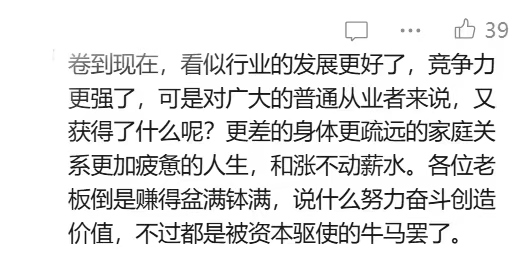
Therefore, implementing an 8-hour workday, ensuring weekends off, and clarifying overtime boundaries have become the most fundamental and core aspirations of Chinese workers today.
This current mutual admiration between Chinese and German workplaces, while seemingly absurd, is a true reflection of the different development stages and competitive landscapes of the manufacturing sectors in both countries. Behind the two narrative trends lie the survival anxieties of their respective industries.
German automakers' advocacy of the 'Chinese working hour model' is essentially a desperate self-help measure after the fading of industrial dividends. In the past, relying on technological barriers, brand advantages, and an efficient, lean short-hour system, the German automotive industry enjoyed high profits and generous workplace benefits.
However, under the multiple pressures of the new energy transformation shock, intensified global competition, and high local labor costs, corporate profit margins have been squeezed, leaving companies unable to sustain the high-welfare, short-hour workplace model. This is similar to the union pressures faced by General Motors and Ford when more cost-effective Japanese cars entered the U.S. market. The so-called 'admiration for China's overtime speed' is nothing more than a passive compromise by German companies in the face of a wave of unemployment, a projection of anxiety during an industry downturn.
Chinese workers' yearning for Germany's short working hours and high-welfare workplace ecosystem is an instinctive demand amidst intense internal competition.
Currently, the domestic automotive industry is engaged in a knockout-style fierce competition, especially with extremely low profit margins. Extending employee working hours and exploiting human value to gain market advantages is a last resort 'life-saving' measure. The fatigue and aspirations of grassroots practitioners are precisely the hidden costs behind the industry's rapid development.
Ultimately, working hours have never been the core secret to competitiveness in the manufacturing sector. Excessive overtime that exploits human resources and extreme cost-cutting that compresses welfare are merely short-term emergency measures that cannot lead companies to long-term success. This mutual admiration reflects the growing pains of the global manufacturing transformation. How to ensure that grassroots employees can also live and work with dignity in a challenging market environment is not only the responsibility of corporate operators but also the deepest aspiration of all practitioners.
Editor-in-Charge: Li Sijia Editor: He Zengrong

THE END
-
![]()
Even Li Auto Is Facing Challenges. Can Xiaomi Make a Mark in the Extended-Range Hybrid Vehicle Market?
-
![]()
Surplus Capacity Leasing vs. Aggressive Expansion: Is Meta's 'Dual Strategy' a Deliberate Move?
-
![]()
German Business Leaders Contemplate 'Embracing the 996 Culture,' While Chinese Auto Workers Simply Aspire to Clock Out On Time
-
Graduating with a Violin Serenade in a Luobo Kuaipao, Enjoying Yunba Rides, and Watching Football with Milu: Shenzhen's Seamless Integration of Driverless Cars into Daily Life
-
![]()
Shenzhen Unveils 331 Nighttime Autonomous Vehicle Routes in Three Months: Even Logistics Embrace Off-Peak Operations in the Vibrant City
-
![]()
Why Did the Lingguang App Lose Its Competitive Edge? A Strong Hand Played Poorly
-
![]()
Monthly Double Building Purchases for 3.8 Billion: Is Duan Yongping Still in Sync with Pinduoduo?
-
![]()
Tesla FSD’s China Debut: How Orbbec’s ‘AI Eyes’ Are Revolutionizing Intelligent Driving and Robotics