Q2 Financial Report: Google Cloud Surges 82%, Tesla's Profit Margin Drops to 1.4%
 07/23 2026
 449
449
Both companies exceeded revenue expectations, yet their cash flows turned negative simultaneously. Google and Tesla are now paying the real costs of AI, with the difference being that the former has already seen returns, while the latter still relies mainly on car sales to fund its future.
Author|Yixiu
Editor|Xiaobai
Illustrations|AI Generated
Produced by|Qiangdiao Next
On July 22, after the market closed, Alphabet and Tesla simultaneously released their financial results for the second quarter of 2026.
Both companies exceeded market expectations in terms of revenue. Alphabet reported revenue of $119.8 billion, up 24% year-over-year. Tesla reported revenue of $28.236 billion, up 26% year-over-year. However, after the financial reports were released, the stock prices of both companies fell by approximately 3% and 4.5%, respectively, in after-hours trading.
Investors are concerned about the same issue: the AI bill is rapidly thickening.
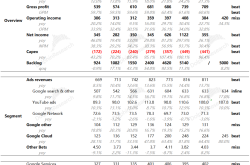
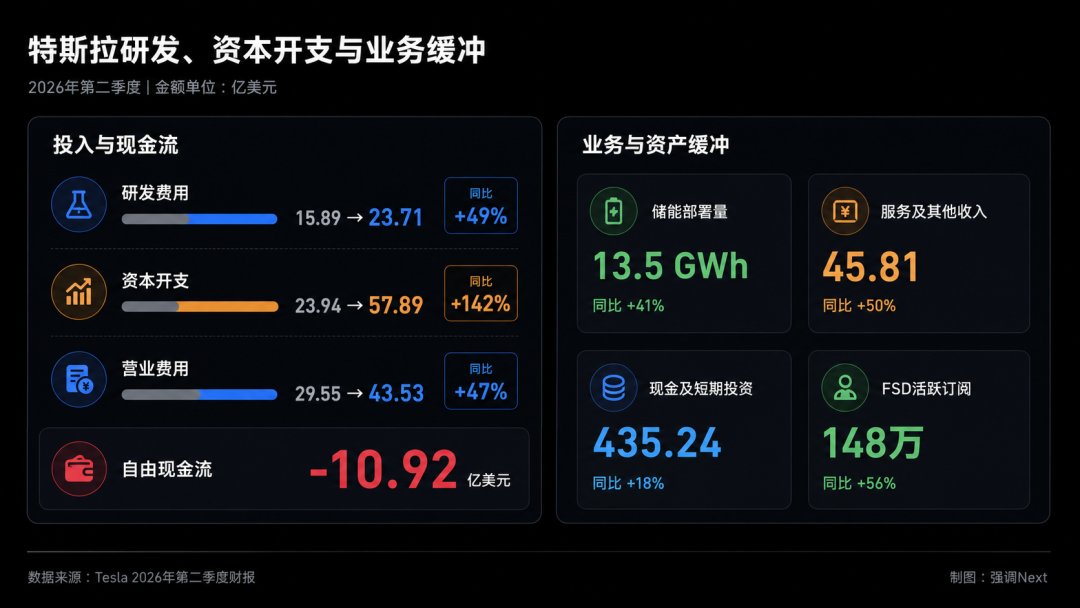
Alphabet's capital expenditures in the second quarter reached $44.924 billion, surpassing the operating cash flow of $39.069 billion for the quarter, resulting in a negative free cash flow of $5.855 billion. This marks the first time in the company's history that quarterly free cash flow has turned negative. Tesla's capital expenditures reached $5.789 billion, up 142% year-over-year, with a negative free cash flow of $1.092 billion, also turning negative for the first time in more than two years.
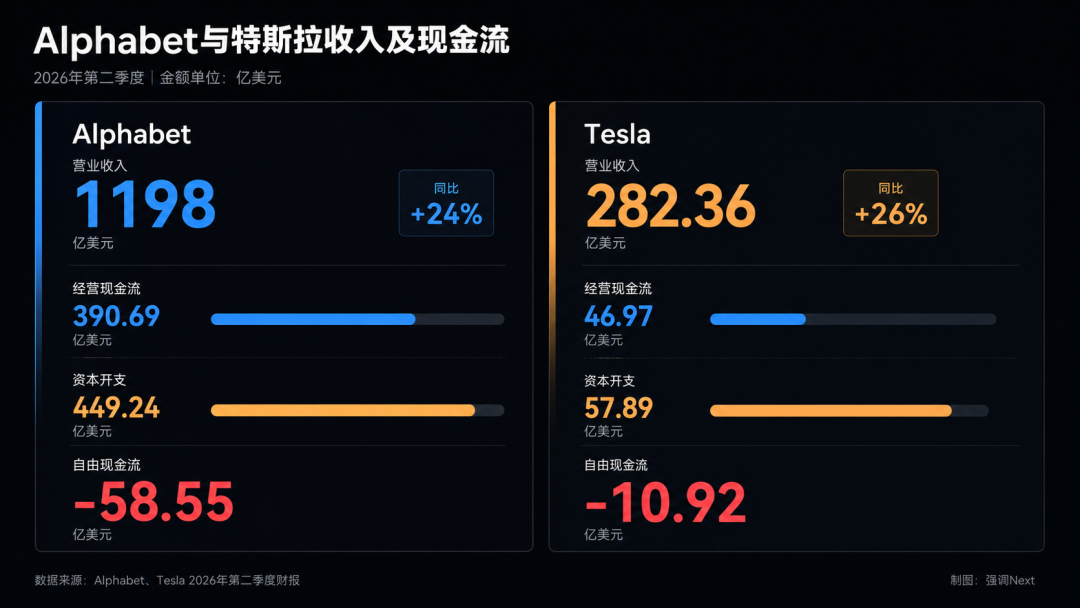
On the surface, both companies are burning money on AI. The difference behind the financial reports is that Google's AI has already generated revenue and profits in its cloud business, while Tesla's Robotaxi and Optimus are still in a phase of heavy investment and light revenue.
1 · The Quality of Performance Growth Differs Significantly
The most eye-catching figure for Alphabet is the net profit of $112.107 billion, up 298% year-over-year. However, this does not mean that Google's main business suddenly earned over $80 billion more.
In the second quarter, Alphabet's equity securities generated a net gain of $99.031 billion, contributing $77.1 billion to net profit after tax and $6.26 to earnings per share. After excluding this impact, earnings per share were approximately $2.85, slightly below Wall Street's expectation of $2.89.
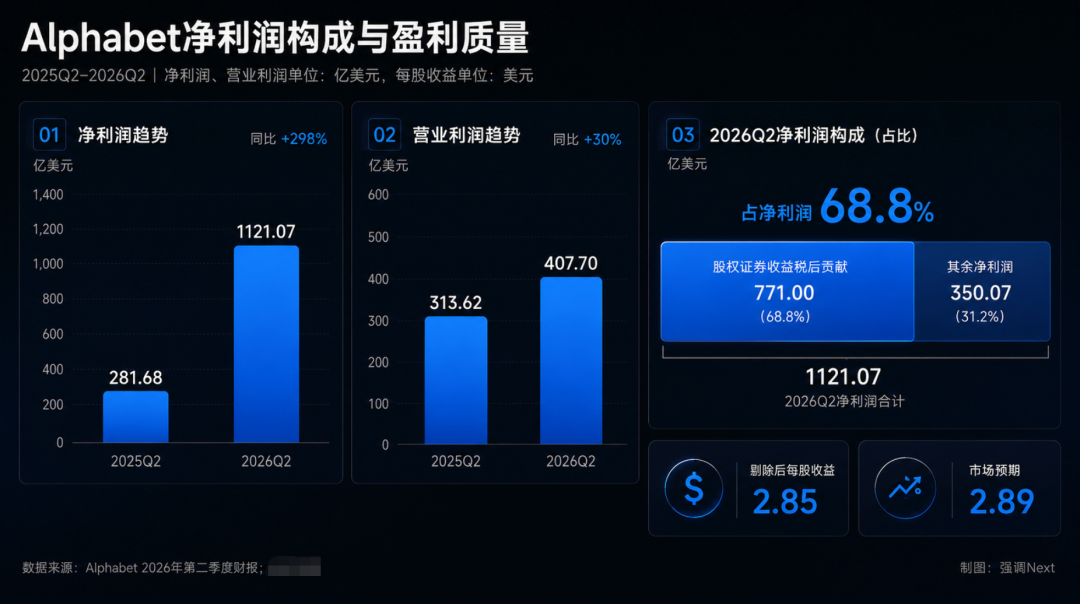
Nevertheless, Google's main business is not weak. Operating profit increased by 30% year-over-year to $40.77 billion, with the operating profit margin rising from 32% to 34%. Search and other advertising revenue grew by 17%, YouTube advertising revenue grew by 13%, and subscription, platform, and hardware revenue grew by 15%. Concerns that generative AI would divert traffic from traditional search have not materialized in this quarter's financial report, at least.
Tesla's situation is the opposite. Its growth mainly comes from sales volume, but profits have not kept pace.
In the second quarter, Tesla delivered 480,100 vehicles, up 25% year-over-year, setting a record for second-quarter deliveries. Automotive revenue grew by 23% to $20.516 billion. However, operating profit was only $398 million, down 57% year-over-year, with the operating profit margin dropping from 4.1% to 1.4%.
The average revenue per vehicle at Tesla fell from $45,300 in the same period last year to $42,700. The automotive gross margin, excluding regulatory credits, was only 16.3%, below market expectations of 18.04%. More cars were sold, but prices and costs eroded the profits brought by the increased sales volume.
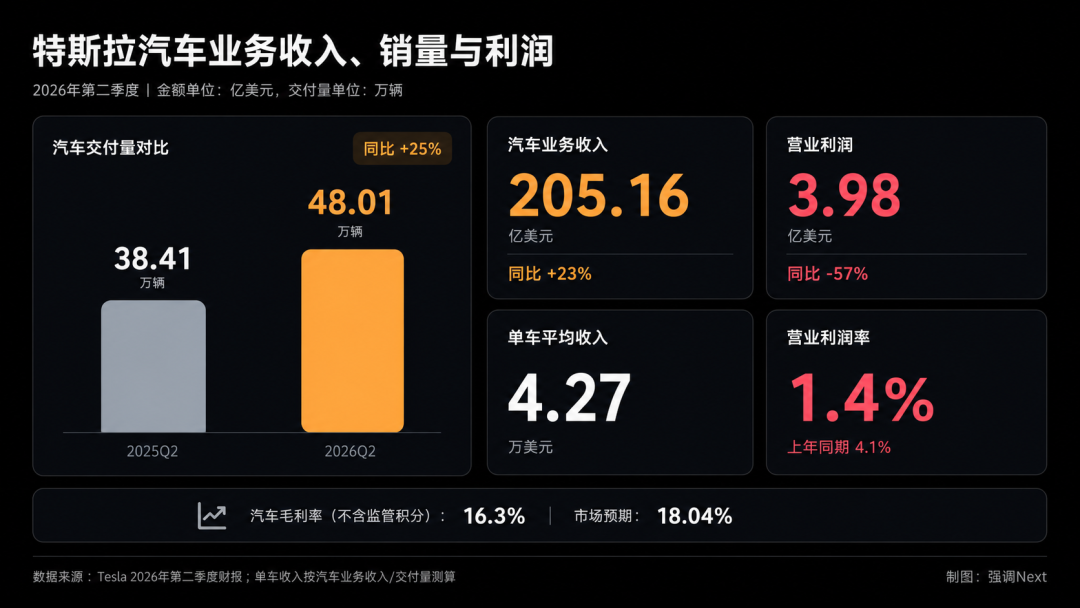
This is the most direct difference between the two financial reports. Google's core business continues to expand profits, while Tesla's core business only expands revenue.
2 · Google's AI Receives Payment First in the Cloud
Google Cloud delivered the strongest set of data in this financial report.
In the second quarter, Google Cloud revenue grew by 82% year-over-year to $24.768 billion, far exceeding market expectations of $6.4 billion. Operating profit increased from $2.826 billion to $8.814 billion, up 212%. The operating profit margin rose from 20.7% to 35.6%. Cloud business contributed approximately 21% of Alphabet's revenue and 22% of operating profit, no longer just a second growth engine beyond search advertising.
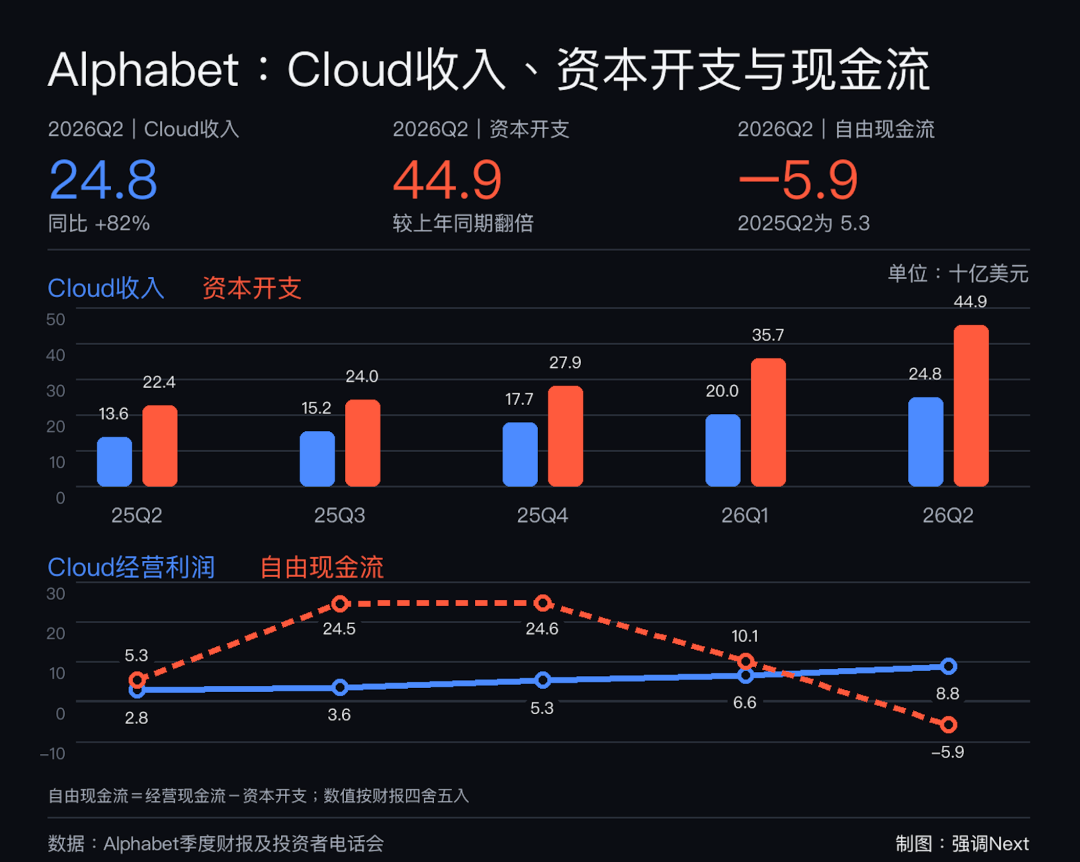
Growth mainly came from enterprise AI solutions, AI infrastructure, and core cloud services. Google also confirmed direct sales revenue from TPUs for the first time this quarter. The self-developed chips, which mainly served internal operations in the past, have now become an external business.
Consumer-side data is also solid. The Gemini App reached 950 million monthly active users, and the Gemini model processed 220 billion API tokens per minute. Nearly 90% of Fortune 100 companies already use Gemini Enterprise. User scale does not directly equate to revenue, but the growth and profitability of the cloud business prove that AI demand has entered Google's financial statements.
The cost is also clear. Alphabet's capital expenditures in the second quarter doubled year-over-year to $44.924 billion, and the full-year capital expenditure guidance for 2026 was raised by $15 billion to a range of $195 billion to $205 billion. Management also confirmed that capital expenditures will continue to grow significantly in 2027.
To expand AI infrastructure, Alphabet issued stocks and mandatory convertible preferred shares in the second quarter, raising a net $49.6 billion, while also issuing $20.3 billion in unsecured bonds. The company did not repurchase any stocks this quarter, compared to $13.238 billion in repurchases in the same period last year.
Google, once one of the most stable cash distributors in the tech industry, is now simultaneously raising large amounts of money from both the stock and bond markets. Cloud business has proven that AI can generate revenue; the next step is to prove whether the new profits can catch up with the increasingly heavy capital expenditures.
3 · Tesla Still Uses Automotive Profits to Fund Its Future
Tesla's AI path is longer and more expensive.
In the second quarter, Tesla's R&D expenses grew by 49% year-over-year to $2.371 billion, and operating expenses grew by 47% to $4.353 billion. The company expects capital expenditures in 2026 to exceed $25 billion, nearly triple that of 2025. Funds will be allocated to AI training computing power, Robotaxi, Cybercab, Optimus, semiconductor factories, and battery and material production capacity.
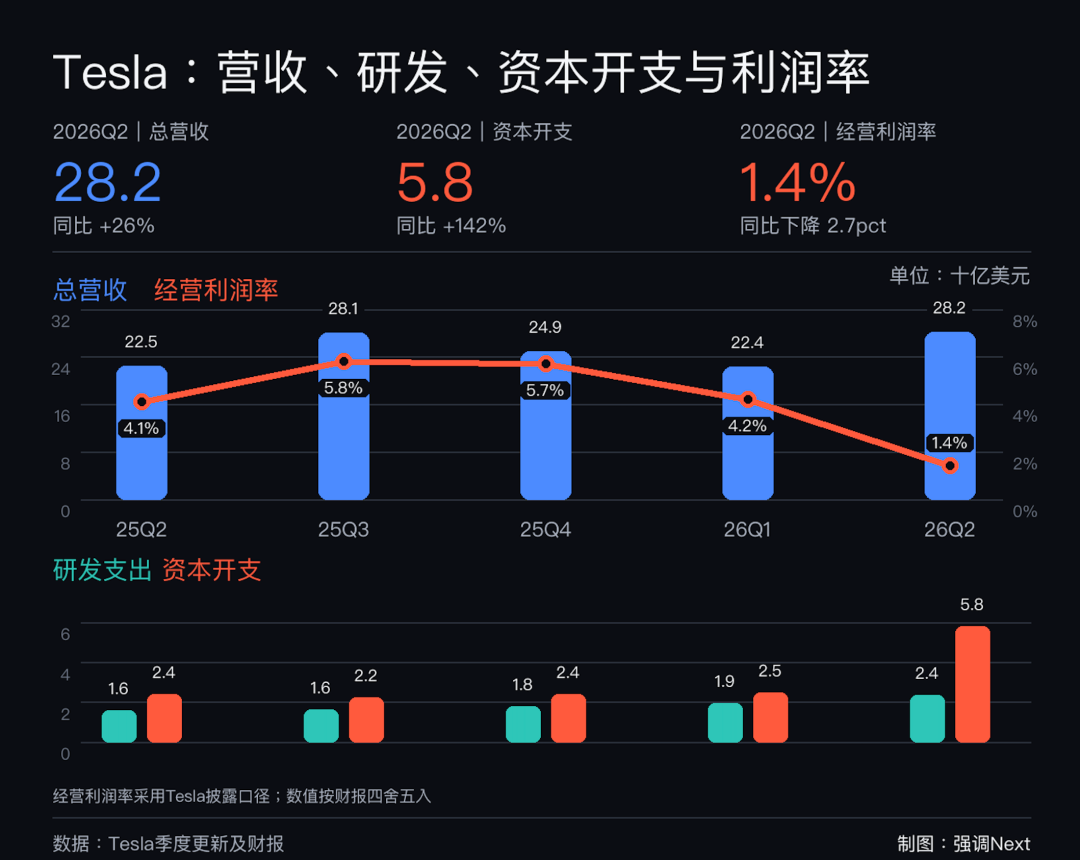
Progress has not been absent. Cybercab has begun production, Robotaxi has entered seven major U.S. cities, active FSD subscribers grew by 56% year-over-year to 1.48 million, and the FSD subscription adoption rate for new cars in North America exceeded 55%. The Fremont factory has dismantled the Model S and Model X production lines and is retrofitting them for the first-generation Optimus production line.
However, these advancements have not yet generated revenue that can be separately accounted for on a large scale. Tesla did not disclose Robotaxi revenue or FSD revenue. The first batch of Optimus robots is mainly used for internal training and data collection and has not yet entered external sales.
Tesla still relies on its automotive, energy storage, and service businesses to foot the bill. In the second quarter, energy storage deployment grew by 41% year-over-year to 13.5 GWh, and service and other revenue grew by 50% to $4.581 billion, with gross profit reaching a record $648 million. Energy storage and services together contributed approximately $1.29 billion in gross profit, accounting for 27% of the company's total gross profit.
These two businesses have provided a buffer but are still insufficient to offset the pressure on profits from AI R&D, capacity expansion, and automotive price cuts.
The good news is that Tesla still has $43.524 billion in cash, cash equivalents, and short-term investments on hand, with no short-term funding pressure. The real pressure comes from the payback period. Capital expenditures have already entered the financial reports, but there is still no set timeline for when Robotaxi and Optimus will appear on the profit statement.
4 · Google Calculates Returns, Tesla Awaits Revenue
Both Google and Tesla are transforming themselves into AI companies, but they are at different stages.
Google uses profits from search advertising to expand its cloud and AI infrastructure, with new computing power already generating revenue through cloud services, enterprise AI solutions, and TPU sales. Its challenge lies in capital efficiency: whether free cash flow and shareholder returns can be maintained when full-year capital expenditures exceed $200 billion.
Tesla uses cash flow from its automotive business to build Robotaxi, robots, and its own computing power. Automotive deliveries have resumed growth, but gross margins remain under pressure. New businesses have made product and operational progress but have not yet delivered scaling (large-scale) financial returns. The focus now is on when Robotaxi and Optimus will transition from projects to businesses.
Going forward, the most critical metric for Alphabet is not how many more users Gemini adds but whether cloud revenue, cloud profit, and free cash flow can continue to match capital expenditures. Tesla also cannot rely solely on the number of cities Robotaxi enters or the progress of Optimus production lines to support its valuation; the market needs to see FSD subscription revenue, paid miles for Robotaxi, and external sales of robots.
In the same round of heavy AI investment, Google has already started calculating its return on investment, while Tesla is still waiting for its first large-scale bill.
- END -
-
![]()
Gemini Slips From Global Top 10: What Lies Ahead for Google's AI Dominion?
-
![]()
Exclusive | Interview with Wu Yongjian, Vice President of Tencent Cloud: The Intelligent Agent Market Has Yet to Enter a Bubble Phase, Though Some Sectors Are Becoming Saturated
-
![]()
Profits Plunge by 57%: China’s Auto Price War Takes a Toll on Tesla
-
![]()
Google: Is AI Going to Collapse? A Savior Has Arrived
-
![]()
The Proxy War Between Uber and Meituan
-
![]()
30 Acres! Another Aerospace Unicorn Secures Land in Yizhuang to Establish a 'Satellite Factory'
-
![]()
A Rocket Soars from the East China Sea: Orient Space Embarks on Dual Solid-Liquid Long-Haul Journey
-
![]()
Baidu Becomes "Younger"