Confronting 20 Billion in Market Barriers: How Formidable Are They?
 07/23 2026
 437
437

Edge AI is Shifting from a Blue Ocean to a Red Ocean
Author | Xin Jian
Editor | Xiaobai
Illustrations | AI Generated
Produced by | Qiangdiao Next
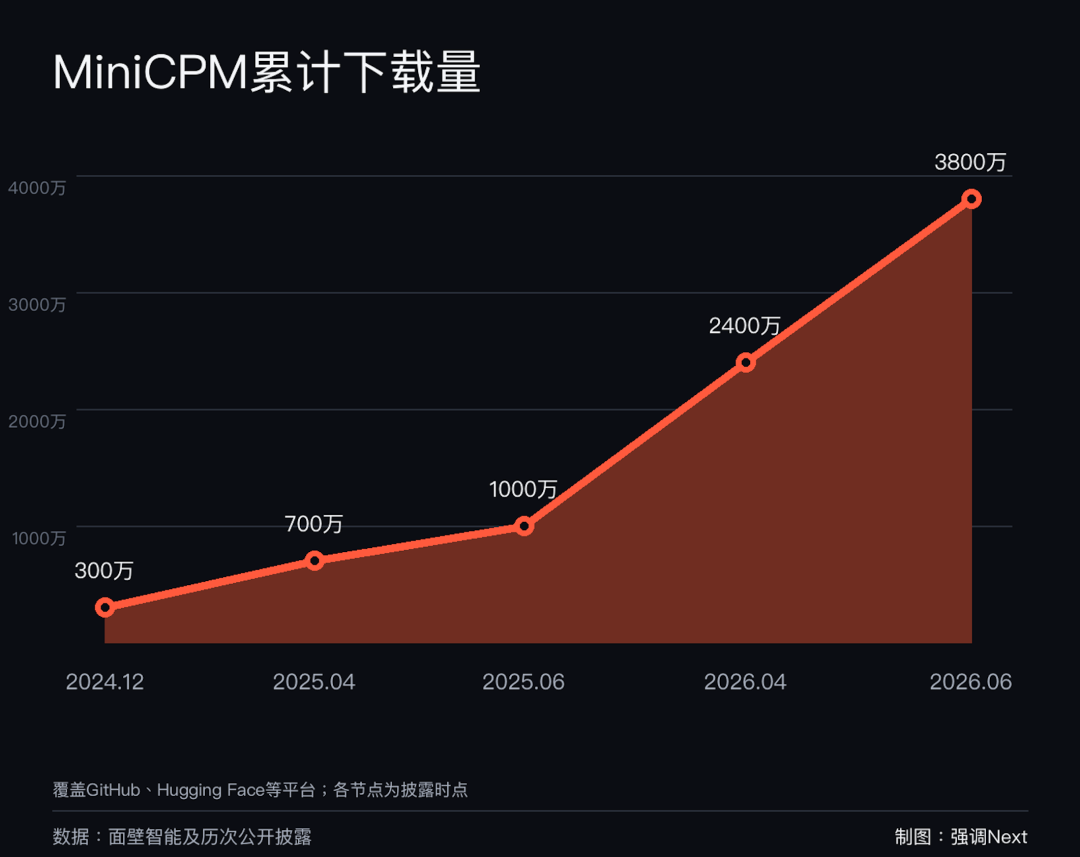
On July 15, media reported that Mianbi AI had completed a new round of financing, raising over 5 billion yuan in the first half of 2026, with its valuation surpassing 20 billion yuan, making it the highest-valued unicorn in the edge intelligence sector. Four days later, at WAIC 2026, Mianbi AI announced another set of figures: the global cumulative downloads of its MiniCPM series of open-source models had exceeded 38 million.
A company that emerged from a Tsinghua University lab has, in four years, transformed a 'non-consensus' business into a 'consensus' that the capital market is willing to back with 20 billion yuan.
However, the formation of capital consensus often marks the beginning of the dilution of first-mover advantages. Over the past two years, giants such as Alibaba, ByteDance, Apple, and Qualcomm have concentrate (this word means concentrated/focused, but in this context, it likely means 'entered' or 'moved into') the edge market. Mianbi AI now needs to prove not just whether its models can run on endpoints but whether these technologies can generate sustained revenue and solidify into genuine commercial barriers.
01. 5 Billion in Six Months: Who's Betting?
Mianbi AI's financing history follows a clear trajectory.
According to reports, Mianbi AI's angel round was led by Zhihu. In June 2023, Li Dahai, then CTO of Zhihu, became a director and CEO of Mianbi AI, overseeing company strategy and daily operations. In 2024, Huawei Hubble and Primavera Ventures led a new round of financing, with the Beijing AI Industry Investment Fund and others following suit.
In May 2025, Hongtai Fund, Guozhong Capital, Tsinghua Holdings Jinxin Capital, and Moutai Fund jointly invested. By December of that year, Jingguorui, Guoke Investment, CICC Porsche Fund, Miju Capital, and Heji Investment collectively invested several hundred million yuan.
The real acceleration came in 2026.
In late February, Mianbi AI completed its first post-Spring Festival financing round, led by China Telecom, with CITIC Goldstone and CITIC Private Equity following. In April, Shenzhen Capital Group and Inovance Industrial Investment jointly led a new round, with Daohe Long-term Investment, Guotai Junan Innovation Capital, and Wuyuefeng Tech Innovation among the followers. By this point, state-owned assets from Beijing and Shenzhen, along with multiple industrial capitals, had entered the shareholder list.
The new financing round disclosed in July introduced national-level funds, central enterprises, and automakers as investors. According to Mianbi AI, the company's cumulative financing in the first half of the year exceeded 5 billion yuan.
Among the shareholders, internet giants like Alibaba, Tencent, and ByteDance—which simultaneously deploy cloud models, endpoint hardware, and user entry points—are nearly absent. In contrast, large model companies like Zhipu and MiniMax have received varying degrees of support from major corporate capitals. Mianbi AI's investor structure leans more toward 'state-owned assets + industrial capital': it includes telecom operators, automakers, local state-owned funds, and industrial automation companies.
The underlying business logic is straightforward. Mianbi AI aims to become a model supplier for automakers, mobile phone manufacturers, and robotics companies, and maintaining relative neutrality helps expand its client base. Being deeply tied to a single internet giant could hinder its collaboration with other ecosystems.
Capital market policies have also altered investors' exit expectations. In June 2026, Wu Qing, chairman of the China Securities Regulatory Commission, announced at the Lujiazui Forum that the application scope of the fifth listing standard for the STAR Market would be expanded to include AI companies, supporting the listing of high-quality AI large model enterprises.
This doesn't mean Mianbi AI has secured a listing ticket, but for large model companies without stable profits, the path to domestic listing is becoming clearer. For the state-owned assets and industrial capitals entering in this round, Mianbi AI is no longer just a long-term tech project but potentially an investment with a clear exit path.
02. The 'Density Law': Academic Achievements as Fundraising Narratives
The core pillar of Mianbi AI's narrative—'we understood edge AI earlier'—is the 'Density Law' proposed by Liu Zhiyuan's team.
This law defines 'capability density' as the ratio of a model's effective parameter scale to its actual parameter scale. Simply put, it means achieving tasks previously only possible with larger models using fewer parameters and lower inference costs.
The related paper was published as a cover story in Nature Machine Intelligence in November 2025. It analyzed 51 open-source foundational models and fitted an empirical curve across five common benchmarks: the maximum capability density of open-source models roughly doubles every 3.5 months.
Mianbi AI's rise to international prominence was also aided by a plagiarism controversy.
In May 2024, a team of two Stanford undergraduates and another researcher released Llama3-V, claiming to have trained a high-performance multimodal model for around $500. The project was soon accused of extensively copying MiniCPM-Llama3-V 2.5, jointly released by Tsinghua and Mianbi AI. Beyond structural and configuration similarities, both models made identical errors when identifying unpublished Tsinghua bamboo slip data.
The two team members subsequently apologized and took down the project. Christopher Manning, director of the Stanford AI Lab, criticized their failure to address the mistakes; Lucas Beyer, then a researcher at Google DeepMind, lamented that the similarly capable MiniCPM had received far less attention.
Mianbi AI's first major international open-source community attention came not from a product launch but from a rival's misstep.
However, the 'density doubling' cycle has shown significant variations across stages.
In multiple speeches and interviews in mid-2024, Liu Zhiyuan and Li Dahai described 'knowledge density doubling every eight months on average.' By late 2024, when formally proposing the 'Density Law,' this became roughly every 100 days, or 3.3 months. The final paper published in Nature Machine Intelligence gave a result of about 3.5 months.
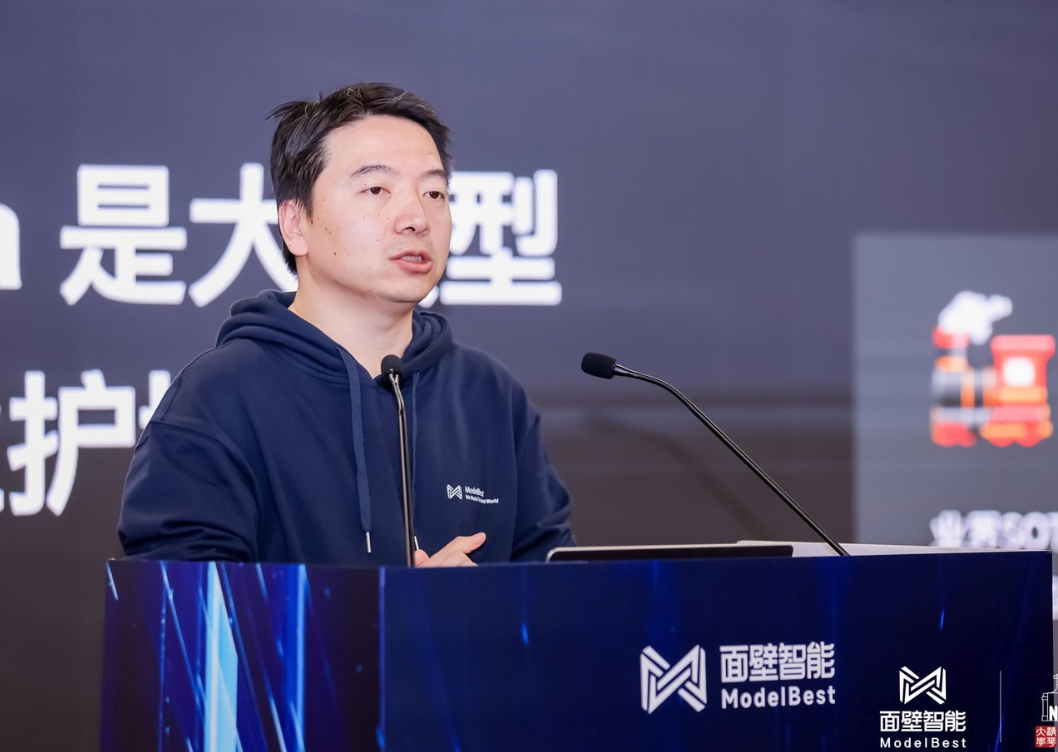 Mianbi AI CEO Li Dahai
These figures aren't fully comparable. Early statements were more conceptual observations, while the formal paper limited model samples, timeframes, and evaluation methods. This means the 'Density Law' is better understood as an empirically updated curve rather than a stable natural law predictably governing future years.
The paper itself acknowledges that current model capability measurements rely on limited benchmarks, which may be affected by data contamination, benchmark saturation, and other factors. Capability density also cannot grow infinitely.
Equally cautious interpretation is needed for Mianbi AI's claim that edge models have 'caught up to the GPT-4 era.' During the 2026 Zhiyuan Conference, Li Dahai cited the AA-Index rankings, stating that MiniCPM5-1B's score approached that of GPT-4o in 2024.
This comparison highlights rapid efficiency gains in small models, but a single benchmark cannot cover comprehensive performance across reasoning, coding, multimodality, and real-world tasks. Framing this as 'intelligence parity with GPT-4' makes for good headlines but isn't a technically verified conclusion through unified benchmarks and third-party cross-validation.
03. Three Commercialization Paths, Revenue Figures Still Undisclosed
Mianbi AI's current commercialization relies primarily on automotive, mobile phone, and enterprise markets, with embodied AI as a new addition.
Automotive is the relatively clear business segment. By 2025, Mianbi AI's edge models had been deployed in mass-produced models like Changan Mazda EZ-60 and Geely Galaxy M9. The company also signed a strategic cooperation framework agreement with Aptiv to leverage its automotive supply chain for broader market access.
However, earlier reports stating 'over 300,000 mass-produced vehicles delivered' were inaccurate. Mianbi AI publicly stated that it expects 300,000 vehicles to carry its edge models by the end of 2026—an annual target, not a completed delivery figure.
In the enterprise market, Mianbi AI claims its agent platform PilotDeck has achieved Large scale commercial use (large-scale commercialization), and during WAIC, it announced CPM for Legal for professional legal services. However, public materials still do not disclose specific client numbers, contract values, or revenue contributions.
For mobile phones, Mianbi AI officially announced that the MiniCPM series would be featured in several Samsung flagship models. Collaboration has entered product and regulatory filing stages, but specific models, shipment schedules, and Mianbi AI's revenue share remain unclear.
Embodied AI is the newest area. On July 19, during WAIC, Mianbi AI released the MiniCPM-Robot series, including the general-purpose vision-language-action model MiniCPM-RobotManip and the mobile tracking model MiniCPM-RobotTrack. MiniCPM-RobotManip, with 1.5 billion parameters, can complete long-horizon tasks like making sandwiches.
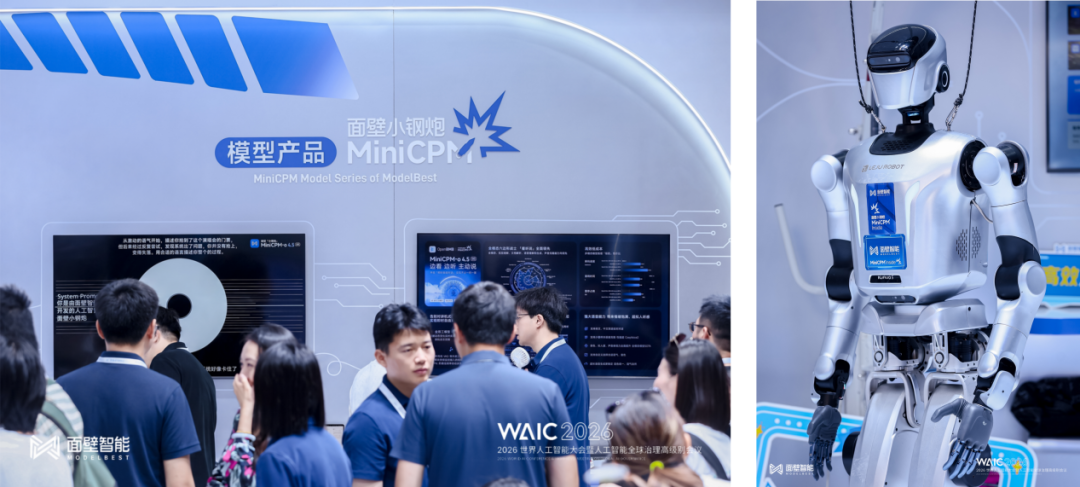
In Mianbi AI's disclosed RMBench evaluation results, MiniCPM-RobotManip scored around 53, while π0.5 scored about 10. However, RMBench primarily assesses robot performance in context-dependent memory-based operational tasks and does not represent comprehensive capabilities across all robotics scenarios.
These figures are substantial individually—downloads, planned deployments, collaboration counts, and benchmark scores—but Mianbi AI has not publicly disclosed actual revenue, gross margins, or client renewal rates.
This is not uncommon among unlisted AI companies. However, for a company that raised over 5 billion yuan in six months with a valuation exceeding 20 billion yuan, the absence of commercial data warrants attention. Especially as listing pathways clarify, public markets will ultimately focus not on model downloads but on revenue quality and cash flow.
Mianbi AI's choices in the consumer market are also noteworthy. Its dialogue assistant 'Mianbi Luca' launched in May 2023 and opened to the public in November of that year, but subsequent public channels rarely show sustained user data updates. Currently, Doubao has 382 million MAUs, and Qianwen has 167 million.
Mianbi AI has not continued heavy C-side investments primarily due to resource allocation. It has bet heavily on supplying foundational models to automakers, mobile phone manufacturers, and robotics companies. This path avoids costly user acquisition and operational expenses but deepens reliance on a few large clients, hardware cycles, and project deliveries.
At least from public information, Mianbi AI has not yet established an independent revenue stream that directly reaches consumers and hedges its B2B business.
04. Edge AI Enters Red Ocean: Moats Shift to Chips and Systems
Mianbi AI was indeed one of China's early large model startups focusing on edge models. The February 2024 release of MiniCPM also gave it strong recognition in lightweight models and endpoint deployment.
Globally, the picture differs. Google released Gemini Nano for mobile phone chips in December 2023. Apple announced a ~3 billion-parameter edge foundational model in June 2024.
At WAIC 2026, the Beijing Academy of Artificial Intelligence and the Beijing Key Laboratory of Edge Intelligence released a report defining 2026 as the 'first year of Large scale implementation (large-scale deployment)' for edge intelligence.
According to Frost & Sullivan, the global edge AI market will grow from 321.9 billion yuan in 2025 to 1.22 trillion yuan in 2029, with a CAGR of ~39.6%. Policy signals are also clearer: the 2026 government work report proposed 'creating new forms of the intelligent economy' for the first time. The 'Opinions on Deepening the Implementation of the 'AI+' Action,' issued by the State Council, set a target of over 70% application penetration for next-gen intelligent terminals and agents by 2027.
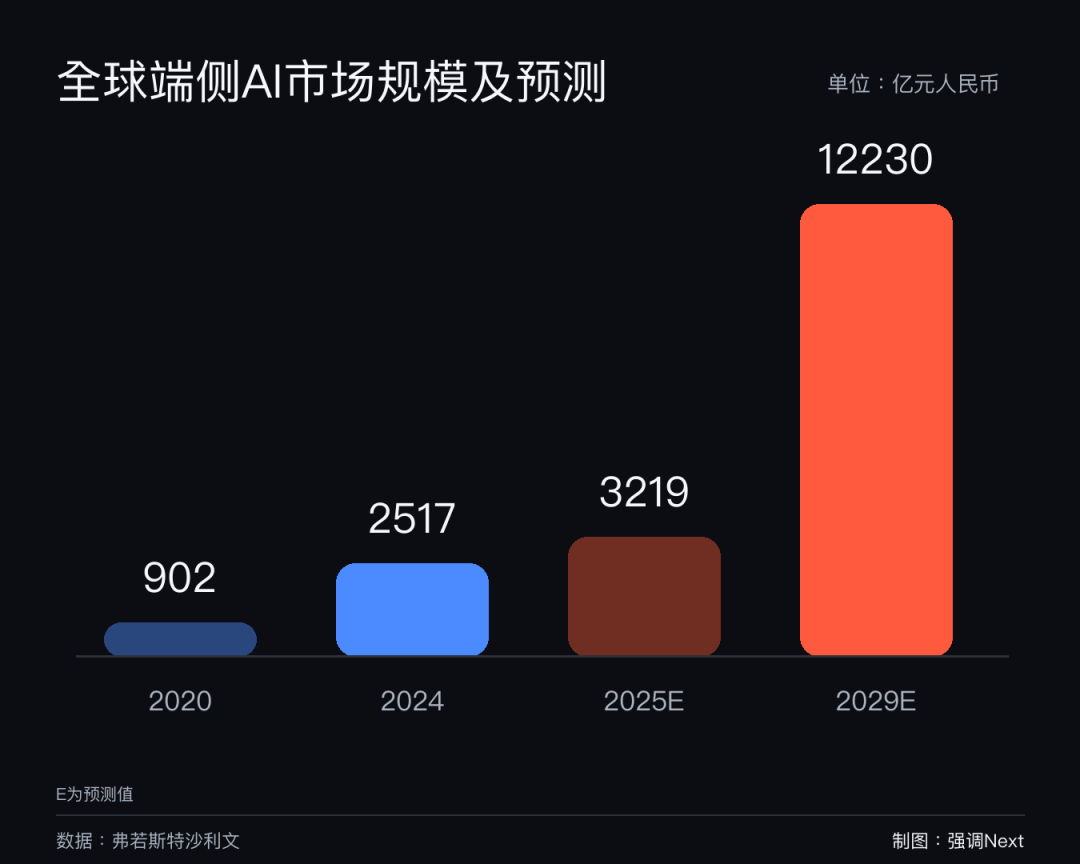
The problem lies here: edge AI has transformed from a niche route into a consensus, and the players at the table are now entirely different.
Alibaba continues to open-source Qianwen models of varying sizes and integrates them into hardware like Kuake AI Glasses. ByteDance is still adjusting Doubao AI Glasses' product plans. Apple launched its Core AI framework for Apple chips in 2026. Qualcomm, MediaTek, and Intel are building their edge AI platforms. Mobile phone makers are embedding large models and agent capabilities into operating systems.
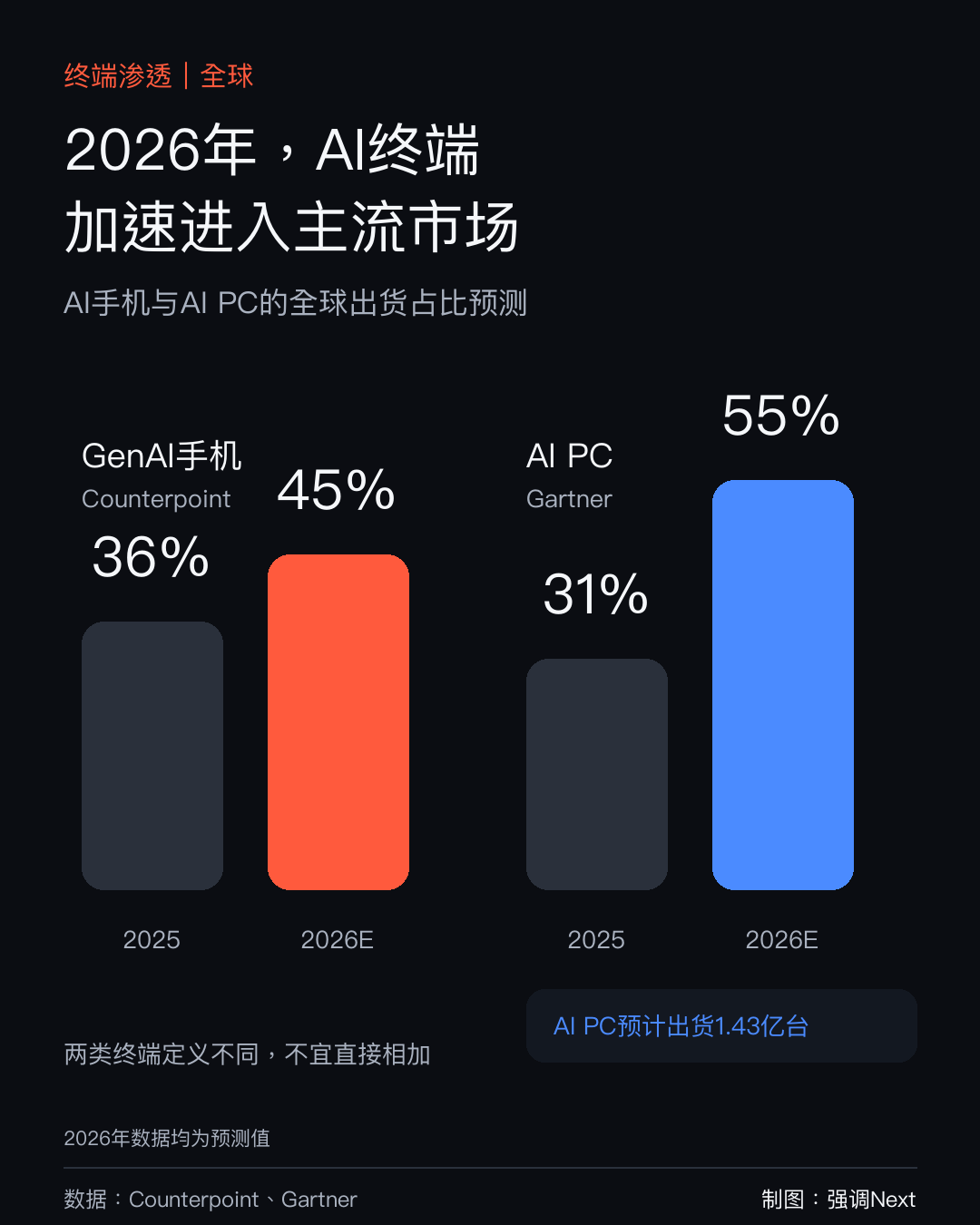
These companies control cloud models, chips, operating systems, or user entry points—many occupy multiple segments. Compared to when Mianbi AI entered the market, they now have more directly callable resources.
Li Dahai acknowledged in a June 2026 interview that the biggest constraint on large-scale edge model deployment is no longer the models themselves but their integration with chips. Terminal devices have severely limited compute, memory bandwidth, cooling, and power consumption, requiring constant hardware-model co-optimization.
From another perspective, edge AI competition is shifting from 'whose model is smaller and stronger' to 'who can best align models, chips, and systems.'
Minimax has completed adaptation to mainstream platforms such as AMD, Intel, MediaTek, and Qualcomm, and is also advancing native training on Huawei's Ascend platform through projects like BitCPM-CANN. This demonstrates its engineering capabilities and platform neutrality, but it also means that Minimax's products must always be built on top of other companies' chips, operating systems, and hardware entry points.
Platform neutrality is both an advantage for Minimax in winning over customers and a constraint it must face over the long term.
Minimax has gained an early position through the Density Law, open-source ecosystem, and engineering capabilities, but whether it can translate this into irreplaceable customer relationships, delivery systems, and cost advantages before major players quickly close the model gap remains uncertain.
The RMB 20 billion valuation answers whether capital believes in edge AI, but it does not mean that Minimax's current revenue, gross margins, and customer renewals can support this valuation.
The real test ahead is whether Minimax can ultimately turn the business into its own on the path it chose early on.
- END -
-
![]()
Gemini Slips From Global Top 10: What Lies Ahead for Google's AI Dominion?
-
![]()
Exclusive | Interview with Wu Yongjian, Vice President of Tencent Cloud: The Intelligent Agent Market Has Yet to Enter a Bubble Phase, Though Some Sectors Are Becoming Saturated
-
![]()
Profits Plunge by 57%: China’s Auto Price War Takes a Toll on Tesla
-
![]()
Google: Is AI Going to Collapse? A Savior Has Arrived
-
![]()
The Proxy War Between Uber and Meituan
-
![]()
30 Acres! Another Aerospace Unicorn Secures Land in Yizhuang to Establish a 'Satellite Factory'
-
![]()
A Rocket Soars from the East China Sea: Orient Space Embarks on Dual Solid-Liquid Long-Haul Journey
-
![]()
Baidu Becomes "Younger"