ByteDance, Capturing 40% of User Time, Seeks to Transform Its Revenue Model
 08/03 2026
 356
356

Monetizing the Time Users Save
Author|Qingyun
Editor|Xiaobai
Illustrations|AI Generated
Produced by|Qiangdiao Next
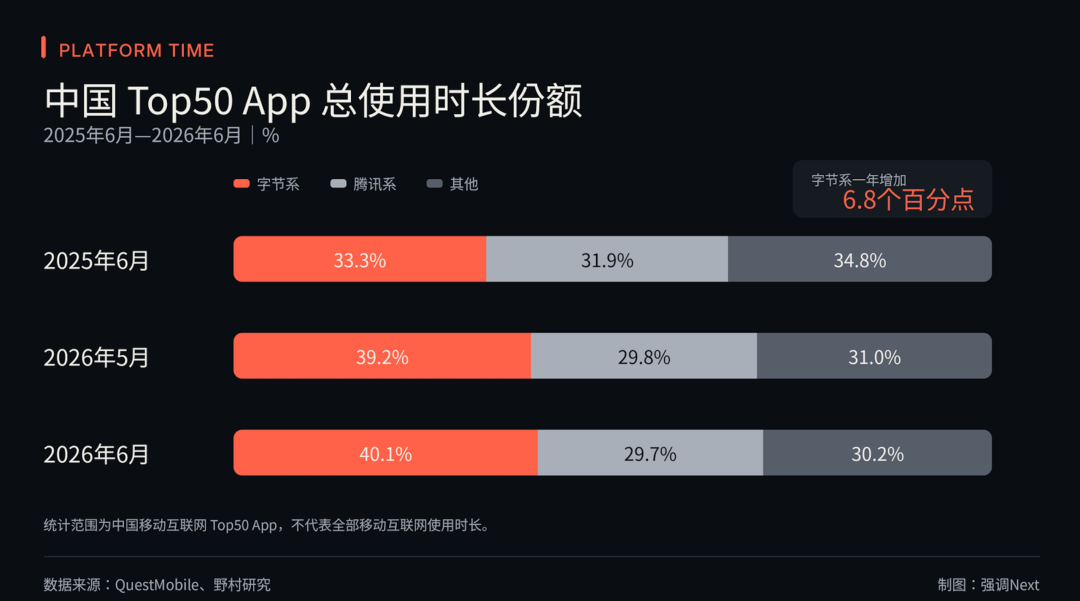
Data from QuestMobile reveals that in June 2026, ByteDance's share of total user time across China's top 50 apps climbed to 40.1%, while Tencent's stood at 29.7%. A year earlier, these figures were 33.3% and 31.9%, respectively. ByteDance saw a 6.8 percentage-point increase over the year, whereas Tencent experienced a 2.2 percentage-point decline, widening the gap from 1.4 to 10.4 percentage points.
Beyond Douyin, ByteDance now boasts three apps with over 100 million monthly active users (MAUs). Doubao reached 382 million MAUs in June, Hongguo Free Short Drama hit 356 million MAUs in May, and Qishui Music achieved 156 million MAUs in March, surpassing NetEase Cloud Music for the first time. While all three products expand ByteDance's user time, their monetization strategies differ significantly. 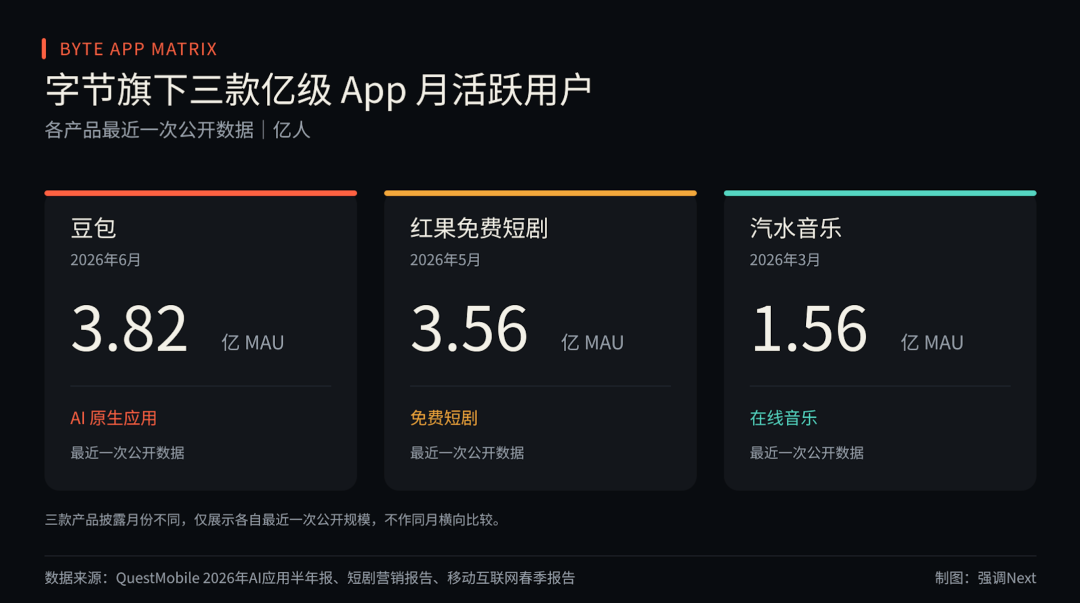
Hongguo primarily relies on advertising, while Qishui Music employs both advertising and membership models. Each additional episode viewed or song listened to increases advertising exposure or membership conversion opportunities. Doubao, however, consumes computational power with every question answered, image generated, or computer operation performed. It prioritizes rapid task completion—the shorter the user's stay, the better the product may perform.
Doubao has disrupted ByteDance's traditional revenue sequence. Douyin, Hongguo, and Qishui Music first compete for user time before selling advertising. Doubao, on the other hand, must deliver results first to charge subscription fees, enterprise API fees, or transaction commissions.
01. Free Content Fuels Time Engagement
ByteDance's additional user time primarily comes from the consumption of free content.
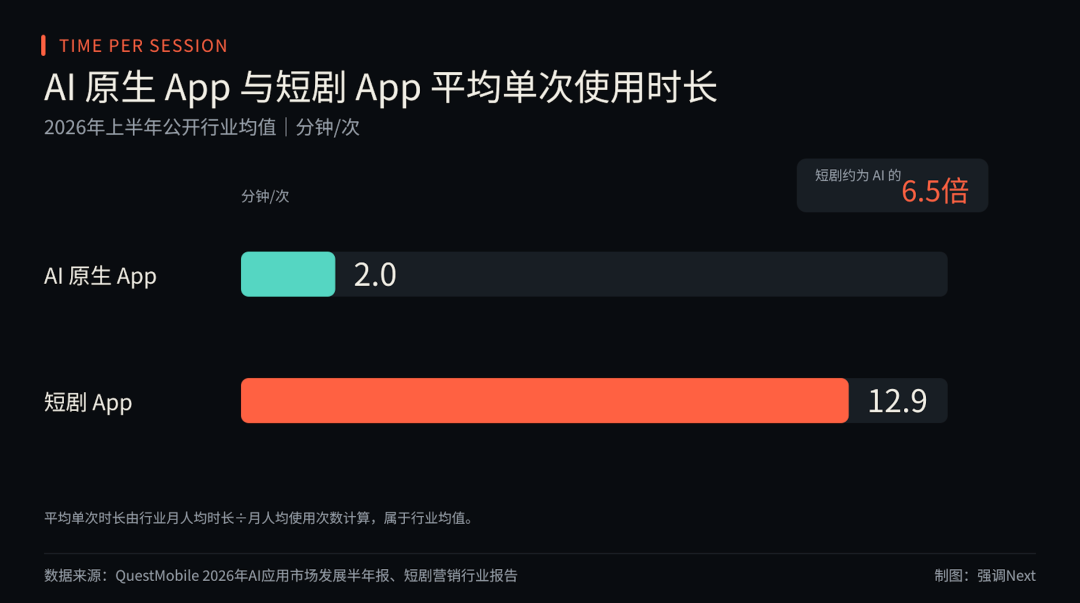
As of May 2026, the short drama industry's deduplicated user base reached 851 million, with 402 million using short drama apps—a 77.1% year-over-year increase. Hongguo Free Short Drama hit 356 million MAUs, up 79.1% year-over-year. Short drama app users average 125.6 sessions and 26.9 hours per month, with each session lasting approximately 12.9 minutes.
Hongguo has reduced paywalls for short dramas to near-zero, using recommendation feeds, incentive systems, and advertising to recoup content costs. From January to May 2026, the top five newly released short dramas each exceeded 290 million views, with the highest, Old Street Zhao Fengsheng, reaching 527 million views. Free does not equate to cheap content—platforms still bear costs for copyright procurement, production revenue sharing, and user incentives. Their advantage lies in mature advertising systems that rapidly commercialize traffic growth.
Qishui Music adopted a similar user acquisition strategy but retained membership revenue. In March 2026, its MAUs reached 156 million, up 78% year-over-year, surpassing NetEase Cloud Music's 147 million to rank third in the industry. Kugou Music and QQ Music had 205 million and 201 million MAUs, respectively, narrowing Qishui Music's gap with leading platforms to around 50 million.
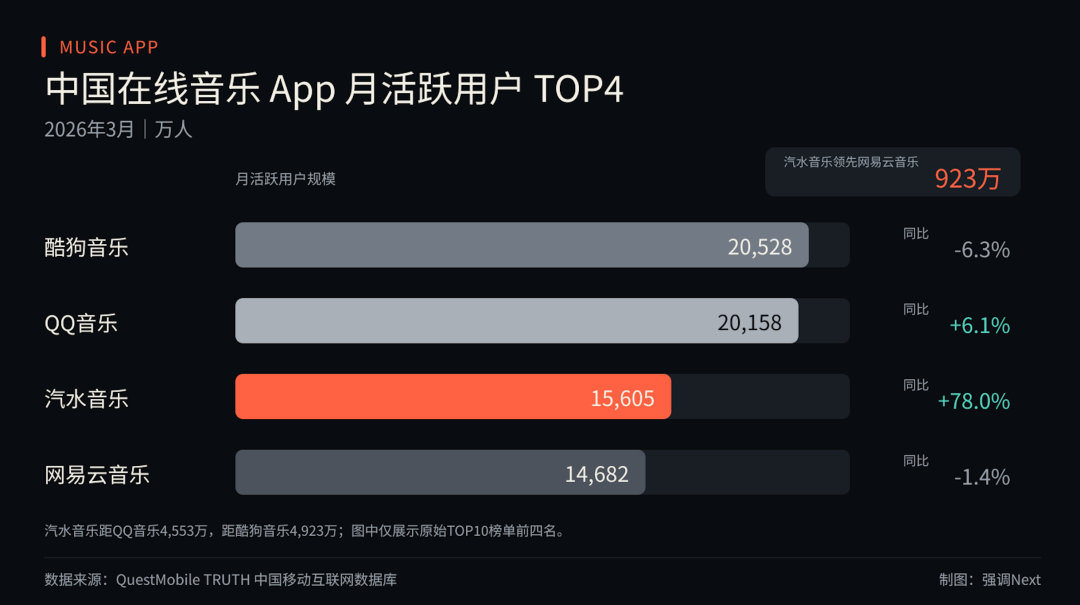
Hongguo and Qishui Music operate in two distinct markets but leverage the same infrastructure: Douyin traffic referrals, algorithmic recommendations, advertising sales, paid user acquisition, content moderation, and creator payouts.
Existing platforms face a dilemma: raising membership fees risks losing price-sensitive users, while expanding free content sacrifices established subscription revenue. ByteDance uses advertising revenue to subsidize free content, pulling long-form video and music platforms into a more familiar pricing landscape.
02. Monetization Efficiency May Not Align with Growth
The 40.1% denominator represents total user time across China's top 50 apps, not all mobile internet time. It also does not differentiate between chat, short dramas, music, shopping, or AI Q&A. A minute counts equally in statistics but not in financial terms.
Tencent's share of user time across the top 50 apps fell from 31.9% in June 2025 to 29.7% in June 2026. However, its Q1 2026 marketing services revenue still grew 20% year-over-year to 38.2 billion yuan. The company attributed this to improved ad recommendation efficiency, WeChat's in-app closed-loop marketing, and higher ad prices. During the same period, WeChat Channels' user time grew over 20% year-over-year, and WeChat Mini Store transaction volume growth boosted merchant technical service fees.
Tencent's data shows that total user time and ad revenue do not move in tandem—core factors include business models and monetization efficiency. WeChat payments, Mini Program transactions, and ad clicks; a short drama episode on Hongguo; or a free song on Qishui Music all contribute user time, but their ad prices, transaction commissions, and willingness to pay vary widely.
ByteDance has not disclosed revenue figures for Hongguo or Qishui Music, nor has it published unit-time ad revenue for domestic products. Current data confirms inventory growth but cannot verify whether this new user time matches Douyin's monetization efficiency.
However, Hongguo's foray into e-commerce suggests relying solely on advertising for 356 million MAUs is challenging. Excessive ads disrupt viewing, prompting the integration of in-show products and a mall to boost transaction revenue. Unlike Douyin's mature live-streaming commerce, Hongguo lacks a proven scenario to convert drama interest into stable sales—success hinges on repurchase rates and average order value.
Short drama apps also differ from mainstream video platforms in user demographics: 47.2% are from the post-70s and post-80s generations, with 63.1% in second- to fourth-tier cities. While these users expand Hongguo's reach, their ad value depends on actual conversion rates and cost-per-mille (CPM) rates.
To assess the value of ByteDance's 6.8 percentage-point user time growth this year, one must examine whether domestic ad revenue, ad prices, and per-user revenue can keep pace with time expansion.
03. Doubao Prioritizes Selling Quotas
Doubao cannot adopt the pricing models of content apps.
QuestMobile's H1 2026 report revealed that AI-native apps reached 499 million MAUs in June 2026, up 85.4% year-over-year. Users averaged 92.7 sessions and 183 minutes per month. At two minutes per session, this is just one-sixth of short drama apps' session duration. The more time an AI assistant saves, the higher its perceived value. Selling ads based on the duration of a user's stay would conflict with product efficiency and platform revenue.
Doubao's scale continues to grow. Its MAUs reached 382 million in June, up 13.78 million from May and 172.1% year-over-year, ranking first among domestic AI-native apps. The professional version launched on June 24, with App-side engagement still rising month-over-month in June, showing no significant user attrition. However, new users do not equate to new paid users—Doubao has not disclosed subscription numbers, paid conversion rates, or retention rates.
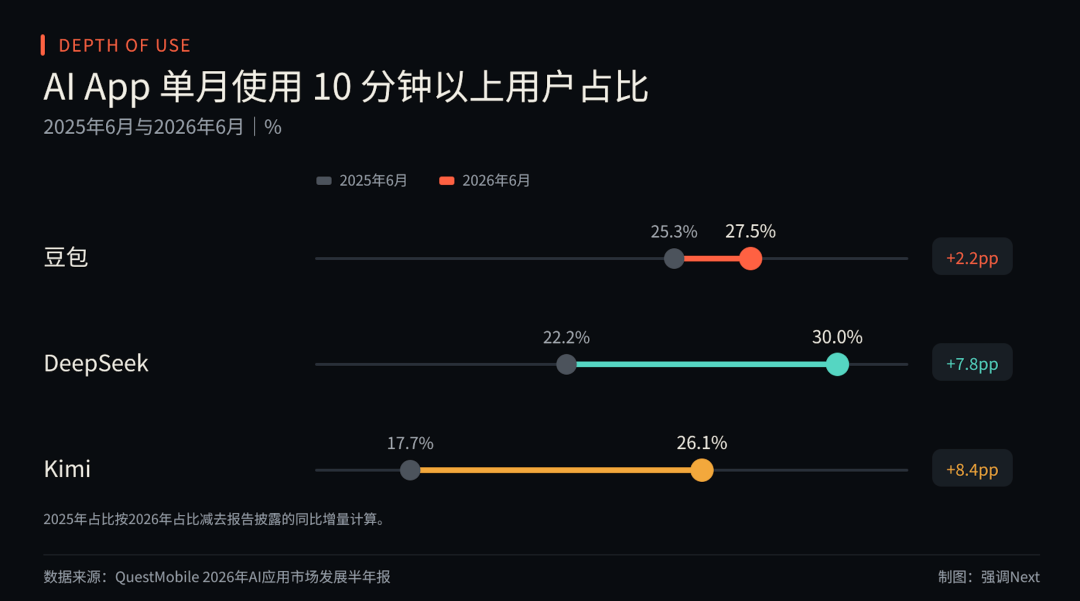
Deep usage metrics better reflect performance. In June, 27.5% of Doubao users spent over 10 minutes per month on the app, up just 2.2 percentage points year-over-year. DeepSeek and Kimi reached 30.0% and 26.1%, respectively, with year-over-year increases of 7.8 and 8.4 percentage points. While Doubao has the broadest reach, its user engagement growth lags behind competitors. For a productivity tool just starting to sell quotas, this directly impacts subscription conversions.
Doubao Professional offers three tiers: 68 yuan, 200 yuan, and 500 yuan. Paid benefits include higher expert mode quotas and office task allowances. Basic Q&A remains free, while complex tasks, long-duration executions, and high-computational tasks are reserved for paying users. Revenue shifted from the duration of a user's stay to model API calls and task delivery—integrating Feishu into Doubao aligns with this strategy.
Subscriptions require retention efforts, enterprise services demand sales and delivery teams, and e-commerce commissions need conversion from answers to orders. All three revenue streams grow slower than user acquisition, and Douyin's existing ad system cannot replicate these processes for Doubao.
These revenue streams mature slower than user growth. Reports in late 2025 claimed ByteDance's 2026 capital expenditures were initially planned at 160 billion yuan, with media in May 2026 suggesting a budget increase to over 200 billion yuan. While unconfirmed by ByteDance, the investment direction is clear: Doubao's user base requires more chips and data centers.
04. Beyond 40% User Time
ByteDance's user time share exceeding 40% means it continues to expand control over user attention. Hongguo and Qishui Music prove that Douyin's distribution, paid acquisition, and advertising capabilities can transfer to short dramas and music.
However, this approach falters with Doubao. AI-native apps average just 183 minutes of user time per month but incur ongoing inference costs. Larger user bases mean higher free service costs. If Doubao fails to improve paid conversion rates, enterprise API revenue, or transaction conversions, its 382 million MAUs will first translate into a larger computational bill.
Integrating Feishu into Doubao reflects ByteDance's hope to generate more revenue from office and enterprise users.
Evaluating ByteDance's new products now requires distinct metrics: Hongguo and Qishui Music should be judged by unit-time revenue, content costs, and ad prices. Doubao should be evaluated based on paid conversion rates, retention rates, per-task costs, and enterprise revenue. This highlights the fundamental difference between internet products and AI-native products.
ByteDance has secured the most user time. Next, it must make users pay for the time they save.
- END -
-
![]()
Analysis of Service Reputation Index in the First Half of 2026
-
![]()
After Leapmotor’s Monthly Sales Surpass 100,000 Units, Netizens Ponder: Who Will Be the Next Newcomer to Achieve Both Scale and Profitability?
-
Auto Market News: Tesla Refutes, Calls It 'False Information'!
-
1.5% Profit Margin for Complete Vehicles: Where is the Automotive Industry's Profit Shifting?
-
![]()
In-Depth Analysis | July Sales Performance of Emerging Auto Brands
-
![]()
July Sales of Emerging Automakers: Widespread Month-on-Month Declines, Leapmotor Leads with Over 100,000 Units Sold
-
![]()
Musk Clarifies: Tesla Has No Plans to Divest Chinese Operations
-
![]()
ByteDance, Capturing 40% of User Time, Seeks to Transform Its Revenue Model