Taobao Flash Sale Restructures: After a Year of 90 Billion Yuan in Losses in the Food Delivery Battle, Even Alibaba Can’t Sustain the Fight
 08/12 2026
 408
408
The organizational framework of Taobao Flash Sale has undergone another transformation.
This time, the focus is on the search function. On August 5, Simo, the former head of Flash Sale search products, shifted reporting lines from the Flash Sale business head to Meng Ke, the head of search at Taobao-Tmall Group. Concurrently, the teams under Junyu, the head of Flash Sale retail operations, responsible for search operations and commodity operations, were also placed under Meng Ke’s unified management.
This restructuring signifies that the three major components of Flash Sale—search products, search operations, and commodity operations—are now fully integrated into the Taobao-Tmall search system.
The official rationale for this move is "capability reuse." After operating independently from the Taobao-Tmall e-commerce system for over a year, Flash Sale is now reintegrating its search function to leverage the core e-commerce capabilities accumulated by Taobao-Tmall over two decades. This includes search and recommendation algorithms, product understanding, and user profiling, aiming to enhance efficiency and reduce costs through mutual complementarity.
While this explanation seems plausible, it may only be part of the story.
Taobao Flash Sale managed to boost its market share from 20% to 45% within a year, achieving an average of 60 million daily orders and peaking at over 120 million. Logically, a business on an upward trajectory should be granted more autonomy to forge ahead, rather than having its core sections reclaimed at this critical juncture.
The answer to this conundrum lies not with Flash Sale itself but with Taobao-Tmall—or more precisely, in Alibaba Group’s financial outlook for 2026.

Let’s first revisit the timeline to understand Flash Sale’s journey over the past year.
In April 2025, Taobao Hourly Delivery was officially upgraded to "Taobao Flash Sale," securing a prominent entrance on the Taobao App homepage and covering 50 cities nationwide on its first day. In July, a large-scale subsidy plan was launched, with subsidies increased again in September, leading to a meteoric rise in orders. In December, the Ele.me App was officially renamed Taobao Flash Sale, completing a comprehensive integration of branding, organization, and fulfillment networks. That same month, the supply chain and operations teams of the former Tmall Supermarket and Taobao Flash Sale were formally merged.
Throughout this year, Flash Sale operated independently—technologically, operationally, and in terms of reporting. The business head reported directly to Jiang Fan, facilitating short decision-making chains and rapid responsiveness.
In the instant retail sector, Meituan has long held sway, with mature infrastructure, user mindshare, and merchant networks. As a latecomer, failing to act swiftly would mean missing out entirely. The advantage of independent operations lies in high decision-making efficiency, allowing for rapid trial and error, adjustments, and scaling without being bogged down by large-system approval processes and cross-departmental coordination costs.
Facts validate this strategy.
By August 2025, Flash Sale’s daily order peak reached 120 million, with monthly active transaction users surpassing 300 million. A report by the China Federation of Logistics & Purchasing revealed that instant delivery orders exceeded 60 billion in 2025, with Meituan holding 51% and Alibaba 42%, solidifying a duopoly in instant retail.
A business that started from scratch managed to narrow the gap with Meituan to within a single position in just one year.
Growth continued into 2026, with overall order volume in the first quarter reaching 2.7 times that of the same period last year, and non-dining retail orders tripling. Daily orders stabilized around 60 million.
In one year, starting from zero, Flash Sale tore open a significant gap in Meituan’s monopolized instant retail market.
But the cost was staggering—nearly 100 billion yuan in losses. According to previous reports by 36Kr, from April 2025 to March 2026, Alibaba’s losses in instant retail reached approximately 90 billion yuan.
This means that with Alibaba’s adjusted EBITA for FY2025 at 173 billion yuan, Flash Sale burned through nearly half in a single year. According to CICC estimates, in Q3 and Q4 2025, Taobao Flash Sale’s EBITA losses were 36.7 billion yuan and 21.1 billion yuan, respectively. Losses remained high at 17-19 billion yuan in Q1 2026.
Flash Sale used massive investments to secure a market position on par with Meituan, proving Alibaba’s ability to enter the local services sector. However, after achieving this interim goal, the financial ledger must be rebalanced.
Image source: AI-generated
In May this year, Jiang Fan clarified new targets for the instant retail business during an earnings call: achieve positive monthly UE by FY2027, surpass 1 trillion yuan in overall transaction volume by FY2028, and achieve overall profitability by FY2029.
This means Taobao Flash Sale can no longer sustain losses.
Thus, the search integration into Taobao-Tmall, officially framed as "capability reuse," is actually aimed at addressing profitability issues. Flash Sale must reintegrate into the system, sharing technology, data, and operational capabilities with Taobao-Tmall to reduce costs, boost efficiency, and meet Alibaba’s stringent profitability targets.
This logic was previously demonstrated with Hema.
Hema’s GMV surpassed 107 billion yuan in FY2026, marking its second consecutive year of positive EBITA. Logically, a consistently profitable business under the "1+6+N" framework should be a priority for independent listing. Yet, CEO Yan Xiaolei’s reporting line shifted from the Hema board to Jiang Fan. A profitable business was similarly "reintegrated."
During the Q2 2025 earnings call, Jiang Fan disclosed that after Hema integrated with Taobao Flash Sale, its overall online orders surpassed 2 million, a year-over-year increase exceeding 70%. This growth largely stemmed from traffic inflows from Taobao Flash Sale rather than Hema App’s independent user acquisition capabilities. For independent listing, this growth structure is a flaw.
The logic is the same for reintegrating a consistently profitable business and a rapidly growing one: on Alibaba’s strategic chessboard, the value of independence has been superseded by systemic value. When the group needs to tighten its belt, all businesses must return to the system to share resources and distribute pressures.

Last year’s subsidy war was Alibaba’s entry ticket, acquired through massive investments. Now that the ticket is secured, the question becomes: how to recoup the money.
In 2026, Alibaba’s financial strategy has shifted.
AI is the top priority. Tongyi LLM, Alibaba Cloud’s intelligent computing power, and AI transformations across business lines all require substantial expenditures, growing by tens of billions annually. According to 36Kr, Alibaba’s leadership emphasized in board meetings that AI businesses must receive the strongest support this year. The two AI battles cannot be lost, as they represent a decade-long strategic direction requiring substantial cash flow. All other businesses must operate with strict fiscal discipline.
Meanwhile, Taobao-Tmall is also facing challenges. In Q1 2026, its adjusted EBITA was 24.01 billion yuan, a 40% year-over-year decline. Profit growth in core e-commerce is slowing, while AI demands continuous investment.
In this financial landscape, an instant retail business losing 10-20 billion yuan per quarter is no longer a "strategic investment" but a "financial burden." Capital markets have never been clearer in demanding profitable growth.
Simultaneously, the external environment is tightening.
In June this year, China’s State Administration for Market Regulation released the "Ten Provisions on Subsidy Behaviors by Food Delivery Platforms (Draft for Comments)," explicitly prohibiting "long-term, large-scale subsidies to exclude or restrict market competition" and "selling goods below cost." Growth driven by subsidies now faces policy ceilings. Burning money is no longer a sustainable moat, as regulations are tightening.
More importantly, at this stage, acquiring additional market share through subsidies becomes increasingly costly, with diminishing ROI. Later-stage factors like rider network density, ground team execution, and offline merchant operational experience require time to develop and cannot be rushed through subsidies.
Thus, Alibaba’s instant retail strategy must change—and change thoroughly.
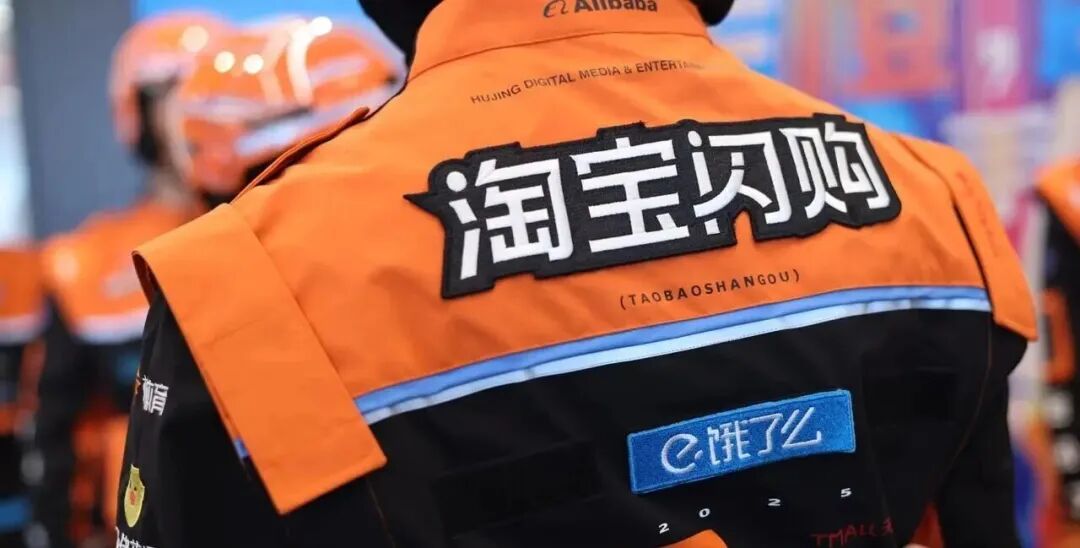
Image source: Internet
The most direct change is budget cuts. According to 36Kr, Alibaba’s investment in Taobao Flash Sale for the new fiscal year is half that of the previous year. Subsidies have been drastically reduced, with daily orders declining by about 30-40% from the summer peak to stabilize around 60 million. However, average loss per order has been compressed from high levels to 1.5 yuan.
From an industry perspective, the instant retail market surpassed 1 trillion yuan in scale in 2026, but its supply structure has long been imbalanced. Current transaction volumes heavily rely on dining categories, while high-margin categories like general merchandise, beauty, and home goods are severely undersupplied online. Traditional convenience stores, focused on in-store consumption, treat online as an ancillary business, offering limited product variety and inefficient picking, struggling to meet consumer demand for "everything delivered in 30 minutes."
Thus, Alibaba’s instant retail pivot.
This year, Taobao Convenience Store’s expansion target jumped from 1,000 to 3,000 stores, with 2 billion yuan in rental subsidies allocated to flash warehouses—30,000 yuan per month in Shanghai, 25,000 yuan in Hangzhou, and over 10,000 yuan in third- and fourth-tier cities. Hema’s front-end warehouses are accelerating deployment, while Tmall Supermarket shifts to 4-hour delivery.
The logic of this pivot is clear: after subsidies recede, what retains users is supply density and fulfillment efficiency. Warehouse networks, not red envelopes, are the true moat.
Alibaba must enable instant retail to achieve self-sufficiency within a visible timeframe. Positive monthly UE by FY2027 is mandatory. Flash Sale can no longer sustain losses because the group’s funds are reserved for AI.
Flash Sale’s current transformation is essentially a strategic choice under financial constraints—independence means independent losses, while reintegration means shared costs and distributed pressures.

Instant retail is evolving from an extension of food delivery into e-commerce infrastructure. As warehouse network densities among Meituan, JD, and Alibaba converge, competition is shifting from "who is faster" to "who is more precise." Precision hinges on search algorithms’ ability to process real-time supply-demand data.
Flash Sale’s role is being redefined. It is no longer merely an instant retail business but an experimental field for upgrading Taobao-Tmall’s search system from "history-driven" to "real-time-driven."
Alibaba’s losses in instant retail bought not just market share but training data for a real-time search algorithm. These data, generated from massive instant supply-demand matching scenarios—from user orders to 30-minute deliveries—provide real-time insights unavailable in Taobao’s years of accumulated "historical data."
Now, this real-time data capability is being injected into Taobao-Tmall’s core search system through organizational integration. Placing Flash Sale’s search under Meng Ke essentially resolves the issue of parallel search systems—data, algorithms, and traffic rules were fragmented between the main site and Flash Sale, incurring high coordination costs and fragmented user search experiences. Post-integration, Taobao-Tmall will have a unified core search system, with the main e-commerce site and Flash Sale sharing underlying algorithmic capabilities, product data, and user profiles.
Meng Ke is the right choice. He has experienced the full AI transformation of Taobao’s search and recommendation system and is familiar with Taobao-Tmall’s vast product inventory and user behavior data. Mature algorithms proven on the main site can potentially be adapted for Flash Sale.
However, this means Flash Sale must prove itself within a narrower financial framework. With subsidies receding and investments halved, it can no longer rely on burning money for growth but must retain users through efficiency and experience.
Otherwise, it risks being redefined into a narrower role.
*The featured image and illustrations in the text are sourced from the Internet.
-
How Far Have Domestic GPUs Progressed Behind Book Losses?
-
![]()
Taobao Flash Sale Restructures: After a Year of 90 Billion Yuan in Losses in the Food Delivery Battle, Even Alibaba Can’t Sustain the Fight
-
![]()
Valued at 7 Billion! Turing Quantum Races to Become the First Photonic Quantum Computing Company to Go Public
-
![]()
Revenue Sees Slight Rise, Net Profit Soars Twofold: Wavelength Opto-Electronic's 'Optics+' Strategy Yields Initial Fruits
-
![]()
Expected loss widens to HK$12.1 million! Ever Smart Eyewear issues profit warning
-
After 'No Right to Recall,' Can GAC Still Spin a Compelling Robot Tale?
-
![]()
Baidu's Critical Moment in AI Transformation: After Losing the Main Apple Partnership, What's Next for Ping Xiaoli's Strategy?
-
![]()
Voice Input: Opening the AI Gateway?