Baidu's Critical Moment in AI Transformation: After Losing the Main Apple Partnership, What's Next for Ping Xiaoli's Strategy?
 08/12 2026
 457
457
Introduction: Behind Apple's Shift to QianWen: Baidu's AI Dilemma and Ping Xiaoli's Commercialization Mandate
Recently, a new page quietly appeared in the Mac user manual on Apple's China website. The new chapter is titled "Using QianWen with Apple Intelligence on Mac."
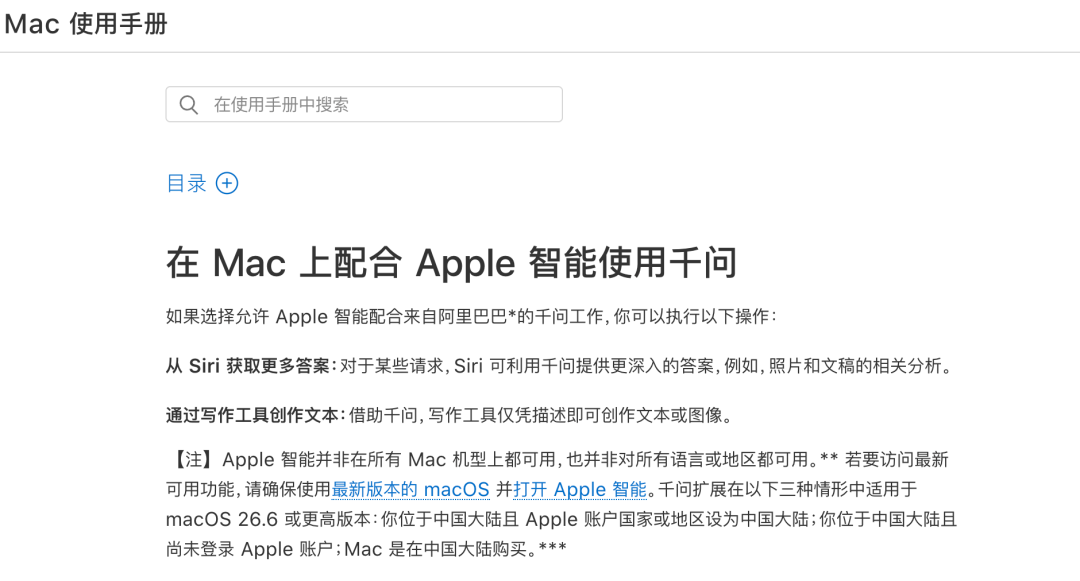
This marks the first time Apple has officially confirmed in documentation that Alibaba's QianWen is the partner for Apple Intelligence in China. Although the page was taken down less than a day after going live, it was seen by those who mattered. Customer service responded that the service is not yet available in the mainland and is still undergoing approval processes.
It is almost certain that Apple's China AI solution is ready, pending only final approvals.
Prior to this, Baidu had been the one constantly rumored to partner with Apple.
Starting in 2024, Apple engaged with Baidu, with many believing that Baidu's ERNIE Bot would serve as the AI foundation for iPhones in China.
However, foreign media also reported that Apple would later advance AI cooperation with Baidu, with the two companies focusing on developing AI-powered search capabilities. These features, part of the "Apple Intelligence" suite, could process images and text and upgrade China's version of Siri.
Rumors suggest Apple approached Baidu, DeepSeek, and ByteDance before finalizing a combination of Alibaba and Baidu, with Baidu handling about 35% of the tasks.
But regardless of whether future cooperation with Baidu occurs, Alibaba has already seized the spotlight and main position in the national iPhone AI partnership.
Once again, Baidu rose early but arrived late.
I. Apple's Choice of QianWen Over Baidu: No Surprise
Looking back, when Apple first engaged with Baidu, ERNIE Bot was performing exceptionally well. In 2024, other domestic AI products were still in their infancy, making Baidu the natural preferred choice.
But that was then.
QuestMobile's latest data clarifies the landscape.
In June 2026, Doubao, QianWen, and DeepSeek had 382 million, 167 million, and 129 million active users, respectively.
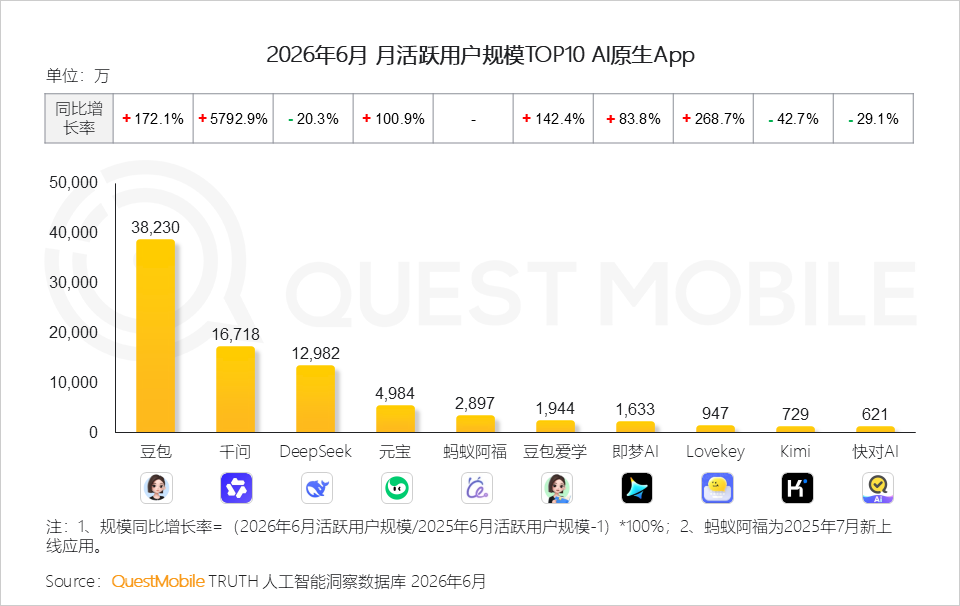
And ERNIE Bot? It fell out of the top ten, even lagging behind spin-off products like Ant Fortune and Doubao Aixue.
Once hailed as a "top contender," the standalone app's monthly active users have declined sharply, widening the gap with the leading pack.
Does Apple need more reasons to choose QianWen over Baidu?
But the impact on Baidu goes far beyond losing a major client.
Baidu is in a critical period of AI-driven growth transformation.
In Q1 2026, Baidu reported total revenue of RMB 32.075 billion, down 2% quarter-over-quarter. Online marketing revenue was RMB 12.6 billion, down 22% year-over-year and 17% quarter-over-quarter. Meanwhile, Baidu's new AI business continued to grow, generating RMB 13.6 billion in revenue, up 49% year-over-year and 21% quarter-over-quarter.
AI business growth is impressive but not yet sufficient to fully support Baidu's massive transformation.
At this juncture, Baidu desperately needs a market-shaking AI deal.
The Apple partnership was more than just a big deal—it was an endorsement that would have boosted market confidence in Baidu's AI capabilities.
What does securing Apple mean? It means the world's most discerning tech company recognize s (recognizes) your technology. Such brand premium is priceless.
Now that QianWen has taken this position, it's not good news for Baidu's transformation.
Imagine the scene.
Internally, Baidu's AI division has worked for years, finally achieving some success, only to see the most iconic deal snatched away. Externally, how will capital markets react? Why didn't Apple choose you? Internally, how to maintain team morale? The models developed with such effort didn't even receive "official certification."
More troubling is the potential for a negative feedback loop.
Without iconic deals, there are fewer scenarios for scaling (scaled) commercialization validation; without validation scenarios, it's harder to attract more major clients; without major clients, AI business revenue growth slows; with slowing revenue growth, the company's commitment to AI may waver.
Baidu desperately needs a win. Currently, there are two opportunities.
One is Robotaxi. In Q1 2026, Apollo Go's fully driverless operation orders reached 3.2 million, up about 129% year-over-year, with a weekly peak of over 350,000 orders in March. In terms of scale and technology, Baidu remains at the forefront of China's Robotaxi market.
The other is Kunlunxin, which is now targeting a Hong Kong IPO with a $50 billion valuation, exceeding even Baidu's current market cap. AI chips are a national strategic sector, and Baidu's early layout (layout) was forward-thinking.
But neither is without risks. In the first half of this year, Apollo Go experienced large-scale simultaneous outages, while the chip market competition is intensifying. Baidu must tread carefully in these two arenas, deepening its moats to better serve its future commercialization transformation.
II. Ping Xiaoli at the Helm of Commercialization: A Key Variable in Baidu's Transformation
When discussing Baidu's commercialization transformation, Ping Xiaoli must be mentioned.
On June 6, 2026, Baidu's Mobile Ecosystem Group announced an organizational restructuring. The E-Commerce Division and Commercial Division merged into the "Grand Commercial Division," while the Digital Human business upgraded from the e-commerce system to an independent business unit. Both changes are under the unified leadership of Group Vice President Ping Xiaoli.
From Baidu APP to Baidu E-Commerce and now the Grand Commercial Division, Ping Xiaoli, a young executive born in the 1980s, has become the most important figure in Baidu's commercialization efforts.
This recalls Alibaba's Jiang Fan.
Similarly born in the 1980s and a young executive who rose internally, Jiang Fan joined Alibaba in 2013, became President of Taobao in 2017, and President of Tmall in 2019, becoming Alibaba's youngest partner. After returning in 2024, he became CEO of Alibaba's E-Commerce Group, fully integrating Taobao & Tmall Group and International Digital Commerce.
It's no exaggeration to say that Alibaba's recent success owes much to Jiang Fan's personal capabilities.
Indeed, young executives are increasingly prominent among today's tech giants.
This year, Xiaomi suddenly ramped up efforts in large models, led by Luo Fuli, a post-90s head of Xiaomi's large model team. Kimi is now thriving, founded by Yang Zhilin, another post-90s.
In the AI era, there are many cases of young leaders stepping up in both technical and managerial roles. By empowering Ping Xiaoli in commercialization, Baidu is essentially doing the same—using younger decision-makers to navigate a rapidly changing market.
Baidu has never lacked talent; its reputation as the "Yellow Military Academy of AI" is well-deserved.
MiniMax founder Yan Junjie, Lingxi Shenzhi founder Cao Xiaodong, and Pony.ai founder Tiancheng Lou all hail from Baidu. Thus, expectations for Ping Xiaoli, a homegrown Baidu executive, are high.
But Ping Xiaoli faces a far more complex situation than Jiang Fan did.
When Jiang Fan took over Taobao and Tmall, Alibaba's e-commerce foundation was rock-solid; his task was to find incremental growth within a stable base. When Ping Xiaoli took over Baidu's commercialization, Baidu's foundation was loosening amid transformation.
In the past, Baidu's core cash flow came from search advertising. This model was so powerful and profitable that it created a gravitational pull, drawing all innovation back into the comfort zone of "how to sell ads better." This may explain why Baidu often saw the trends but failed to truly take off.
For example, Baidu recognized the mobile trend as early as 2009.
But when Toutiao and others captured user attention with information feeds and algorithms, Li Yanhong hesitated over whether small screens would degrade the experience. By the time Baidu reacted, Toutiao had grown into a behemoth.
When you hold the most profitable hammer, everything looks like a nail. But you forget that others might be inventing screwdrivers.
Today, Baidu stands at the crossroads of AI monetization. Ping Xiaoli and her commercialization team shoulder a heavier burden than ever, testing her personal capabilities.
The question Ping Xiaoli must answer is not "how to sell AI ads better" but "what else can Baidu do besides sell ads." If the answer remains "sell more and better AI ads," Baidu is merely replacing an older guardian with a younger one.
Baidu's biggest issue over the past decade was not unclear strategy but the inability to execute it. Every strategic shift eventually circled back to the comfort zone of search advertising.
Behind this was an overly long decision chain and centralized power. In 2025, Li Yanhong said internally that "organizational leaders should be younger, and we should encourage competition." In 2026, Baidu reformed its ranking system to empower young leaders and delegate authority to the frontlines. The direction is right, but implementation takes time.
Baidu is not without a chance to turn things around. The story of DeepSeek's overnight disruption of ChatGPT is still fresh, and the AI landscape is far from settled. Baidu has technical accumulate (accumulation), search access, and 679 million monthly active users on Baidu APP—these trump cards remain.
But having trump cards doesn't guarantee victory. What Ping Xiaoli and her team must prove is not that Baidu can survive in the AI era but that it can once again define the rules.
A company's youth may fade, but its courage to restart never grows old.
Those who typed the first lines of code in Zhongguancun in 2000 may have asked themselves at night: Can this path really work?
More than two decades later, at the AI era's crossroads, Baidu's young leaders face similar confusion. The answer lies not in anyone's hands but in the steps taken forward.
But someone must take the first step.
Disclaimer:
Please note: This analysis is based on publicly disclosed information (financial reports, announcements, etc.). The author does not guarantee the sufficiency or currency of the information sources. The stock market carries risks; principal may be lost. Investment decisions require extreme caution! All views expressed herein are solely the author's comments and are not buy/sell recommendations. Investors must conduct independent research based on their own circumstances, exercise prudent judgment, and assume all risks.
-
After 'No Right to Recall,' Can GAC Still Spin a Compelling Robot Tale?
-
![]()
Baidu's Critical Moment in AI Transformation: After Losing the Main Apple Partnership, What's Next for Ping Xiaoli's Strategy?
-
![]()
Voice Input: Opening the AI Gateway?
-
![]()
This Year’s Chengdu Motor Show: A Subdued Affair
-
![]()
Can a Small Car Priced at 63,900 Yuan Help Leapmotor Achieve Its Goal of 60% Overseas Sales?
-
![]()
Behind Two Renewed Agreements: Joint Venture Automakers Choose Long-Term Presence in China's New Energy Sector
-
![]()
Will Zunjie’s Launch of Two L3-Ready MPVs Spell the End of the ‘Price Markup Era’ for Alphard and Its Peers?
-
![]()
17 Strategies, 1.8 Billion Parcels, 12.5 Billion Yuan: Huizhou, Guangdong, Paves the Way for Autonomous Vehicle and Drone Delivery