How Far Have Domestic GPUs Progressed Behind Book Losses?
 08/12 2026
 488
488

Introduction: The Pursuit and Surpassing of Domestic GPUs.
Since a flurry of domestic GPU companies went public late last year, many have been keenly observing just how competitive domestic GPUs truly are. Recently, leading domestic GPU companies such as Cambrian and Moore Threads have successively released their financial reports for the first half of 2026, revealing more company details that warrant careful analysis.
As the first among the "Four Little Dragons of Domestic GPUs" to go public, Moore Threads serves as a typical example of the domestic general-purpose GPU route. Cambrian, representing an earlier-listed domestic GPU company, fiercely competes with other domestic GPU manufacturers in terms of product routes and commercialization.
Currently, both Moore Threads and Cambrian have cloud-based product lines. However, in terms of financial performance, Cambrian appears more stable. For instance, in terms of gross margin and profitability indicators, Moore Threads is still striving to improve. Is this solely due to differences in product routes?
01 Is the Decline in Gross Margin Due to Intelligent Computing?
Both Moore Threads and Cambrian operate in the domestic GPU sector, with one opting for full-function general-purpose GPUs and the other for dedicated AI acceleration chips. However, they share significant commonalities in commercialization, primarily targeting B2B clients such as major internet companies, government and enterprise clients, and intelligent computing centers.
Nevertheless, there are differences. Moore Threads has experienced a noticeable decline in gross margin, while Cambrian has maintained relative stability.
From a reporting period perspective, from the first quarter of 2025 to the first half of 2026, Cambrian's gross margin has remained around 55%, whereas Moore Threads' gross margin has dropped from 78% to 57%. Compared to its own historical data, Moore Threads' gross margin in the first half of this year has significantly decreased by approximately 12.19 percentage points year-on-year and by over 10 percentage points compared to the first quarter.

Moore Threads' Gross Margin Level; Source: East Money

Cambrian's Gross Margin Level; Source: East Money
The primary incentive (Note: ' incentive ' is translated as 'cause' or 'factor' in context, but kept as pinyin for accuracy if it's a specific term) behind the changes in Moore Threads' gross margin lies in its delivery structure.
Moore Threads derives the majority of its revenue from cloud-based products, accounting for over 97% of total revenue. In 2025, revenue from Moore Threads' cloud-based products reached approximately 1.461 billion yuan, and in the first half of 2026, it reached approximately 1.693 billion yuan. Relying on the strong sales of cloud-based products, Moore Threads' total revenue reached 1.506 billion yuan and 1.736 billion yuan in 2025 and the first half of 2026, respectively, with year-on-year increases of 243.37% and 147.42%.
However, the costs associated with cloud-based products are also high. In 2025, while revenue from cloud-based products increased by 250.3% year-on-year, the operating costs for this product line surged by 317.67% to 434 million yuan. Although the gross margin remained high at 70.32%, it still decreased by 4.79 percentage points year-on-year. In the first half of 2026, the cost of Moore Threads' cloud-based products reached 722 million yuan, with the company's overall cost reaching 748 million yuan, a year-on-year increase of 245.22%.
Moore Threads analyzed that the significant increase in operating costs in the first half of 2026 was primarily due to rising raw material prices in the semiconductor industry amid substantial revenue growth.
So, what are Moore Threads' main cloud-based products?
From a broad product line perspective, Moore Threads' current main products are simply categorized into cloud-based products and edge and terminal products. Cloud-based products refer to cloud intelligent computing boards, intelligent computing all-in-one machines, and intelligent computing clusters.
The main products of cloud intelligent computing boards include MTT S5000, MTT S4000, MTT S3000, etc., which are core computing units at the basic computing power level. The representative product of the intelligent computing cluster is Moore Threads' KUAE 10,000-card intelligent computing cluster, built based on the MTT S5000 intelligent computing card, primarily providing high-performance underlying computing power support for the training and inference of ultra-large-scale models.
The KUAE intelligent computing cluster can be considered Moore Threads' "heavy artillery." In late March this year, Moore Threads disclosed that it had sold KUAE intelligent computing clusters to clients, with a total contract value of 660 million yuan, and had completed delivery and revenue recognition.
The revenue from this significant order directly accounted for 38% of the company's total revenue in the first half of the year, approaching 40%.
However, it must also be acknowledged that the construction costs for "heavy artillery" like the KUAE intelligent computing cluster are substantial. Intelligent computing clusters do not just sell GPU boards but also require the purchase of a large number of third-party hardware components such as switches, power supplies, and server chassis. The costs of these externally procured components are fully included in operating costs, and the gross margin on these components is relatively low.
Although Cambrian also derives its main revenue from cloud-based products, its cloud-based products primarily include cloud intelligent chips and boards, as well as intelligent complete machines.
In particular, intelligent complete machines are server complete machine products that provide core computing capabilities through Cambrian's self-developed cloud intelligent chips and boards. The difference between its intelligent complete machine products and intelligent computing cluster system business lies in the fact that intelligent complete machines primarily provide individual servers within computing clusters rather than offering full cluster construction services, mainly targeting commercial client groups with a certain technical foundation.
In other words, in choosing between intelligent computing clusters and intelligent complete machines, Cambrian opted for the latter, making it relatively "lighter" than Moore Threads.
The decrease in gross margin cannot be solely attributed to products; clients must also be considered.
One of the risks faced by Moore Threads is its high proportion of major clients. This results in the concentration of major revenue and accounts receivable in the hands of a single major client or the top five clients. In terms of revenue, data from 2025 shows that sales to Moore Threads' top five clients amounted to approximately 1.375 billion yuan, accounting for 91.36% of the annual total sales. Sales to a single client exceeded 50% of the total.
More importantly, in terms of accounts receivable, as of June 30, 2026, 51.92% of Moore Threads' accounts receivable came from the client with the largest accounts receivable balance, while 99.27% of accounts receivable originated from the top five clients. In 2025, similarly, over 99% of accounts receivable came from the top five clients.
The top five clients account for almost all accounts receivable. Major clients have strong bargaining power, which can also affect gross profit margins.
In stark contrast to the gross margin of cloud-based products, although edge and terminal products account for a very low proportion of Moore Threads' revenue, their gross margin is very high. Financial report data for 2025 shows that the gross margin of edge and terminal products that year was approximately 39.99%, a significant year-on-year increase of 43.89 percentage points.
Moore Threads' edge and terminal product lines primarily include desktop graphics acceleration cards, professional visual acceleration cards, edge AI computing modules, and intelligent agent terminal devices. The representative product is the more consumer-oriented MTT S80, touted as the first domestic consumer-grade graphics card to support the Windows operating system and DirectX11/12 graphics APIs, primarily providing users with smooth 3A gaming experiences and daily entertainment computing support.
In addition, Moore Threads has also developed AI computing modules for the robotics and edge computing markets, such as the MTT E300, primarily based on its self-developed "Yangtze River" SoC chip, featuring an innovative modular design that highly integrates heterogeneous computing capabilities including full-function GPUs, high-performance CPUs, NPUs, and VPUs. It also offers products like MTT AIBOOK and MTT AICUBE for individual and home users.
02 Cambrian Remains Profitable, but Is Moore Threads Losing Money?
The contrast in profitability indicators between Moore Threads and Cambrian is also very stark.
From the first quarter of 2025 to the first half of 2026, Cambrian has consistently remained profitable, while Moore Threads only showed profitability in the first quarter of 2026. Does this mean Moore Threads is not truly profitable?
From the perspective of its main business, this may not be the case.
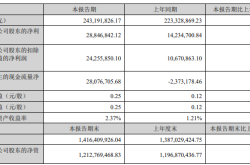
Financial data shows that in the first half of 2026, Moore Threads reported a net loss attributable to shareholders of 11.5631 million yuan and a net loss after deducting non-recurring items of 151 million yuan, but it had significantly reduced losses year-on-year.
Notably, a significant portion of these losses was due to "share-based compensation." The financial report clearly indicates that after deducting the impact of share-based compensation, Moore Threads was profitable by 83.5316 million yuan, compared to a loss of 166 million yuan in the same period last year.
This share-based compensation specifically refers to equity-settled share-based compensation and cash-settled share-based compensation.
Moore Threads adopts equity-settled share-based compensation, which involves transactions where the company provides services in exchange for shares or other equity instruments as consideration.
The recipients of Moore Threads' share grants include sales, management, and R&D personnel. In the first half of this year, a total of approximately 607,500 shares were granted, corresponding to a total fair value of equity of approximately 210 million yuan.
All costs arising from share-based compensation are settled in equity rather than cash.
Among these, in sales expenses, share-based compensation costs amounted to approximately 11.1531 million yuan; in management expenses, the costs were approximately 37.2191 million yuan; and in R&D expenses, the costs were approximately 46.7226 million yuan. These three items totaled approximately 95.0947 million yuan.
From the structure of share-based compensation costs, it is evident that nearly half (46.7226 million yuan) of Moore Threads' over 90 million yuan in share-based compensation costs were allocated to R&D, far higher than the sales and management sectors. This also reflects the technology-intensive nature of the GPU industry, where chip architecture, driver algorithms, and hardware iteration all require substantial long-term R&D investment. Offering substantial equity incentives to retain core R&D personnel is a common practice among chip design companies.
For example, Cambrian also stated that it continues to implement equity incentive plans. In the first half of this year, Cambrian incurred share-based compensation costs of 43.8482 million yuan, of which 33.2613 million yuan occurred in the R&D sector, accounting for approximately 75.86% of the share-based compensation.
It is also interesting to note here that Cambrian's share-based compensation amount is significantly lower than Moore Threads', perhaps reflecting different attitudes towards equity incentives between the two companies.
In the first half of this year, after deducting the impact of equity-based payments, Cambrian's net profit attributable to shareholders increased from 2.311 billion yuan to 2.355 billion yuan.
It is important to clarify that the impact of share-based compensation on the net profits of companies like Moore Threads and Cambrian is persistent.
Moore Threads' total equity grant of 210 million yuan (total fair value on the grant date, theoretical upper limit, not equal to the remaining amortization) only amortized 95.0947 million yuan in the first half of the year. The remaining amount may partially lapse or be amortized into expenses in future years, and subsequent financial reports will continue to be affected by share-based compensation costs. The reported net profit will remain lower than the operating profit after deducting share-based compensation for an extended period.
Although share-based compensation increases the company's accounting costs in the short term, it is aimed at maintaining technological competitiveness in the long term. In the first half of 2026, Moore Threads experienced "accounting book losses while its main business was already profitable." The losses were due to the accounting treatment of equity incentives without actual cash outflow. The company's main GPU-related business had already generated positive operating profits. Substantial R&D equity incentives are a Regular (Note: ' Regular ' is translated as 'common' or 'standard' in context, but kept as pinyin for accuracy if it's a specific term) practice for chip companies at their development stage. However, the remaining equity amortization expenses will continue to affect the company's reported net profit data for some time.
To add a bit more detail, according to Moore Threads' "2026 Restricted Stock Incentive Plan (Draft)" formulated in April 2026, the 607,500 second-class restricted stock units granted in this phase are not immediately vested upon grant.
The equity vests in two equal installments of 50% each, with the earliest vesting period after May 2027 and the latest vesting window until May 2029. Employees must meet three conditions simultaneously—being employed, the company achieving revenue performance targets, and passing personal performance evaluations—to complete vesting and must pay an exercise price of 320.4 yuan per share.
If the company fails to meet performance targets, employees leave, or fail evaluations, the corresponding batch of shares becomes void and invalid, and employees cannot acquire that portion of equity.
The share-based compensation costs already accounted for in the financial report represent periodic amortization at the accounting level and have a time lag compared to employees actually receiving equity and realizing cash-out. There is also the possibility of partial cost reversal due to equity lapse.
From the perspective of the entire domestic GPU industry, the financial reports of these two leading companies reflect two unignorable realities in the industry.
First, domestic GPU companies are still in the early stages of commercialization. Although high R&D expenses create operating pressure, from a main business perspective, they have already entered or are about to enter a positive cycle.
Second, chip competition ultimately boils down to talent competition, and equity incentives have become an industry-wide choice. This means that share-based compensation will continue to affect financial report net profits for an extended period. For domestic GPU companies, in addition to focusing on net profit indicators, revenue growth, gross margin, and operating cash flow are also signals closer to true business operations.
The true test for domestic GPU companies is not book profitability under a certain adjusted caliber (Note: ' caliber ' is translated as 'basis' or 'method' in context, but kept as pinyin for accuracy if it's a specific term) but their ability to continuously secure client orders and genuinely generate positive cash flow.
-
How Far Have Domestic GPUs Progressed Behind Book Losses?
-
![]()
Taobao Flash Sale Restructures: After a Year of 90 Billion Yuan in Losses in the Food Delivery Battle, Even Alibaba Can’t Sustain the Fight
-
![]()
Valued at 7 Billion! Turing Quantum Races to Become the First Photonic Quantum Computing Company to Go Public
-
![]()
Revenue Sees Slight Rise, Net Profit Soars Twofold: Wavelength Opto-Electronic's 'Optics+' Strategy Yields Initial Fruits
-
![]()
Expected loss widens to HK$12.1 million! Ever Smart Eyewear issues profit warning
-
After 'No Right to Recall,' Can GAC Still Spin a Compelling Robot Tale?
-
![]()
Baidu's Critical Moment in AI Transformation: After Losing the Main Apple Partnership, What's Next for Ping Xiaoli's Strategy?
-
![]()
Voice Input: Opening the AI Gateway?