China Initiates Satellite IoT Operations, with Geely Satellite Networks Poised for 6G
 08/25 2026
 491
491

Why Geely Satellite Networks' Licensing Could Mark a Turning Point for the Commercial Space Industry
The gateway to satellite IoT operations has now been unlocked for private enterprises.
On August 20th, the MIIT (Ministry of Industry and Information Technology) website announced the approval granted to Zhejiang Geely Satellite Networks Technology Co., Ltd. to conduct a two-year commercial trial for satellite IoT operations.
In recent years, over 600 domestic commercial space entities have emerged, with industry-wide financing reaching approximately RMB 18.6 billion in 2025, marking a 32% year-on-year increase. Yet, a fundamental question persists: Who will foot the bill for continuous signal provision after satellite launches?
Satellite manufacturing, network deployment, and launches all demand substantial capital investment, yet a clear pathway to compliant commercialization has remained elusive. The absence of operational qualifications has hindered the establishment of long-term service contracts—a challenge prevalent across the industry.
With Geely Satellite Networks' approval, this invisible barrier has been overcome. During the trial period, the company is legally permitted to operate satellite IoT services and provide global device connectivity. This transition from "usable" to "chargeable" signals a fundamental shift in industry logic.
However, questions linger: Why was Geely Satellite Networks chosen among over 600 candidates?
To answer this, we must delve deeper than the approval itself—into founder Wang Yang's 12-year journey in the industry, the complete evolution of China's satellite IoT sector, and the industry's pivot from satellite manufacturing to operational realization.
01 The Significance of a License
To grasp the value of this approval, we must examine the industry's previous landscape.
Satellite IoT is not a novel concept. Low-Earth orbit (LEO) satellites inherently offer global coverage and low latency, making them the only viable option for oceans, deserts, high-altitude regions, and remote mining areas where terrestrial networks are unavailable.
However, regulatory ambiguities in this field have long persisted: unclear rules governed frequency allocation, operational qualifications, and data security management. Enterprises faced a dilemma—commercialization lacked compliant pathways, while non-commercial operations left orbiting constellations as mere cost centers.
By 2025, policies had finally taken shape. The MIIT issued notices for commercial satellite IoT trials, setting stringent entry requirements: applicants must obtain satellite mobile frequency usage permits and space radio station licenses; constellation projects require National Development and Reform Commission approval; operational satellite constellation systems must be in orbit; and robust cybersecurity and data protection capabilities must be demonstrated.
Frequency and constellation approvals represent policy prerequisites, while in-orbit systems prove technical prowess. Security and service capabilities form the operational foundation. Each requirement acts as a rigorous filter, eliminating many enterprises still in the planning stages.
The high threshold underscores the significance of this endeavor. Satellite communications operations involve frequency resources, national security, and public services—far exceeding the scope of ordinary businesses. Enterprises clearing these hurdles have undergone comprehensive state-level reviews of their constellation construction, system operations, and security capabilities.
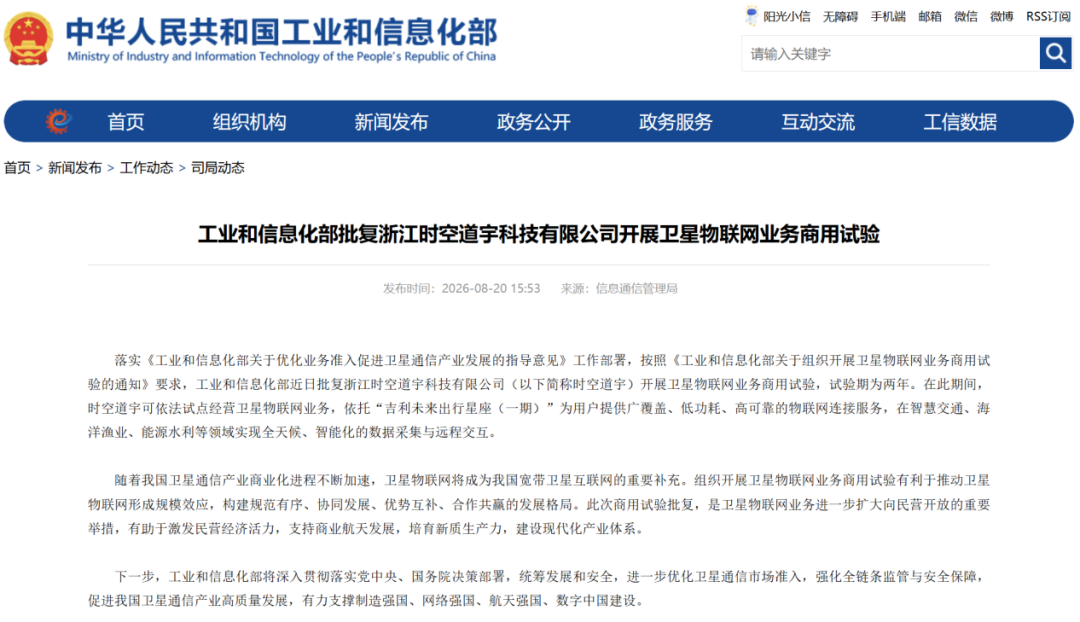
MIIT Screenshot
The approval sends a clear message: satellite IoT operations are now open to private enterprises, which will play a pivotal role in industrial development.
Previously, private companies primarily handled manufacturing and launches in the commercial space chain, with operations remaining restricted. Now, their role expands from "launching satellites" to "delivering signals."
More profoundly, this shifts the industry's competitive logic. Market evaluations of commercial space enterprises previously focused on rocket launch frequency, in-orbit satellite count, and constellation scale—emphasizing manufacturing and networking speed.
With operational qualifications established, evaluation criteria now pivot: Can constellations operate stably? Can they serve real customers? Can they generate sustainable revenue? Can they achieve commercial viability?
Manufacturing satellites is merely a means; operations are the ultimate goal. As compliant operational pathways open, the satellite IoT industry's focus naturally shifts from construction to operations. This represents a paradigm shift across the entire sector, with licensed enterprises now standing at the starting line of this new race.
02 Wang Yang's Twelve-Year Odyssey
Geely Satellite Networks' ability to clear this threshold is inseparable from Wang Yang's vision and leadership.
After graduating in 2004, Wang's first job was with Huawei during China's critical 2G-to-3G telecommunications transition. This experience taught him that communication technologies derive value from universal service accessibility—technical sophistication alone isn't the endpoint; enabling broader scenarios and user affordability defines the telecommunications industry's essence.
In 2008, Wang joined the Shanghai Micro-Satellite Engineering Center at the Chinese Academy of Sciences. Starting as a satellite onboard computer software engineer, he participated in the entire satellite development process—from R&D and ground testing systems to final assembly, integration, and testing. Every aerospace mission he handled during those years achieved success, building his comprehensive understanding of aerospace systems engineering.
His institutional research experience established solid technical foundations while revealing limitations in traditional aerospace models for commercialization. While satellites could be precisely delivered to orbit, penetrating mass markets and serving diverse industry scenarios proved challenging.
By then, he had determined that LEO satellite communications based on microsatellites represented the inevitable convergence of aerospace and telecommunications.
In 2014, China first encouraged private capital to enter the aerospace sector. Wang responded immediately, leaving his position to establish a team focused on LEO communications satellite R&D. With no mature domestic private satellite supply chain, no reference mass production models, and restricted procurement channels for core components, the team had to independently develop everything from constellation design and satellite platforms to ground systems—completing the entire process from scratch.
Four years later, the "Jiading-1" satellite successfully reached orbit. This microsatellite, weighing under 100 kg, became China's first IoT communications satellite independently developed by a private enterprise. Its successful orbital deployment validated the feasibility of private aerospace ventures.
In 2018, Geely Satellite Networks was formally established. The founding team carried strong aerospace pedigrees: 14 of the 18 core members were engineers averaging 15 years of aerospace experience, with many having served as chief commanders or chief designers for satellite models.
From the outset, Wang understood that commercial aerospace must prioritize commerce over traditional customized, project-based approaches. A scalable, replicable, and mass-producible path was essential.
Instead of pursuing the then-popular LEO broadband communications track, the team chose LEO satellite IoT. Operating in UHF/VHF bands, their technical approach emphasized connection reliability and continuous availability.
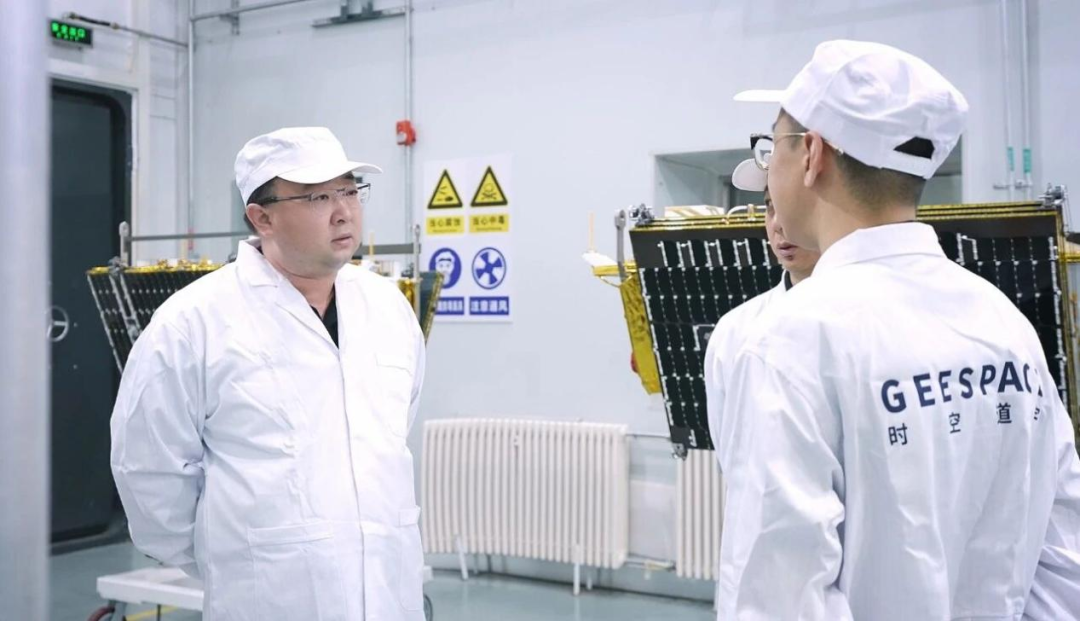
In remote oceans, deserts, and forests—or during disasters when public networks fail—this satellite link must remain stable. This positioning secured Geely Satellite Networks' constellation as the ultimate backup network.
Notably, this strategic choice relied on the company's full-stack self-developed technologies.
From constellation system design and satellite R&D/mass production to communications protocols and ground control networks, from terminal chip/module development to modular satellite manufacturing processes, the team mastered core technologies across the entire chain. To control costs and boost production capacity, they introduced automotive industry mass production management techniques—modular design, pulse production lines, and standardized testing systems—to revolutionize satellite manufacturing workflows.
In June 2022, Geely Satellite Networks successfully launched its first orbital deployment with nine satellites. Over the next three years, five successful launches completed Phase I constellation deployment by 2025. Currently, all 64 in-orbit satellites maintain 100% operational and network reliability.
However, completing Phase I deployment marked only a phased milestone. Looking toward the 6G era, Wang holds a longer-term vision.
In his view, 6G represents more than just communication speed improvements—it redefines network boundaries, expanding from terrestrial to space-based coverage and from partial to universal connectivity. Satellite networks will transition from terrestrial communication supplements to essential components of next-generation integrated space-terrestrial networks.
This vision explains Geely Satellite Networks' early focus on LEO satellite IoT, which now aligns perfectly with 6G development directions.
Within the 3GPP framework, NTN (Non-Terrestrial Network) technology evolves along two paths: IoT NTN for massive low-power IoT connections, and NR NTN for direct smartphone satellite connectivity. Geely Satellite Networks has initiated IoT NTN technical trials while advancing NR NTN R&D, showcasing related satellite technology solutions at MWC Shanghai.
This creates a clear technological evolution path: entering through satellite IoT, validating network capabilities through industry applications, then extending into 6G scenarios.
While overseas LEO communications constellations started earlier, technological evolution windows exist between legacy satellites and next-gen communication standards. As 6G approaches commercialization, Chinese enterprises can bypass previous technological iterations and directly deploy next-gen solutions.
From satellite IoT to 6G NTN, Geely Satellite Networks is transforming today's commercial capabilities into first-mover advantages for next-gen communication networks.
03 From Networking to Operations
Obtaining the license marks only the beginning.
The two-year trial period will truly test whether satellite IoT can achieve scalable commercial operations and sustainable profitability—a question awaiting industry-wide validation.
Current progress shows Geely Satellite Networks has completed commercial validations across multiple scenarios.
In 2023, mass-produced vehicles equipped with Geely Satellite Networks' communication terminals entered the market, enabling emergency calls, location reporting, and messaging in areas without terrestrial signals. Over 20,000 vehicle-mounted terminals have now been pre-installed. Autonomous driving fleets partnered with ride-hailing platforms, fully equipped with LEO satellite IoT terminals, have conducted real-vehicle tests across multiple cities, accumulating nearly 100,000 kilometers of verified operation.
Construction machinery represents another rapidly growing field. Geely Satellite Networks has completed commercial validation tests with multiple leading domestic construction machinery enterprises, with installation scale expected to reach tens of thousands of units this year. In mining sites and remote construction areas with weak terrestrial coverage, satellite connections enable real-time equipment status transmission and remote scheduling, improving operational efficiency while providing communication infrastructure for unmanned operations.
For ocean-going and coastal vessels, satellite terminals enable full-waterway position tracking, distress signaling, and two-way messaging, supporting ship-shore safety management and coordination. In Zhejiang, LEO satellite communication devices have been deployed on maritime patrol boats, addressing communication gaps in offshore law enforcement. In eastern Guangdong waters, satellite-enhanced buoys create dual-link redundant communication architectures, resolving unstable far-sea navigation marker communications.
Energy, water conservancy, emergency response, forestry, and other sectors are also completing validations. For example, a laboratory jointly established with PetroChina is advancing satellite IoT applications across the entire oil and gas supply chain. During flood control drills in Guiping, Guangxi, the satellite system transmitted hydrological data. In emergency communication drills in Mabian, Sichuan, satellite terminals supported position reporting, trajectory tracking, and one-click distress calls for frontline emergency responders after public network failures.

These industry-specific implementations share a common logic: terrestrial network coverage always has boundaries, while satellite communications fill these gaps, providing guaranteed connectivity for scenarios requiring continuous online presence. This extends network coverage boundaries, becoming part of the digital infrastructure for societal operations.
The arrival of 6G further amplifies this value.
From today's industrial IoT to 6G technology pre-research, satellite communication's user base continuously expands. For Geely Satellite Networks, accumulated capabilities in constellation deployment, terminal development, operations, and industry applications will form the basis for entering the 6G integrated space-terrestrial communication system.
While advancing steadily in the domestic market, the company is also expanding globally. Focusing on the Middle East, Africa, Southeast Asia, Central Asia, South Asia, and Latin America, Geely Satellite Networks has completed commercial validation tests with communication operators in over 20 countries.
The company is on a mission to attain global commercialization. In contrast to Starlink, which aims to completely supplant terrestrial networks, Geely Satellite Networks is currently focusing on medium-to-low-speed satellite communications tailored for IoT industrial applications. The goal is to amass 20 million users worldwide, positioning itself as the world's second-largest communication constellation by user volume, following Starlink.
The achievement of this approval can be attributed to technological advancements, strategic route planning, and robust implementation capabilities. Over the course of twelve years of deep industry immersion, the team has developed a rigorous understanding of aerospace systems engineering and the essence of telecommunications services. By mastering full-stack self-developed technologies and maintaining a commercial mindset for scalable implementations, they have emerged as the private candidate that meets all entry criteria.
The industrial significance of this approval extends well beyond a mere qualification breakthrough for a single company. It signifies China's satellite IoT industry officially stepping into the operational services phase, with competition transitioning from constellation scale to commercial viability.
More significantly, operational capabilities are emerging as core variables in the competition for next-generation communication networks. The current commercialization of satellite IoT represents Geely Satellite Networks' initial foray into telecommunications. Their pre-research on IoT NTN and NR NTN technologies for 6G opens up even broader avenues for imagination.
The upcoming trial period will delve into establishing compliant operational standards, replicable business models, and scalable implementation paths for the entire industry, thereby amassing valuable experience for future market entrants.
The boom in satellite manufacturing will inevitably wane. The true industrial marathon has only just commenced.
This article is an original work by Xinmou. For reprint authorization and business cooperation, please get in touch.
— END —
-
![]()
Beyond APIs: Future-Oriented Strategies for AI Global Expansion
-
![]()
Behind the Daily Average of 140 Trillion Token Calls: Who Will Become China's Future New Three Major Operators?
-
![]()
How Many Zhipu Members Were Wrongly Banned?
-
![]()
Leapmotor Revises Profit Goal to 3 Billion Yuan: Targets 400,000 Overseas Sales in the Coming Year, Forges Symbiotic Alliance with FAW | MINGJINGpro
-
![]()
Behind the 140 Trillion Token Calls Per Day: Who Will Become China's New Big Three Operators in the Future?
-
![]()
DPCA Technology Launched, Pioneering a New Era for Joint Ventures: Taking 'Chinese Heritage' Global
-
![]()
Spring in the Rack: UCloud Rides High, Yet Fundamentals Impose Limits
-
![]()
Why Has the 'Urban Bulk Commodity Boom' Intensified Over the Past Two Years?