2025 Autonomous Driving Insights (4): Six Key Trends in Global Autonomous Robotaxi Services, with Apollo Go, Google Waymo, and Tesla at the Forefront; China’s Policy and Regulatory Framework Need a Sw
 12/31 2025
 640
640
Introduction
In 2025, the global landscape of Robotaxi companies is witnessing distinct developmental trajectories:
Chinese autonomous driving pioneers, exemplified by Apollo Go, are making significant inroads on the global stage, penetrating markets across the Middle East and Europe, including Dubai, Abu Dhabi, and Switzerland, thereby showcasing a diversified and expansive market presence.
Concurrently, U.S. giants such as Google Waymo and Tesla are intensifying their all-weather service offerings in cities like San Francisco, Phoenix, and Los Angeles, accelerating the large-scale deployment within their domestic markets.
Simultaneously, the competitive landscape in the Robotaxi sector has shifted from a singular focus on 'driverless' capabilities to a holistic competition encompassing vehicle dispatch efficiency and user travel experience. Leading players are harnessing their extensive operational networks, with the 'data flywheel effect' becoming increasingly prominent, establishing formidable barriers in handling long-tail scenarios and accelerating algorithm iteration. Furthermore, alliances between traditional automakers and tech firms are deepening, collectively driving the integration of vehicle manufacturing, AI platforms, and mobility services, thereby laying a robust foundation for the next phase of global market expansion.
Reflecting on 2025, six pivotal trends in the global Robotaxi industry have spanned the entire year and warrant attention. (For reference, please click: 2025 Autonomous Driving Insights (3): Autonomous Driving Surges Ahead, Transitioning from Technical Validation to Commercial Mass Production, Unleashing a Wealth of Opportunities in the Industrial Chain!)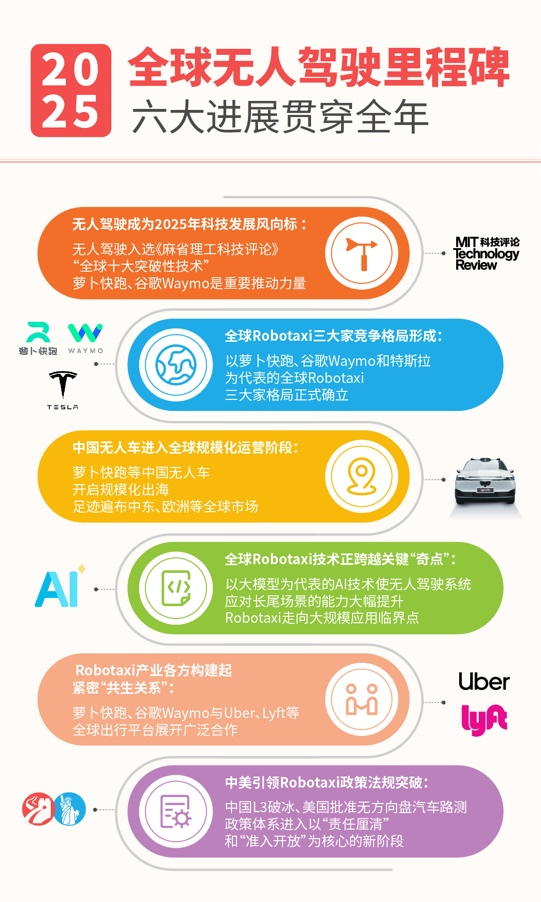
Development 1: Autonomous Driving Emerges as a Technological Benchmark in 2025
In January 2025, the globally esteemed technology journal MIT Technology Review unveiled its 'Top 10 Breakthrough Technologies of the Year,' with autonomous driving and generative AI among the selected emerging industries. Players like Baidu and Google have emerged as pivotal forces driving the global advancement of autonomous driving technology. (For reference, please click: Autonomous Driving: Selected as One of MIT Technology Review's 'Top 10 Breakthrough Technologies of 2025'! Baidu, Google, and Others Lead the Way)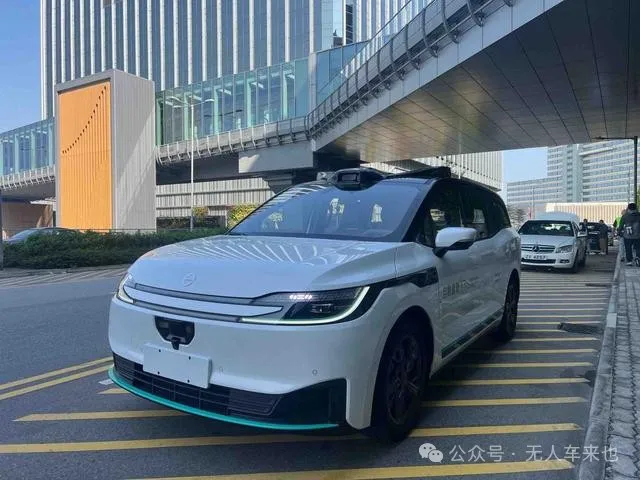
MIT Technology Review stated, "Robotaxi services from companies like Baidu are now accessible in multiple cities across China, with plans to expand into Singapore and the Middle East. Compared to three years ago, the autonomous driving industry has undergone profound transformations, with an increasing number of people experiencing Robotaxi services and a growing recognition of this innovative technology."
Development 2: Emergence of a Tripartite Competition Among Global Robotaxi Leaders
In June 2025, Tesla made a grand announcement regarding the launch of its Robotaxi service in Austin, Texas, with Musk boldly asserting plans to deploy millions of Robotaxis globally. This marked the formal establishment of a global Robotaxi leadership trio, represented by Apollo Go, Google Waymo, and Tesla. The race among global tech firms in this domain continues to intensify, underscoring the urgency for China to secure the technological high ground promptly.
Specifically, Waymo has deployed over 2,500 autonomous vehicles across the United States and plans to expand from its current five cities to twelve, including Detroit and Washington. Tesla has announced the removal of safety operators, aiming to cover eight to ten metropolitan areas across multiple U.S. states by the year's end. Meanwhile, Apollo Go has launched services in 22 cities worldwide, with cumulative service trips surpassing 17 million.
Development 3: Chinese Autonomous Vehicles Enter the Global Mass Operation Phase
In 2025, the overseas expansion of Chinese manufacturing enterprises and digital economy platforms, representing new quality productive forces, has transcended mere hardware and commodity trade, entering a new era centered on 'intelligent solutions' and 'digital ecosystems.' This showcases robust capabilities in technology integration and customized overseas expansion.
In the autonomous driving sector, companies like Apollo Go have pioneered large-scale overseas expansion, establishing a presence in Middle Eastern and European markets such as Dubai and Abu Dhabi, marking a significant milestone for China's Robotaxi industry in 2025. (For reference, please click: China's Autonomous Driving Robotaxi Market Has Formed a 'One Super, Two Strong' Landscape: Baidu Apollo Go Leads, with WeRide and Pony.ai as Core Challengers)
Notably, Apollo Go's autonomous driving services are poised to be the first to enter London, UK, in 2026, expanding into global right-hand drive markets beyond Hong Kong, China. From large-scale services in domestic markets like Beijing, Shanghai, Shenzhen, Wuhan, and Chongqing to the deployment in global right-hand drive markets like Hong Kong and London, Chinese autonomous vehicles have taken the lead in technical validation and are exploring a profound transformation from 'domestic leadership' to 'global operations,' continuing to lead in the global autonomous driving race.
Development 4: Global Robotaxi Technology Approaches a Critical 'Tipping Point'
In 2025, global Robotaxi technology is on the cusp of a breakthrough, with significant enhancements in perception and prediction capabilities and end-to-end algorithms. AI technologies, represented by large models, have substantially improved the system's ability to handle long-tail scenarios. Meanwhile, the performance of core components such as automotive-grade computing chips, operating systems, LiDAR, and millimeter-wave radar continues to improve, with costs steadily declining.
Driven by the trifecta of technological maturity, cost reduction, and expanded demonstration applications, Robotaxi services are nearing the critical point of large-scale deployment.
Development 5: Robotaxi Industry Players Forge Close 'Symbiotic Relationships'
In 2025, the Robotaxi industry has evolved from isolated technological competitions to a deep collaboration centered around 'technological deployment and commercial closed loops.' Tech companies, algorithm firms, mobility platforms, and traditional automakers are engaging in extensive cooperation to jointly advance technological deployment and operational rollouts.
Focusing on technological empowerment and ecosystem openness, leading autonomous driving companies like Apollo Go and Google Waymo have begun to play 'foundational' roles, opening up their capabilities to partners within the ecosystem.
For instance, Apollo Go has collaborated with global mobility platforms Uber and Lyft to deploy Robotaxi services on a large scale in the Middle East, Asia, and Europe. It has also partnered with local mobility service providers in Abu Dhabi and Switzerland to implement technological and service rollouts. Similarly, Google Waymo has joined forces with Uber and Toyota to advance its Robotaxi services. NVIDIA has collaborated with mainstream automakers like Lucid, Toyota, and Mercedes-Benz to develop Level 4 autonomous vehicles. These deep partnerships among companies are rapidly constructing a technology symbiosis, ecosystem sharing, and supply chain linkage system, marking an upgrade in the Robotaxi industry's competition from single technological breakthroughs to a showdown of comprehensive ecosystem capabilities.
Development 6: Accelerated Breakthroughs in Robotaxi Policies and Regulations
In 2025, the policy environment for autonomous driving has achieved landmark breakthroughs, with the global autonomous driving policy framework accelerating into a practical operational phase centered around 'clarifying responsibilities' and 'access openness.'
The United States has established a federal-local two-tier management structure, continuously easing regulations while ensuring safety, such as approving road tests for steering wheel-free autonomous vehicles, jointly driving industry development. China, on the other hand, has adopted a coordinated approach of top-level strategy and local pilots, with cities like Beijing, Shanghai, and Wuhan establishing comprehensive testing and demonstration systems. The Ministry of Industry and Information Technology has issued the first batch of permits for Level 3 autonomous vehicles on public roads, initiating a new model of 'policy-driven, scenario-based pilots.'
The industry consensus is that the future deployment of Robotaxi services will necessitate relevant departments to reasonably define the rights, responsibilities, and interests of automakers, system suppliers, platforms, and other stakeholders based on safety standards and audit mechanisms, laying a solid institutional foundation for the safe and orderly innovation of the industry. With the continuous iteration of core autonomous driving technologies, the increasing maturity of policy and regulatory frameworks, and the deepening of cross-regional ecological cooperation, the service scale and user experience of global Robotaxi services are expected to undergo a new round of leaps in 2026.
However, it is crucial to recognize that autonomous driving is not merely a pivotal track in the automotive industrial revolution but also a driving force behind the transformation of transportation services. It can not only foster the deep integration of the real economy and the digital economy, accelerating the process of new industrialization, but also cultivate new quality productive forces and enhance the overall efficiency of the national innovation system. The global race for autonomous driving is not just a technological competition but also a struggle for rules and standards. Whoever can first form a replicable commercial closed loop will dominate the future industrial chain and seize this 'strategic high ground' of autonomous driving.
In conclusion, the WeChat public account 'Autonomous Vehicles Are Here' believes that in the future, relevant departments should incorporate autonomous driving and other unmanned technologies into the '15th Five-Year Plan' through strategic planning, fully authorizing qualified regions to explore applications in a wider range of scenarios based on local conditions, continuously improving the policy and regulatory environment, and fostering an objective and inclusive social atmosphere that supports innovation, firmly seizing this window of opportunity that determines future industrial competitiveness.
What are your thoughts, dear readers?
#AutonomousVehiclesAreHere #AutonomousDriving #SelfDriving #AutonomousVehicles
-
![]()
Enflame Tech's IPO Journey: Navigating Over 5.9 Billion Yuan in Losses and Soaring Debt in Q1 This Year
-
![]()
Trillion-Yuan Giant Li Shufu 'Streamlines': Could Levc Be the Casualty?
-
![]()
AI Competes for Electricity and Generates Power in the Gobi Desert
-
![]()
The First Batch of Victims of the AI Bubble: Programmers
-
![]()
ByteDance, DJI, and Xiaohongshu Secure Top Three Positions Among China’s Fastest-Growing Unicorns
-
Tesla's in-car voice system in China is finally learning to 'understand human language'
-
![]()
Foreigners Are Amazed: Chinese Electric Vehicle Drive Systems Unveil Innovative 'Poses'
-
![]()
700,000 Brothers and the Future of Robots: Behind JD.com's 'Nirvana Plan'