Is the Once-Prominent Outlier Set to Make a Comeback?
 01/14 2026
 543
543
Are the defunct new car-making forces launching a 'race to return'?
Do you recall those new car-making forces that quietly faded from the scene? Brands like Neta, WM Motor, and HiPhi, which were once lost amidst the industry's shakeout, are now collectively planning a 'comeback'.
By the end of 2025, China's New Energy Vehicle (NEV) industry has quietly ignited an unprecedented 'wave of revival'. Neta has secured new investors through bankruptcy reorganization, WM Motor has relaunched its official channels, signaling its return, and HiPhi is leveraging Middle Eastern capital to resume production... These defunct new forces are striving to re-enter the competitive arena through restructuring and fundraising.
From 2015 to 2025, China's NEV industry has witnessed a golden decade, transitioning from nascent exploration to global leadership. This period has also been marked by rapid growth and fierce competition among new car-making forces. Around 2015, players such as Leapmotor, Yudo, Li Auto, Seres, and WM Motor entered the fray, followed by over 60 companies flooding the 'track' (a Chinese term meaning 'competitive arena'). After a decade of intense rivalry, Leapmotor, Li Auto, NIO, and XPeng have cemented their positions as industry leaders through technological advancements, product iterations, and economies of scale. Meanwhile, former 'star brands' like Byton, WM Motor, Saleen, and HiPhi have exited the market due to funding shortages, strategic missteps, and other challenges.
'The past decade has been incredibly arduous, even a battle for survival,' admitted Zhu Jiangming, founder, chairman, and CEO of Leapmotor, at the company's 10th-anniversary event. 'We've just crossed the 'subsistence line' and are far from celebrating success.'
However, in the automotive industry, 'falling' does not signify the end. In 2025, companies like Neta, WM Motor, and HiPhi have begun to show signs of potential 'revival'. Industry analysts believe that scarce manufacturing qualifications and mature production bases remain valuable amidst increasing industry concentration, making these companies viable candidates for 'revival plans'.
Plotting a Rebirth After Exiting the Market
In December 2025, Neta Auto's 'revival process' reached a critical juncture.
On December 2, the administrator of its parent company, Hozon New Energy, issued a public announcement recruiting a management trustee. On December 18, the recruitment results were officially announced, with one interested institution successfully selected. Notably, the administrator explicitly emphasized in the 'core objectives' of the management trusteeship requirements the need to 'maintain dual vehicle manufacturing qualifications' to safeguard Neta Auto's technological capabilities and core asset value.
Under current industrial policies, Neta Auto, which has been dormant for over a year, must produce at least 2,000 vehicles by 2026 to retain its precious 'dual vehicle manufacturing qualifications'. Failure to do so will result in the loss of its license.
On December 11, Zhejiang Qianhe Automotive Co., Ltd. was established in Tongxiang, Zhejiang Province, where Hozon New Energy is headquartered. The company is wholly owned by Shanghai Shanzi Youqian Technology Co., Ltd. Just a day earlier, on December 1, Zhejiang Shanzi Youqian Automotive New Retail Co., Ltd., an affiliate of Shanzi Hi-Tech, was also established, with a business scope covering NEV sales. Insiders revealed that Shanzi Hi-Tech's establishment of these two companies aims to pave the way for Hozon New Energy's restructuring and Neta Auto's revival.
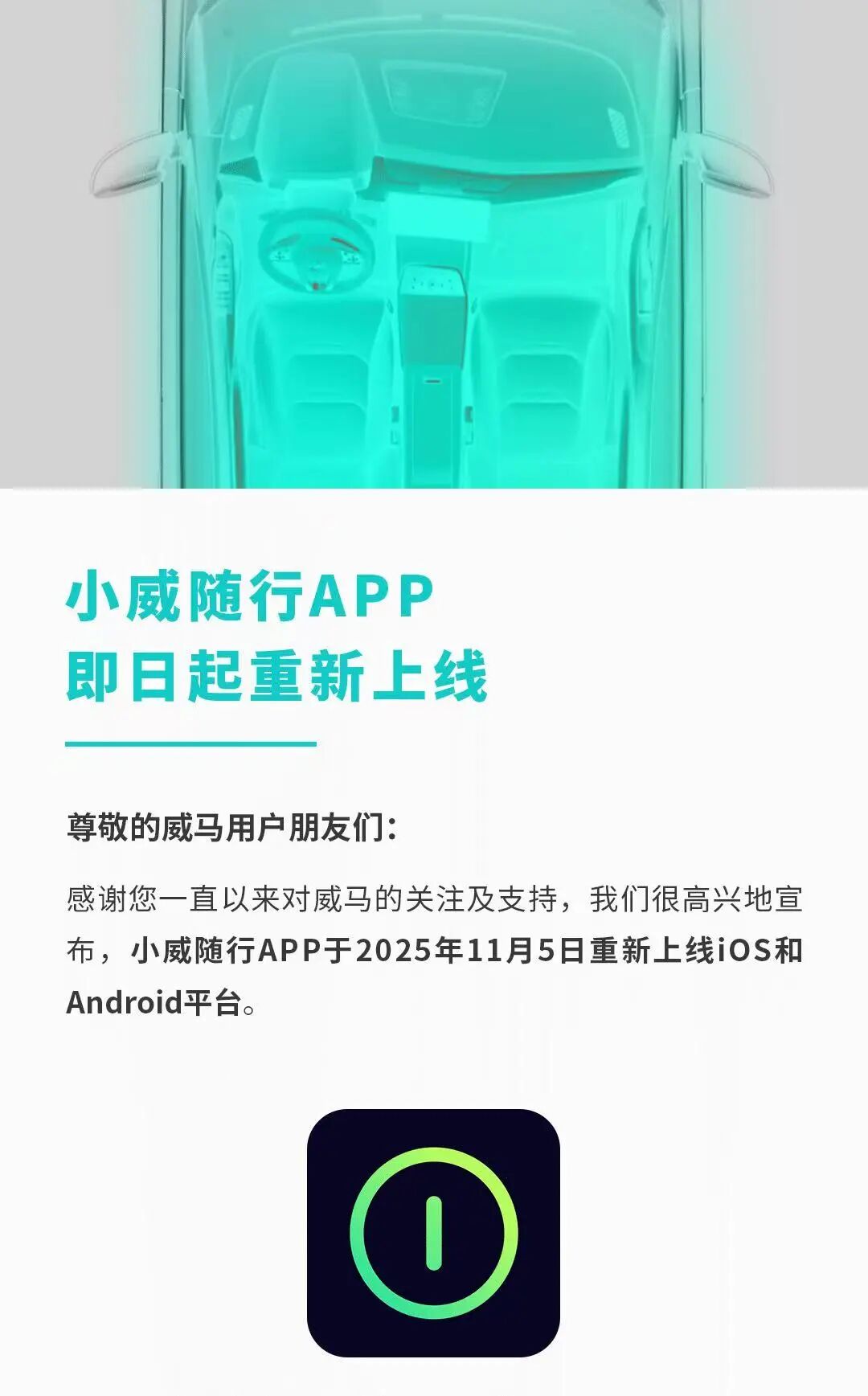
Image source: Weimar Motor's official WeChat account
Besides Neta, other defunct new forces like WM Motor and HiPhi are also actively advancing their 'revival plans'. On November 3, 2025, WM Motor released a teaser poster on its official social media with the message 'Something good is coming soon. Stay tuned,' while its official app, 'Xiao Wei Sui Xing,' reappeared on major app stores on November 5, signaling a clear return. HiPhi, on the other hand, has opted to introduce Middle Eastern capital to aid its revival. Although no major public progress has been announced, media reports indicate that HiPhi's Yancheng factory renovation project has entered the environmental impact assessment public announcement stage. The company has already initiated small-batch trial production of facelifted HiPhi X and HiPhi Y models, with the first batch of orders targeted at the Middle Eastern market, attempting to break through via overseas markets.
Statistics from the National Passenger Car Market Information Joint Conference reveal that between 2023 and 2025, over 10 new car-making forces have entered bankruptcy reorganization procedures. Among these companies, those possessing core resources like complete production bases and product access qualifications have become key targets for capital and local governments, further underscoring the critical importance of scarce resources for 'revival'.
Red Sea Competition: The Strong Get Stronger
While the defunct new forces are eager to 'return to the table', the competitive landscape they face today has undergone significant changes compared to a few years ago.
The NEV market has now entered an era of stock competition. On one hand, the number of competing automakers and new models in the market has surged. Meanwhile, the Matthew effect has become increasingly pronounced, with leading firms continuously capturing the vast majority of market share.
In terms of market structure, BYD and Geely have undeniably emerged as the top two domestic automakers in terms of sales volume in 2025. BYD's cumulative sales for the year exceeded 4.6 million units, representing a nearly 8% year-on-year increase. Geely Auto followed closely, with cumulative sales surpassing 3.02 million units, also a record high, up 39% year-on-year. The primary reason for Geely's significant sales growth in 2025 is its outstanding performance in the NEV market, with cumulative sales nearing 1.69 million units, a 90% year-on-year increase.
Among the new car-making forces, Leapmotor delivered 596,600 vehicles in 2025, up 103.1% year-on-year, setting a new annual sales record for new forces. XPeng Motors delivered 429,500 new vehicles in 2025, a 125.94% year-on-year increase.
Faced with such fierce market competition, leading new forces continue to raise their targets and expand production capacity. Leapmotor has explicitly stated its goal of challenging annual sales of 1 million units in 2026 and aiming for 4 million units annually within the next decade. This goal signals that leading firms have entered a phase of 'scaled development', implying that market resources will further concentrate toward the top, leaving narrower survival space for 'revival hopefuls'.
Zhang Yongwei, Secretary-General of the China Electric Vehicle 100 People's Forum, stated that the domestic auto market will enter a period of high sales volume but low growth, with a projected 2% micro-growth in 2026. NEV sales are expected to reach 20 million units, with the NEV ownership ratio increasing from 10% in 2025 to 15% in 2026. Meanwhile, in a survey conducted by the China Automobile Dealers Association on 'expected changes in the 2026 new vehicle market compared to 2025', 32.3% of respondents anticipated growth, 41.4% expected stability, and 26.6% predicted negative growth.
The shakeout process in the NEV industry continues to accelerate, with competition intensifying at every level. For leading firms, profitability is merely the 'entry ticket to stay at the table'. For 'revival hopefuls' eager to re-enter the 'track' (a Chinese term meaning 'competitive arena'), they must not only overcome historical challenges like debt resolution, production capacity restoration, and supply chain reconstruction but also face direct competition from leading firms in core areas such as technological iteration, product innovation, and brand rebuilding. The ultimate outcome of this NEV market 'race to return' remains to be seen, as it will be decided by the market.
-
![]()
Enflame Tech's IPO Journey: Navigating Over 5.9 Billion Yuan in Losses and Soaring Debt in Q1 This Year
-
![]()
Trillion-Yuan Giant Li Shufu 'Streamlines': Could Levc Be the Casualty?
-
![]()
AI Competes for Electricity and Generates Power in the Gobi Desert
-
![]()
The First Batch of Victims of the AI Bubble: Programmers
-
![]()
ByteDance, DJI, and Xiaohongshu Secure Top Three Positions Among China’s Fastest-Growing Unicorns
-
Tesla's in-car voice system in China is finally learning to 'understand human language'
-
![]()
Foreigners Are Amazed: Chinese Electric Vehicle Drive Systems Unveil Innovative 'Poses'
-
![]()
700,000 Brothers and the Future of Robots: Behind JD.com's 'Nirvana Plan'