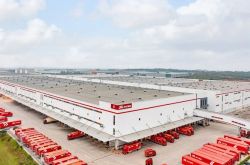
In 2025, China's auto production and sales will both surpass 34 million units, with new energy vehicle (NEV) production and sales exceeding 16 million units each: Autonomous driving is stealing the la
 01/15 2026
 704
704
Introduction
Data released by the China Association of Automobile Manufacturers on January 14 shows that in 2025, China's auto production and sales will exceed 34 million units for the first time, with NEVs reaching a staggering 16 million units, accounting for over 50% of domestic new vehicle sales—meaning one out of every two vehicles sold will be electric.
These two figures would keep competitors sleepless in any corner of the world for a year. Amidst the cheers of "world's No. 1" and "far ahead," I want to pour a bucket of cold water to sober everyone up:
The first half of the electric vehicle war is over. The era of competing on range and batteries has seen a clear winner.
The frontline of the second half has shifted: autonomous driving.
(For further reading, please click: "The 'Butterfly Moment' of Autonomous Driving: NVIDIA's Bet from Open-Source Models to Superchips, a $10 Trillion Gamble by Jensen Huang")
Chapter 1: The 'Carnival of 16 Million Bodies' and the 'Collective Anxiety' of Souls
16 million NEVs represent an epic victory. It means China has achieved a brilliant "lane change" in its energy strategy within a decade.
This is a perfect symphony of national will, industrial chain resilience, and market vitality.
However, an undeniable truth is that hardware homogenization brought by electrification is arriving faster and more fiercely than anyone anticipated.
Except for Tesla and a few others, the differences between most electric vehicles are rapidly narrowing for consumers to "battery size," "screen dimensions," and "sofa comfort."
The technological barriers of the three-electric systems (battery, electric motor, and electronic control) are being rapidly broken down, with costs pushed to the limit. Electric vehicles are becoming "standardized industrial products" of the new era.
Anxiety has spread to the top of the entire industrial chain.
Auto executives wake up in the middle of the night, haunted by the same question: "What will make consumers pay more next? What will build our brand moat?"
The answer is as clear as a lighthouse and as dangerous as a swamp: intelligence, especially autonomous driving.
Among NEVs, the proportion of vehicles equipped with Level 2 or higher intelligent driving functions is rising at an astonishing rate.
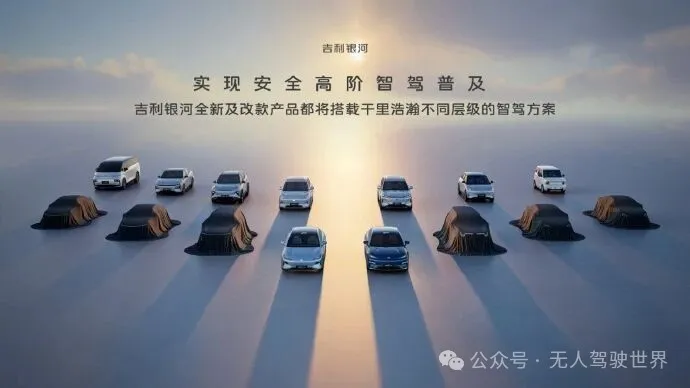
Consumers are no longer satisfied with vehicles that "can run;" they now demand vehicles that "can run smartly" and "run themselves." Autonomous driving is rapidly shifting from a premium selling point to a mass "quasi-necessity."
Thus, a century-long project to inject "intelligent souls" into millions of "electric bodies" has kicked off with great fanfare.
Chapter 2: A Trinity Offensive: China's "Saturated Attack" on Autonomous Driving
Unlike most Western players who focus solely on the high-risk RoboTaxi track, China's autonomous driving industry showcases typical "Eastern wisdom" by launching a trinity of "saturated attacks" across land, sea, and air.
The First Frontline: The "People's War" of Mass-Produced Vehicles (L2+/L3 Progressive Route)
This is currently the loudest and most participated main battlefield. From NIO, XPeng, and Li Auto to Huawei's AITO and Xiaomi's vehicles, almost all players are investing crazy (fengkuang, "madly") in this area. The essence of this route is "nurturing algorithms with sales and feeding models with data." Every vehicle sold with LiDAR and high-computing-power chips becomes a mobile data collector.
Geely Auto has obtained L3 testing licenses covering over 9,000 square kilometers across Hangzhou, which is not just a license but a "mining permit" to legally collect data on China's most complex urban road conditions.
(For further reading, please click: "Is the Era of 'Full-Scenario Validation' for Autonomous Driving Here? Geely's Zeekr 9X: Obtaining Hangzhou's Full-Domain L3 Autonomous Driving Testing License! What's the Technical Backing of Horizon H9's Intelligent Driving Solution?")
Their goal is blunt: to build the nation's largest autonomous driving corpus. You can think of it as cloning the soul of a seasoned driver in the virtual world using massive amounts of Chinese road data.
Meanwhile, giants like BYD and GAC Aion are fully committed to bringing high-level intelligent driving functions to the mainstream price range of 150,000-200,000 yuan.
When ordinary families can buy vehicles capable of self-driving on highways and even handling complex urban road conditions for the price of a fuel-powered vehicle, the popularize (puji, "popularization") of intelligent driving will be explosive.
The Second Frontline: The "Blitzkrieg" in Commercial Scenarios (L4 Closed/Semi-Closed Scenarios)
While RoboTaxi is still struggling with "how much profit per kilometer" models, China's autonomous driving has already broken through in B2B/G2G scenarios such as sanitation, trunk logistics, mining areas, and ports—and is starting to make money.
Remember that astonishing figure from 2025? The total contract value of unmanned sanitation projects nationwide exceeded 12.6 billion yuan. Guangdong, Zhejiang, Jiangsu, and Anhui provinces led the way.
(For further reading, please click: "Behind the 12.6 Billion Yuan in Orders: Decoding the Deep Logic and Regional Rivalry Behind the 2025 Boom in Unmanned Sanitation Vehicles, with Guangdong, Jiangsu, Zhejiang, and Anhui Leading")
Why sanitation?
Because the math works. One unmanned sweeper can replace multiple sanitation workers, unaffected by extreme weather or fatigue.
Shenzhen's "Urban Steward" project includes dozens of unmanned vehicles in a single order, with annual contract values easily exceeding 100 million yuan.
In Xiong'an New Area, Neolix's unmanned delivery vehicles have become the capillaries of park logistics; in Wuhai, Inner Mongolia, unmanned patrol vehicles guard key areas 24/7.
These projects are not about showing off technology but solving real, urgent, and calculable business problems—cost reduction, efficiency improvement, and safety assurance. They provide valuable cash flow, engineering experience, and a trial ground away from public scrutiny.
The Third Frontline: The "Shangganling" of RoboTaxi (L4 Open Roads)
This is the technological high ground and the deep water zone of commercialization. Here, Chinese players are competing head-to-head with global top-tier contenders like Waymo and Cruise.
The most exciting news comes from Pony.ai, which achieved single-vehicle profitability (UE turned positive) for RoboTaxi in Guangzhou's core operational area, with daily revenue approaching 300 yuan.
While the figure is small, its symbolic significance is enormous: it is a ray of dawn proving that, theoretically, the revenue from unmanned ride-hailing services can cover costs in specific regions. This is a breakthrough from 0 to 1.
Meanwhile, Baidu Apollo, WeRide, and others are expanding operational scopes in multiple cities. This battle is exceptionally tough, competing not on PPTs but on hard metrics like interventions per thousand kilometers and extreme weather pass rates.
These three frontlines may seem independent but are secretly interconnected:
Profits from commercial scenarios feed back into R&D;
Massive data collected from mass-produced vehicles train more powerful algorithms;
Technological challenges conquered by RoboTaxi will eventually be deployed in mass-produced vehicles.
They form a self-reinforcing ecosystem.
Chapter 3: Hidden Reefs: The Triple Gates of Trust, Data, and Ecosystem
However, the path ahead is not smooth. Behind the celebration of 16 million units, the road to scaling autonomous driving faces at least three massive "icebergs."
The First Iceberg: The "Fragile Foundation" of Social Trust
The Shenzhen Intelligent Connected Vehicle Association themed its annual conference "Trust 2026," hitting the nail on the head. Autonomous driving needs to integrate into the complex system of human society. This trust is layered:
Technological trust: Can your vehicle guarantee absolute safety? How to handle "ghost pedestrians" or heavy rain?
Liability trust: Who is responsible in an accident? The owner, automaker, algorithm company, or road operator? Current traffic laws and insurance systems are nearly silent on this.
Public trust: How will pedestrians perceive unmanned vehicles passing by? Will there be panic? As in Dongying, Shandong, where residents suggested "banning unmanned delivery vehicles during rush hours," the friction between new technologies and old orders has just begun. Building trust takes longer than conquering any technical challenge.
The Second Iceberg: "Data Silos" and Fragmented Ecosystems
The current autonomous driving industry resembles the " knockoff phone (shanzhai ji, "knockoff phones")" era of early smartphones.
NVIDIA, Qualcomm, Huawei, Horizon Robotics... major chip and platform suppliers are fragmented;
Automakers vary from full-stack self-research to multi-party collaborations. The result is split technological routes and inconsistent data formats, forming "data silos."
This severely hinders overall technological progress.
Future smart cities need a "symphony" of vehicle-road-cloud coordination, but currently, everyone is practicing their own "solo."
The Third Iceberg: The "Standard War" Under Global Competition
We are not without worries. NVIDIA is building a vast "DRIVE" autonomous driving ecosystem, with Jensen Huang's ambition to become the AI "power plant" of the physical world.
Tesla relies on "shadow data" collected from its global million-vehicle fleet, with its FSD system evolving crazy (fengkuang, "madly").
Future competition will not just be about products and markets but also about technological standards and data security rules. Whoever sets the standards holds the key to the future.
Chapter 4: The Future Is Here: When "Software-Defined" Reshapes Everything
So, what kind of world awaits us when the "soul" of autonomous driving finally inhabits the "bodies" of tens of millions of vehicles?
First, the automotive industry's business model will be completely refactor (chonggou, "restructured").
Today's automakers mainly profit from "selling hardware," but the future will shift to a hybrid model of "hardware + software + ongoing services."
You can buy a vehicle outright, but unlocking higher-level autonomous driving functions or more personalized cabin experiences may require monthly or yearly subscriptions.
Vehicles will transform from "one-time industrial products" to "tech service terminals" providing continuous value.
Second, "vehicle-road-cloud integration" will be China's ultimate trump card.
This is a uniquely Chinese strategic project. By massively deploying sensing devices along roadsides and building highly reliable, low-latency communication networks, real-time data exchange between vehicles, roads, and clouds is achieved.
This equips each vehicle with "clairvoyance" and "acute hearing," greatly compensating for the perception limitations of single-vehicle intelligence.
This is not just a technological route but a national-level digital new infrastructure—a systemic advantage no foreign enterprise can replicate.
Finally, it will redefine the relationship between cities and people.
When private vehicles' idle time can be used for shared mobility by autonomous driving systems, cities will need significantly less parking space.
Logistics deliveries can be quietly completed by unmanned vehicles at night, alleviating daytime traffic pressure. Even urban road planning and traffic light designs will change in response to autonomous driving.
In conclusion, the WeChat public account " Autonomous vehicles have arrived (Wurenche Laiye, "Autonomous Vehicles Are Coming")" believes:
16 million electric vehicles are China's generous gift to the world's transportation energy transition.
Next, how to make these millions of vehicles "intelligent" and "interconnected" will be China's even more anticipated answer to the future of human mobility.
The grader of this answer is time—and each of us.
What do you think, dear?
#AutonomousVehiclesAreComing #AutonomousDriving #SelfDriving #DriverlessVehicles
-
![]()
Enflame Tech's IPO Journey: Navigating Over 5.9 Billion Yuan in Losses and Soaring Debt in Q1 This Year
-
![]()
Trillion-Yuan Giant Li Shufu 'Streamlines': Could Levc Be the Casualty?
-
![]()
AI Competes for Electricity and Generates Power in the Gobi Desert
-
![]()
The First Batch of Victims of the AI Bubble: Programmers
-
![]()
ByteDance, DJI, and Xiaohongshu Secure Top Three Positions Among China’s Fastest-Growing Unicorns
-
Tesla's in-car voice system in China is finally learning to 'understand human language'
-
![]()
Foreigners Are Amazed: Chinese Electric Vehicle Drive Systems Unveil Innovative 'Poses'
-
![]()
700,000 Brothers and the Future of Robots: Behind JD.com's 'Nirvana Plan'