Intelligent Electric Vehicles: The Simplest and Most Swiftly Deployable 'Embodied AI' Robots
 02/09 2026
 447
447
When we mention 'Embodied AI,' our minds often drift to humanoid robots, such as those crafted by Boston Dynamics or Tesla Optimus. While they are indeed impressive, let's face it—their widespread adoption in our daily lives is still a distant prospect.
In reality, there's already a 'colossal robot' that surrounds us ubiquitously and is evolving at a breakneck pace: the intelligent electric vehicle.
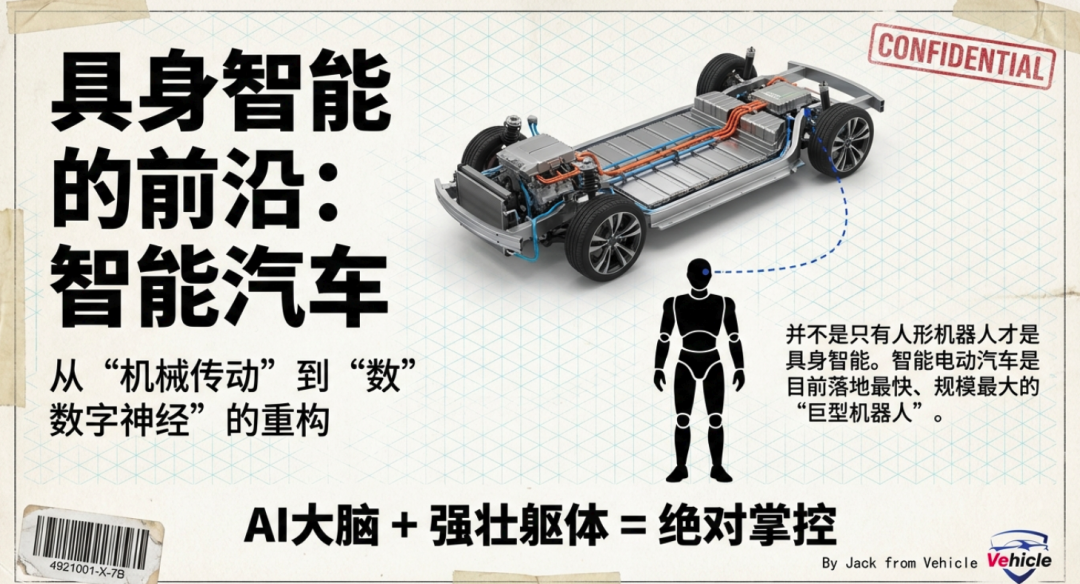
Why are intelligent electric vehicles the simplest and most rapidly deployable form of embodied AI? Because they are undergoing a profound transformation, shifting from 'mechanical transmission' to 'digital nervous systems.' Through X-by-Wire chassis technology, the AI 'brain' now has absolute control over the vehicle's steel frame for the first time.
I. The Ongoing Evolution: From Machine to 'Living Organism'
For an extended period, cars were perceived as precision mechanical contraptions. Their quality was gauged by engine horsepower, transmission gear ratios, and chassis mechanical tuning.
However, with the advent of intelligent electrification, core automotive components are undergoing a complete paradigm shift. Cars are no longer just a cold assembly of steel; they are evolving into 'silicon-based life forms' with a nervous system and brain.
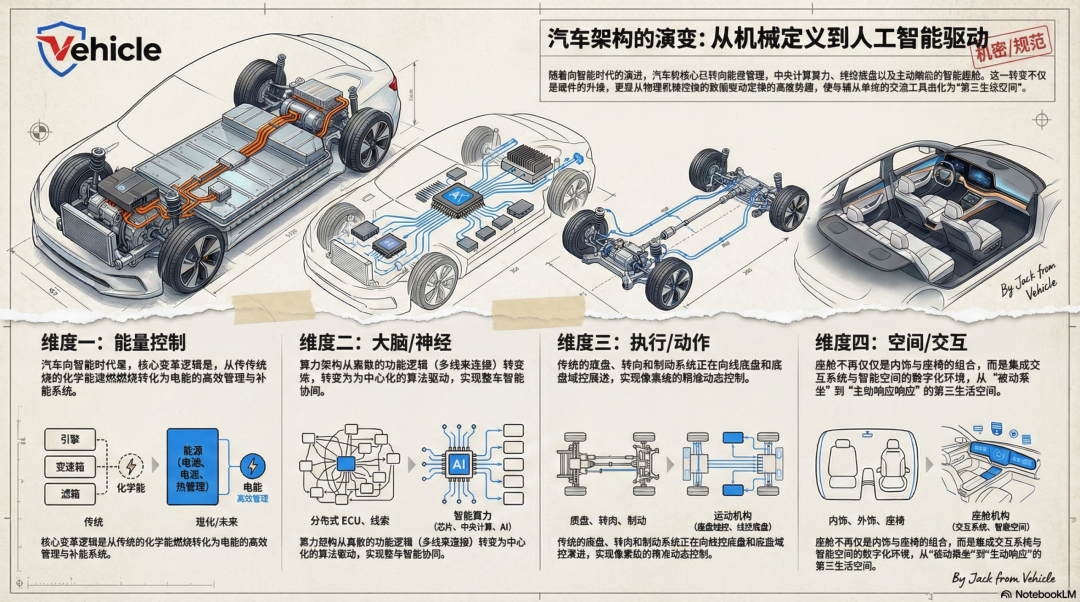
We can observe this leap from the 'mechatronic age' to the 'intelligent age' through a comparative diagram:
Dimension, Traditional Definition (Mechatronic Machine), Future Definition (Software-Defined Intelligence), Core Logic of Evolution
Energy Heart: Engine, Fuel Tank → Battery, Electric Drive. Efficient management of chemical energy combustion to electrical energy.
Brain Nerves: Distributed ECUs, Complex Wiring Harnesses → Central Computing Chips, Domain Controllers, AI. Stacked discrete functions to centralized algorithm-driven systems.
Limb Movements: Mechanical Chassis, Hydraulic Brakes → X-by-Wire Chassis. Slow mechanical or hydraulic connections to data line signal transmission for pixel-level millisecond-response control.
This is the material foundation for cars to become 'embodied AI': They possess sensors to perceive the world (akin to eyes and ears), a central brain to process complex information (high-computing-power chips), and, most crucially, a fully digitized body that obeys the brain's commands—the X-by-Wire chassis (steer-by-wire, brake-by-wire, active suspension).
II. How AI Understands the Physical World: Decoding Vehicle Posture
An embodied AI robot's primary mission is to move safely and stably in the physical realm. To accomplish this, the AI brain must grasp the essence of 'motion.'
In automotive engineering, we employ vehicle dynamics to depict all actions in space.
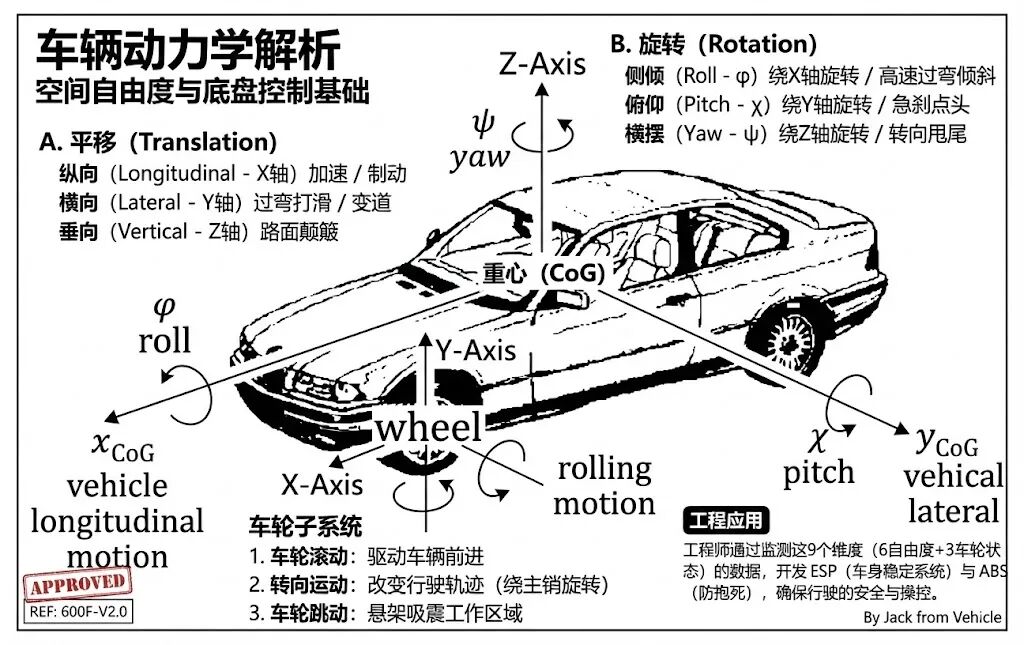
Envision a core point at the vehicle's center—the Center of Gravity (CoG). All motion essentially revolves around this point. To precisely describe this motion, engineers dissect vehicle movement into six degrees of freedom (6 DOF), whereas humanoid robots possess several times more—some claim over four times.
AI perceives the vehicle's current state by monitoring and calculating data from these six dimensions in real-time:
1. Three Translational Movements (Where Are You?)
These are straightforward changes in spatial position:
Longitudinal Motion (X-axis): Accelerating forward or braking backward.
Lateral Motion (Y-axis): Lane-changing sideways or skidding during turns.
Vertical Motion (Z-axis): Body bouncing due to road bumps.
Intelligent driving assistance primarily addresses longitudinal, lateral, and their combined motion control, so we won't delve deeper here.
2. Three Rotational Movements (What's Your Posture?)
These determine comfort and handling—the most challenging aspects for human drivers to control precisely but AI's forte:
Roll (Rotation around X-axis): Scenario—At high speed through a sharp curve, centrifugal force seems to 'flip' the body outward, causing tilt.
Pitch (Rotation around Y-axis): Scenario—Hard braking makes the nose dive ('nodding'); sudden acceleration lifts it ('nose up' in Chinese).
Yaw (Rotation around Z-axis): Scenario—Imagine a pin inserted vertically through the roof; the body rotates around it. Turning, U-turns, or uncontrolled tail drifting are all yaw motions.
III. The Art of Execution: How Three X-by-Wire Technologies Control 6-DOF?
Understanding these six degrees of freedom elucidates why intelligent electric vehicles are top-tier embodied AI robots.
In traditional cars, controlling these freedoms relied on mechanical compromises: Stiff suspensions to suppress roll but reduce comfort; complex structures to prevent braking nose-dive. Original hydraulic systems also lacked the millisecond-level closed-loop response needed for electronic control.
In intelligent vehicles, 'mechanical links' are supplanted by 'data lines' (X-by-Wire technology). The AI brain utilizes algorithms to command the electric chassis in milliseconds, achieving 'decoupled control' over the six degrees of freedom.
Here's how AI executes movements:
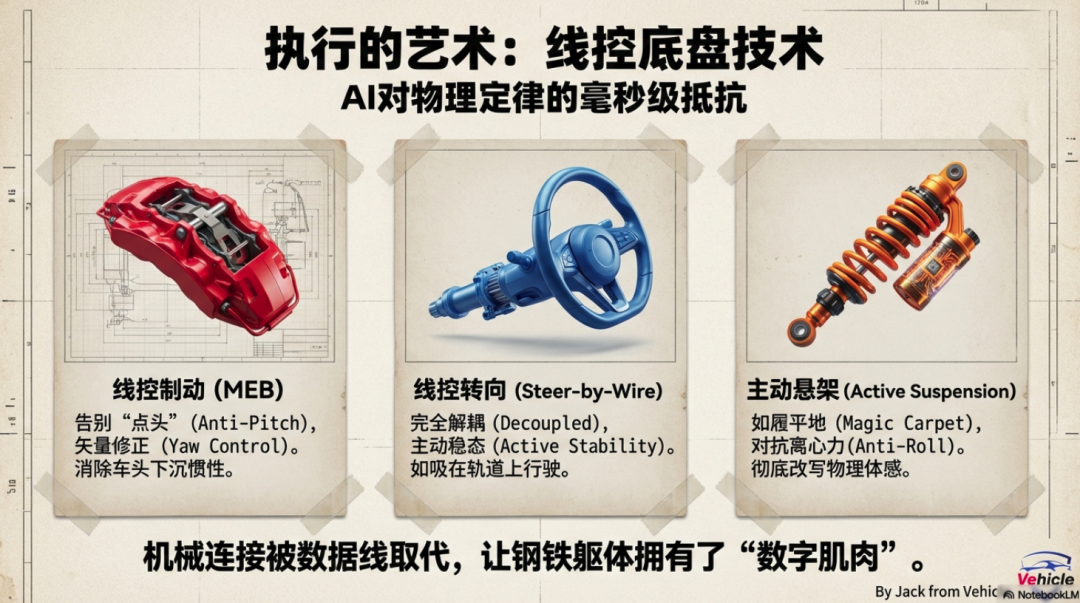
In this new architecture, traditional mechanical links are severed, replaced by 'electrical signals.' This enables AI algorithms to directly command three 'digital muscle groups':
1. Longitudinal & Posture Master: Brake-by-Wire (EMB)
Control Dimensions: Longitudinal (X), Pitch (Y), Yaw (Z)
Technical Principle: Traditional brakes rely on vacuum boosters and hydraulic lines, which are slow and non-real-time adjustable. EMB (Electro-Mechanical Brake) abandons hydraulic fluid entirely, employing motors to directly push brake calipers.
Embodied AI Performance:
Anti-Pitch: When AI decides to brake hard, EMB not only outputs braking force (controlling X-axis) but also microsecond-adjusts front/rear wheel braking distribution based on suspension status, even coordinating motor reversal to nearly eliminate nose-dive inertia at stop.
Yaw Control: During high-speed understeer (pushing wide in turns), EMB can precisely apply braking force to the inside rear wheel, generating torque to 'pull' the nose into the curve—much faster than traditional ESP.
2. Lateral Commander: Steer-by-Wire
Control Dimensions: Lateral (Y), Yaw (Z)
Technical Principle: No physical shaft connects the steering wheel to wheels. Your hands turn a 'simulator'; signals are transmitted to algorithms, which then command the steering gear to move wheels.
Embodied AI Performance:
Full Decoupling: At high speeds, steering angle reduces for stability; during U-turns, it increases for one-turn maneuverability.
Active Yaw Stability: When encountering standing water or ice on one side, the vehicle would normally drift laterally (Y-axis instability). Steer-by-Wire automatically counter-steers before the driver notices, keeping the body straight like glued to rails.
3. Vertical Magic: Electrically Controlled Active Suspension
Control Dimensions: Vertical (Z), Roll (X), Pitch (Y)
Technical Principle: Utilizes air springs (adjusting height/stiffness) and CDC electromagnetic valves (adjusting damping), or even motor systems in fully active suspensions, to counteract gravity and inertia.
Embodied AI Performance:
Magic Carpet Ride (Z-axis Control): Cameras detect speed bumps ahead ('magic carpet' function); suspension softens preemptively to absorb shocks. On highways, it stiffens automatically for lower center-of-gravity 'ground-hugging' driving.
Anti-Roll: Traditional cars must lean in curves. Active suspension instantly lifts the outside body and lowers the inside during turns, controlling roll angle to 0 degrees or even reverse tilt (like motorcycles leaning into curves), rewriting physical perception.
Of course, traditional luxury brands like ABB (Audi, BMW, Mercedes-Benz) possess unique skills honed in the mechatronic era, fine-tuning their mechanical chassis to perfection. However, AI X-by-Wire chassis still confronts old questions: how to digitize human sensations, what chassis language and personality suit different product demographics, etc. Taste becomes even more pivotal in the AI era.
[Conclusion]
Intelligent electric vehicles are no longer tools necessitating strenuous operation.
By fully electrifying and digitizing the chassis, cars now boast an extremely obedient 'muscle system.' Central computing platforms and AI algorithms endow them with an extremely intelligent 'brain.'
They constantly perceive changes in their six degrees of freedom around the center of gravity, adjusting power output to all four wheels and suspension states at speeds and precision beyond human capability.
This is the most swiftly deployable embodied AI. It doesn't just safely transport you from A to B—it utilizes algorithms to defy physical laws, creating a comfortable, stable, and intuitive mobile space.
*Reproduction or excerpting without permission is strictly prohibited-
-
'Computing Power Leather' Surges 77% in 9 Days, NIO Supplier Also Chases the 'Light'
-
![]()
Storage and Computing Power Becoming Scarcer: Google Initiates Exploration of Using Old Smartphones to Build AI Servers
-
![]()
Storage Computing Power Grows Scarcer: Google Explores Using Old Smartphones for AI Servers
-
![]()
Huawei Imposes a $0.5 Patent Fee Per Device: Is It Time for Huawei to Reap Global Patent Royalties?
-
![]()
Geely Invests 1.8 Billion Yuan Post-Acquisition: The Launch of Flyme Auto 3.0 Sparks Questions on Meizu’s Enduring Influence
-
![]()
MBBF 2026 on the Bund in Shanghai: Deciphering Mobile AI's Future Trajectory
-
![]()
Commercialization of ASIC: The Turning Point Has Arrived
-
![]()
Doubao Charges Fees: Zhang Yiming Helps Zhang Xiaolong Explore the Path