March Auto Market: New Energy Vehicle Penetration Rate Tops 52.9%, Signaling Structural Market Shift
 03/27 2026
 452
452
Author / Li Qi
Produced by / Insight Auto
The Chinese passenger vehicle market has displayed a notable divergence during the post-Spring Festival recovery phase. While overall retail sales have rebounded significantly on a month-on-month basis, they still reflect a year-on-year decline. In contrast, new energy vehicles (NEVs) have achieved a historic milestone, with their retail penetration rate consistently exceeding 50% for the first time.
This transformation not only reshapes the competitive dynamics of the auto market but also signifies a profound shift from policy-driven to market-driven growth.
According to the latest data from the China Passenger Car Association (CPCA), from March 1 to 22, retail sales of passenger vehicles in China reached 920,000 units, representing a 16% year-on-year decrease but a 19% month-on-month increase, indicating a gradual recovery from the post-holiday slump.
On a weekly basis, the market demonstrated a clear trend of gradual improvement. In the first week, average daily retail sales were 31,000 units, down 24% year-on-year. The second week saw an increase to 45,000 units, with the year-on-year decline narrowing to 19%. By the third week, sales rose further to 51,000 units, with only a 7% year-on-year decrease, clearly signaling a warming trend.
The performance on the manufacturer wholesale side was even more remarkable, with wholesale volumes reaching 1.084 million units during the same period, down 14% year-on-year but up 62% month-on-month. This reflects automakers' intensified production and supply efforts to boost quarter-end sales and accelerate inventory adjustments.
Considering the full-month data, total retail sales of narrow passenger vehicles are estimated at approximately 1.7 million units, up 64.5% month-on-month but still down 12.4% year-on-year.
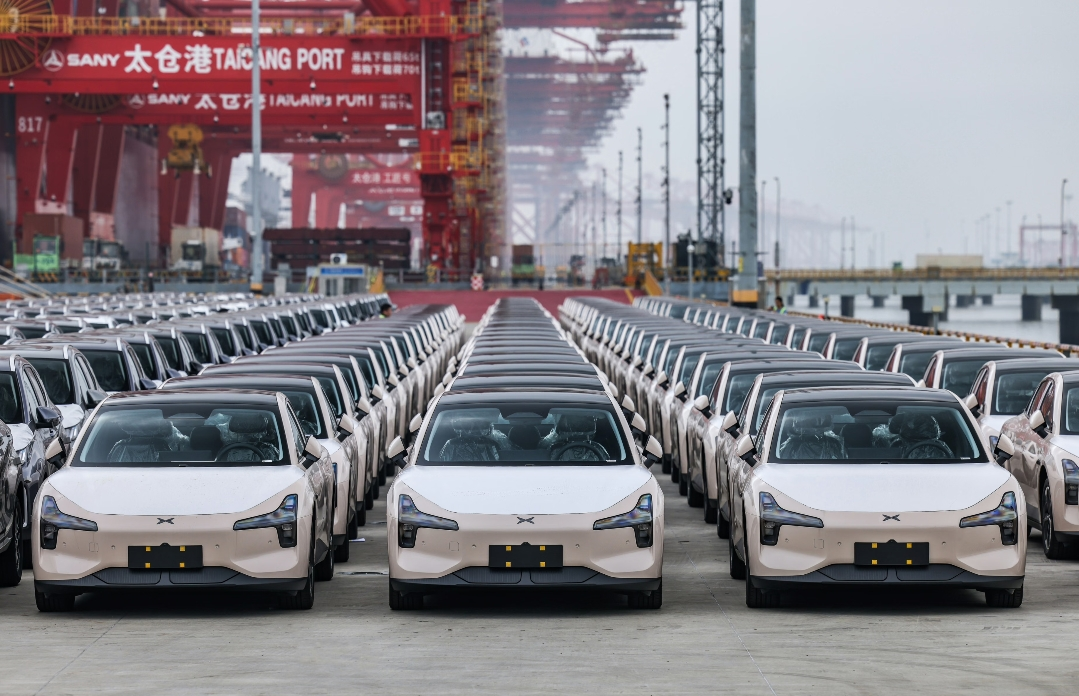
In the new energy sector, not only has there been a robust month-on-month recovery, but market share has also surpassed that of fuel vehicles.
From March 1 to 22, retail sales of new energy passenger vehicles reached 495,000 units, down 17% year-on-year but up 66% month-on-month, with the retail penetration rate soaring to 53.9%. Manufacturer wholesale volumes stood at 543,000 units, down 15% year-on-year but up 71% month-on-month, with the wholesale penetration rate also reaching 50.1%.
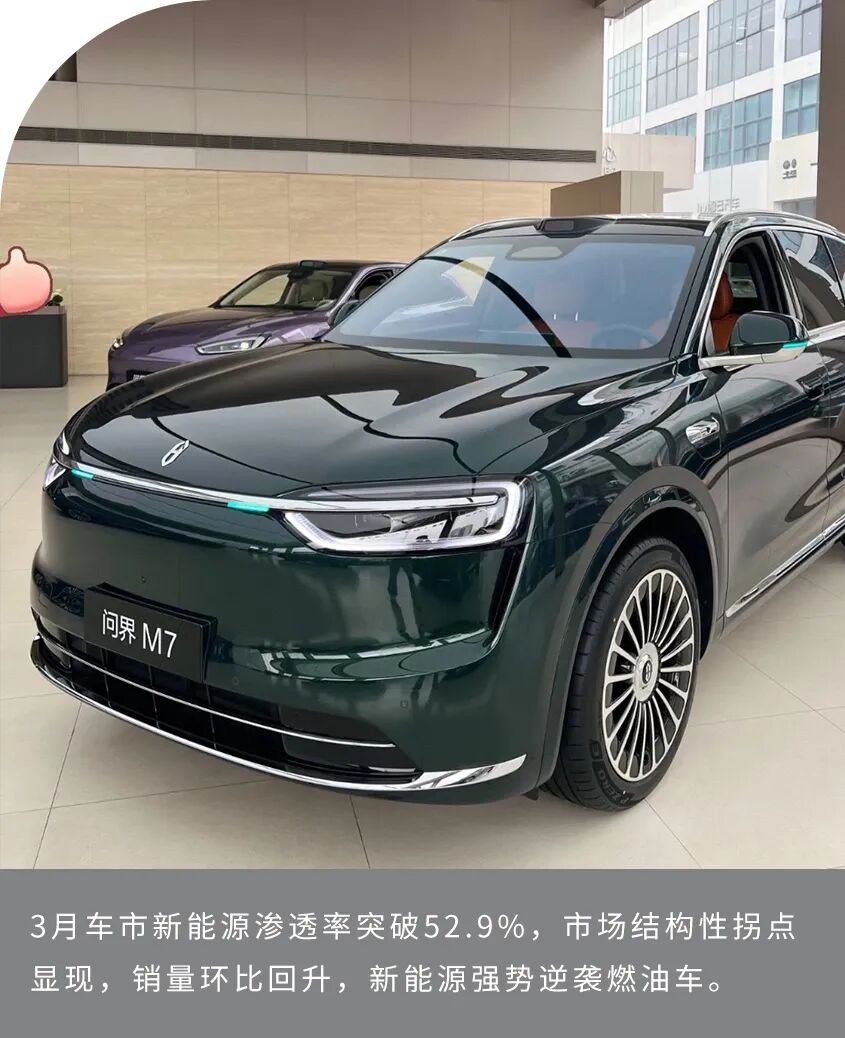
For the full month, new energy retail sales are expected to reach 900,000 units, with a penetration rate of approximately 52.9%, while the market share of fuel vehicles is set to fall below 48% for the first time.
This breakthrough was no coincidence. In the first half of March, new energy retail sales reached 285,000 units, with the penetration rate already exceeding 50%, laying a solid foundation for the full-month reversal.
From 44.9% in February to 52.9% in March, the penetration rate increased by nearly 9 percentage points in just one month, fully demonstrating the growing appeal of new energy vehicles to consumers.
The strong performance of the new energy market is supported by both policy incentives and product availability.
The implementation of the policy to halve the purchase tax on new energy vehicles has reduced the tax burden by up to 15,000 yuan per vehicle. Meanwhile, the comprehensive implementation of trade-in subsidy rules offers a 12% subsidy, up to 20,000 yuan, for scrapping old vehicles and purchasing new energy vehicles, and an 8% subsidy for replacement and upgrades. Local governments have also introduced supporting subsidies, creating a synergistic effect between national and local policies.
On the consumer side, post-holiday foot traffic has gradually recovered. In the first half of March, customer inquiries increased by 28.5% month-on-month, and order volumes surged by 98.7% month-on-month, indicating a gradual restoration of consumer confidence.
At the product level, the launch of high-profile new models such as the AITO M6, Xiaomi SU7, and the facelifted BMW 5 Series, covering various price ranges and usage scenarios, has further enriched the new energy product lineup and stimulated consumer demand.
Additionally, rising fuel prices have increased the operating costs of fuel vehicles, making cost advantages a key factor for consumers choosing new energy vehicles.
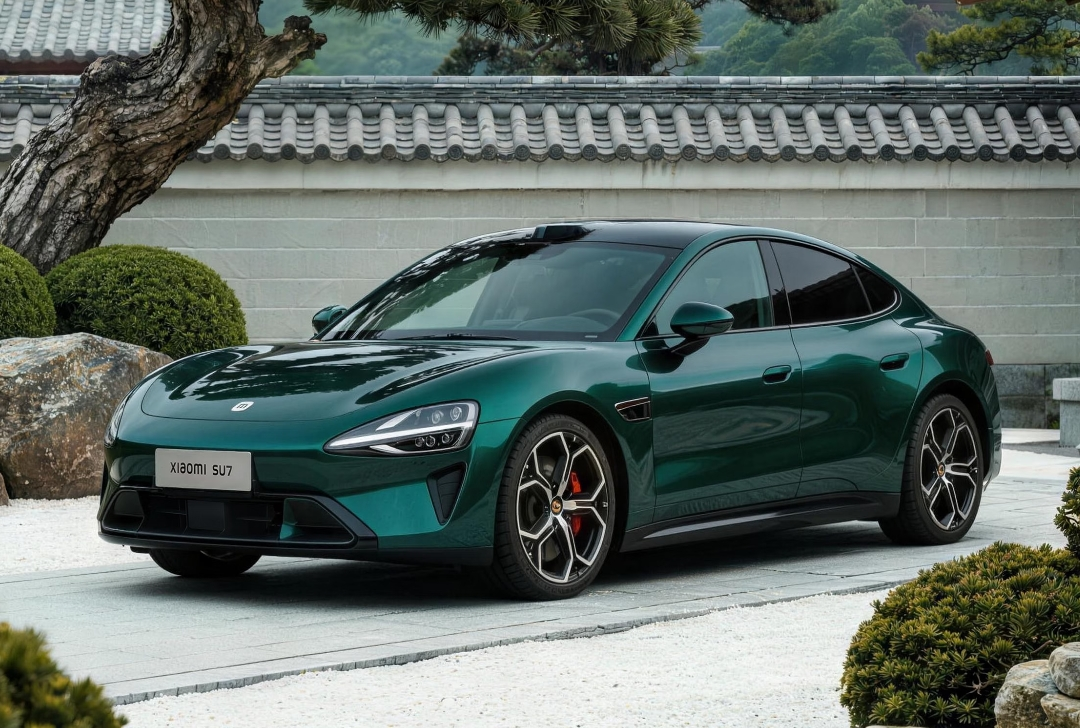
In stark contrast to the strength of the new energy sector, the fuel vehicle market continues to face pressure, with its recovery process hindered.
On the production side, the production of pure fuel light vehicles declined by 19% year-on-year. Although hybrid models also saw a 23% year-on-year decrease, they experienced an 87% month-on-month increase, serving as an important supplement in the transition from fuel vehicles to new energy vehicles.
Luxury brand fuel vehicles, despite attempting to boost sales through price cuts and promotions, have generally struggled to reverse the market downturn, exacerbating industry differentiation.
The performance of the March auto market clearly illustrates the transformation direction of the Chinese automotive market. The new energy penetration rate exceeding 50% is not just a data milestone but also the result of consumer preferences, technological advancements, and policy guidance working in tandem.
For automakers, accelerating the layout of new energy products, enhancing intelligent capabilities, and optimizing cost control have become key to survival and development. New energy vehicles have shifted from a novelty option to a top choice for home use, with the market selection scale having tilted decisively.
END
-
![]()
The Unstoppable Rise of 'Optical Progress and Copper Decline': Sunny Optical’s Strategic Vision for the Next Decade
-
![]()
AI + Going Global in the Second Half: No Intermission for Robot Vacuum Cleaners
-
![]()
The Suffering Endured in E-commerce, Walmart Doesn't Want to Repeat in AI
-
![]()
What Does the Doubling of New Energy Vehicle Exports Mean?
-
![]()
Ghosn: 'Only I Can Save Nissan'
-
![]()
Volkswagen Lays Off 100,000 Employees, The Elephant Sits Down
-
![]()
Expanding Production Capacity! Yutong Optics Acquires Approximately 1.5 Hectares of Industrial Land in Chang'an, Dongguan
-
![]()
Why Is Nokia Making a Comeback in the AI Era?