Great Changes Among NIO, XPENG, and LI Auto: Bowing to Price Wars, Unlikely to Become the BBA of Electric Vehicles
 04/09 2026
 593
593
Amid the intense price war, NIO, XPENG, and LI Auto cannot maintain high premium margins and are temporarily unable to become the BBA of the electric vehicle sector. The new opportunities brought by AI represent a new focus for NIO, XPENG, and LI Auto. The new interactive experiences AI brings to vehicles are expected to create new brand narratives.
“For NIO now, survival is the top priority.” This was a resigned statement from William Li after significantly lowering the pre-sale price of the third-generation ES8.
Zhu Jiangming, the founder of Leapmotor, has been expressing a similar viewpoint since 2024.
This seems to be the most direct and effective strategy in the industry right now.
NIO, which initially insisted on benchmarking against BBA, and XPENG, which once aimed for the high-end market, finally achieved a low-to-high trajectory after releasing lower-priced models and introducing price cuts for revised versions. In contrast, LI Auto, which insisted on not cutting prices, is now facing its darkest moment.
“NIO, XPENG, and LI Auto” are back on the same starting line.
Part.
01
Price Defeat, Sales Recovery
2025 marks a turning point for “NIO, XPENG, and LI Auto.”
Standing at the beginning of 2025, few would have believed that LI Auto's sales would be surpassed by NIO and XPENG.
At that time, LI Auto set an annual sales target of 750,000 units, nearly equivalent to the combined total of NIO and XPENG.
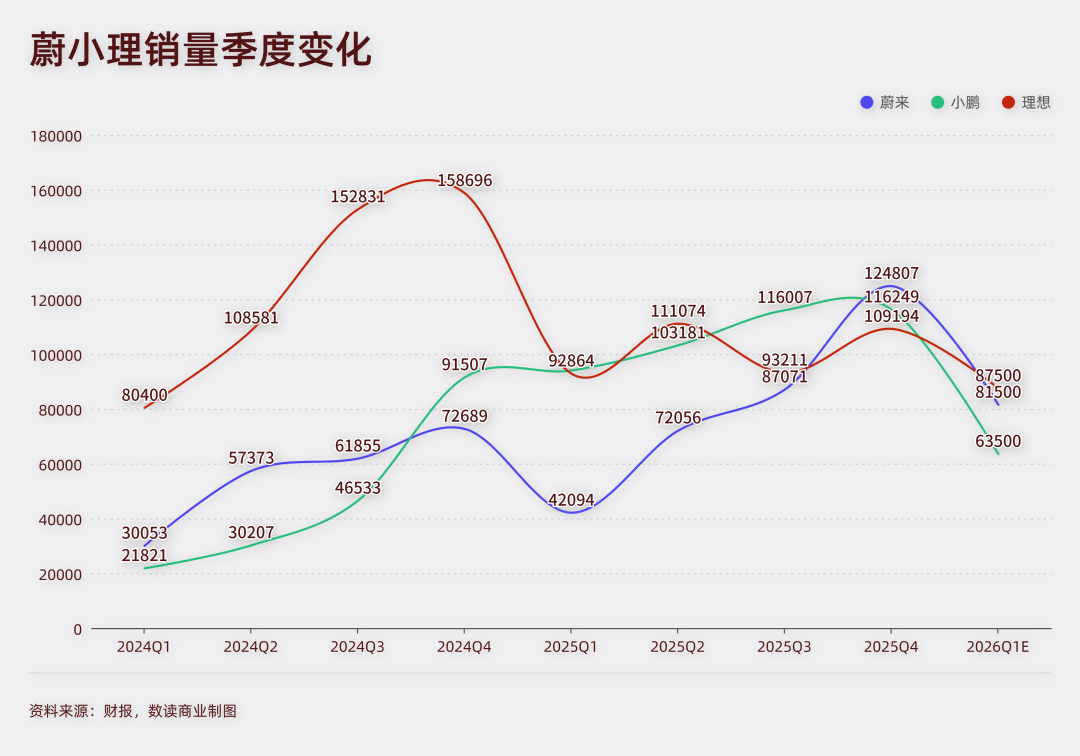
However, the final outcome was that LI Auto only briefly led “NIO, XPENG, and LI Auto” in the second quarter and finished last among the three in the fourth quarter. With annual sales of only 406,000 units, LI Auto not only failed to meet its target but was also surpassed by XPENG.
In contrast to LI Auto's high-start and low-finish trajectory, NIO achieved a “turnaround,” with quarter-over-quarter growth in all four quarters and taking the lead in the final quarter.
XPENG also continued to rise. Although its momentum weakened in the fourth quarter, its stable sales performance ultimately made it the highest-selling of the three in 2025.
The key reason for the sales changes lies in the strategic divergence between LI Auto and NIO and XPENG.
In 2025, LI Auto released two models, the i8 and i6. After the setback with the MEGA, LI Auto's pure electric vehicle journey has been challenging. Similar to the L6, the i6 is a key model for LI Auto to explore lower price points and boost sales. However, LI Auto priced the i6 between RMB 249,800 and RMB 269,800 and still did not venture into the sub-RMB 200,000 price segment.
In comparison, NIO and XPENG have compromised.
In 2024, NIO launched its first model under its first sub-brand, the Lexis L60, with a price point dropping to RMB 219,900. By the end of the year, the launch of its third brand, Firefly, further penetrated the RMB 100,000-RMB 200,000 price segment.
That same year, XPENG, which already had a presence in the RMB 100,000-RMB 200,000 price segment, introduced the MONA series, further lowering its starting price to RMB 119,800.
Price cuts have led to increased sales, which further drive revenue growth.
In 2025, XPENG's revenue grew by 87.7%, leading in revenue growth, while NIO's revenue increased by 33.1%. In contrast, LI Auto saw a revenue decline of 22.3%.
Not only in revenue but also in development metrics, LI Auto was nearly at the bottom.
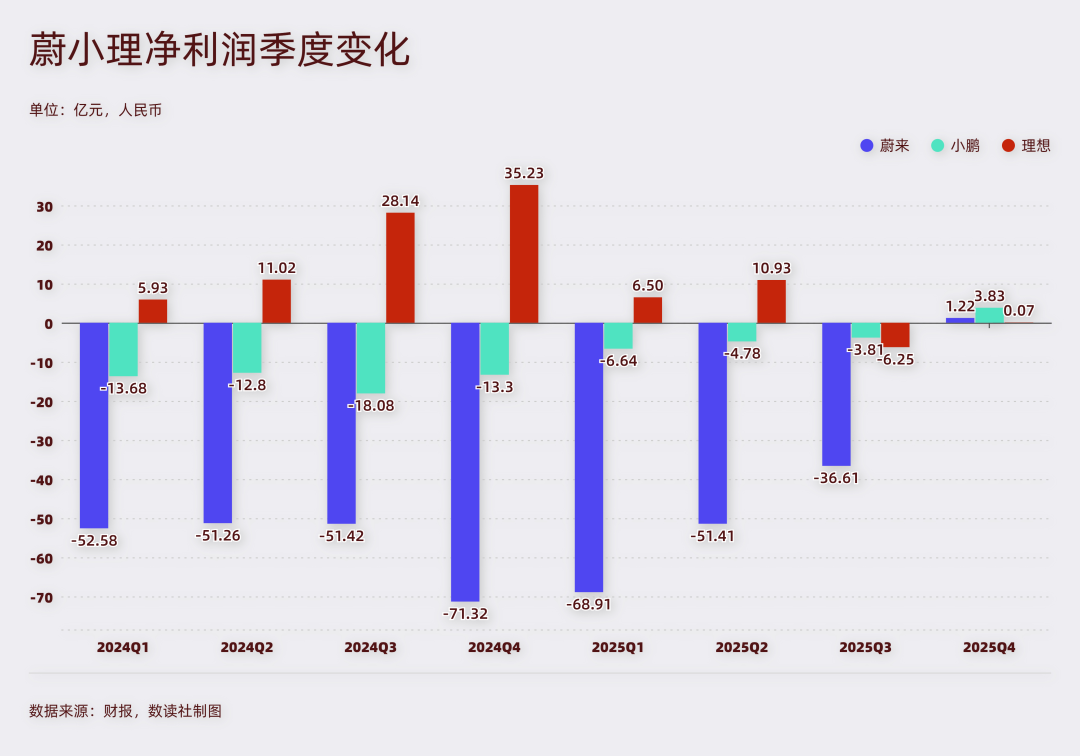
NIO achieved its first quarterly profit in Q4 2025, with a net profit of RMB 120 million, ending a streak of consecutive losses. This was mainly due to a record-high delivery volume of 125,000 units, which diluted costs through economies of scale. In Q1 2026, deliveries increased by 98.3% year-over-year, further amplifying economies of scale and suggesting continued profitability.
XPENG also turned a profit in Q4 2025, earning RMB 380 million.
In contrast, LI Auto reported a loss of RMB 630 million in Q3 2025 and barely returned to breakeven in Q4, with a net profit of only RMB 7 million. Its annual profitability relied solely on the first half of the year.
2025 was a watershed year: NIO and XPENG were on an upward trajectory, while LI Auto was mired in difficulties.
As one falls and another rises, in 2026, the three automakers returned to a tug-of-war, with LI Auto projecting annual sales of 500,000 units, XPENG 550,000-600,000 units, and NIO 456,400-489,000 units, showing minimal gaps.
In just one year, the landscape had changed dramatically. Why did exploring lower price segments lead to such significant changes?
Part.
02
Price Cuts: Not a “Choice” but “Survival”
The key metric of ASP (Average Selling Price) reveals the underlying principle behind this phenomenon.
Automakers do not disclose ASP, but based on automotive sales revenue and sales volume, a rough estimate shows that from 2021 to 2025, NIO's ASP dropped from RMB 362,800 to RMB 235,800, a cumulative decline of 35%.
XPENG's ASP fell from RMB 204,200 to RMB 159,200, a cumulative decline of 22%.
The price declines for these two automakers are not surprising. The Lexis and Firefly brands lowered NIO's average price, while the price drop of the MONA M03 also reduced XPENG's ASP.
The outlier is LI Auto. Over the past two years, except for the i6, it has only released high-priced models. However, its ASP still dropped from RMB 288,800 to RMB 262,500, a cumulative decline of about 9.1%. In the past two years alone, it has consecutively fallen below the RMB 270,000 and RMB 260,000 marks.
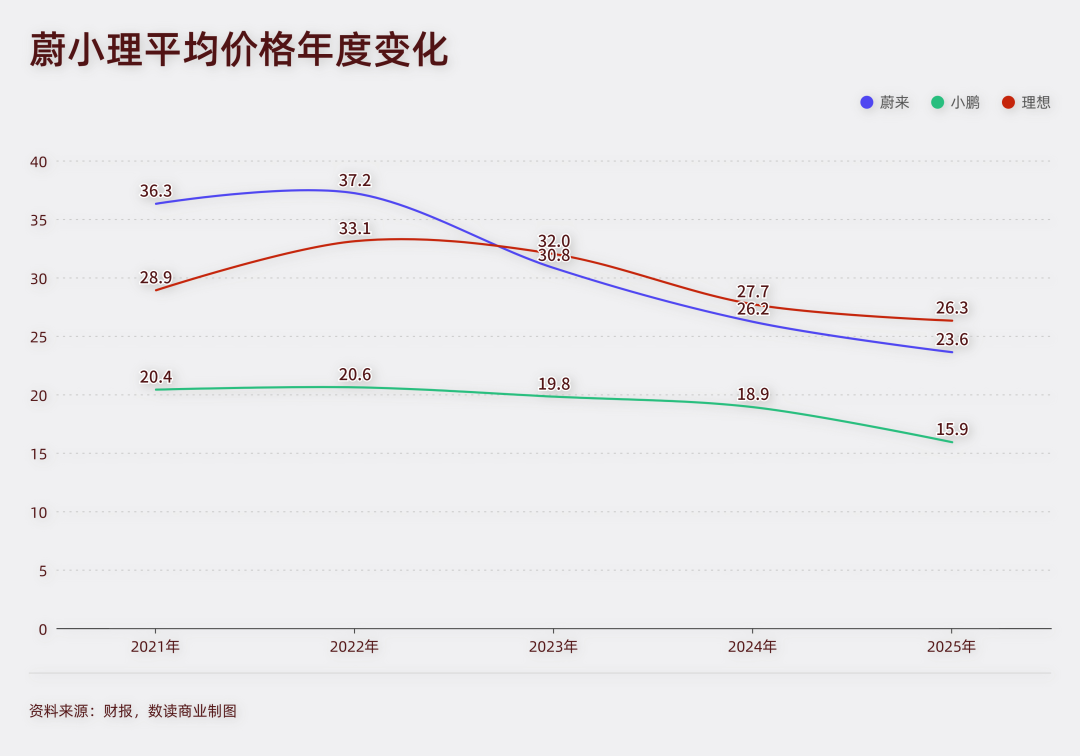
This indicates that even though LI Auto attempted to maintain its high-end positioning, users still preferred the lowest-priced models.
In the second half of 2025, LI Auto began to loosen its stance. In October, LI Auto offered indirect price cuts for all models in the L series under the guise of insurance subsidies.
Price cuts are now one of the mainstream strategies in automotive competition. From 2024 to 2025, the price war intensified. In 2025, the profit margin of China's entire automotive industry dropped to 4.1%, the lowest in a decade, with new energy vehicles being the hardest hit.
Considering the external competitive environment, traditional automakers are also expanding across all price segments. With increased pressure from more well-known brands like Huawei and Xiaomi, NIO, XPENG, and LI Auto are finding it difficult to maintain the price segments they initially set.
When William Li stated, “Survival is the top priority,” it indirectly confirmed the mainstream trend of cutting prices to stay in the game.
Lei Jun once said that the key to true success is to go with the flow and find the right opportunity.
Clearly, in 2025, NIO and XPENG were going with the flow, while LI Auto's insistence on high price points seemed to go against the trend. The current situation is not surprising.
From a business perspective, price cuts do not necessarily equate to “operating at a loss.”
Reviewing the 2025 performance, LI Auto's gross margin plummeted in Q3 from 21.5% to 16.3%, slightly recovering to 17.8% in Q4 but still lower than XPENG's.
XPENG, which cut prices, saw its gross margin continuously improve from 12.9% in Q1 2024 to 21.3% in Q4 2025. NIO's gross margin also significantly recovered, rising from 7.6% in Q1 2025 to 17.5% in Q4.
In 2025, LI Auto's gross margin fell below the 20% threshold for two consecutive quarters, a red line that founder Li Xiang had previously valued greatly. In contrast, XPENG broke through the 20% threshold for two consecutive quarters, and NIO also surged, nearly matching LI Auto in the fourth quarter.
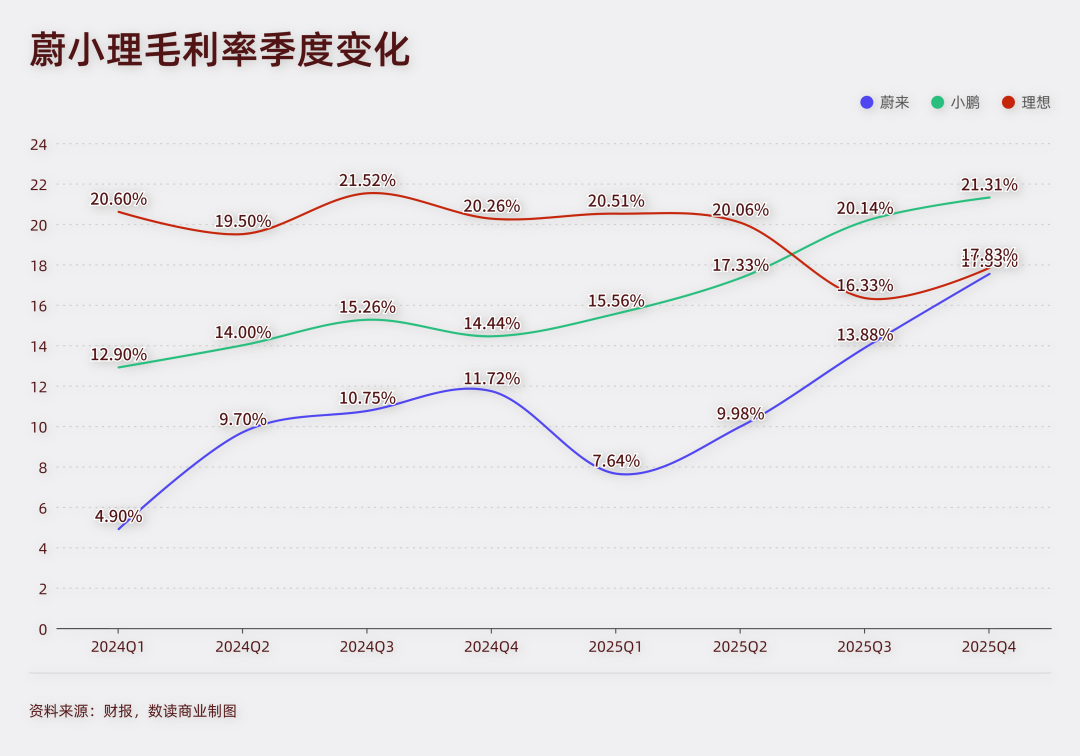
The key reason is that increased sales can dilute costs.
XPENG's annual R&D expense ratio dropped to 12.4%, a year-over-year decrease of 2.43 percentage points. Its selling, general, and administrative expense ratio fell to 12.3%, a decrease of 4.56 percentage points.
After NIO's scale recovered, its R&D expense ratio dropped to 12.12%, a year-over-year decrease of 7.12 percentage points. Its selling, general, and administrative expense ratio fell to 18.29%, a year-over-year narrowing of 5.56 percentage points.
LI Auto, once known for cost control, struggled to manage its expense ratios. In 2025, its R&D expense ratio rose to 10.07%, an increase of 2.41 percentage points, while its selling, general, and administrative expense ratio was 9.5%, an increase of 1.04 percentage points year-over-year.
This demonstrates that exploring lower price segments is currently the easiest choice for “NIO, XPENG, and LI Auto,” but the trade-off is brand image.
Part.
03
“NIO, XPENG, and LI Auto” Cannot Become the “BBA” Yet
During their relatively short development, “NIO, XPENG, and LI Auto” have all benchmarked against “BBA.”
He Xiaopeng proclaimed when revising the P7, “Let luxury no longer be exclusive to BBA.”
When launching the ET7 Executive Edition, William Li stated, “The administrative sedan market is BBA's core stronghold, and NIO is willing to take the lead.”
As early as 2023, Li Xiang proudly said, “With just three SUV models, we have surpassed the combined SUV sales of any BBA brand in the Chinese market.”
With the rise of Chinese new energy vehicle companies, BBA is indeed declining and can no longer maintain its pricing power.
In 2025, Mercedes-Benz, BMW, and Audi's sales in China fell to levels close to those in 2017. The triple pressures of delayed electrification, insufficient intelligence, and competition from local brands are forcing these century-old giants to accelerate strategic restructuring.
After the 2026 Spring Festival, BBA collectively adjusted their prices, with the BMW 7 Series offering discounts of up to RMB 270,000, the entry-level Mercedes-Benz GLB dropping to RMB 144,900, and some Audi A6L models offering discounts exceeding RMB 150,000.
However, the decline of “BBA” does not mean that “NIO, XPENG, and LI Auto” can take their place.
The core characteristics of BBA are not just high prices but also brand premium, price stability, and not relying on price cuts to drive sales.
Facing fierce competition in higher price segments, “NIO, XPENG, and LI Auto” do not have sufficient brand premium space.
NIO and XPENG have exchanged scale for low-priced models, essentially choosing between “brand stature” and “survival space.” Although LI Auto has not actively explored lower price points, it also cannot maintain price stability amid the price war. The decline in both sales and profits indicates that it also lacks the resilience that BBA once had.
Additionally, the China Automotive Data Research Institute's February 2026 report on the residual value rates of new energy vehicles in China showed that among the top ten pure electric models for one-year residual value, NIO, XPENG, and LI Auto only occupied two spots, and for plug-in hybrid models, they also occupied two spots. For three-year residual value, they occupied zero and two spots, respectively. Their brand residual value is not significantly higher than other automakers.
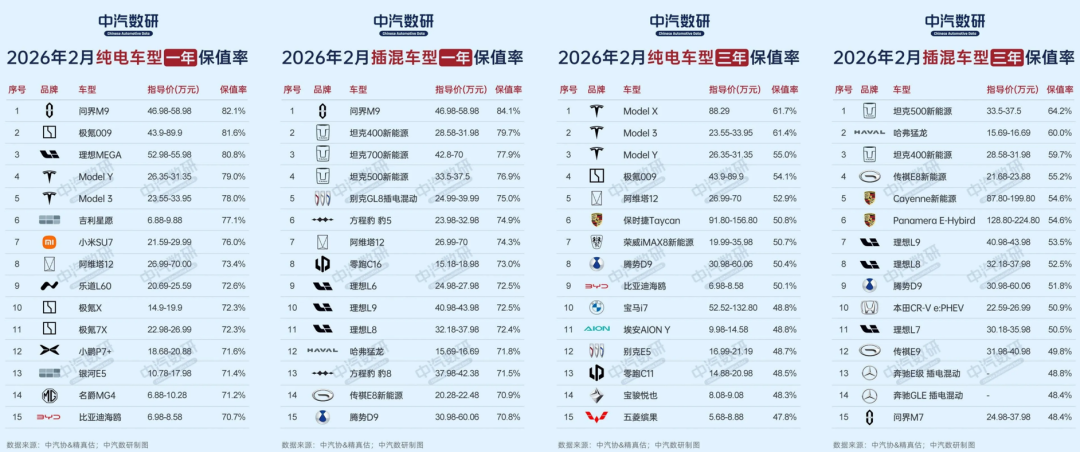
Facing foreign automakers, traditional automakers, and new large internet brands, NIO, XPENG, and LI Auto are currently more focused on finding a way forward rather than relying on their brands to maintain a stable position.
The breakthrough strategies for NIO, XPENG, and LI Auto have converged on a grander narrative.
LI Auto and NIO remain committed to the automotive main storyline (main theme), enhancing human-vehicle interaction through cutting-edge technologies like AI.
LI Auto is betting on the narrative of AI and embodied intelligence.
On social media, Li Xiang frequently discusses his thoughts on the development of embodied intelligence. With the launch of the new-generation LI Auto L9 in the second quarter, LI Auto may attempt to create a “experience gap” through AI and embodied intelligence. In Li Xiang's own words, it is about “building a car that truly understands you and is full of vitality.”
NIO is focusing more on enhancing interactive experiences through self-developed capabilities.
Earlier this year, NIO established the Artificial General Intelligence (AGI) Committee. In an internal speech, William Li outlined two directions for AI investment: strengthening full-stack intelligent driving R&D and implementing AI across the entire business chain to build a company-wide AI capability system.
XPENG is more broadly involved in fields such as flying cars, humanoid robots, AI chips, and autonomous driving models.
On March 27, XPENG Motors rebranded as “XPENG Group.” In He Xiaopeng's view, “XPENG is a technology company, not just an automotive company.” He bluntly stated, “The automotive business is not a good business.” Previously, He Xiaopeng had repositioned the company as “an explorer of mobility in the physical AI world and a global embodied intelligence company.”",
-
![]()
AI Gives Volcano Engine a Chance to 'Change the Table'
-
![]()
A Smart Parking IPO Emerges in Xiamen with a 204% Surge on the First Day of Listing
-
![]()
Alibaba Exits Gaming Industry: A Strategic Move Forward?
-
![]()
New Car Model Faces Unprecedented Negative Campaign; Leapmotor Navigates Through Challenges Amid Profitability Concerns
-
![]()
Overnight Vanishing Act: 1.8 Trillion Gone! Silicon Giants Are Splurging While Carbon-Based Consumers Are Priced Out
-
![]()
2026 China GEO Industry Application Scenario Maturity and Supplier Selection Analysis Report (Part 1)
-
![]()
Fresh Air in Healthy Cabins Starts with a CO2 Sensor
-
![]()
The Unstoppable Rise of 'Optical Progress and Copper Decline': Sunny Optical’s Strategic Vision for the Next Decade