Can Autonomous Driving ‘Leapfrog’ Levels?
 04/09 2026
 435
435
Intelligent Driving Development at a Crossroads
In 2026, the intelligent driving industry finds itself at a pivotal juncture, with technological roadmaps diverging significantly.
Recently, Oliver Zipse, the Global CEO of BMW Group, announced at the 2026 fiscal year meeting that BMW would temporarily deprioritize research and development on Level 3 autonomous driving technology due to its failure to achieve commercial profitability. Additionally, the revamped 7 Series model slated for release in April of the same year will no longer feature the Personal Pilot Level 3 autonomous driving system.
Almost concurrently, Mercedes-Benz made a similar move. The Level 3 autonomous driving option, previously available on flagship sedans like the S-Class and EQS, has been removed from new models.
Meanwhile, tech-driven companies such as Xpeng, Baidu, and Tesla have openly advocated for skipping Level 3 and advancing directly to Level 4, aiming to eliminate transitional solutions in favor of full-scenario intelligent driving.
On the other hand, China has paved the way for Level 3 autonomous driving with policy support. In December 2025, the Ministry of Industry and Information Technology issued the first batch of model permits, with Chang'an Deepal and Arcfox leading the charge in conducting on-road trials in designated regions. Against this backdrop, domestic automakers are intensifying their efforts towards mass production of Level 3 vehicles. VOYAH unveiled the first mass-produced Level 3 SUV, while GAC, Geely, Chery, and Zeekr have all announced mass production timelines. Huawei ADS plans to achieve large-scale commercial use of highway Level 3 by 2026...
A faction of brands is adhering to the incremental upgrade path of L2 → L3 → L4, creating a stark contrast with the retreat of German brands and the direct leap to Level 4 by tech companies.

Image source: Che Baihui Research Institute
“Both routes should be allowed to coexist, with the market ultimately deciding the outcome, a decision that is expected to become clear within the next two to three years,” said Academician Ouyang Minggao from the Chinese Academy of Sciences at the 2026 Che Baihui Research Institute Expert Media Exchange Meeting.
High Investment, Low Returns: Is Level 3 Becoming a Liability?
Level 3 autonomous driving, defined as conditional automation, was envisioned as the crucial bridge between Level 2 assisted driving and Level 4 high automation. It allows drivers to briefly disengage from driving tasks in specific scenarios triggered by the system, without the need for constant monitoring of the driving environment, but requires prompt takeover when the system requests it. This technology was once highly anticipated by the industry and even considered the primary direction for the mass production of autonomous driving in 2026. However, Level 3 now appears to be a burden that some automakers are eager to offload.
The most pressing issue is the severe imbalance between costs and benefits. Both Mercedes-Benz and BMW acknowledge that user demand for Level 3 is low, while development and system costs are exorbitant. The technical architecture of Level 3 necessitates compromise designs for “human-machine takeover,” with redundant systems merely meeting basic safety requirements. Its R&D investment approaches that of Level 4 but cannot directly leverage Level 4 technologies, representing a wasteful and redundant allocation of resources.
Specifically, the Mercedes-Benz Drive Pilot system is priced at €5,000–9,000 (approximately RMB 40,500–73,100) as an option in Germany, with an annual subscription fee of $2,500 (approximately RMB 17,400) in the U.S. market. The Personal Pilot Level 3 option for the BMW 7 Series also reaches €6,000 (approximately RMB 48,600).
However, the use of Level 3 autonomous driving is subject to numerous restrictions, requiring specific road sections and stringent conditions such as good weather, no construction, and no interference from non-motorized vehicles, resulting in extremely low actual usage frequency. Under these heavy restrictions, consumers receive a very limited experience despite paying such high costs.
In addition to soaring costs and subpar experiences, an even more daunting challenge is the unclear liability boundaries. The core feature of Level 3 is “human-machine co-driving,” where the system dominates driving when activated but requires the driver to maintain the ability to take over at any time. This dynamic switching seems reasonable but poses liability determination challenges in real accidents: Did the system provide sufficient advance warning? Was the driver in a responsive state? Did the fault originate from the algorithm, hardware, or environment? Multiple variables may lead to a situation where liability is shifted among the driver, automaker, and supplier.
Because of this, He Xiaopeng, Chairman of Xpeng Motors, clearly stated during the 2026 Two Sessions that autonomous driving should skip Level 3 and move directly from Level 2 to Level 4 to avoid liability disputes during the transitional phase.
Intelligent Driving Crossroads: The Fate of Level 3 to Be Determined in Two to Three Years
Despite the withdrawal of leading automakers, Level 3 autonomous driving has not reached its end. According to traditional industry understanding, the evolution of autonomous driving should follow a linear path, progressing through Levels 2, 3, and 4. The year 2026 is also widely regarded as the critical first year for the mass production of Level 3.
At the policy level, China has opened the door for Level 3. Eight departments, including the Ministry of Industry and Information Technology, jointly released the “Automotive Industry Stable Growth Work Plan (2025-2026)” in September 2025, approving the production access of Level 3 models from a policy perspective. In December 2025, the Ministry of Industry and Information Technology announced the first permits for two models equipped with Level 3 autonomous driving functions (Chang'an Deepal SL03 and Arcfox Alpha S 6), conducting on-road trials in designated areas of Chongqing and Beijing, respectively. This is seen as a milestone event in advancing China's policies for Level 3 autonomous driving.
Meanwhile, VOYAH recently made a high-profile announcement that it will launch the “China's first mass-produced Level 3 SUV,” the VOYAH Taishan Ultra, in March. Automakers such as GAC and Geely have successively announced mass production timelines for Level 3, attempting to seize the “first” position.
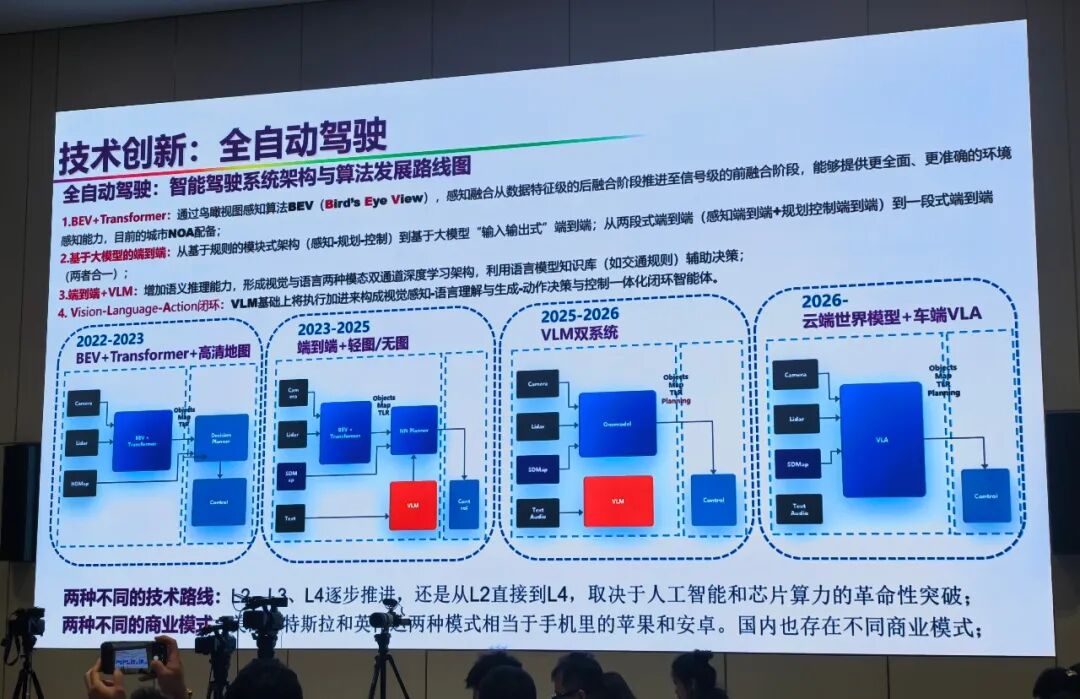
Academician Ouyang Minggao's presentation slide (Photo by Liu Shanshan)
On one hand, policies are paving the way, and some automakers are making steady progress. On the other hand, luxury brands are cutting investments, and tech companies are advocating for leaps forward. The autonomous driving industry is presenting two distinct technological roadmaps. “There are now two technological roadmaps: one progressing gradually from L2, L3, to L4, and the other jumping from L2 to L4. I believe this depends on revolutionary breakthroughs in artificial intelligence and chip computing power. Transitioning from L2 to L4 may be relatively simpler in terms of regulations and policies,” said Ouyang Minggao. He believes that both routes should be allowed to coexist, with the market deciding the outcome, a decision that is expected to become clear within the next two to three years.
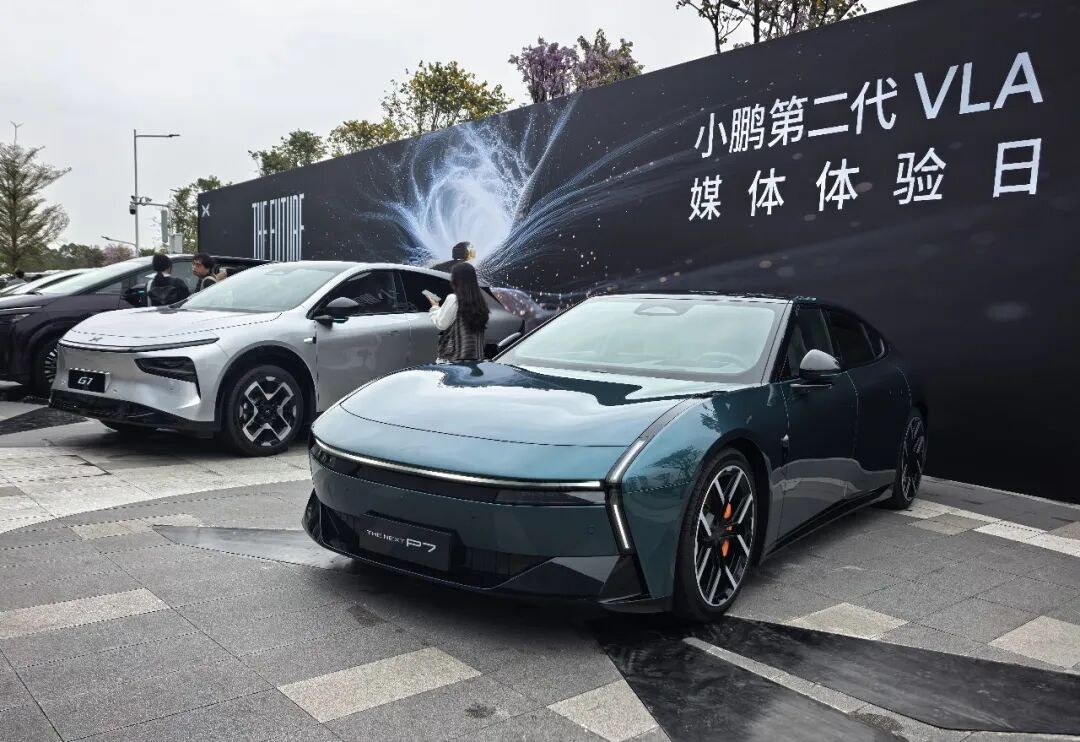
Xpeng Motors' Second-Generation VLA Media Experience Day (Photo by Liu Shanshan)
“I firmly believe that fully autonomous driving will be realized in one to three years, and all cars will become super intelligent agents, and powerful ones at that, in three to five years,” said He Xiaopeng. On March 2, Xpeng Motors officially released its second-generation VLA (Visual Language Action Model) architecture. Vehicles equipped with this system demonstrated full-scenario intelligent driving capabilities, able to autonomously navigate and drive smoothly in alleys, internal community roads, construction zones, and even parking lots.
Prior to this, Su Qing, Vice President and Chief Architect of Horizon Robotics, also clearly stated that with the maturation of urban assisted driving systems like FSD and HSD, the previously distinct “two worlds” of L2 and L4 have now been connected. Therefore, the industry has seen a clear development roadmap for the autonomous driving (AD) industry: after the large-scale popularization of urban L2 systems, a brief transitional phase of L3 will follow, ultimately leading to the arrival of L4 with extremely low-cost deployment and rapid regional expansion, which will be implemented in both passenger vehicles and Robotaxi forms.
Current policies have opened the door for Level 3, but whether the market will accept it still hinges on whether automakers can address key factors such as high costs, subpar user experience, and difficulties in liability determination. If Level 3 fails to achieve large-scale cost reduction and scenario expansion within a limited time, it will struggle to avoid marginalization despite policy support. Conversely, if the implementation speed of Level 4 technology exceeds expectations and costs drop rapidly, Level 3 is likely to be completely abandoned.
In the next two to three years, with continuous breakthroughs in high-computing-power chips and end-to-end large models, as well as further improvements in the regulatory framework, the technological roadmap for autonomous driving will face a final decision. For the entire industry, Level 3 may be a necessary exploration but will not be the endpoint. When more mature, safer, and practically valuable solutions enter the market, those transitional and compromise technologies will be left behind by the times.
-
![]()
Geely and BYD Step Up Efforts: Giants Aren't Willing to Lose in the Breakthrough Battle for New Energy Pickups
-
![]()
From Selling Computers to Selling AI: How Far Has Lenovo Come?
-
![]()
What Enlightenment Does the Successfully Verified Trillion-Dollar Anthropic Bring to SaaS Enterprises?
-
![]()
Li Auto L9 Livis: Caught Between 'Daddy Car' and 'AI'
-
![]()
From 'Flying Machines' to 'Embodied Intelligent Agents': How Embodied Intelligence is Revolutionizing the Commercial Landscape of Low-Altitude Equipment
-
![]()
Launch of the Lynx S10: Why is DeepRobotics Developing a Small Wheeled-Legged Robot?
-
![]()
AI Accelerator: The Powerhouse Behind AI Algorithm Operations and Applications
-
![]()
Ferrari Luce Electric Debuts: Ferrari’s Essence Endures in the Electric Age | On-Site Report