Volvo Needs Geely, But Not Too Much Like Geely
 05/12 2026
 497
497
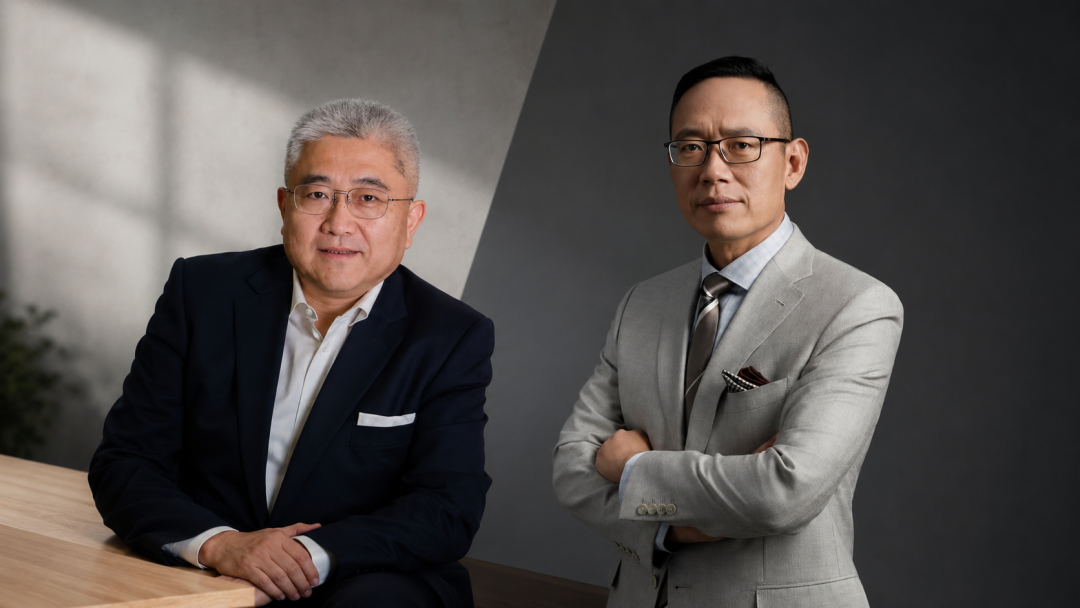
Geely's efficiency, translated into Volvo's value.
Original content from Autopix (ID: autopix)
On May 11, 2026, Yuan Xiaolin stepped down as President and CEO of Greater China, succeeded by Duan Jianjun, who recently left Mercedes-Benz China.
Yuan Xiaolin worked at Volvo for 16 years and was one of the key operators of Geely's acquisition of Volvo Cars in 2010. Volvo officially stated that this is "a normal management handover based on the existing regional strategy and organizational structure, not involving changes in strategic direction." Yuan Xiaolin "decided to step down from daily operational management to spend more time with family."
Duan Jianjun is taking over a Volvo that has been re-priced in the Chinese market.
In 2025, Volvo's sales in China declined slightly by 4%, maintaining scale, but revenue fell by 23% year-on-year, from SEK 63.682 billion to SEK 49.304 billion, making it the single market with the largest revenue decline for Volvo globally.
Once the price anchor loosens, it's hard for luxury brands to go back.
Next, Duan Jianjun will fight two battles simultaneously. One is at the terminal level, repairing Volvo's terminal system; the other is at the product level, proving that SMA can translate Geely's efficiency into Volvo's own value.
01
Yuan Xiaolin Built the City, Duan Jianjun Defends It
The main task for Yuan Xiaolin's generation of Volvo China managers was to transform Volvo in China from an imported luxury niche brand into a second home market with local R&D, manufacturing, and supply chains.
Yuan Xiaolin, a former diplomat, joined Geely Holding in 2009 to oversee the Volvo acquisition project. After the acquisition, he first served as the Director of the Chairman's Office at Volvo Group in Gothenburg, returned to China in 2014 as President of the China region, and joined the global executive management team in 2017 as President and CEO of the Asia-Pacific region.
Key actions during his tenure include: ramping up production capacity at Volvo's Chengdu and Daqing plants; establishing the Asia-Pacific R&D Center in Shanghai; transporting Chengdu-made vehicles to Belgium via the China-Europe Railway Express; and increasing China market sales from 81,000 units in 2014 to 180,200 units in 2023.
Volvo Global CEO Håkan Samuelsson evaluated Yuan Xiaolin, saying, "Under his leadership, China has become a true second home market for Volvo Cars."
During this phase, Volvo's logic was to build systems, expand channels, and integrate, especially in managing its relationship with Geely.
2023 was also the peak for Volvo's China sales. In 2024, sales dropped to 156,400 units, and in 2025, they further declined to 149,500 units. Luxury brands in China are being besieged by local new forces with more aggressive intelligence and pricing. BBA is already struggling, and Volvo, as a second-tier luxury brand, faces even more direct pressure.
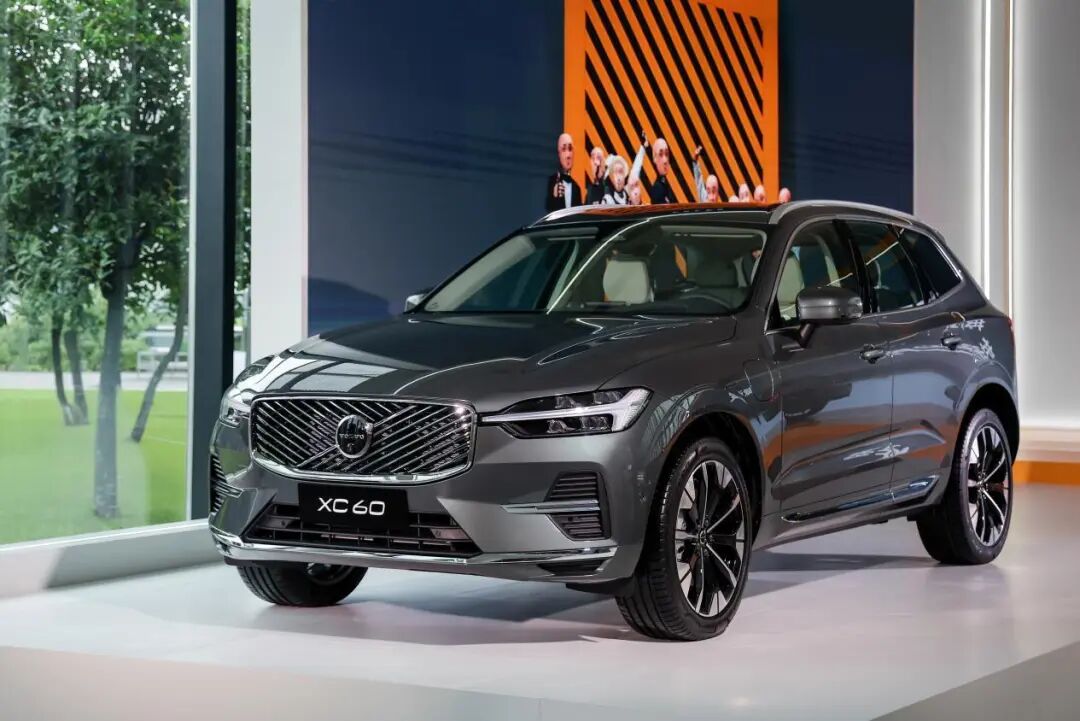 ▍Volvo XC60
Duan Jianjun is taking over a Volvo that has already been re-priced by the market.
Duan Jianjun started his career at Fiat China in the late 1990s, joined Volkswagen China in 2003, became Vice President of Sales at BMW Brilliance in 2008, joined Beijing Mercedes-Benz Sales Service Co., Ltd. in 2013, and was promoted to President and CEO in May 2023, becoming the first Chinese head of the company.
On February 14 this year, Mercedes-Benz announced Duan Jianjun's departure for personal reasons, effective March 1, with him serving as a strategic advisor until April 30. The gap between his departure from Mercedes-Benz and joining Volvo was less than two weeks.
In 2023, Duan Jianjun said, "What we need to do is call for artillery fire in the most intense battlefield." At the time, he was talking about Mercedes-Benz, but it also reflects the real state of China's luxury car market. Relying on brand inertia is no longer enough to hold market share in China's luxury car market. Duan Jianjun's task is to protect the brand amid price wars, stabilize dealers when channels are under pressure, and reorganize offensives when sales decline.
Building a city is one ability; defending and attacking it is another. Volvo's choice of Duan Jianjun this time prioritizes the second ability.
02
SMA's Debut: Hype Exists, But Growth Is Insufficient
Reorganizing the offensive requires products. Mercedes-Benz is still searching for direction, but Volvo has it. Over the next few years, the core product proposition will be SMA.
Volvo Cars currently has two architectures for new energy directions. One is SPA2, led by Volvo Gothenburg, positioned as a global pure electric flagship, with EX90 and ES90 developed based on this architecture.
The other is SMA, developed by Volvo relying on Geely's system, officially launched in May 2025, positioned as a plug-in hybrid for the Chinese market. Volvo officially describes it as a "dual-track" new energy strategy.
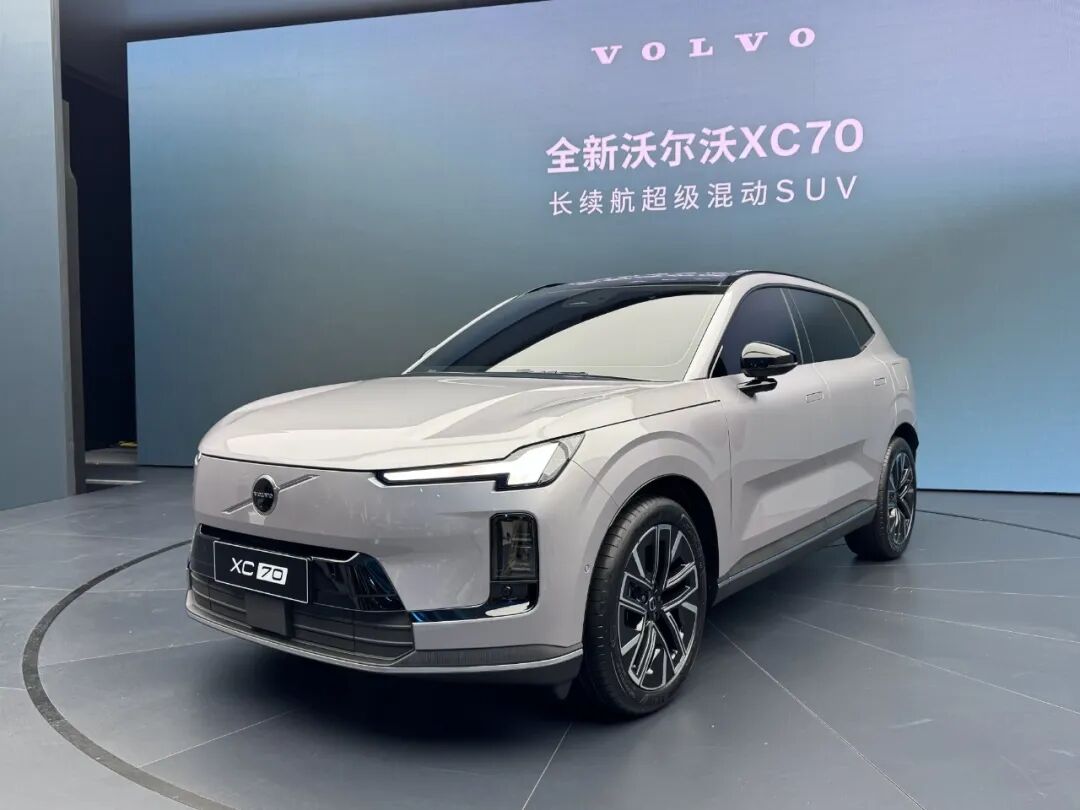
The first model under the SMA architecture is the Volvo XC70. Launched in Shanghai on September 26, 2025, with a limited-time price of RMB 269,900 to 349,900, it is positioned as a mid-to-large SUV, between XC60 and XC90.
Although XC70 is positioned in a gap in Volvo's product lineup, its price range inevitably overlaps with XC60. These two models rank first and second on Volvo's monthly sales list, contributing over 60% of the brand's sales.
We learned that a portion of XC70 users originally belonged to the potential buyer pool of XC60, which affected XC60's sales in the first quarter. While XC70 helps Volvo enter the long-range hybrid market, it inevitably diverts internal demand from existing fuel (internal combustion engine) mainstay models.
If new energy transformation is considered a must-answer question, the pain period of internal competition is hard to avoid. So the core issue is that XC70's market share is not big enough.
XC70 adopts a 1.5T engine + 3-speed DHT gearbox, with a P1+P2+P4 three-motor combination. Volvo Cars Global CEO Samuelsson described it as "the perfect bridge to full electrification."
According to the China Passenger Car Association, XC70's monthly sales in the six months after launch: 2,757 units in October 2025, 5,354 units in November, 4,988 units in December, 2,016 units in January 2026, 737 units in February, and 3,895 units in March. Its share of Volvo China's monthly sales during the same period: 21.43%, 40.16%, 33.02%, 21.30%, 23.56%, and 29.59%.
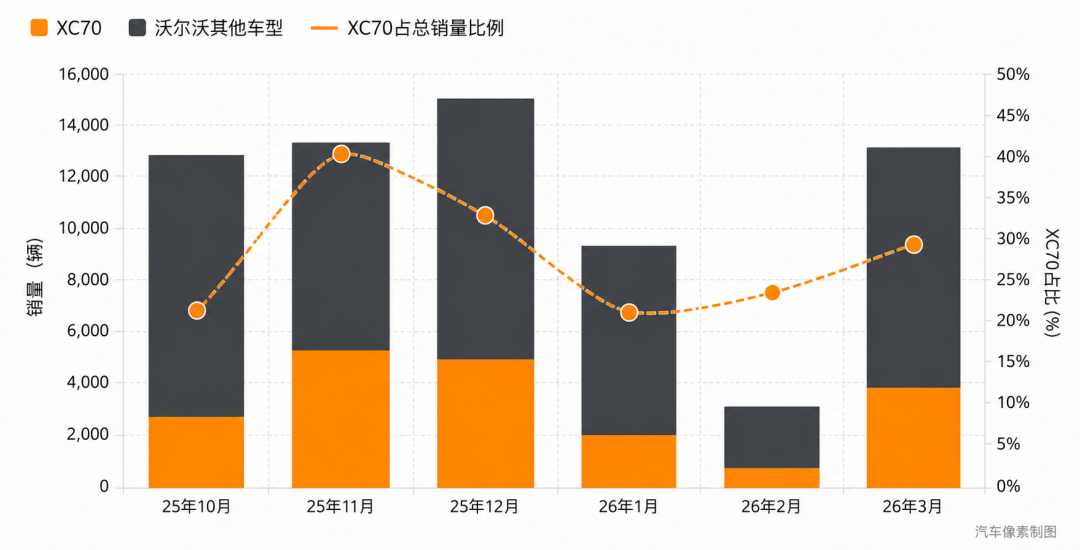
The share has been rising, but viewing it in the context of total sales provides another interpretation. Volvo China's total monthly sales during the same period were 12,866 units, 13,332 units, 15,106 units, 9,465 units, 3,128 units, and 13,164 units, respectively. Excluding the heavily impacted February due to the Spring Festival, the average sales in January and March were about 11,300 units, about 13% lower than the 2024 monthly average.
In other words, while XC70's share has increased, its sales are not strong. On the other hand, other models are declining faster in the downward trend.
XC70's true performance cannot yet be considered stable. After the initial sales surge, its monthly sales of 3,000 to 4,000 units are closer to natural sales levels, one tier lower than the previously estimated threshold of 5,000 units.
On the other track of the "dual-track" strategy, the pure electric flagships EX90 and ES90 under the SPA2 architecture have not been released yet, and the pure electric narrative of the SPA2 architecture has effectively failed in the Chinese market. Volvo China currently resembles more of a dual-engine company with fuel (internal combustion engine) and SMA.
The first question Duan Jianjun needs to answer is whether to pull XC70 up to become the first stable pillar of the SMA strategy or to first address the issue of sales diversion.
03
SMA's Debut: Hype Exists, But Growth Is Insufficient
SMA brings efficiency and an opportunity for counterattack to Volvo, but it also brings a problem. Volvo in China may split into two Volvos.
One is Global Volvo, with EX90, ES90, and classic models like XC60, emphasizing Swedish engineering, Nordic design, and safety DNA, targeting BBA's pure electric flagships at the same price point.
The other is "China Volvo" under the SMA architecture, including XC70 and more models to be developed based on the SMA platform, priced between RMB 250,000 and 400,000, sharing some supply chains and powertrains with certain products in Geely's system.
The two Volvos are not the same in terms of product strength and cost structure. If consumers distinguish them mentally, it will be difficult for "China Volvo" to unlock brand premium capabilities.
There is a precedent for this in luxury brand history. Lincoln and Infiniti both attempted localized repositioning in China, resulting in a gradual slide from luxury to premium joint ventures.
Volvo has one advantage over them: its parent company, Geely, is also its supply chain partner, with very high collaboration efficiency. But this is also a disadvantage, as Lynk & Co, Zeekr, and Galaxy brands within the same group already have sufficient layout (presence) in the 200,000 to 350,000 RMB hybrid SUV market.
Volvo's SMA models need to answer a question within their own group: why should consumers pay tens of thousands of yuan more for the same technology?
 ▍Volvo XC70
Specific actions may have three levels. First, restructure the product pricing and incentive system to avoid continuous terminal concessions eroding the brand anchor. Second, shift XC70's communication narrative from a "me-too" super hybrid to a more Volvo-centric product, reducing product comparison frameworks with Lynk & Co and Zeekr. Third, position the second SMA product well.
Volvo China's current cash cow is the XC60 fuel (internal combustion engine) version, with 4,466 units sold in March, a model with relatively high gross profit per unit.
If the second SMA product is positioned as a replacement for XC60, Volvo China will replace its highest-gross-profit product with a lower-gross-profit one within two years. If it avoids XC60 and targets XC90's position, it means Volvo China voluntarily gives up competing head-on with new models from the same group in the mid-to-large SUV market.
This decision goes beyond the sales level and involves coordination among the global headquarters, Geely Group, and Volvo China. As a veteran of the Geely system, Yuan Xiaolin had a natural voice in coordination. Duan Jianjun, as an outsider, needs to rebuild his voice.
Over the next 18 months, what Duan Jianjun does in coordinated decision-making will be more important than how many cars he sells.
The challenge of secondary localization is that Volvo needs to successfully package Geely's efficiency as Volvo's value. This is the question Yuan Xiaolin left for Duan Jianjun and the question Volvo left for the Chinese market.
This article is original content from Autopix (autopix) and may not be reproduced without authorization.
-
![]()
Liang Wenfeng: Marching to His Own Beat
-
![]()
Trillion-Yuan Intelligent Computing Market Surge: Key Trends in the Computing Power Industry
-
![]()
Global Capital Betting Big on Chinese Robotics
-
Summary of the Online Voice Recorder Market in Q1 2026: A Touchstone for AI Integration into Hardware, with Initial Signs of Ecosystem-Based Competition Emerging
-
Summary of the Online Drone Market in Q1 2026: Ecological Breakthrough and High-Quality Development of the Low-Altitude Economy Entering a New Phase
-
![]()
Challenges in Claim Settlements and Soaring Premiums: A Ping An Good Car Owner's Tale of Woe
-
![]()
AI Glasses Achieve Breakthrough with Lightweight Design: Materials and Balance Emerge as Key Competitive Factors
-
![]()
Volvo Needs Geely, But Not Too Much Like Geely