Germany Launches Electric Vehicle Subsidy Applications, Chinese Automakers May Benefit
 05/27 2026
 569
569
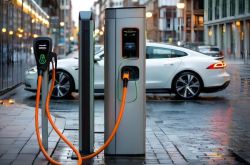
Recently, Germany officially launched an online application portal for individual subsidies for new electric vehicles. Consumers purchasing electric vehicles, plug-in hybrid vehicles, and extended-range electric vehicles can apply for government subsidies online, with amounts ranging from 1,500 to 6,000 euros depending on the vehicle model and personal circumstances. The program is retroactive to January 1, 2026. German media predict that the subsidy budget will support 3-4 years, covering approximately 800,000 new vehicles.
The most significant change in this policy is the introduction of "income and family status" factors, with subsidy amounts varying based on household income and number of children. Families with lower incomes and more children will receive higher subsidies. However, households with annual incomes exceeding 90,000 euros are not eligible for subsidies.
Additionally, there is no vehicle price cap for subsidies, and vehicle origin is not a distinguishing factor. Some plug-in hybrids and extended-range models must meet environmental requirements, such as having an all-electric range of over 80 kilometers or CO2 emissions below specified standards.
Among major European countries, France offers subsidies of up to 6,000 euros, but its carbon footprint scoring mechanism effectively excludes most Chinese electric vehicles; Italy offers subsidies of up to 11,000 euros; the UK provides purchase subsidies of up to 3,750 pounds for electric vehicles; and Spain offers subsidies of up to 7,000 euros. Germany's approach, characterized by no nationality restrictions and no price cap, will become one of the most Chinese automaker-friendly markets in Europe.
▍Chinese Automakers: Cost-Effectiveness Advantage Further Amplified
Currently, the EU imposes import tariffs of up to 45.3% on Chinese-made electric vehicles, requiring Chinese brands to compete with local brands in the European market based on manufacturing efficiency and leading battery technology. France's subsidy policy has explicitly excluded most Chinese-made models, but Germany's open stance provides a rare breakthrough opportunity for Chinese automakers.
The fact that this subsidy does not distinguish between vehicle origins means that vehicles manufactured outside the EU are also eligible to apply. Matt Schmidt, founder of industry research firm Schmidt Automotive Research, pointed out that this policy will bring highly attractive car purchase and leasing options to German consumers, and Chinese brands, with their cost and battery technology advantages, will also be beneficiaries.
Take the Leapmotor T03, for example, an electric vehicle developed in collaboration with Stellantis. Priced at approximately 15,000 euros before subsidies, its monthly leasing cost could drop to as low as 50 euros after subsidy coverage, almost equivalent to the average monthly mobile phone bill for ordinary consumers. The Volkswagen ID. Polo's starting price after subsidies could drop to 18,955 euros, while the BYD Dolphin Surf's starting price would be reduced to 18,990 euros.
Germany is the birthplace of European automobiles, boasting globally renowned brands such as Volkswagen, BMW, and Mercedes-Benz. Local consumers have a natural preference for domestic products. Therefore, Chinese manufacturers have largely not yet truly penetrated this market, but Schmidt stated that this situation may change with the new subsidy program. Five years ago, German subsidies opened the door for Tesla, and now the same opportunity will belong to Chinese brands.
Investment bank UBS noted in its latest research report that electric vehicle (including all-electric and plug-in hybrid) sales in Germany have grown by 32.9% year-to-date. "Given the implementation of the subsidy policy and persistently high gasoline prices, we expect this trend to accelerate further in the coming months."
UBS also analyzed that German manufacturers are likely to be the biggest beneficiaries. Meanwhile, with the household income cap set at 90,000 euros, the subsidies primarily benefit the mass market rather than high-end luxury vehicles. In this market segment, there is no differential treatment among manufacturers, and Chinese automakers are poised to capture a significant share.
▍Germany's Policy 'Balancing Act'
Unlike France, which explicitly excludes most Chinese-made electric vehicles from subsidies, Germany's subsidy policy treats all brands equally. This is not an oversight but a pragmatic consideration.
The German automotive industry is deeply intertwined with the Chinese market. Volkswagen entered China in the mid-1980s, and today, the three giants—Volkswagen, BMW, and Mercedes-Benz—still derive significant profits from sales in China. If the German government were to follow France's example and impose restrictions targeting Chinese-made vehicles in subsidies, it could trigger retaliation, directly harming the core interests of domestic automakers.
Schmidt commented on this, saying, "German Chancellor Friedrich Merz must walk a tightrope between safeguarding German industry's commercial interests in China and leaving room for Chinese companies to develop in Germany." He also pointed out that the timing of the new subsidy policy coincides with Volkswagen's launch of affordable electric models like the ID. Polo and Skoda Elroq. "The base version of the Volkswagen ID. Polo is priced below 25,000 euros before subsidies, which will help Volkswagen recoup profit margins lost over the past two years due to price reductions to meet carbon emission targets."
In short, Germany needs profits from the Chinese market to support its domestic transition and naturally cannot "close the door" on subsidies. This has opened a door for Chinese automakers to enter Germany.
In the future, can Chinese brands replicate Tesla's "subsidy dividend" in Germany? Will German domestic automakers accelerate the launch of low-cost electric vehicles as a result? And will the EU intervene again to close this "loophole"? Regardless of the answers, one thing is clear: Chinese electric vehicles are using cost and technology to knock on the door of Europe's most discerning market.
Typesetting 丨 Zheng Li
Source 丨 Forbes
Image Source 丨 Qianku Network
-
![]()
Europe's Q1 Smartphone Market Shipments Revealed: Samsung Holds Firm at First Place, Honor Surges Over 60%
-
![]()
Mixed Fortunes: The Ongoing Transformation of the Automotive Industry's Value Landscape
-
![]()
Germany Launches Electric Vehicle Subsidy Applications, Chinese Automakers May Benefit
-
![]()
Struggling to Keep Pace with 618 in 2026? The Reality is More Intricate
-
![]()
JD May Be Cracking the Key Challenge of Physical AI
-
Computing Power Crisis: Four Major Forces Enter Token Service Market
-
![]()
Agnes AI Releases Three Core Multimodal Models: Text, Image, and Video
-
![]()
Tesla Abandoned Radar Five Years Ago; Now, China’s Market is on the Verge of Delivering Its Verdict