Why Aren't Foreign Brands Offering Large SUVs Priced Above 100,000 Yuan?
 05/29 2026
 374
374
Lead
Introduction
With the flourishing of domestic large SUVs, why haven't joint venture brands ventured into this segment earlier?
On May 27th, the launch of two SUVs clearly demonstrated the ambitions of Chinese auto brands to ascend further in the market. The new AITO M9 starts at 479,800 yuan, with the Ultimate Extended 6-Seater version priced at 659,800 yuan. The NIO ES9 is available for purchase at prices ranging from 498,000 to 628,000 yuan, or through a battery leasing scheme at 390,000 to 520,000 yuan.
Traditionally, domestic vehicles were seen as budget-friendly alternatives, often priced 30-40% lower than comparable foreign models. However, AITO and NIO are now challenging this norm by pricing their models in the same range as flagship offerings from foreign brands, thus directly competing with them on equal footing.
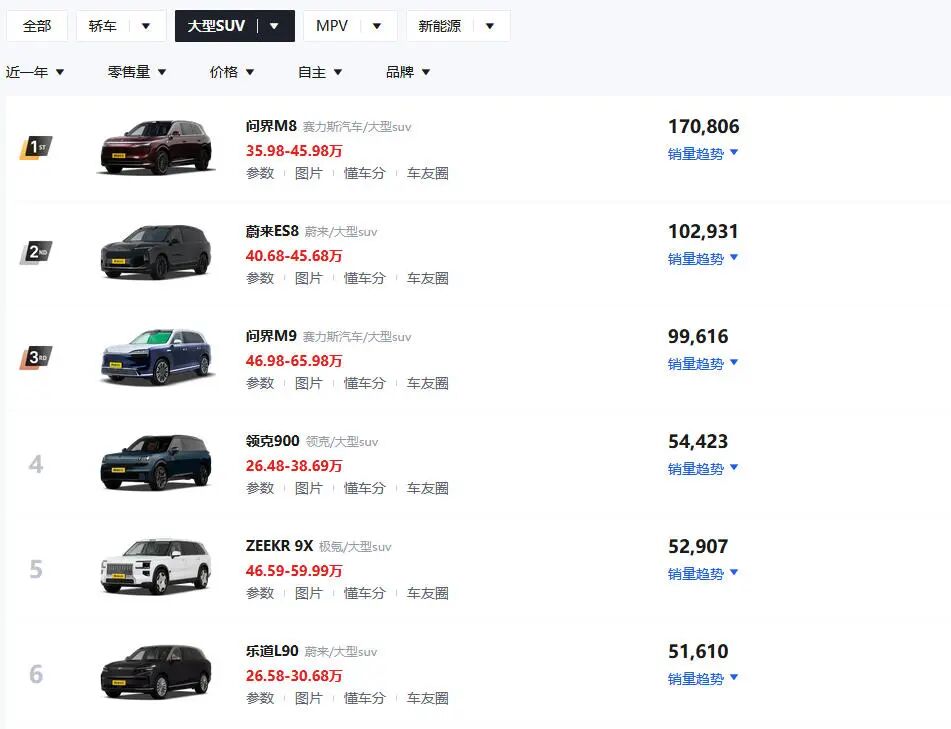
In fact, the domestic automotive market has witnessed a fascinating trend over the past two years. Mid-size and large SUVs have become hot sellers, with models like the Li Auto L9, AITO M9, NIO ES8, and Zeekr 9X, each larger and more lavishly equipped than the last.
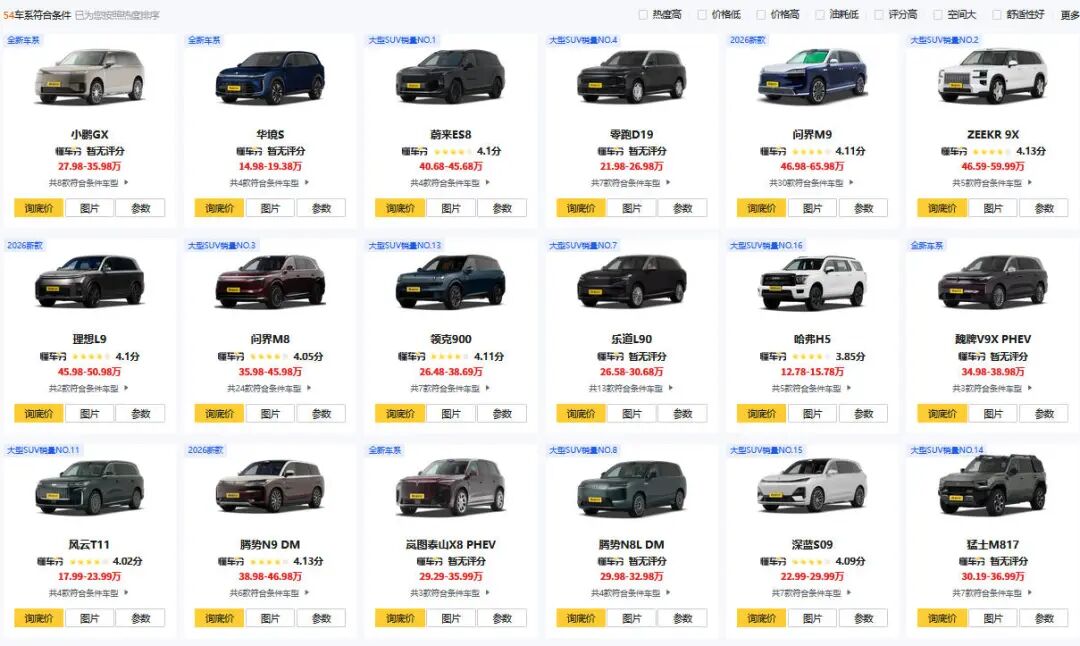
Most notably, many large SUVs launched this year have continued to drive prices down. Previously, we considered pricing like the Leapmotor D19, Fengon T11, and Seres S09 at just over 200,000 yuan to be extreme. However, the Huawei Jing S has pushed prices down to the 150,000 yuan range, and the Wuling Xingguang L's pre-sale price starts at just 117,800 yuan.
A quick tally reveals that dozens of new domestic large SUVs have emerged in the past two years, all enjoying decent sales. In contrast, when we look at joint venture brands, the number of large SUVs available on the market is quite limited: the Mercedes-Benz GLE/GLS, BMW X5/X7, and at the top end, models like the Rolls-Royce Cullinan and Bentley Bentayga, with a significant gap in between.
Audi still lacks a true large SUV in its lineup, while the Toyota Land Cruiser barely qualifies as mid-large, and the Lexus LX is large enough. American brands offer the Lincoln Navigator and Chevrolet Tahoe, but these models have limited visibility in China.
Theoretically, joint venture brands possess decades of experience in the Chinese market, along with established channels, brand recognition, and technological accumulation. Consumer demand for large vehicles is not new either. In the past, the Highlander commanded a premium, and the Teramont had waiting lists, indicating a persistent desire for spacious vehicles.
So, why do joint venture brands offer relatively few large SUVs overall?
01 The Rules of the Game in the Fuel Era
To understand why joint venture brands don't produce a large number of large SUVs, we must first examine the logic of fuel-powered vehicles.
Mid-size or large SUVs, often exceeding five meters in length and easily surpassing two and a half tons in weight, require engines with sufficient displacement and power to move and perform smoothly. This is determined by basic physical laws.
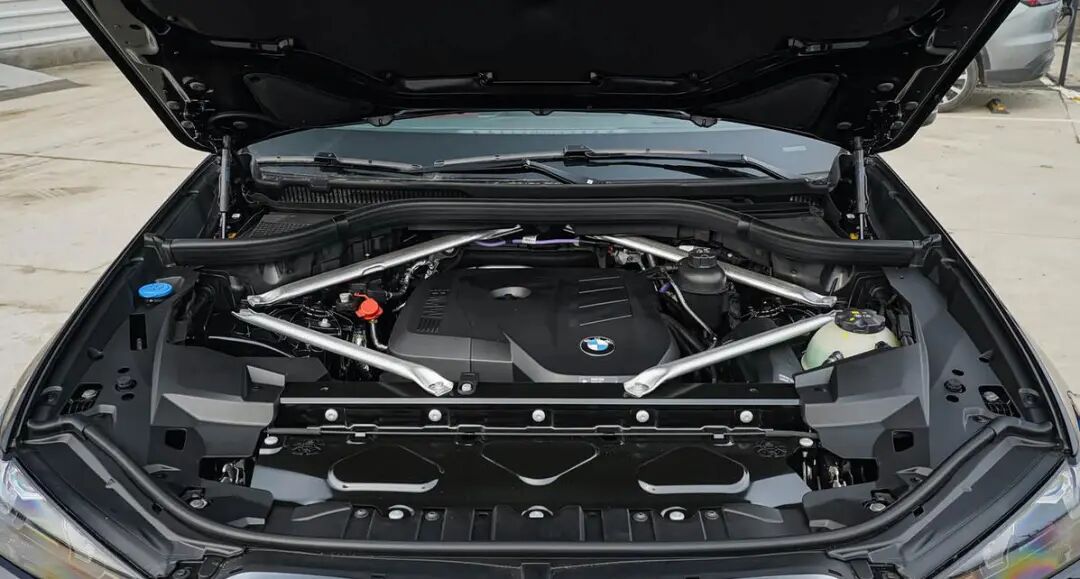
A two-and-a-half-ton vehicle equipped with a 2.0-liter four-cylinder engine is not entirely incapable, but the driving experience will be poor. For example, sluggish acceleration, noticeable turbo lag, strained high-speed overtaking, and struggling to climb slopes with the air conditioning on, even with the accelerator floored. To address this, the most straightforward solution is to increase power, such as with six-cylinder or eight-cylinder engines.
However, this introduces new issues. Large-displacement engines are inherently costly, and in the Chinese market, displacement taxes are unavoidable. The consumption tax for engines ranging from 3.0 to 4.0 liters is 25%, and it jumps to 40% for engines exceeding 4.0 liters. This means that for an imported 4.0-liter large SUV, the combined consumption and value-added taxes significantly increase the cost.
Additionally, even if joint venture brands localize production, core components like engines and transmissions often need to be sourced from abroad or produced under license, making cost reduction difficult. Therefore, a decade ago, the only true large SUVs available were models like the Mercedes-Benz GLS, BMW X7, Nissan Patrol, and Toyota Sequoia, with starting prices in the seven figures and landing prices approaching 1.5 to 1.6 million yuan.
Such models, constrained by their high prices, were neither intended for nor affordable to ordinary families.
However, high costs are just the surface reason. The deeper cause lies in a rigid, decades-old market pricing system. Traditional automakers, represented by BBA, have tacitly established a set of rules that classify vehicle models based on axle length, power, and configuration.
Class A vehicles are for the masses, Class B for the middle class, Class C for the bourgeoisie, and Class D as status symbols. Between each class, the axle length increases by just a dozen or twenty centimeters, with minimal increases in material costs, yet prices can jump by 40-50%. This additional cost represents the premium for vehicle class differentiation.
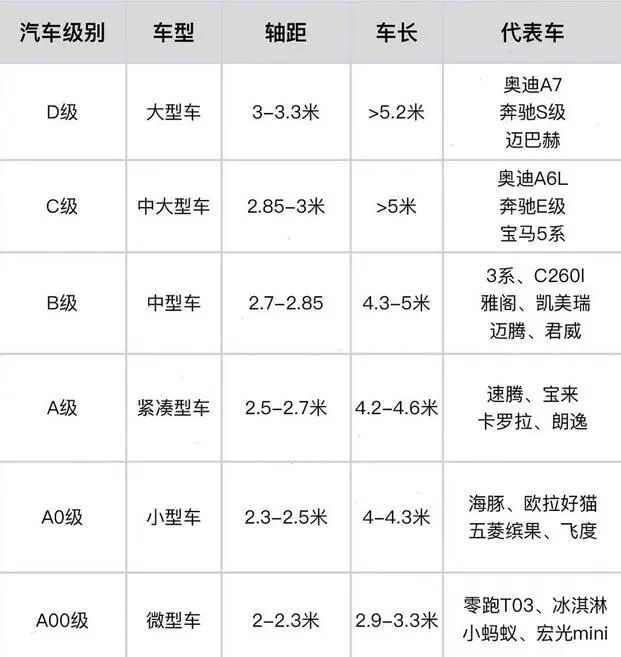
Large SUVs are naturally placed at the pinnacle of this pyramid, serving as standard equipment for premium models, much like quarter windows, chrome accents, and large wheel hubs. This system has operated worldwide for decades, allowing automakers to maintain brand image and reap substantial profits.
Moreover, these models don't require frequent updates; a six-to-eight-year development cycle is common, allowing automakers to profit while remaining complacent. Within this system, even if high-priced models are localized in China, joint venture partners often act more as assembly plants, with the majority of profits flowing back to foreign shareholders through various means.
Flagship models that command high premiums are either produced abroad to maintain their flagship image or have their localization strictly controlled to prevent dilution of their premium feel. Therefore, foreign brands are reluctant to bring their best offerings to China at affordable prices.
It's not that they can't make large SUVs or are unaware of Chinese consumers' preference for large vehicles. Rather, their business calculations reveal that lowering the price of large SUVs to a range affordable to ordinary people would undermine the entire premium structure from Class A to Class D, harming the brand's premium attributes.
This raises a broader question: in a market without competitors, they naturally prefer monopoly. If compact SUVs can sell for 200,000-300,000 yuan, why offer better products at lower prices?
02 New Energy Disrupts the Status Quo
According to statistics, there are 14 large SUVs (including both domestically produced and imported models) from foreign brands sold in the Chinese market, with slightly more than 40 mid-size SUVs. However, Chinese auto brands offer 23 large SUVs with sales statistics and as many as 60 mid-size SUVs, not to mention many newly launched and upcoming models.
The proliferation of domestic large SUVs ultimately comes down to one factor: new energy technology has shattered the fortress built on displacement and class hierarchy during the fuel-powered vehicle era.
The first barrier broken is the physical constraint of large-displacement engines. Fuel-powered vehicles need large-displacement, multi-cylinder engines to move a two-and-a-half-ton body. Electric motors, however, operate differently, delivering maximum torque from the start without relying on RPM buildup. Two-hundred-kilowatt motors are common and can effortlessly propel a large SUV.
Automakers no longer need to stack six or eight cylinders for sufficiency or bear high displacement taxes and fuel consumption for power reserves. Extended-range or plug-in hybrid technologies work similarly, with 1.5-liter small-displacement engines primarily serving as generators, offering multiple benefits to consumers.
For daily urban commuting, pure electric mode costs less than 0.1 yuan per kilometer. On long trips, the engine operates at peak efficiency, achieving around 7-8 liters per 100 kilometers in fuel consumption. Previously, a large SUV could easily consume 15-16 liters per 100 kilometers in urban driving, with monthly fuel costs exceeding 1,000 yuan. Now, energy costs are reduced to one-third or even lower.
Another aspect is the cost logic. In the fuel-powered vehicle era, enlarging a vehicle involved more than just additional steel and plastic. The powertrain needed re-matching, the chassis re-tuning, the transmission to withstand greater torque, and upgrades to cooling, braking, and suspension systems. Each upgrade incurred significant costs, and most of these core technologies were controlled by foreign Tier 1 suppliers, limiting bargaining power.
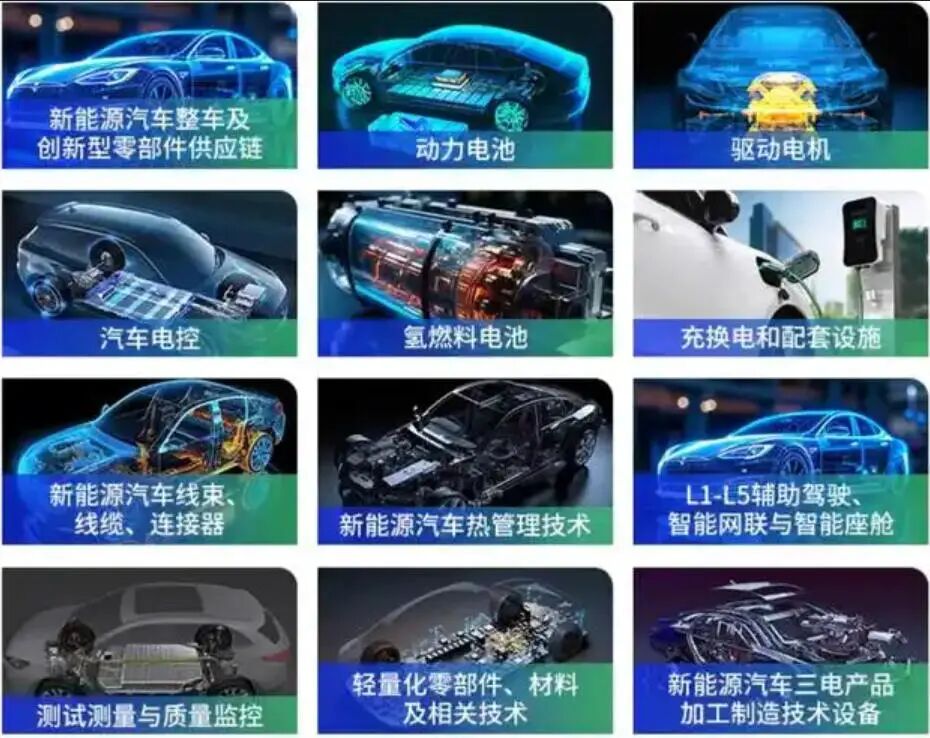
However, in the electric vehicle realm, China has established the world's most complete and lowest-cost supply chain for the three core electric systems: battery, motor, and electric control. Motor procurement prices have been driven very low, while components like car bodies, seats, and screens are extremely affordable in China, the world's largest automotive production base.
Thus, a domestically produced large SUV measuring 5.2 meters in length and fully loaded with configurations can sell for under 300,000 yuan and still be profitable. This was unimaginable in the fuel-powered vehicle era, where similar sizes and power levels from joint venture brands would cost 800,000 yuan or even 1 million yuan. This is why Chinese automakers often claim their vehicles rival million-yuan luxury cars.
More importantly, the significant flatness advantage of electric vehicle chassis provides a natural design benefit for large SUVs. Fuel-powered vehicles need to accommodate driveshafts, exhaust pipes, and fuel tanks, making it difficult to achieve a flat chassis and compromising interior space with various protrusions and bulges. Electric vehicles, by eliminating the engine and transmission, can shorten the front compartment, resulting in larger interior space for the same vehicle length. The flat floor enhances the seating experience in the second and third rows.
As for joint venture brands, it's not that they lack technological reserves, but turning a large ship is difficult. The internal combustion engine production lines, transmission factories, and supplier systems they've built over decades represent sunk costs in the billions. Moreover, they've fallen significantly behind Chinese brands in battery supply chains and intelligent software capabilities.
By the time they realized the situation, they found themselves needing to produce large SUVs with the same size, configuration, and price as domestic models in China's new energy era. Models like the Buick E5, Audi Q6, Nissan NX8, and Volkswagen ID.ERA 9X can indeed be made. It's believed that more joint venture large SUVs will emerge in the future.
Ultimately, the reason joint venture brands didn't make large SUVs before isn't a technical or market issue. Their current predicament stems from the fact that the old order, built on fuel-powered technology and class hierarchy, has been dismantled by China's new energy industry chain. Therefore, the boom in domestic large SUVs essentially meets widespread consumer demand through technological democratization.
Editor-in-Chief: Yang Jing Editor: He Zengrong

THE END
-
![]()
The Agent hasn't arrived yet, but Ascend has already paved the way from hardware to software.
-
![]()
In 71 years, He sold products to 100 million people
-
![]()
First-hand Practical Test! Opus 4.8 Vs ChatGPT 5.5 Vs Kimi 2.6: Which is the Most Usable?
-
![]()
Fourfold Uncertainty Challenges Facing China's Agent Industry - Interpretation of the 'Report' (Part Six)
-
Crazy Anthropic
-
![]()
CNPC’s Kunlun Model Advances with 152 Implemented Scenarios, Showcasing Proactive AI
-
![]()
Revenue Increases, But Profits Don't: Pinduoduo's Anxiety Amidst Billion-Dollar Brand Building
-
![]()
Half Flock In, Half Flee Out: The Dual Dynamics of Singapore as an AI Hub