Strictly Control the Acceptance of Intelligent Driving: Final Results of Shenzhen Bus Group's Tender and Procurement Announced
 05/29 2026
 450
450
On May 28, Shenzhen Bus Group officially announced the winning bidders for its recent procurement project of pure electric buses. The procurement was divided into three lots, totaling 1,220 vehicles, with the winning bidders being Nanjing Golden Dragon, Zhongtong Bus, and BYD. While the allocation of the lots remained unchanged, the seemingly routine procurement list reflects Shenzhen's stringent control over technical standards in the second half of the public transportation intelligence race.
According to the announcement, Lot 1, '725 10-11m low-floor pure electric buses,' was awarded to Nanjing Golden Dragon for approximately RMB 631 million; Lot 2, '295 10-11m high-floor pure electric buses,' was awarded to Zhongtong Bus for approximately RMB 265 million; and Lot 3, '200 8-9m low-floor pure electric buses,' was awarded to BYD for RMB 176 million.
For the upcoming APEC conference support tasks, these vehicles are not just means of transportation but also important windows to showcase Shenzhen's level of intelligence. Therefore, Shenzhen Bus Group has set extremely strict acceptance standards. This control is not simply about market exclusivity but is aimed at ensuring that all vehicles put into operation meet unified high standards. Any vehicle that does not comply with the established intelligent driving acceptance requirements will fail the acceptance process and not receive payment. This effectively transforms technical thresholds into entry barriers, forcing suppliers and bus manufacturers to enhance their intelligence levels.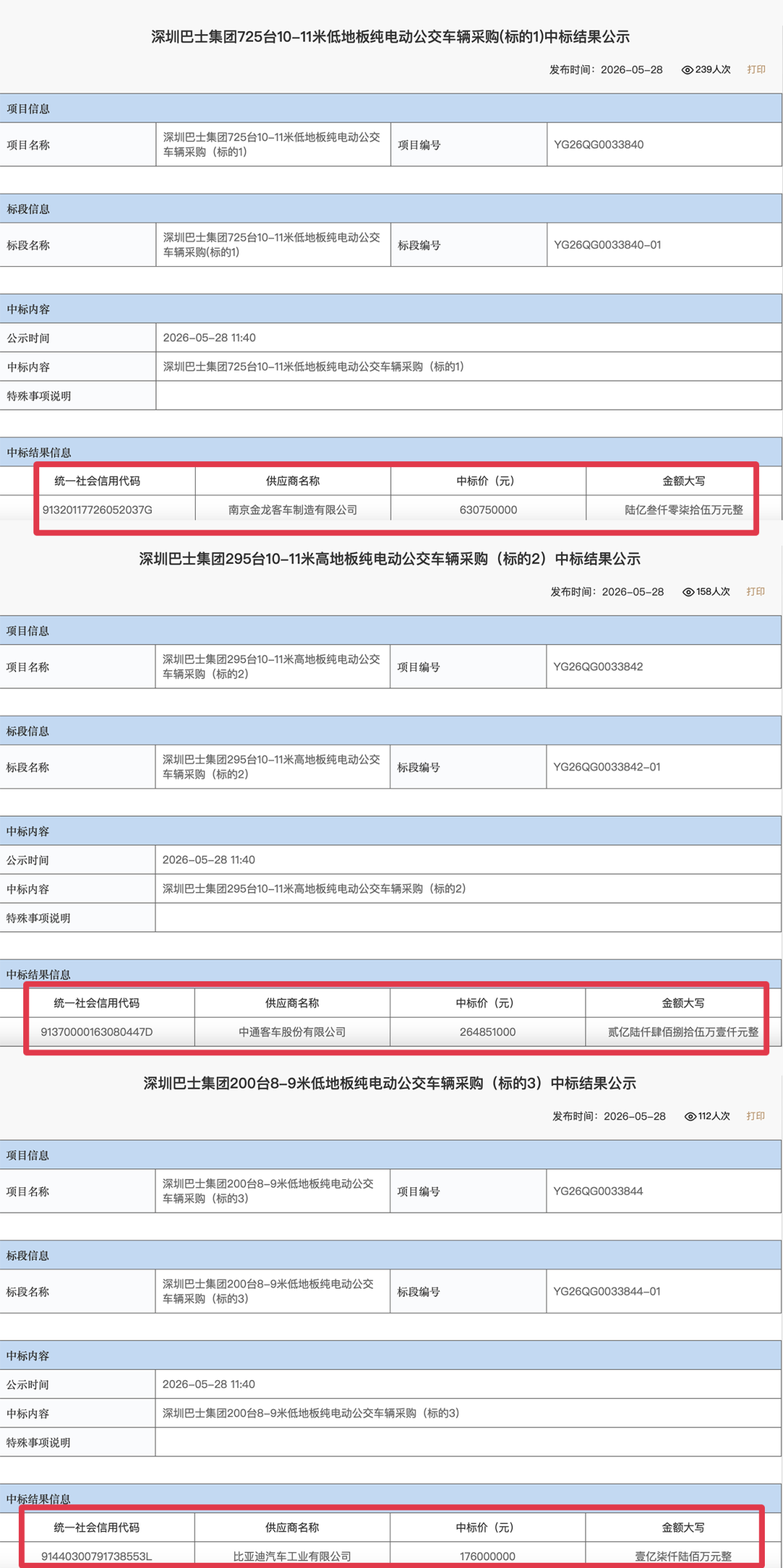
Behind this move lies Shenzhen's firm determination to fully sprint into the 'intelligent second half' after successfully concluding the 'electrification first half.' As the first city in China to achieve full electrification of its buses, Shenzhen has completed the green replacement of its hardware facilities. Now, faced with high-profile international events like the APEC conference and the need for refined urban traffic management, mere electrification is no longer sufficient to sustain future competitiveness. The government clearly recognizes that the pace of intelligence must not lag and should even proceed more steadily and solidly than electrification.
Therefore, this tender and procurement process is not just about buying vehicles but is also a comprehensive assessment of the practical capabilities of intelligent driving systems. By directly linking intelligent driving acceptance standards to procurement payments, Shenzhen Bus Group is effectively implementing an important local strategy: using major event support (such as the APEC conference) as a touchstone to forcibly promote the intelligent upgrade of the public transportation system. This 'promotion through testing, promotion through use' model, while increasing compliance costs and technical pressure on enterprises in the short term, avoids low-level redundant construction in the long run, ensuring that every cent of financial investment is converted into tangible intelligent transportation capacity.
For the winning bidders, this is not just an order but also a ticket to enter Shenzhen's advanced intelligent driving ecosystem. In future competition, only enterprises that truly master core intelligent driving technologies and can pass stringent field validations will be able to establish a firm foothold in Shenzhen's intelligent landscape.
-
![]()
The Agent hasn't arrived yet, but Ascend has already paved the way from hardware to software.
-
![]()
In 71 years, He sold products to 100 million people
-
![]()
First-hand Practical Test! Opus 4.8 Vs ChatGPT 5.5 Vs Kimi 2.6: Which is the Most Usable?
-
![]()
Fourfold Uncertainty Challenges Facing China's Agent Industry - Interpretation of the 'Report' (Part Six)
-
Crazy Anthropic
-
![]()
CNPC’s Kunlun Model Advances with 152 Implemented Scenarios, Showcasing Proactive AI
-
![]()
Revenue Increases, But Profits Don't: Pinduoduo's Anxiety Amidst Billion-Dollar Brand Building
-
![]()
Half Flock In, Half Flee Out: The Dual Dynamics of Singapore as an AI Hub