2 Million Zunjie Models to Be Launched Soon: A Last-Ditch Effort After Six Consecutive Quarters of Losses
 05/29 2026
 546
546
Xingkongjun noticed a piece of news: Huawei and JAC Motors are discussing contract manufacturing with Maserati.
At first glance, it seems absurd. How can JAC Motors, a company known for making pickup trucks, contract manufacture for Maserati?
However, a deeper look into JAC Motors reveals that it indeed has the capability.
On one hand, JAC Motors collaborates with Huawei on the high-end Hongmeng Zhixing brand: Zunjie, which has seen considerable sales and positive feedback. On the other hand, JAC Motors' parent company has received investment from Volkswagen, making it the largest shareholder (50%, tied with the Anhui Provincial SASAC).
Maserati, as a subsidiary brand under Stellantis, lacks complete independent R&D capabilities and has long collaborated with Ferrari (which is now also under Stellantis).
From a capital perspective, JAC Motors' contract manufacturing for Maserati is essentially a collaboration between Volkswagen and Stellantis.
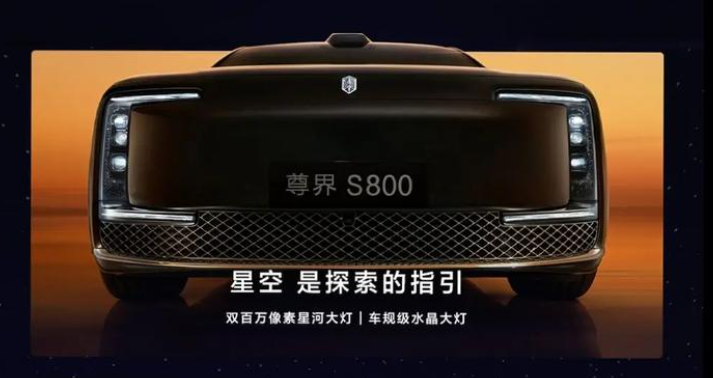
The collaboration model follows Hongmeng Zhixing's 'Five Brands' approach: Huawei leads product definition and provides core technologies such as intelligent cockpits, intelligent driving, and electric drive systems. JAC Motors co-develops and uses the Zunjie Super Factory for manufacturing. Maserati contributes styling design, chassis tuning expertise, and brand licensing endorsement. Adopting a 'dual-branding for the same model' approach, the domestic version will be part of Huawei × JAC's existing ultra-luxury brand Zunjie, while the overseas version will bear the Maserati badge for sales in foreign markets.
However, this collaboration is still full of uncertainties, with reports also suggesting that BYD is interested in acquiring Maserati.
Yet, Xingkongjun believes that Geely might be a better fit for this endeavor. Li Shufu has proven adept at acquiring foreign brands.
Although JAC Motors has started manufacturing cars costing over a million yuan and showing progress, its financial reports are not optimistic.
1. Sixth Consecutive Quarter of Losses
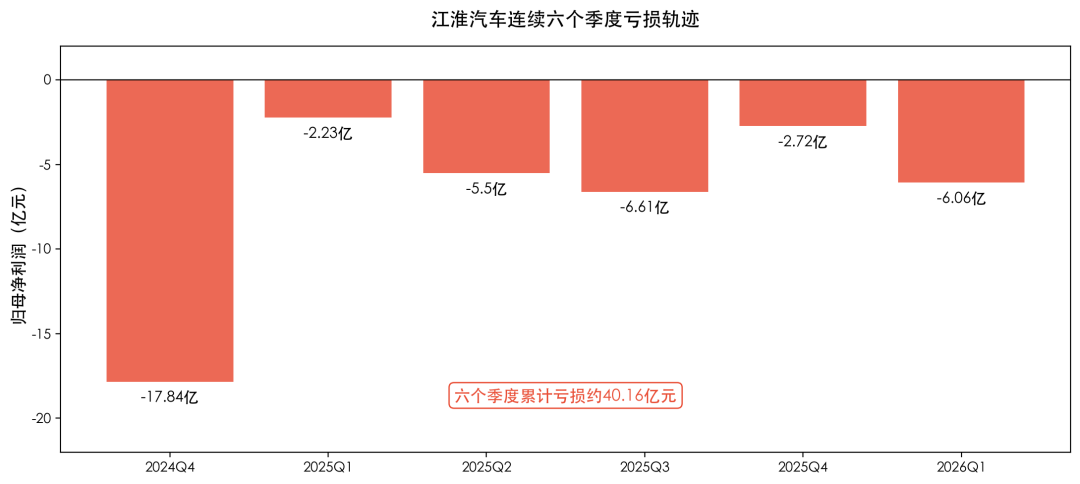
Six consecutive quarters of losses.
This is the most glaring issue in JAC Motors' Q1 2026 report. While the market debates whether 'losses are narrowing,' a more fundamental question arises: Can this veteran automaker turn around with Zunjie?
In Q1 2026, losses reached RMB 606 million, a 171.74% YoY increase. Net profit after non-recurring items was -RMB 727 million, indicating that the core business's ability to generate cash has not recovered.
Revenue in Q1 2026 was RMB 11.459 billion, a 16.91% YoY increase. On the surface, revenue is growing. But what lies behind this growth? Is it contributions from Zunjie or a recovery in traditional business?
More noteworthy is the operating cash flow, which saw a net outflow of RMB 3.902 billion, the worst level in recent quarters. The core business is not only failing to bring in cash but is also consuming significant amounts.
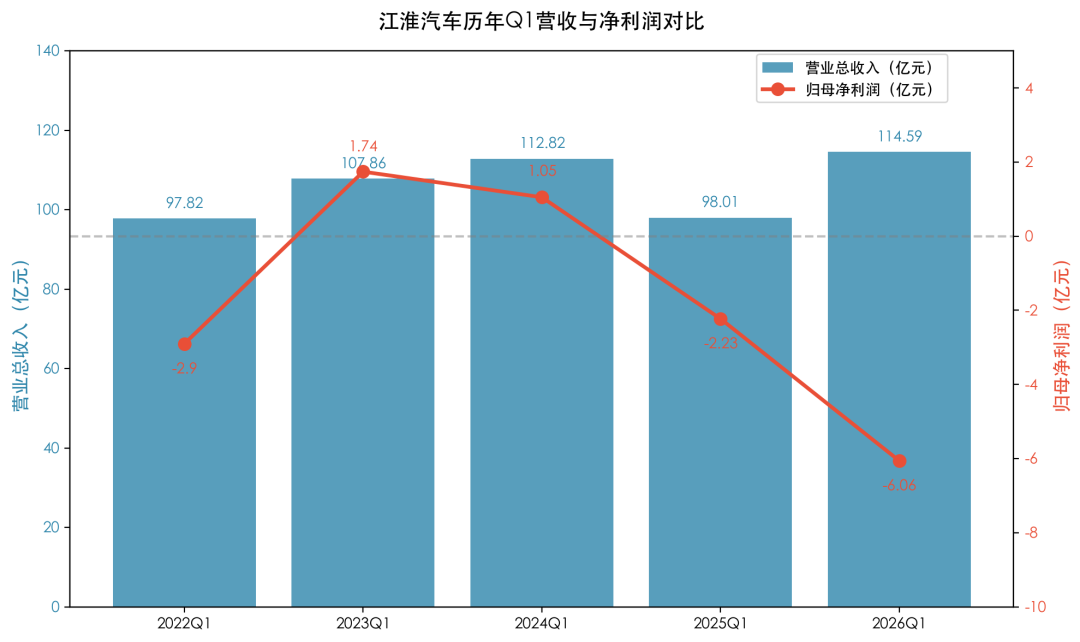
In the first three quarters of 2024, JAC Motors was profitable (Q1: RMB 105 million, Q2: RMB 196 million, Q3: RMB 324 million). However, a Q4 loss of RMB 1.784 billion completely reversed the annual trend.
Q4 2024 became JAC Motors' 'Waterloo.'
Observing the timeline, the company's core business has long lacked the ability to generate cash, with net profit after non-recurring items suffering consecutive losses for nine years, totaling approximately RMB 16.3 billion from 2017 to 2025.
2. Is Zunjie the Lifesaver?
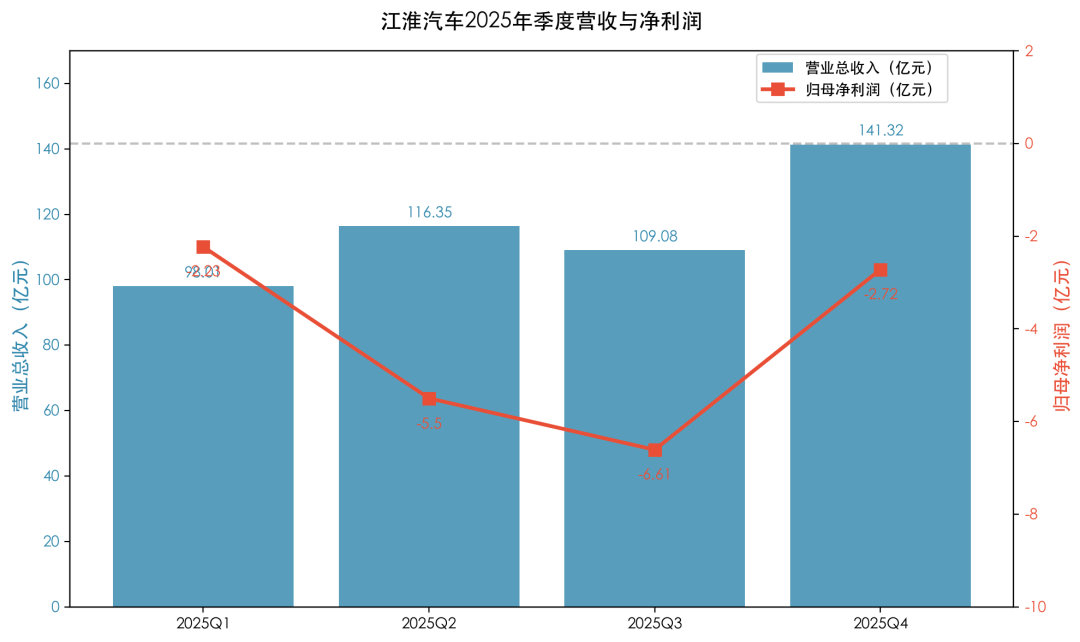
In 2025, JAC Motors' vehicle and chassis sales reached 384,100 units, a 4.72% YoY decrease. However, revenue increased by 10.35% despite the sales decline. This 'volume decrease, revenue increase' trend is mainly due to changes in product mix, with the million-yuan high-end brand Zunjie, launched in collaboration with Huawei, significantly raising the average selling price per unit.
However, industry experts generally believe that the concentration of growth also brings concerns. JAC Motors admitted in its annual report that 'except for Zunjie, the company's passenger vehicle brands lack market competitiveness.'
In 2025, JAC passenger vehicle sales were 149,000 units, a 10.63% YoY decrease. The company disclosed a designed passenger vehicle capacity of 340,000 units, corresponding to a capacity utilization rate of only about 42.36%. In the capital-intensive automotive manufacturing industry, depreciation expenses from significant idle capacity continue to erode profits.
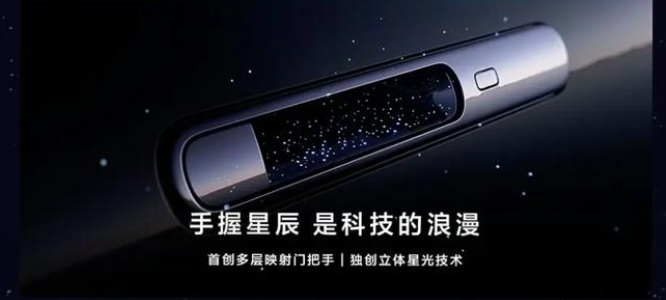
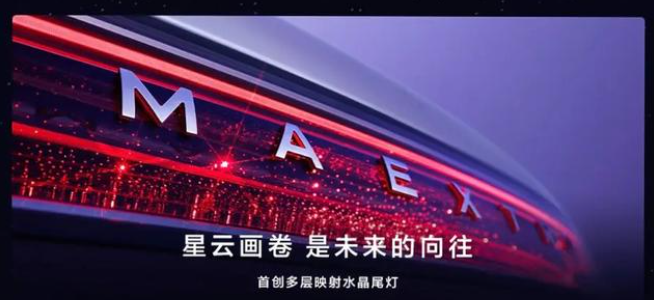
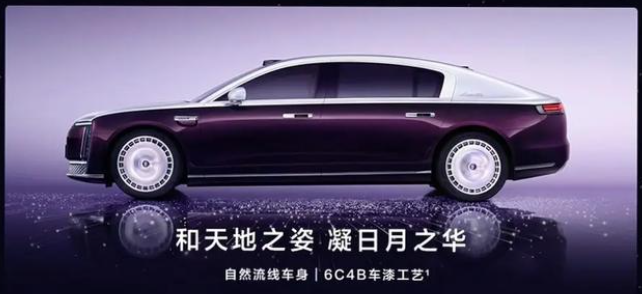
The Zunjie S800 is JAC Motors' flagship product in collaboration with Huawei, positioned as a million-yuan ultra-luxury intelligent electric vehicle. Launched on May 30, 2025, cumulative deliveries exceeded 10,000 units by the end of 2025, driving a 46.99% YoY increase in passenger vehicle segment revenue to RMB 17.996 billion.
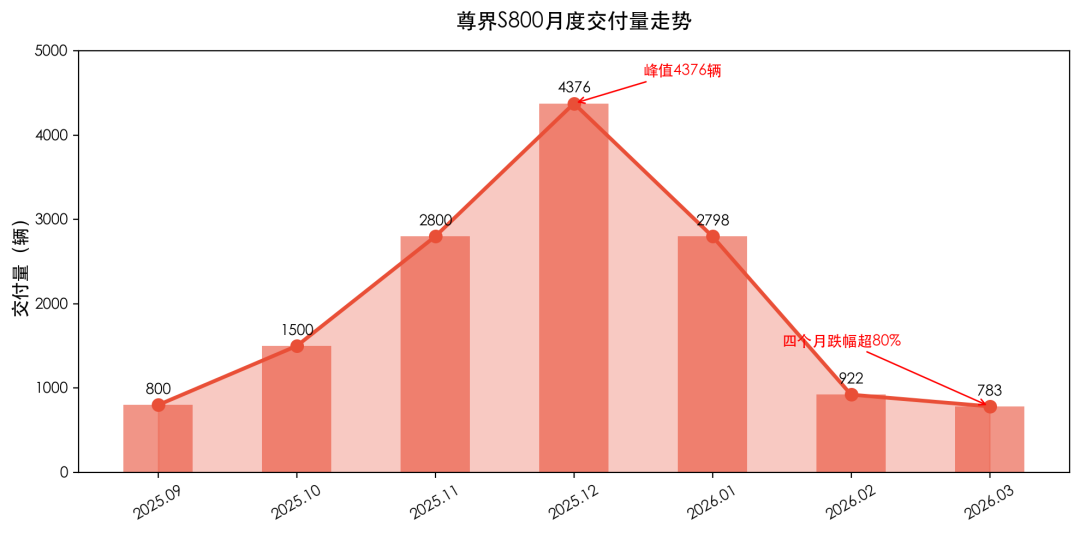
However, Zunjie's sales curve resembles a roller coaster. In December 2025, monthly deliveries peaked at 4,376 units, consistently ranking first in the luxury sedan segment priced above RMB 700,000 for several months.
Entering 2026, the situation took a sharp turn:
January 2026: 2,798 units;
February 2026: 922 units (Spring Festival factor);
March 2026: 783 units.
A more than 80% drop over four months. More concerning are new orders, with February and March seeing an average of only 500 to 800 units per month.
As of early April 2026, Zunjie indeed had about 5,000 to 6,000 outstanding orders, but if new orders do not keep pace, deliveries may further decline after existing orders are fulfilled.
In the short term, the cliff-like drop in Zunjie S800 sales is one of the core variables behind JAC Motors' Q1 performance falling short of expectations.
2026 is a significant year for Zunjie's product lineup. In addition to the S800, Zunjie will launch an MPV and an SUV model, targeting the Toyota Alphard and Range Rover, respectively, with price positioning expected to fill the RMB 500,000 to RMB 1 million gap in Hongmeng Zhixing's product portfolio.
JAC Motors has invested significant resources: The Zunjie Super Factory, with a total investment of approximately RMB 10 billion and an annual capacity of 200,000 units, is expected to generate RMB 100 billion in output value upon full production. The company has assembled a dedicated R&D and delivery team of over 5,000 people and established the Zunjie Shanghai Design Center.
On April 26, JAC Motors and Huawei officially signed the 'Joint Innovation Cooperation Agreement' in Beijing, marking a comprehensive deepening of their strategic collaboration.
Yu Chengdong revealed that Zunjie's even higher-end model priced at RMB 2 million will be unveiled at the end of June.
3. Overseas Sales: A Second Growth Curve?
JAC Motors has a foundation in overseas markets, particularly in commercial vehicle exports. In Q1 2026, JAC Motors exported a cumulative 45,000 units, maintaining its leading position in mid-to-high-end light truck exports. Since 1990, it has exported to 132 countries and regions globally, with total deliveries surpassing 1.7 million units.
Before the launch of the Zunjie brand, overseas business was JAC Motors' primary contributor to gross profit. From 2023 to the first half of 2025, gross profit margins for overseas sales generally exceeded 15%, while domestic sales margins were only about 1.5%-4.5%. In the first half of 2024-2025, overseas revenue accounted for over 55% of total revenue, with gross profit contributing over 92%.
However, challenges in overseas markets cannot be ignored: geopolitical risks (trade barriers, tariffs), insufficient brand recognition, lagging after-sales service network construction, and the depth of cooperation with local distributors. Given the current cash flow pressures, it is questionable whether JAC Motors can sustain investments in overseas markets.
On January 10, 2026, the first JAC high-end light truck rolled off the production line at the JAC overseas KD assembly plant in Oran, Algeria, marking a milestone breakthrough in the Assembly of individual parts (knock-down kit assembly) project jointly advanced by JAC Motors and its Algerian partners for over a decade. In recent years, exports to countries along the 'Belt and Road' have accounted for over 80% of total exports.
4. New Energy Transformation: Too Late or Still an Opportunity?
JAC Motors made early layout (layout) in the new energy sector, but its production volume lags behind BYD, NIO, XPeng, and Li Auto.
In Q1 2026, new energy passenger vehicle sales reached 6,160 units, a 66.04% YoY increase, becoming a major bright spot in Q1 performance.
In the commercial vehicle segment, new energy light truck sales increased by 2.9% YoY, ranking fourth in the industry. Bus sales increased by 16.8% YoY. JAC Motors' layout (layout) in the new energy commercial vehicle sector is showing results.
Collaboration with Huawei (Zunjie) is a 'shortcut' for JAC Motors' new energy transformation. By leveraging Huawei's technological accumulate (accumulation) in intelligent driving (ADS), intelligent cockpits, and electric control systems, JAC Motors aims to achieve ' overtake on a curve ' (overtaking on curves). However, this collaboration model also carries risks: core technologies are controlled by Huawei, brand voice may be diluted, profit distribution is uncertain, and over-reliance on Huawei is a concern.
-END-
Disclaimer: This article is based on the public company attributes of listed companies and relies primarily on information disclosed by the companies in accordance with their legal obligations (including but not limited to interim announcements, periodic reports, and official interaction platforms) as the core basis for analysis and research. Shiyu Xingkong strives for fairness in the content and viewpoints presented in the article but does not guarantee its accuracy, completeness, or timeliness. The information or opinions expressed in this article do not constitute any investment advice, and Shiyu Xingkong is not responsible for any actions taken based on this article. Copyright Notice: The content of this article is original to Shiyu Xingkong and may not be reproduced without authorization.
-
![]()
The Agent hasn't arrived yet, but Ascend has already paved the way from hardware to software.
-
![]()
In 71 years, He sold products to 100 million people
-
![]()
First-hand Practical Test! Opus 4.8 Vs ChatGPT 5.5 Vs Kimi 2.6: Which is the Most Usable?
-
![]()
Fourfold Uncertainty Challenges Facing China's Agent Industry - Interpretation of the 'Report' (Part Six)
-
Crazy Anthropic
-
![]()
CNPC’s Kunlun Model Advances with 152 Implemented Scenarios, Showcasing Proactive AI
-
![]()
Revenue Increases, But Profits Don't: Pinduoduo's Anxiety Amidst Billion-Dollar Brand Building
-
![]()
Half Flock In, Half Flee Out: The Dual Dynamics of Singapore as an AI Hub