BYD’s Bold Move: What’s Behind Its All-Out Push for Intelligent Driving?
 05/29 2026
 409
409
On May 28, BYD Chairman Wang Chuanfu took center stage and, without much fanfare, unveiled the full spectrum of BYD’s intelligent driving capabilities. Dubbed the “Dare to Lead” launch event, the presentation eschewed flashy gimmicks and over-the-top PowerPoint displays, focusing instead on three concrete announcements: a 12,000-yuan optional upgrade to the “Celestial Eye B” laser system across all models, a one-year safety net for urban navigation, and the mass production of China’s first 4nm automotive-grade intelligent driving chip, the Xuanji A3.
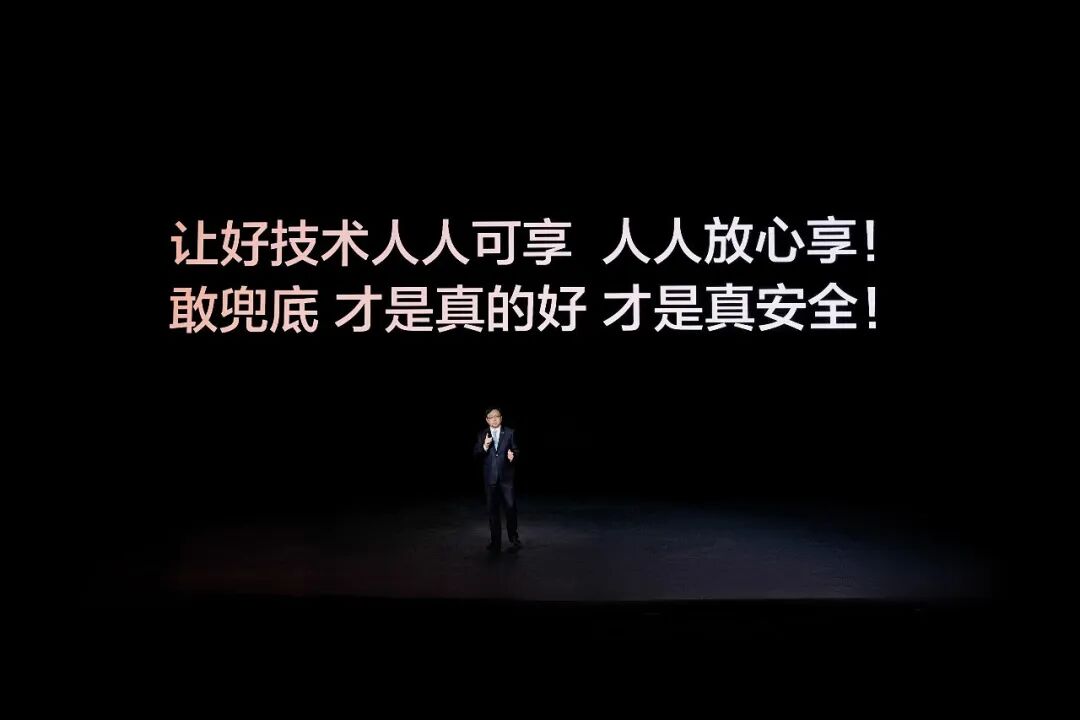
This was no ordinary tech reveal; it was more like a declaration of intent. BYD sent a clear, no-nonsense message to the industry: the era of high-end monopolies in intelligent driving is coming to an end. But questions lingered: while other automakers are still wrestling with the costs and liability issues surrounding intelligent driving, how does BYD dare to price its offering at cost and even offer a safety net for high-risk urban navigation?
The 12,000-Yuan Intelligent Driving Package: Breaking Industry Norms
Wang Chuanfu stated bluntly at the event that the 12,000-yuan optional price for the “Celestial Eye B” is already at cost. This straightforward declaration punctured the industry’s long-standing unspoken rules. Previously, urban navigation packages with LiDAR typically ranged from 20,000 to 30,000 yuan, with some brands adding annual software subscription fees of several thousand yuan—effectively double-dipping on intelligent driving.
BYD’s approach is different: its 12,000-yuan package is a one-time buyout, offering full functionality for life with no hidden fees. More importantly, this price applies uniformly across all models, from the 70,000-yuan Seagull to the luxury Denza, with identical hardware and software specs for the optional package. This eliminates the distinction between “basic” and “fully-loaded” intelligent driving, making advanced features accessible to all.
This confidence stems from BYD’s vertically integrated supply chain. From LiDAR to cameras, from chips to algorithms, BYD controls nearly every core component of its intelligent driving system. Combined with the economies of scale from 3.15 million intelligent driving vehicles on the road, it can slash hardware costs to industry-leading levels.
Of course, it’s worth noting that the 12,000-yuan price is made possible by BYD’s massive sales volume. Without annual sales in the millions, no automaker could reduce intelligent driving hardware costs to this level. This also means other automakers will struggle to match BYD’s pricing.
Urban Navigation Safety Net: Strategy, Not Just Marketing
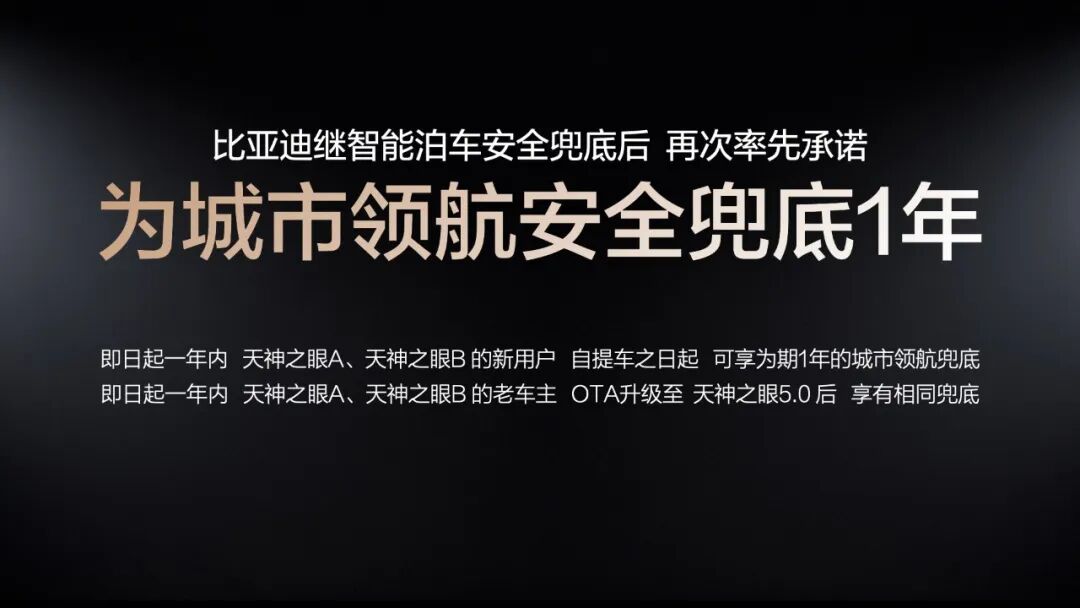
While the 12,000-yuan optional price addresses affordability, the urban navigation safety net tackles the biggest hurdle: user reluctance. Wang Chuanfu announced that, effective immediately and for one year, both new and existing users of the “Celestial Eye A” and “B” systems will receive full compensation from BYD for all economic losses their vehicle is liable for in the event of a responsible traffic accident while using urban navigation in compliance with regulations. This includes vehicle repair costs, third-party property damage, and personal injury losses.
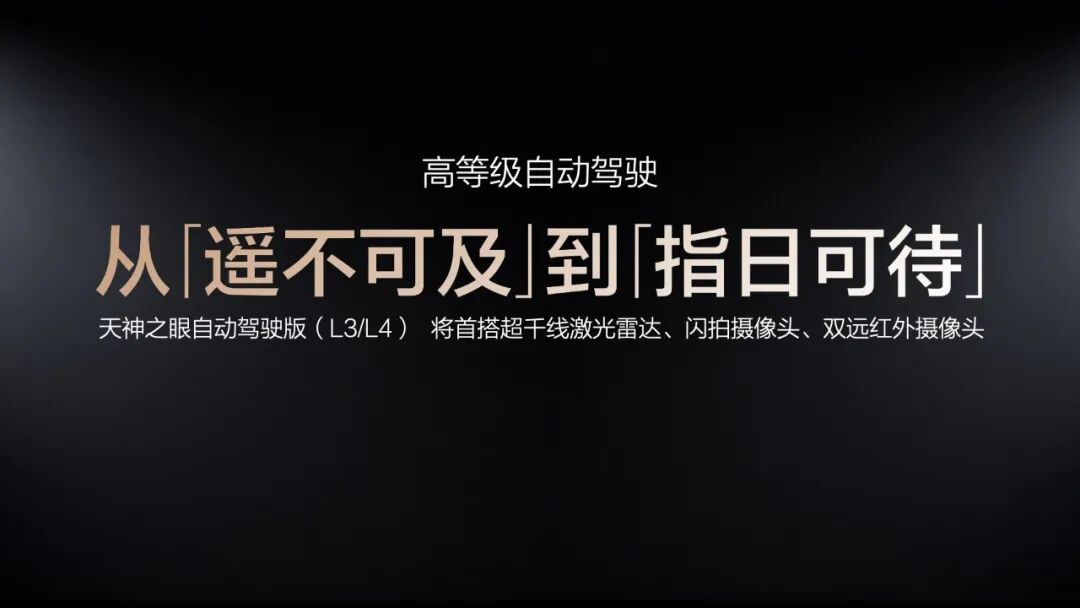
This is not commercial insurance but an official technical commitment from BYD. It differs from intelligent driving insurance in three key ways: no cost to the user, no cap on compensation, and no impact on future insurance premiums. In short, users get unlimited safety coverage without spending an extra dime.
While some may dismiss this as a marketing ploy, it’s actually a strategic move by BYD to boost intelligent driving adoption. After introducing a safety net for intelligent parking last July, BYD saw usage of the “Celestial Eye” intelligent parking system skyrocket from 21% to 93%, with virtually zero accidents. Expanding the safety net to urban navigation aims to encourage more users to try—and ultimately trust—intelligent driving features.
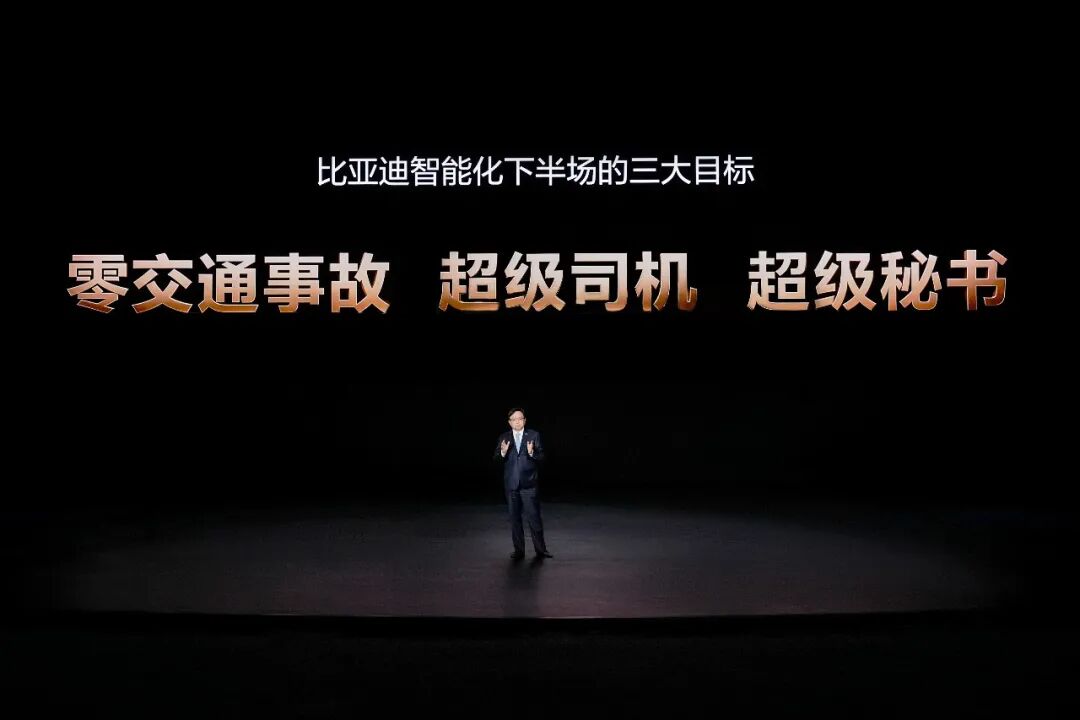
BYD’s confidence is backed by three “China firsts”: 3.15 million intelligent driving vehicles on the road, over 200 million kilometers of real-world driving data collected daily, and a team of over 5,000 dedicated to assisted driving R&D. These figures enable rapid iteration and continuous optimization of the “Celestial Eye” system in complex scenarios. However, the one-year safety net period suggests BYD is not yet fully confident in its technology, reflecting a pragmatic, step-by-step approach.
Xuanji A3: The Core Asset for Intelligence
The most significant announcement at the event was the mass production of China’s first 4nm automotive-grade intelligent driving chip, the Xuanji A3. Wang Chuanfu stated, “The first half of electrification was about batteries; the second half of intelligence is about chips.” This underscores the core of future automotive competition.
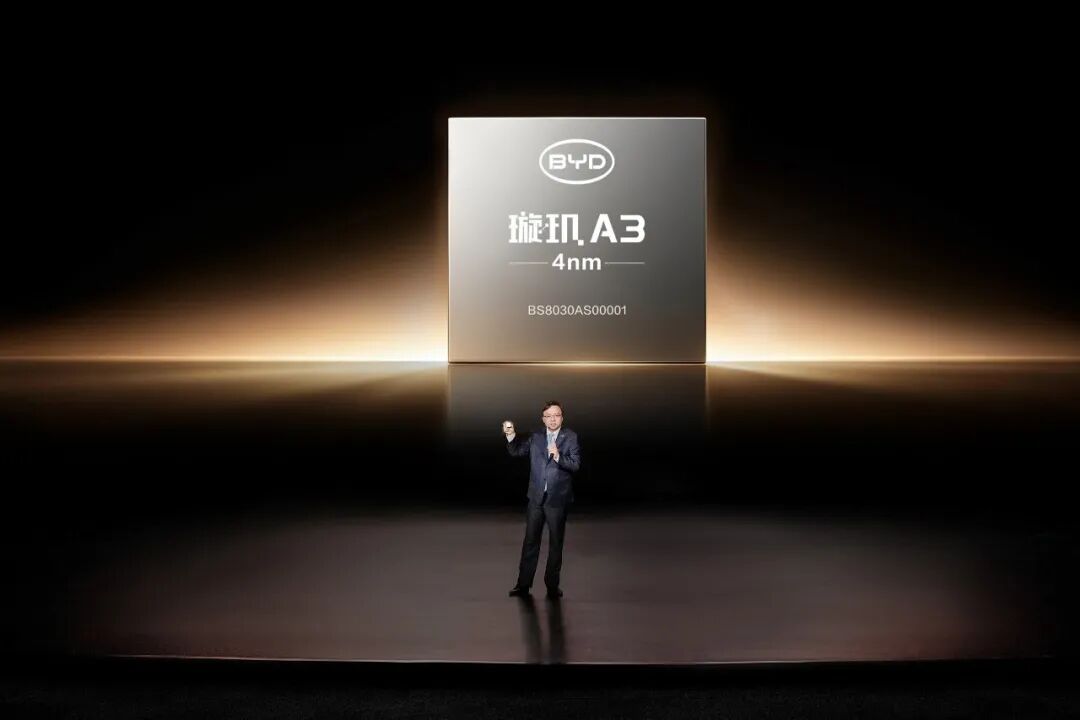
Built on a 4nm process, the Xuanji A3 features a 16-core CPU and 3-core NPU, delivering a total computing power exceeding 2100 TOPS when three chips work in tandem. More importantly, its power efficiency per unit of computing power is 20% lower than comparable products, and with BYD’s proprietary algorithm optimizations, computing power utilization has doubled. This means BYD’s chip can handle more tasks with the same computing power while consuming less energy.
Few know that BYD’s chip ambitions predate its automotive manufacturing. Since establishing its semiconductor team in 2002, BYD has invested over 100 billion yuan in chip R&D over 24 years, boasting a team of over 7,000 and five wafer fabrication plants. Today, BYD offers over 2,000 chip products, including 567 automotive-grade chips used by 46 domestic and international automotive brands.
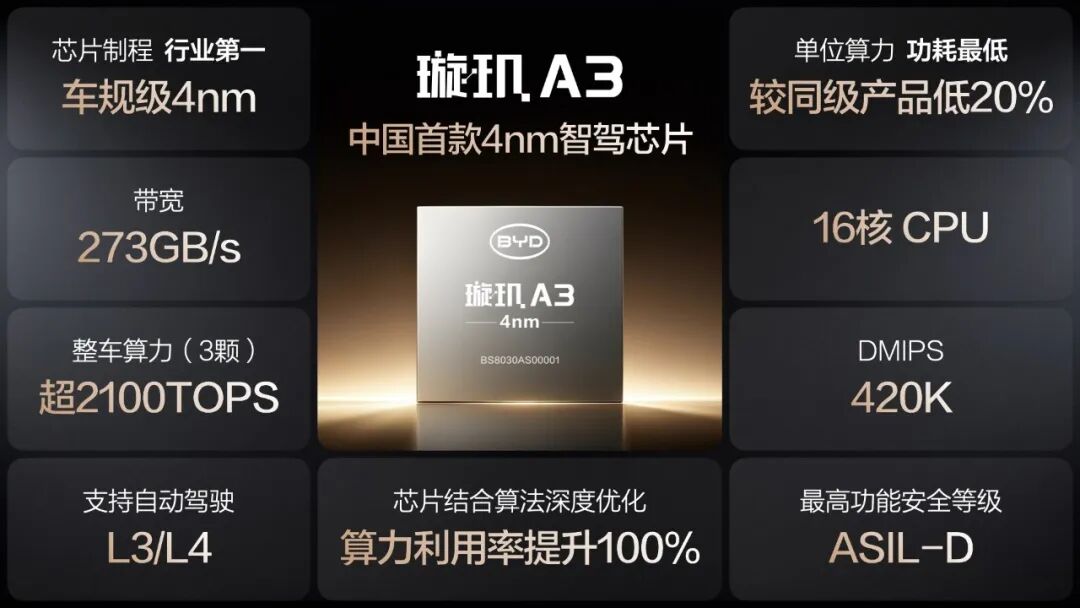
The greatest advantage of in-house chip development lies in the deep integration of hardware and software and autonomous control over iteration cycles. BYD no longer needs to rely on third-party chip suppliers or compromise performance to fit generic chips. This lays a solid foundation for the rapid deployment of L3/L4 autonomous driving in the future.
Conclusion:
At this launch event, BYD eschewed grandiose concepts and instead redefined the standards for intelligent driving adoption with tangible products and policies. It demonstrates that intelligent driving should not be exclusive to a few high-end models but a safety feature accessible to all users.
Of course, BYD’s journey toward full intelligence has just begun. Its intelligent driving system still lags behind industry leaders in terms of user experience, and its closed, full-stack self-developed model may face challenges in ecosystem openness down the road. However, BYD has undeniably propelled China’s automotive industry into a new phase of intelligent competition with its unique approach. In the first half of electrification, BYD gained an edge with its Blade Battery and vertically integrated model. In the second half of intelligence, it has played its cards with in-house chips and safety net policies. Whether it can play these cards well remains to be seen.
-
![]()
The Agent hasn't arrived yet, but Ascend has already paved the way from hardware to software.
-
![]()
In 71 years, He sold products to 100 million people
-
![]()
First-hand Practical Test! Opus 4.8 Vs ChatGPT 5.5 Vs Kimi 2.6: Which is the Most Usable?
-
![]()
Fourfold Uncertainty Challenges Facing China's Agent Industry - Interpretation of the 'Report' (Part Six)
-
Crazy Anthropic
-
![]()
CNPC’s Kunlun Model Advances with 152 Implemented Scenarios, Showcasing Proactive AI
-
![]()
Revenue Increases, But Profits Don't: Pinduoduo's Anxiety Amidst Billion-Dollar Brand Building
-
![]()
Half Flock In, Half Flee Out: The Dual Dynamics of Singapore as an AI Hub