Betting Hundreds of Billions on Self-Developed Chips and Piling into Large SUVs: What Are NIO, XPeng, and Li Auto Really Betting On?
 06/04 2026
 462
462
Article by Tan Zhu
Source: Bowang Finance
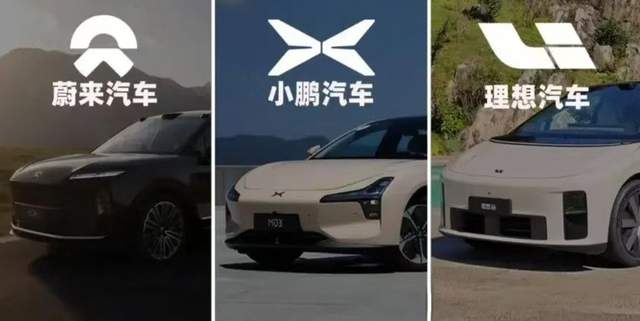
In late May, NIO, XPeng, and Li Auto successively released their first-quarter reports. Laying out the three report cards side by side, you get a sense of disorientation—these three companies, once shoulder-to-shoulder in the “first tier of new forces,” are now living entirely different realities.
One has just barely touched profitability, another has plunged from profit into loss, and the third has hit a record high in losses.
According to their financial reports, NIO reported a net profit of RMB 43.5 million in Q1, marking two consecutive quarters of profitability, but with a net profit margin of less than 0.2%. XPeng reported a net loss of RMB 1.78 billion, with an overall gross margin of 20.6% looking the best at first glance, but a vehicle gross margin of only 12.1% upon closer inspection. Li Auto delivered 95,142 units, the most among the three, but its gross margin collapsed from 20.5% to 6.1%, with a net loss of RMB 2.3 billion, a record high.
Put simply, one is barely profitable, another is heavily loss-making, and the third is bleeding profusely.
But the interesting part is that despite such stark divergence in financial numbers, all three have converged on one thing—they are all betting on flagship large SUVs for profit, equipping new models with self-developed chips, and have arrived at the same crossroads in the spring of 2026: scale matters, but the prerequisite for survival is learning to make money first.
01 Three Report Cards, Three Shades of Performance
NIO: Profitable, but Barely
According to NIO’s Q1 2026 financial report, the company delivered 83,465 units, up 98.3% year-on-year; revenue reached RMB 25.53 billion, up 112.2% year-on-year. Among the three, NIO’s growth momentum is the strongest. More critically, NIO achieved a net profit of RMB 43.5 million in Q1, marking two consecutive quarters of profitability.
Profitability is, of course, a good thing. After all these years in the new energy vehicle sector, few have truly cracked the profitability model.
But let’s be honest—a net profit of RMB 43.5 million on RMB 25.53 billion in revenue? That’s a net profit margin of less than 0.2%. You hustle to sell over RMB 25 billion worth of products and only make tens of millions in profit—what’s the difference from making nothing? A single slip-up in any link, and those RMB 43.5 million vanish.
So how is this slim profit being sustained?
According to the financial details, NIO’s Q1 vehicle gross margin was 18.8%, rising for four consecutive quarters—not a bad figure on paper. Gross profit totaled around RMB 4.8 billion, but nearly all of that was eaten up. R&D expenses accounted for 13.7% of revenue, with three brands advancing simultaneously and a sprawling R&D pipeline that’s hard to rein in. Add in the operation of battery swap stations and maintenance of the service system, and what’s left in the pocket are mere crumbs.
The real driver of reported profitability is the ES8.
According to NIO’s internal product structure data, the ES8 alone contributed 50% of the overall gross margin, with a vehicle gross margin exceeding 20%. In other words, without the ES8, NIO would likely have reported a loss in Q1. A single model’s success or failure determines the entire company’s profitability—a profit structure that’s far too fragile. If ES8 sales fluctuate or competitors disrupt the market, those RMB 43.5 million will evaporate in an instant.
XPeng: Highest Gross Margin, But Most Watered-Down
Now, XPeng. According to XPeng’s Q1 2026 financial report, the company delivered 62,682 units, down 33.3% year-on-year; revenue reached RMB 13.03 billion, down 17.6% year-on-year. Net loss stood at RMB 1.78 billion—keep in mind they were profitable by RMB 380 million in Q4 last year, wiping out all previous gains in a single quarter.
Interestingly, XPeng’s overall gross margin was 20.6%, the highest among the three.
But if you buy into that number, you’re being fooled.
Upon closer inspection, XPeng’s vehicle gross margin was only 12.1%, a mid-tier level in the industry—nowhere near “high gross margin.” So where did the 20.6% come from? According to the financial breakdown, XPeng generated over RMB 2 billion in revenue from Volkswagen technology licensing, parts sales, and technical services. This segment boasts extremely high gross margins—licensing costs are nearly zero, so every dollar earned is largely pure profit.
In essence, XPeng is now making money more like a “technology outsourcing company” than by selling cars. Technology licensing is certainly a good business—who wouldn’t want to earn royalties lying down? But the question is, how long can this last? Once Volkswagen slows down its collaboration pace, this figure will plummet immediately.
Meanwhile, XPeng’s R&D investment continues to surge. According to the financial report, Q1 R&D spending rose 46.8% year-on-year, surpassing NIO and Li Auto in a single quarter. On one hand, selling cars means real losses; on the other, heavy R&D investment continues, with the GX launch forced into significant price cuts to drive volume. XPeng’s financial report is quite contradictory.
Li Auto: Highest Sales, Worst Losses
The worst-off is Li Auto.
According to Li Auto’s Q1 2026 financial report, the company delivered 95,142 units, the most among the three. But revenue reached RMB 23 billion, down 11.4% year-on-year. Gross margin fell to 6.1%–7.9%, compared to 20.5% a year earlier—a cliff-like drop in just one year. Net loss hit RMB 2.3 billion, a record high.
This is the classic case of “the more you sell, the more you lose.”
The issue lies with the i6. According to Li Auto’s internal product cost analysis, while the i6’s sales performance is decent, its per-unit gross margin is extremely low, dragging down overall profitability with every unit sold. The dividend (dividends) from range extenders are nearly exhausted, pure electric models haven’t taken over, and the L series is in a generational transition lull—during this gap, gross margins collapse fastest.
But Li Auto isn’t without aces up its sleeve. According to the financial report, Li Auto’s Q1 selling and administrative expenses fell 19% year-on-year, demonstrating the strongest cost control among the three. Cash reserves still exceed RMB 90 billion, the thickest war chest by far. In other words, while Li Auto’s financials look ugly, it has money in the pocket and time to adjust.
Just how long that adjustment window lasts, no one knows.
After reviewing the three report cards, you’ll notice an interesting commonality: NIO relies on the ES8 to sustain profitability, XPeng uses technology licensing to subsidize losses, and Li Auto depends on the i6 to maintain market share. Outwardly, they’re taking different paths, but in reality, they’re all doing the same thing—betting on large vehicles for profit. Simply put, in the second half of the new energy vehicle race, the competition isn’t about who sells more, but who has the truest profit-generating capability.
02 Converging on the Same Gamble
The financial data looks uglier by the day, but here’s the interesting part—all three have made the same choice.
Just look at the timeline. According to NIO’s official data, the ES8, priced over RMB 400,000, has sold over 10,000 units for multiple consecutive months, single-handedly contributing 50% of the overall gross margin. XPeng’s GX, positioned as a premium luxury large SUV with a starting price around RMB 280,000, secured over 24,000 reservations within 12 hours of launch. Li Auto’s L9, a new generation model launched on May 15, features high configurations and pricing—Li Xiang is clearly aiming to reclaim dominance in the premium market.
Honestly, the timing couldn’t be more precise. All three companies as if by prior agreement (coincidentally) launched flagship large SUVs in mid-to-late May—do you really believe that’s a coincidence? Only a fool would.
Simply put, large six-seater SUVs currently offer the highest per-unit gross margins, period. Family users want space, prestige, and intelligence, and they’re relatively willing to open their wallets. Who wouldn’t want a slice of that pie?
But there’s only so much pie to go around. Market capacity is limited, and competition has reached fever pitch. You launch a large six-seater? So do I, with even higher specs and lower prices. It’s unclear how long this trend will last.
Relying on large vehicles props up the present. But what about the future?
All three give the same answer: self-developed chips.
Three years ago, no one would’ve believed it. Back then, NIO, XPeng, and Li Auto were bickering over who sold 5,000 more units, while chips were just NVIDIA Orin models—buy and use. But with supply chain bottlenecks still fresh in memory and computing costs remaining high, developing chips in-house has become a necessary move.
NIO moved fastest. According to NIO’s official disclosure, the Shenji NX9031 is the world’s first 5nm automotive-grade intelligent driving chip, with over 250,000 units shipped. Its standout feature is memory bandwidth—double that of global flagship chips. Later, Qin Lihong proposed five criteria for advanced in-vehicle chips: real computing power, high memory bandwidth, ISP image processing capabilities, efficient collaboration, and stable mass production. It sounds like self-promotion, but dig deeper—each point addresses industry pain points.
Li Auto isn’t far behind. According to Li Auto’s releases, the Mach M100 is also a 5nm automotive-grade chip with 1,280 TOPS of computing power per unit. The L9 Livis directly equips two units for a total of 2,560 TOPS. Li Xiang’s message is clear: if you want to build a “family space robot,” it better have a sharp mind.
XPeng is the most aggressive. According to XPeng’s disclosures, its Turing AI chip can equip up to four units, pushing computing power to 3,000 TOPS—a ceiling for current mass-produced vehicles.
But does self-developing chips complete the story? Not necessarily.
Let’s be real—building cars and building chips are entirely different ballgames. According to CITIC Securities’ research, automotive chip self-development requires lifetime shipments in the millions to achieve economic viability. What does “millions” mean? NIO has only recently crossed that cumulative delivery threshold after years in the market. Li Auto and XPeng still need years of sales.
So here’s the situation: chips exist, but will scale effects materialize? Unclear. At least in the short term, these self-developed chips are more about telling a story of “technological independence.” The day they actually turn a profit is still far off.
Large vehicles prop up the present; chips build the future. But the three companies’ bets on the future have completely diverged.
NIO is betting on battery swapping plus a multi-brand matrix. According to NIO’s management, the battery swap network’s scale effects are becoming visible, with some stations already achieving stable profitability and overall breakeven expected within the year. The three-brand matrix is also accelerating—NIO’s premium brand defends profitability, Ledo drives volume for scale, and Firefly targets younger users in sink (lower-tier) markets. Qin Lihong’s calculations are precise: use battery swapping to lock users into the ecosystem, then use multiple brands to capture users across price segments. If this model succeeds, NIO’s moat will be deeper than anyone’s. But the question remains: can the construction costs of battery swap stations be contained, and can Ledo and Firefly build brand recognition? Time isn’t waiting.
XPeng is betting on physical AI. That sounds abstract, but it boils down to three things: Robotaxi, robots, and flying cars. According to XPeng, Robotaxi is already in trial operations, the IRON robot will enter mass production by year-end, and flying cars await policy tailwinds. He Xiaopeng’s ambitions have never been limited to “car manufacturing”—he wants to build the tech company of the next era. But let’s be honest: each of these three ventures is a money pit, and none are anywhere near large-scale commercialization.
Li Auto is betting on embodied intelligence, but via a different path than XPeng. According to Li Auto’s product plans, the L9 Livis is positioned as a “family space robot,” with its first wheeled robot already taking shape. Li Xiang is more pragmatic than He Xiaopeng—no flying cars, no roaming taxis, just focusing on the “home” scenario. Family users are Li Auto’s core base, and integrating robots into the home makes logical sense. But is the “family robot” a genuine demand or a false one? No one knows yet.
You see, while all three appear to be converging on the same strategy—relying on large vehicles for profit and self-developed chips for the future—their underlying bets are entirely different.
NIO is betting on ecological closure. XPeng is betting on technological crossover. Li Auto is betting on scenario extension.
Who’s right? Time will tell.
03 Can Different Paths Converge?
At the end of the day, NIO, XPeng, and Li Auto have taken three entirely different roads, yet in the spring of 2026, they’ve all hit the same barrier—you need scale, profitability, or preferably both.
But reality is harsh.
According to their financial reports, all three spend over RMB 10 billion annually on R&D. What does “RMB 10 billion” mean? For an automaker selling fewer than 30,000 units monthly, burning over RMB 1 billion on R&D is essentially gambling on tomorrow. Win, and technology becomes a moat; lose, and it’s money down the drain. Without scale, R&D is just burning cash—and you might not even know how you failed.
Without profitability, it’s even tougher. If gross margins can’t hold up, you’re forced into price wars—they cut prices by RMB 30,000, you follow, only to realize there’s no money left in the account. That’s a war you can’t afford.
So here’s where the three companies stand, each with its own struggles.
NIO barely flipped its net profit margin positive—to 0.2%. Let’s be real, what’s the difference from zero? With the ES8 shouldering over half the company’s profitability, the structure is too singular, with all risks concentrated in one model. Can the ES9 and Ledo truly drive volume? Will the battery swap network transform from a burden into a moat, or keep sinking deeper? William Li needs answers within the next two quarters.
XPeng is even more anxious. Primary deliveries fell 33% year-on-year, with vehicle gross margins stuck at the bottom. Now it’s relying on technology licensing to stay afloat, but how long can that last? He Xiaopeng knows full well that MONA’s volume is just stemming the bleeding—the real key is whether the GX can truly lift vehicle gross margins.
Li Auto has over RMB 90 billion in cash reserves, a thicker safety net than anyone else. But the safety issue lies precisely there—the i6 sells more but loses more, with gross margins collapsing to 6%, propped up only by legacy range-extender profits. Can the L9 Livis restore profitability? Li Xiang’s shift from range extenders to pure electric is necessary, but the elegance of this transition will determine whether Li Auto evolves from “the most profitable new force” into a “truly all-rounded automaker.”",
-
This field has reached a new high
-
![]()
May Sales Review: Top 5 Independent Chinese Automakers Shine; BYD Holds Lead, Chery Expands Globally
-
![]()
The Godfather of AI Launches a Startup: Silicon Valley Places Bets on the 'Next-Gen AI Paradigm'
-
![]()
We’re Still 300 Kilometers Short of the 'All-Electric Era'
-
![]()
Why Is CATL Included on DeepSeek's Major Investor List?
-
![]()
Investors Flock to Spirit AI, Amassing 5 Billion Yuan in Just 3 Months! Its Embodied Model Outshines NVIDIA
-
![]()
How Has Tencent's AI Become So Bold?
-
Thin Glass Fiber Fabric: Jensen Huang’s Special Journey to Japan to Secure This Vital Material