Investors Flock to Spirit AI, Amassing 5 Billion Yuan in Just 3 Months! Its Embodied Model Outshines NVIDIA
 06/04 2026
 451
451

AI Capital Bureau, Shi Tao, June 3
Spirit AI, a frontrunner in the field of embodied intelligence, officially announced today that it has successfully concluded a Series A+ funding round, raising a substantial 1.5 billion yuan. This round of investment attracted top-tier U.S. dollar funds, major industrial capital, and state-owned funds, with existing shareholders continuing to show their support. Remarkably, the company has completed four rounds of intensive financing in just three months, amassing a total of nearly 5 billion yuan, setting a new benchmark for financing speed within the embodied intelligence sector.
Capital Rush: Top-Tier Investors and Industry Titans Converge
Sources close to the deal disclosed that the funding round swiftly drew the interest of dozens of institutions eager to participate, with shares in exceptionally high demand. The final investor lineup includes international top-tier U.S. dollar funds and several major industrial investors. Such a rapid funding pace is a rarity in the hard technology sector, underscoring the capital market's robust confidence in the embodied intelligence track.
Looking back at Spirit AI's financing journey, its capital base is truly impressive. In February 2026, the company secured two consecutive rounds of financing, totaling nearly 2 billion yuan, with a post-money valuation surpassing 10 billion yuan. Investors included Yunfeng Capital, Chaos Investment (led by Ge Weidong), Sequoia China, TCL Ventures, Minghui Investment (the family office of Zhu Xingming, Chairman of Inovance Technology), as well as state-owned capital from entities like Chongqing Industrial Investment Mother Fund and Hangzhou Gold Investment. On April 7, Spirit AI secured an additional 1 billion yuan in Series A funding, co-led by Shunwei Capital and Yunfeng Capital. This marked the first instance of Lei Jun and Jack Ma making a substantial joint investment in an embodied intelligence company, with a post-money valuation exceeding 20 billion yuan.
To date, Spirit AI has assembled a comprehensive capital lineup consisting of "top-tier financial PE + international U.S. dollar funds + industrial capital + local state-owned capital." Among its industrial investors are industry giants such as CATL, JD.com, Xiaomi, and Huawei, fostering a deep integration of capital and industrial resources.
The AI Capital Bureau believes that the influx of industrial capital signifies that the automotive and high-end manufacturing supply chains are expediting their布局 (layout, here we use the original Chinese term to keep the professional context) in the embodied intelligence track. They aim to drive the large-scale application of humanoid robots in vehicle assembly, component inspection, and other areas through a closed-loop system of algorithms and hardware.
Chinese Model Tops International Benchmark for the First Time
Coinciding with this funding round, Spirit AI announced a significant technological breakthrough. Its self-developed embodied foundational model, Spirit v1.6, claimed the top spot in the RoboArena evaluation, often referred to as the "Olympics" of North American embodied intelligence. It outperformed NVIDIA's latest Cosmos3 model and Physical Intelligence's Pi0.5 model in overall score, becoming the first Chinese embodied model to achieve this feat. 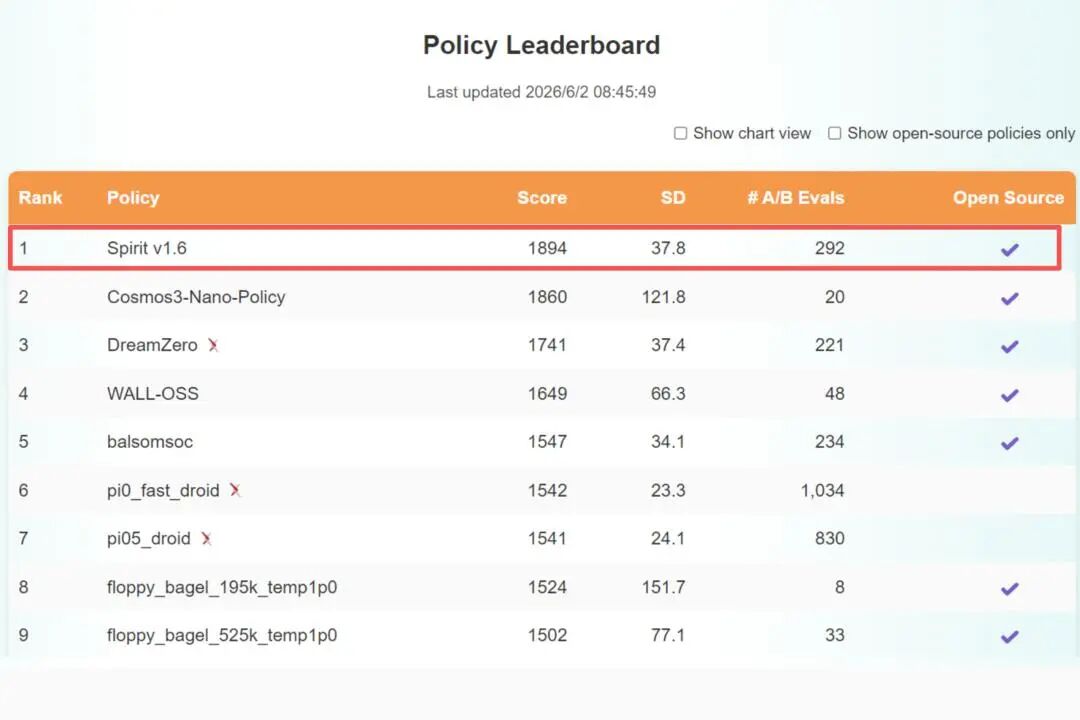
RoboArena stands as one of the most authoritative embodied intelligence evaluation platforms globally, assessing multiple dimensions such as object manipulation, navigation and obstacle avoidance, and task planning. It is widely regarded by the industry as the "gold standard" for measuring an embodied large model's capabilities in the real physical world. Previously, this list was predominantly dominated by Silicon Valley tech giants.
Public records indicate that Spirit AI was established in January 2024 by Han Fengtao, Gao Yang, and Zheng Lingyin. The core team members, mostly graduates from prestigious institutions like UC Berkeley, Tsinghua University, and Peking University, boast an average age of under 30. One of the company's primary focuses is developing a "universal brain" for robots—a general-purpose embodied large model—aiming to address the core challenge of transitioning embodied intelligence from virtual to real-world applications. 
In June 2025, Spirit AI unveiled its first full-force-controlled humanoid robot, Moz1. Equipped with 26 degrees of freedom in its integrated force-controlled joints and a load-to-weight ratio of 1:1, the robot is powered by its self-developed VLA model, Spirit v1. It was the first to overcome industry challenges such as long-range manipulation of flexible objects.
Industry Trends: Capital Focuses on Market Leaders, Commercialization Takes Center Stage
The financing frenzy surrounding Spirit AI is merely a microcosm of the current embodied intelligence landscape. According to IT Juzi, domestic financing in the embodied intelligence sector has exceeded 34.5 billion yuan in 2026, surpassing the total for the entire year of 2025. In just three days from June 1 to 3, several companies announced financing: Astribot, dubbed the "Chinese version of Figure," completed a Series B funding round exceeding 1 billion yuan; embodied brain company Xingyuan AI Robot completed a Pre-A round, raising a cumulative 1 billion yuan in 10 months since its inception.
Notably, unlike the early days of broad-based investment, the AI Capital Bureau observed that capital is now clearly concentrating on market leaders, with investment logic shifting from "betting on the track" to "backing certainty." The focus is on the two core segments of embodied large models (the "brain") and robot bodies (the "body"). Delivery capability has replaced technological concepts as the primary valuation metric, with companies capable of large-scale real-world deployment receiving more capital support.
However, some analysts caution that the embodied intelligence industry is still in its nascent stages, with technological routes not yet fully matured and commercialization scales relatively limited. While Spirit AI has achieved deployment in some scenarios, it still faces numerous challenges in achieving large-scale profitability. Additionally, with international giants like NVIDIA and Google increasing their investments in embodied intelligence, domestic companies will encounter even fiercer global competition.
As of press time, Spirit AI had not disclosed the specific valuation or detailed investor list for this funding round. 
The AI Capital Bureau is a professional observation and analysis platform dedicated to tracking capital market dynamics in the artificial intelligence field. We closely monitor capital operations such as financing, listings, and mergers and acquisitions of AI and embodied intelligence-related companies, conducting in-depth analyses of industry trends and corporate development trajectories to provide valuable insights for industry participants. We are committed to bridging the gap between AI innovation and capital markets, helping Chinese hard technology companies achieve value discovery and growth.
Risk Warning and Disclaimer: The market is inherently risky, and investment should be approached with caution. This article does not constitute investment advice and should not be used as a basis for actual operations. Trading risks are borne by the investor.
-
Ofilm Teams Up with ADSensE to Propel Large-Scale Deployment of All-Solid-State LiDAR Powered by ADS6311 Chip!
-
![]()
Loss of 2.5 Billion Yet Facing Strong Demand for Shares? Another Battle for Control of Lianchuang Electronics
-
![]()
Huawei’s Enjoy Series Flies Off the Shelves, Prompting Xiaomi to Double Down on Budget Smartphones
-
![]()
Beijing Hyundai's Top Executive Criticizes Industry Disorder: Certain Brands Treat Customers as Beta Testers
-
![]()
The domestic mobile phone market has declined for five consecutive quarters! Huawei defies the trend with significant growth: maintains its top market share
-
Annual Revenue Surpasses 3 Billion: An Automotive Trim 'Little Giant' Makes Its Debut on the Beijing Stock Exchange
-
![]()
The Space Force Wants to Spend $30 Billion on Rocket Launches: Is Trump Doubling Down, and Is SpaceX the Big Winner?
-
![]()
Going Crazy! One out of Every Three Plug-in Hybrids Sold in Europe is a Chinese Vehicle