A New Brand Emerges! Saidoo Technology Unveils AIVA, Targeting the Premium Market Above 200,000 Yuan
 06/10 2026
 373
373
The First Model Set to Debut in the Second Half of the Year
”
Author|Wang Lei
Editor|Qin Zhangyong
A new contender has entered the automotive arena.
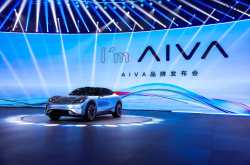
Saidoo Technology has officially launched its all-new brand, 'AIVA,' featuring a logo as follows:
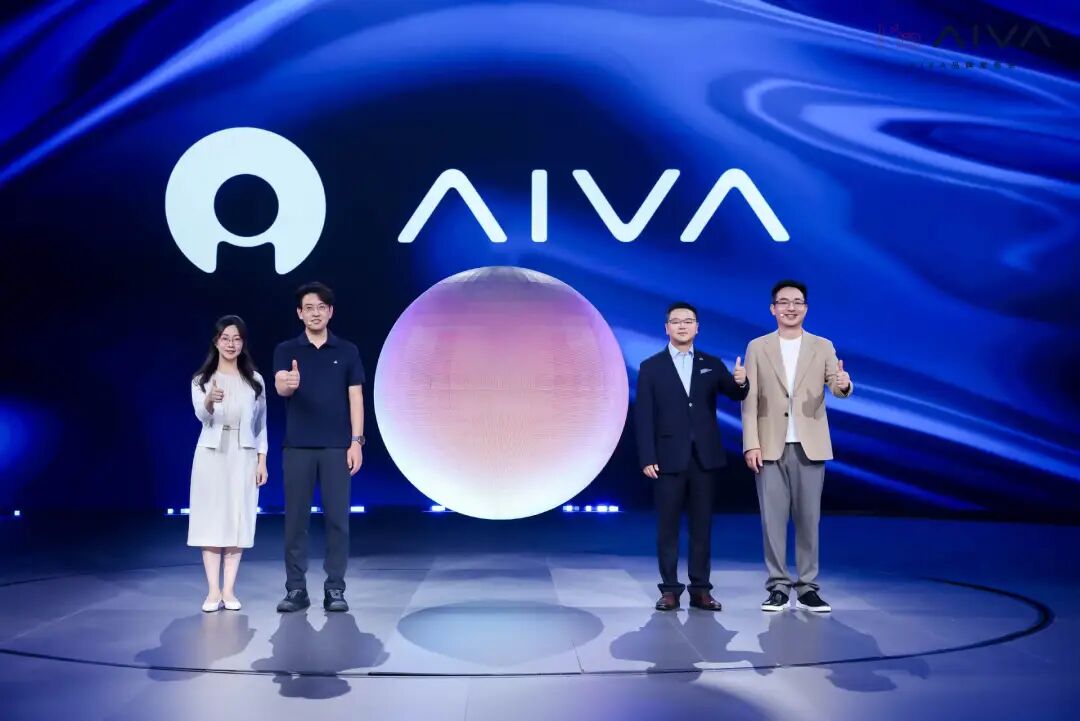
The brand's strategy is evident from its name, AIVA.
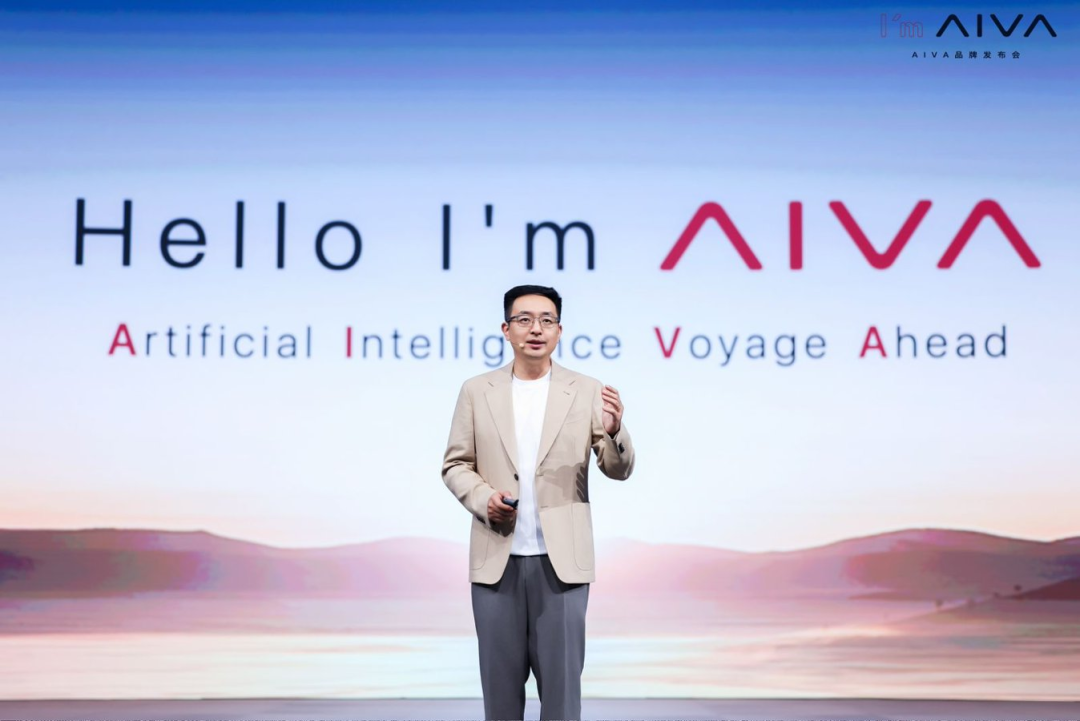
The full form, Artificial Intelligence Voyage Ahead, signifies 'AI accompanies you on your journey.' Interestingly, it also resonates with 'Ai Wo' (Love Me), highlighting a warm and engaging AI companionship.
AIVA's launch was accompanied by the introduction of its brand president, Li Bo, who also serves as the product manager for AIVA. Notably, he previously led Huawei's Smart Selection Vehicle Product Department.
Despite being a newcomer, AIVA made no attempt to downplay its ambitions. At the launch event, Li Bo provided a comprehensive overview, covering everything from the brand's car-building philosophy to its upcoming mass-produced models, with the first model on the horizon.
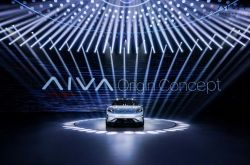
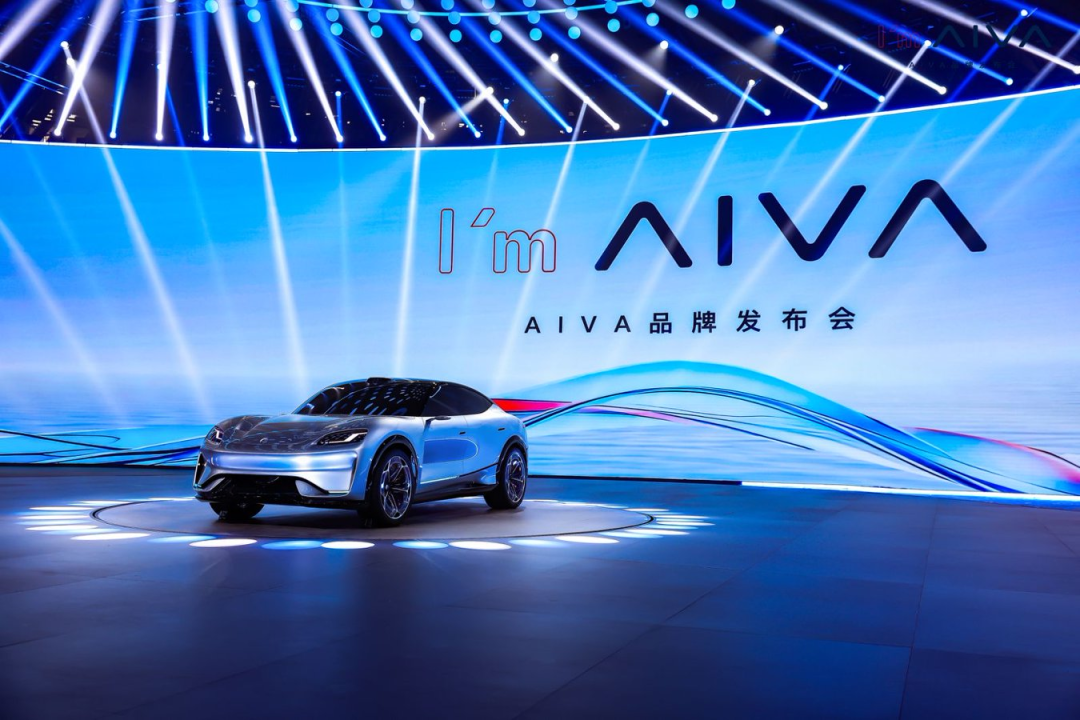
The first concept car, AIVA Origin Concept, is presented as follows:
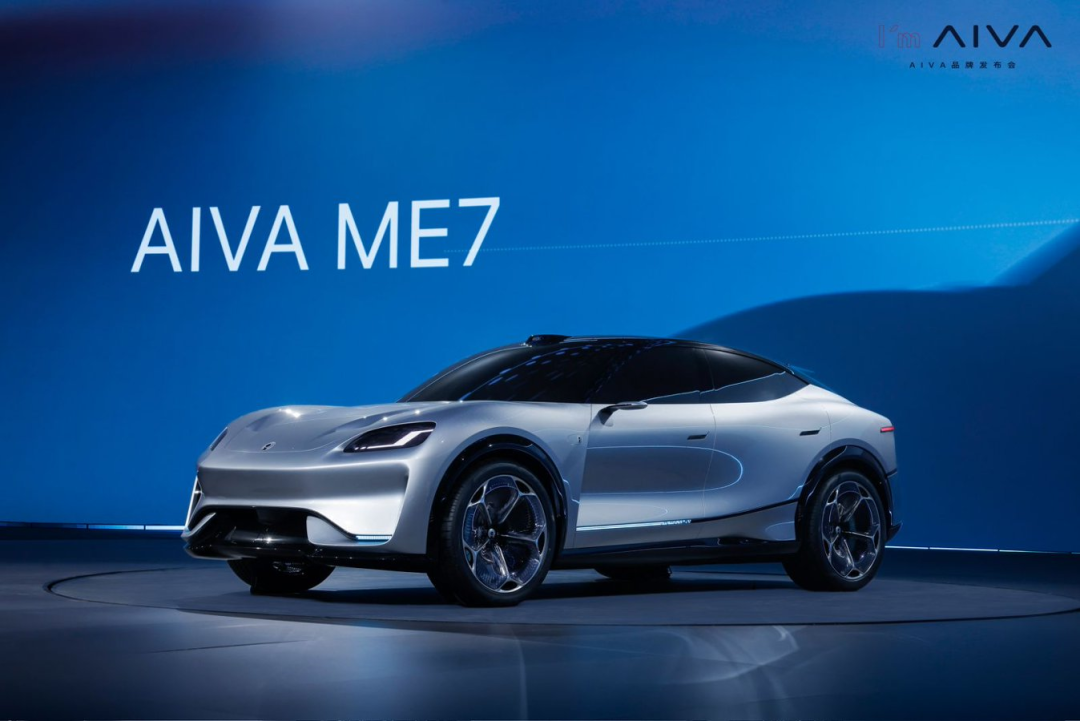
The first mass-produced model based on this concept, AIVA ME7, will also be introduced within the year. It is positioned as a crossover between an SUV and a sedan.
As a brand-new entity with a compelling story and models ready for mass production, AIVA, as the second brand under Seres, must address a critical question: Can Seres thrive without relying on the Huawei halo?
01 Building Cars with AI at the Core
Strictly speaking, Seres is not venturing into this alone.
This time, Seres has partnered with Volcano Engine, a subsidiary of ByteDance, for AIVA.
Although ByteDance has issued a statement denying any plans to build cars or launch an automotive brand and clarified that there is no equity cooperation with Saidou, defining their relationship as a 'technology supplier' rather than ByteDance entering the car-building arena.
However, Yang Liwei, Vice President of Volcano Engine, appeared at the launch event to show support.
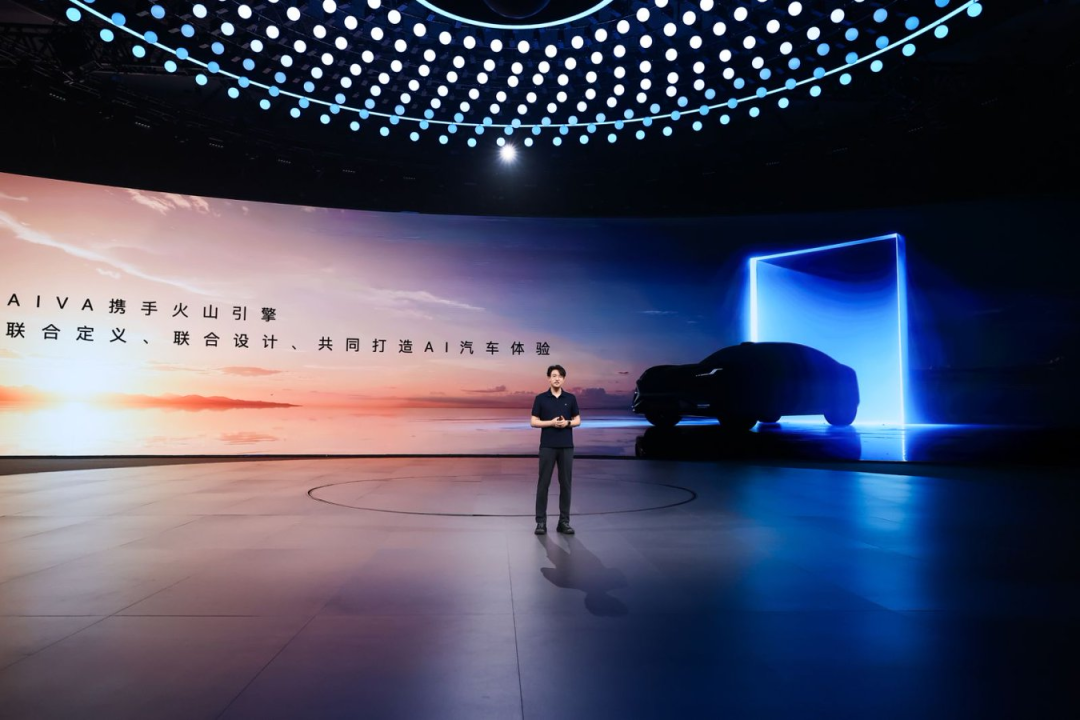
It was officially announced that AIVA would collaborate with Volcano Engine to jointly define, design, and create an AI-driven automotive experience. Volcano Engine will provide AIVA with technical services, including the Doubao large model and smart cockpit solutions, to enhance the in-car intelligent interaction experience.
The division of labor is clear: ByteDance, through Volcano Engine, will contribute embodied intelligence technology and smart cockpit systems, while Seres will handle core hardware such as the three-electric systems, chassis tuning, vehicle control, and overall vehicle manufacturing.
However, this collaboration goes beyond simply 'buying software' or integrating an AI assistant into the vehicle. It represents a deep co-creation centered around 'how AI can redefine the automobile.' 'What we're doing is not just putting AI in the car, but making the car a new species of physical AI,' Yang Liwei emphasized.
This is also the car-building philosophy that AIVA adheres to—'AI first, then the car.'
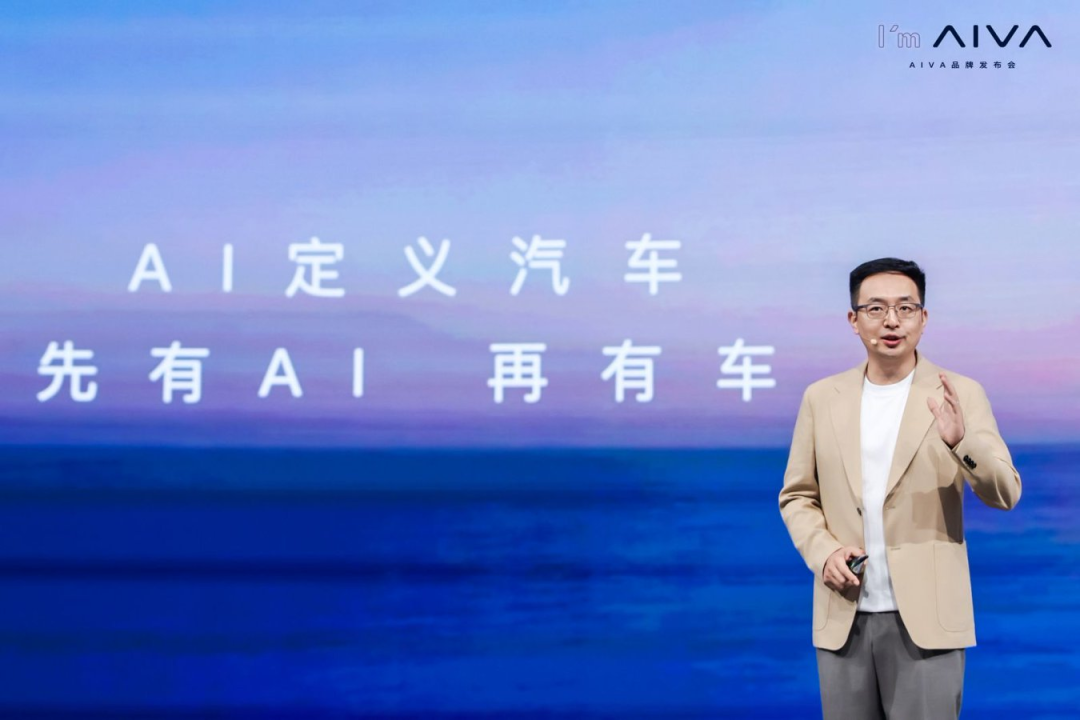
Li Bo believes that the difference between 'adding AI to a car' and 'redefining a car with AI' lies not in the presence of AI but in the timing of AI's involvement in product definition: whether it is integrated after the vehicle's functions are determined or involved from the very beginning of product definition.
At the launch event, he used a vivid metaphor to explain: 'In the past, people mined ahead; now, AI mines ahead, and people refine behind.' In his view, the car is not just a designed product but a carrier that evolves from AI's understanding of humans.
While current smart cars often add functions after the hardware platform is established, AIVA aims to place AI at the source of product definition. AI will first participate in understanding user needs, scenario derivation, capability invocation, and interaction experience design, and then organize the automotive product accordingly.
For instance, in terms of demand prioritization, car-building should not start from a feature list but from real-life travel scenarios, understanding what users truly need in different contexts such as commuting, family trips, long-distance driving, and relaxation.
It also involves considering which vehicle capabilities, data interfaces, and execution systems AI needs to invoke, allowing the car to reserve space for AI collaboration from the underlying architecture. This enables AI to organize capabilities around user goals, allowing the vehicle to understand user habits over time and form a continuously evolving experience.
With this approach to car-building, in Li Bo's view, the car will no longer be a product defined once and remaining unchanged for a long time. Instead, it will become an embodied AI life form capable of continuous evolution and growth with perceptual and action capabilities.
At the launch event, he provided several examples to illustrate the differences under different paths.
For example, regarding air conditioning temperature, some people may habitually set it to 22 degrees. However, AIVA will match the most suitable temperature for you based on the scenario. This is because 22°C in a T-shirt in summer is not the same as 22°C in a wool sweater after taking off a down jacket in winter. AIVA can customize a temperature unique to you.
Besides air conditioning, AIVA will also remember users' travel habits. For instance, if you leave 5 minutes late on your commute, AIVA will find a way to make up those 5 minutes. During rush hour commutes, it knows the driver dislikes being cut off and will automatically reduce the following distance; once on the highway, it will automatically increase the distance for safety.
In short, AIVA has 'memory,' remembering your travel preferences and generating a unique travel plan each time based on the route and scenario. The in-car assistant will no longer be a one-size-fits-all fixed style but will change with your habits and scenarios.
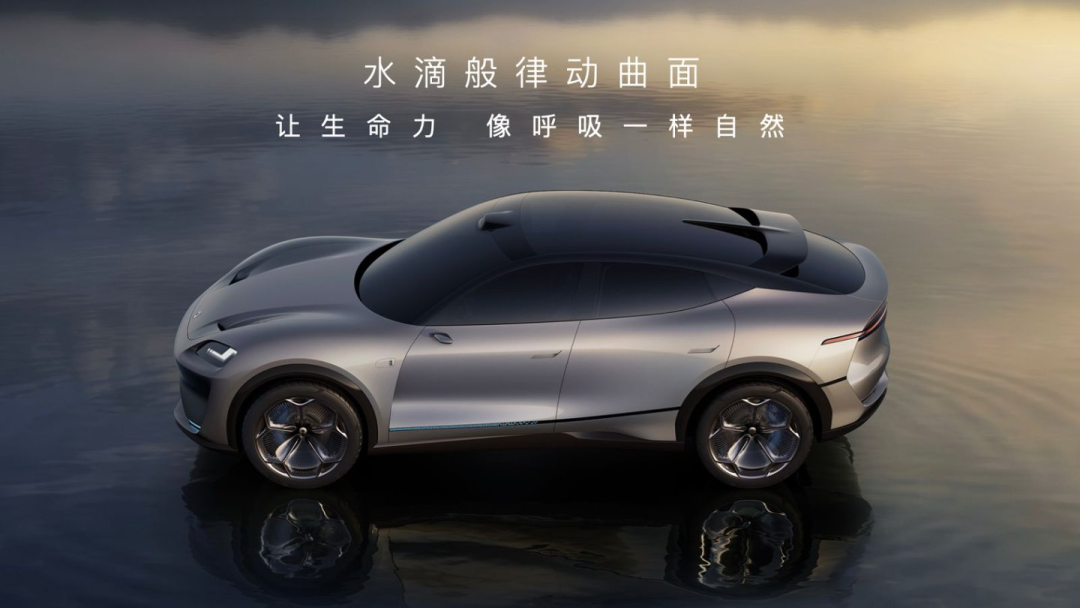
Based on this car-building philosophy, AIVA's first concept car, the AIVA Origin Concept, was unveiled simultaneously.
This car adopts a biomechanical bionics approach in design, with no harsh edges or deliberate fold lines. Where headlights would typically be, interactive and expressive screens are installed, while the wheel design is inspired by the furcula structure of birds.
Although this is a concept car, its path to mass production is faster than expected. Li Bo announced on-site that the first mass-produced model, AIVA ME7, will be based on the AIVA Origin Concept and is expected to officially meet the public in the second half of this year.
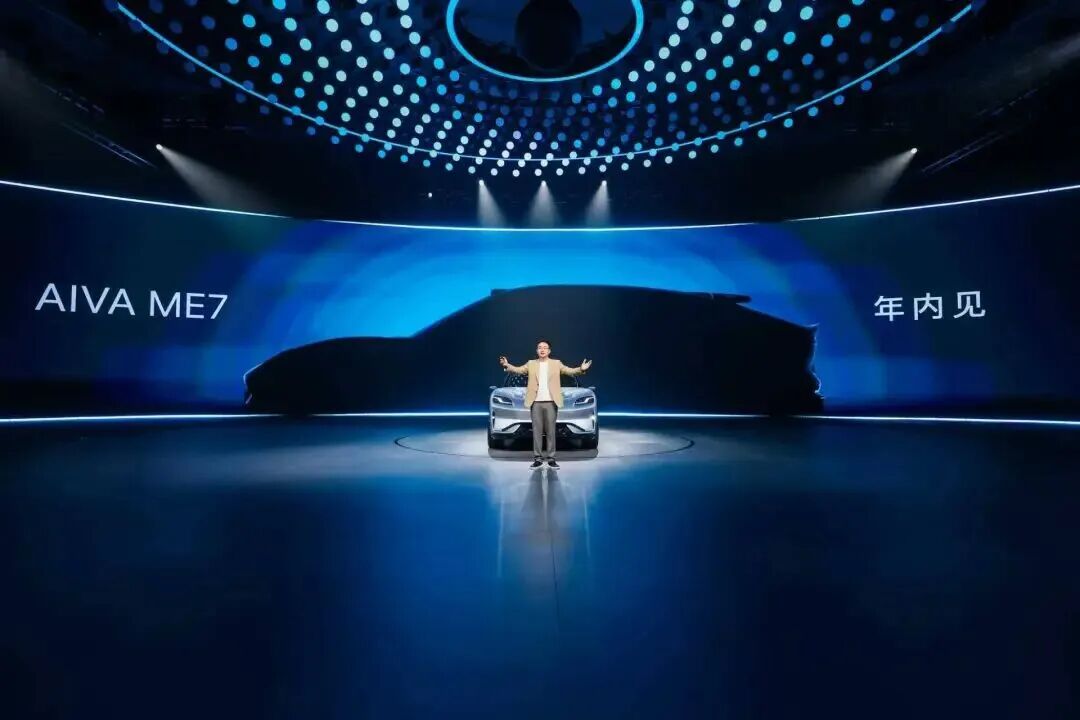
Moreover, contrary to previous industry predictions that it would enter the 100,000-200,000 yuan price range, according to Li Bo, the entire model range will cover the mainstream market above 200,000 yuan.
Above 200,000 yuan, with a name ending in 7, and as a sporty crossover SUV, AIVA's initial target is already quite clear.
02 From AITO to AIVA
Beyond the brand itself, Seres' strategic layout is even more noteworthy.
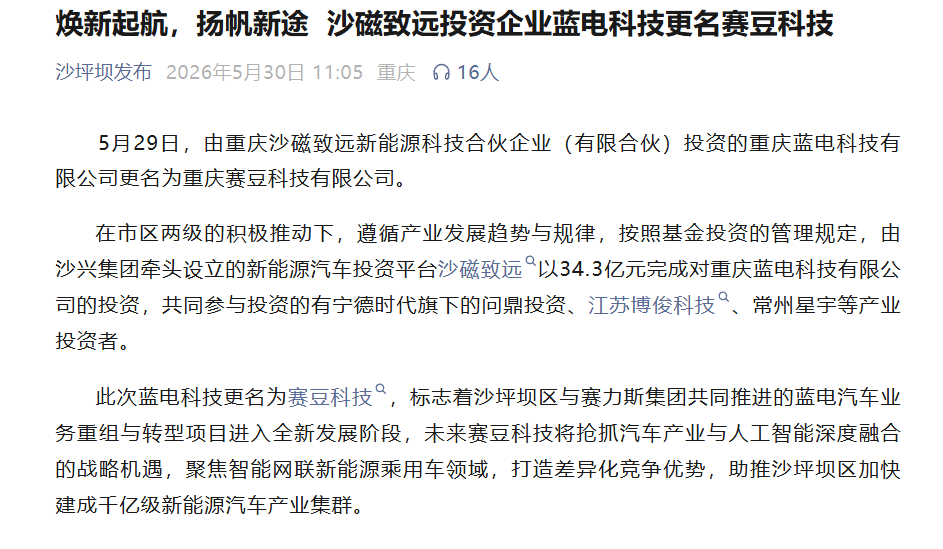
As the operating entity of AIVA, Saidou Technology may sound unfamiliar. However, its predecessor was Seres' proprietary new energy brand, Landian Technology.

However, its market performance has been unsatisfactory. In 2023, it launched its first model, the Landian E5, priced at 139,900 yuan. Nine months after its launch, the official price was reduced by 40,000 yuan. In 2024, Landian sold 29,000 units, dropping to less than 20,000 units in 2025; by 2026, monthly sales had fallen to around 500 units.
In fact, as early as 2024, Seres began secretly preparing for a new brand internally. It wasn't until February 2026 that Seres signed a cooperation agreement with the Shapingba District Government in Chongqing, planning to spin off Landian's existing assets and restructure them into a new entity.
In May, Landian Technology completed a capital increase and share expansion of approximately 6.671 billion yuan. After the increase, Shacizhiyuan, a local state-owned asset platform in Chongqing, became the largest shareholder with a 34.5% stake, while Seres' shareholding dropped to 32.96%, becoming the second largest. Ningde Times' wholly-owned subsidiary, Wending Investment, acquired approximately 9.89% of the shares. Seres no longer controls Saidou Technology, which is also no longer consolidated into the listed company's financial statements, achieving independent operations.
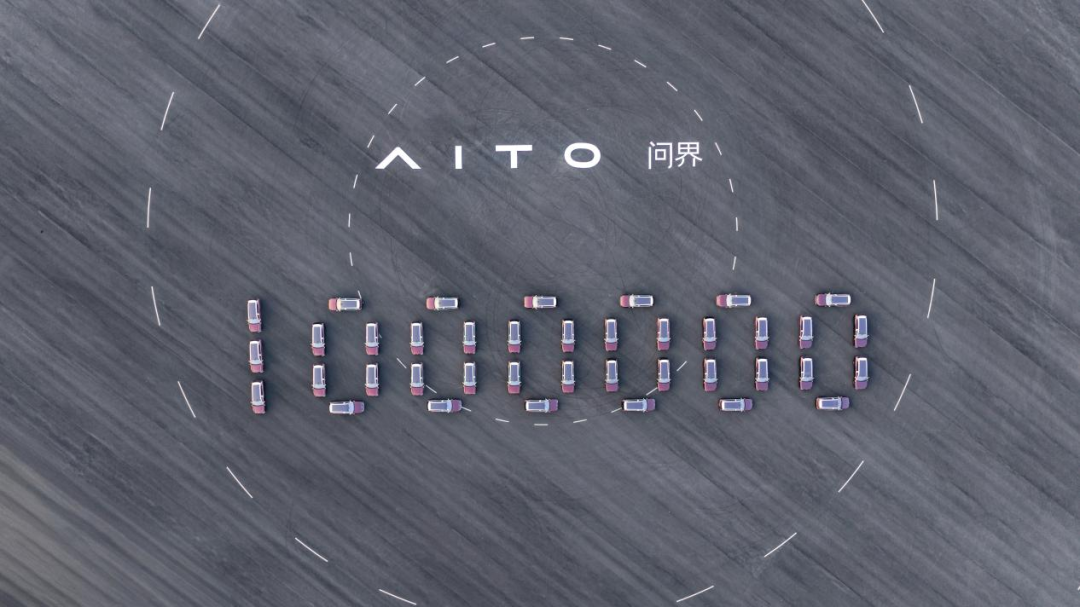
As we all know, Seres' rise from a fringe player in 2020 to the first tier would not have been possible without Huawei. AITO went from nothing to accumulating over one million deliveries in just a few years, with corporate revenue soaring from billions to tens of billions, and Xiaokang Co., Ltd. renaming itself Seres, completely shedding its low-end manufacturing label.
At that time, the depth of their partnership was such that the market generally equated AITO with Seres' ticket to a comeback. However, the cost of this comeback was not small.
In 2025, Seres' sales expenses reached 24.19 billion yuan, a 26% year-on-year increase, primarily used for advertising and sales services; R&D expenses were 7.95 billion yuan, a 42% increase, with R&D personnel growing by 2,818 to 9,019 in one year. A significant portion of this money flowed to Huawei.
In just the first half of 2025, Seres paid Huawei 20 billion yuan in procurement fees, accounting for one-third of its revenue during the same period. On average, for every car sold, Huawei took away 136,000 yuan. If we extend the timeframe to 2022-2025, the cumulative amount paid exceeded 75 billion yuan.
Some joke that Seres seems to be 'working for Huawei,' and while this may be an exaggeration, the data is objective.
What worries Seres even more is that Huawei's 'friend circle' is expanding. As more automakers join the Harmony Intelligent Mobility Alliance, Huawei's technology is spreading to more brands. The cooperation dividends Seres accumulated early on are being continuously diluted by 'latecomers' like Chery, JAC, and BAIC.
Data also confirms this dilution effect. In May this year, Harmony Intelligent Mobility delivered 46,100 units across all models, with AITO accounting for 34,300 units, still representing a high 74.4%, but the 'scarcity' premium has weakened.
Therefore, the emergence of Saidou Technology is essentially Seres finding another path outside of AITO.

Seres has also stated in its official financial reports that the company has developed the systemic capability to continuously create popular products, including deep user insights, collaborative innovation, and efficient mass production of intelligent achievements. This capability, validated in the high-end market, is seen as a reusable foundation.
The birth of the AIVA brand is precisely the extension of this capability into the mass market.
Moreover, 'having more children' is a common strategy among Chinese automakers. Geely has Zeekr and Lynk & Co, BYD has Yangwang and Fangcheng Bao, and Chery has iCAR and Exeed. If AITO is Seres' high-end flagship, AIVA is Seres' mass-market AI experimental field. With both paths running in parallel, risks are diversified, and the logic holds.
However, the market segment above 200,000 yuan is already a red ocean with strong competitors. Whether AIVA can carve out a path with its AI capabilities remains to be seen based on the actual performance of its products after launch.
-
![]()
Breaking into the AI Computing Power and Low-Altitude Economy Sectors! Tongya Technology Heads for Hong Kong IPO: Tripling Revenue in Three Years, Third in Global Market Share, with Matrix Partners Ch
-
![]()
Will ByteDance’s Collaboration with Saido Follow Huawei’s Footsteps?
-
![]()
Revenue Surges 50-Fold: Q1 Earnings Match Annual Profit, This Year's Hottest Business Revealed
-
![]()
Cook’s Gourd Holds No Magic Cure for Apple’s AI Woes
-
![]()
Stellantis Presents a Catalyst, Propelling Chinese Automobiles Towards Global Supremacy
-
![]()
The First AI Car! Seres + ByteDance, AIVA Targets the 200,000+ Market with Its First Vehicle Launching This Year | Mirror Pro
-
![]()
Most People Don't Understand Kimi's World Cup Prediction
-
![]()
Behind Saido: The Strategy of a Company Backed by CATL and ByteDance