Most People Don't Understand Kimi's World Cup Prediction
 06/10 2026
 615
615
It's summer again.
As the college entrance examination (Gaokao) begins, a group of 'AI exam-takers' have unexpectedly emerged once more. Having different AI models take the Gaokao and then comparing their scores has become a clichéd routine over the past three years.
While competitors and media argue fiercely over differences in scores for Chinese composition and advanced math problems, Kimi steps forward: The summer of 2026 doesn't belong to the Gaokao—it belongs to the World Cup.
Last night, Kimi directly released a massive 200+ page '2026 World Cup Event Analysis and Prediction Report' and generously launched a 'Trillion Token Giveaway' event. The scale and logical rigor of this report even surpass many top-tier consulting firms' specialized sports event research.
At first glance, this seems like another attention-grabbing tactic similar to having AI take the Gaokao. However, when you dissect the technical foundation—which involved over 300 agents in collaborative simulations—the essence of the matter becomes different.
Kimi's World Cup prediction goes far beyond forecasting scores and champions. By treating football as a sandbox, it's testing AI decision-making logic in complex, nonlinear, chaotic real-world scenarios. This is what most people fail to grasp.
In this age of agents, people emphasize how much work AI can do rather than how intelligent it is. Over the past three years, writing Gaokao essays and solving advanced math problems merely showcased AI's performance abilities. Predicting the World Cup, however, tests AI's survival and decision-making capabilities.
As the World Cup approaches, AI is transitioning from generative copywriting to predictive decision-making, achieving another leap in model capabilities in AI's evolutionary history.
01 Chaotic Simulations of the Real World
Why is World Cup prediction a more advanced training ground than the Gaokao?
The Gaokao assesses a student's knowledge accumulation over three years. However, under Transformer architectures and reinforcement learning paradigms, models can absorb this knowledge in minutes.
In other words, Gaokao questions are closed-ended, never exceeding high school knowledge boundaries—nearly all have standard answers. Except for Chinese and English compositions, questions with standard answers perfectly fit reinforcement learning training set requirements. For compositions assessing human aesthetics, models only need to memorize high-scoring human-written essays and combine them logically to achieve high scores.
This assessment is effective for humans with limited memory and learning abilities but merely compares reproduction capabilities for AI models.
The World Cup is different. This quadrennial event is filled with open, chaotic, and incompressible uncertainties. The existence of the term 'upset' proves that no game ever has a so-called standard answer. From a macro perspective, the World Cup serves as a microcosm of the real world, constantly testing AI's cognitive modeling of reality.
To many, predicting the World Cup seems no different from 'Paul the Octopus' making diving predictions. But Kimi's report contains no mention of 'luck.' In Kimi's view, describing the World Cup as a 'football match' is inaccurate—it's more precisely a 'low signal-to-noise ratio time series inference problem.'
Facing an expanded format with 48 teams and 104 matches, AI must process far more than teams' past win-loss records—it must handle countless environmental variables:
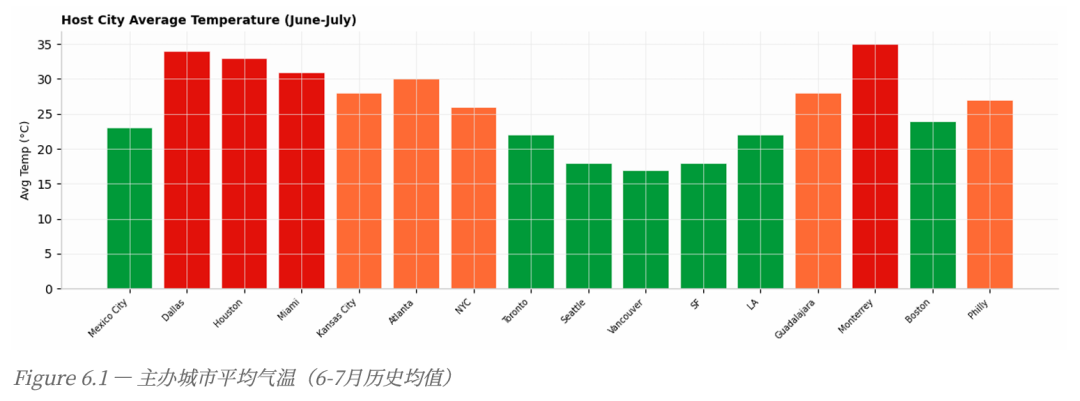
For example, the 'invisible tax' of environmental physiology:
The Kimi model introduces the WBGT (Wet Bulb Globe Temperature) index, comprehensive consideration (comprehensively considering) multiple scientific indicators like radiation, humidity, and wind speed that directly reflect human heat dissipation efficiency. The model calculates not only the performance degradation coefficients for high-intensity running distance and passing decision time in high-temperature stadiums like Dallas and Miami but also converts them into 'performance discounts' through exercise physiology data.
These complex calculations might seem theoretical but acutely point out that for Germany's high-pressing tactics, this 'environmental tax' could be the critical variable determining knockout stage success or failure.
For example, the 'prisoner's dilemma' of tournament strategy:
Under the new 48-team format, the probability of third-place teams advancing from group stages is significantly optimized. Kimi's model accurately predicts the possibility of 'strategic draws'—where strong teams, having secured advancement, might trigger a Nash equilibrium to avoid meeting championship favorites in high-risk halves.
While Chinese fans excel at simulating such point-calculation games, this far exceeds simple technical statistics. It requires models to understand coaches' 'motivations' and players' rational choices for energy allocation late in matches.
For example, recursive propagation of injury correlations:
Injuries are often seen as unavoidable accidents, but Kimi doesn't view them in isolation. Using injury-tracking agents in Monte Carlo simulations, it quantifies how core player injuries disrupt entire tactical chains. The paper's example of Spanish player Rodri's recovery curve after ACL surgery illustrates this perfectly: When a midfield metronome is absent, consequences extend beyond defensive decline—the entire midfield passing trajectory requires reconstruction.
This represents the 'commercial infrastructure' attribute that general AI should possess.
People don't need Kimi as merely a chat window—it must become a universal decision support system capable of processing macro geopolitics, micro exercise physiology, and probabilistic game theory.
This is also the declaration Moonshot AI made to the world in the summer of 2026: AI's future lies not in writing more moving poems but in understanding and predicting the operating rules of the physical world.
02 From Single-Point Prediction to Organizational Thinking
What shocked the tech community most about Kimi's World Cup prediction wasn't the model's performance itself but the Agent Swarm architecture introduced by Moonshot AI.
Under traditional single-model logic, AI easily falls into mental rigidity due to confirmation bias. Simply put, a model trained on historical data will always see strong teams as strong and weak teams as weak. If so, football's charm disappears.
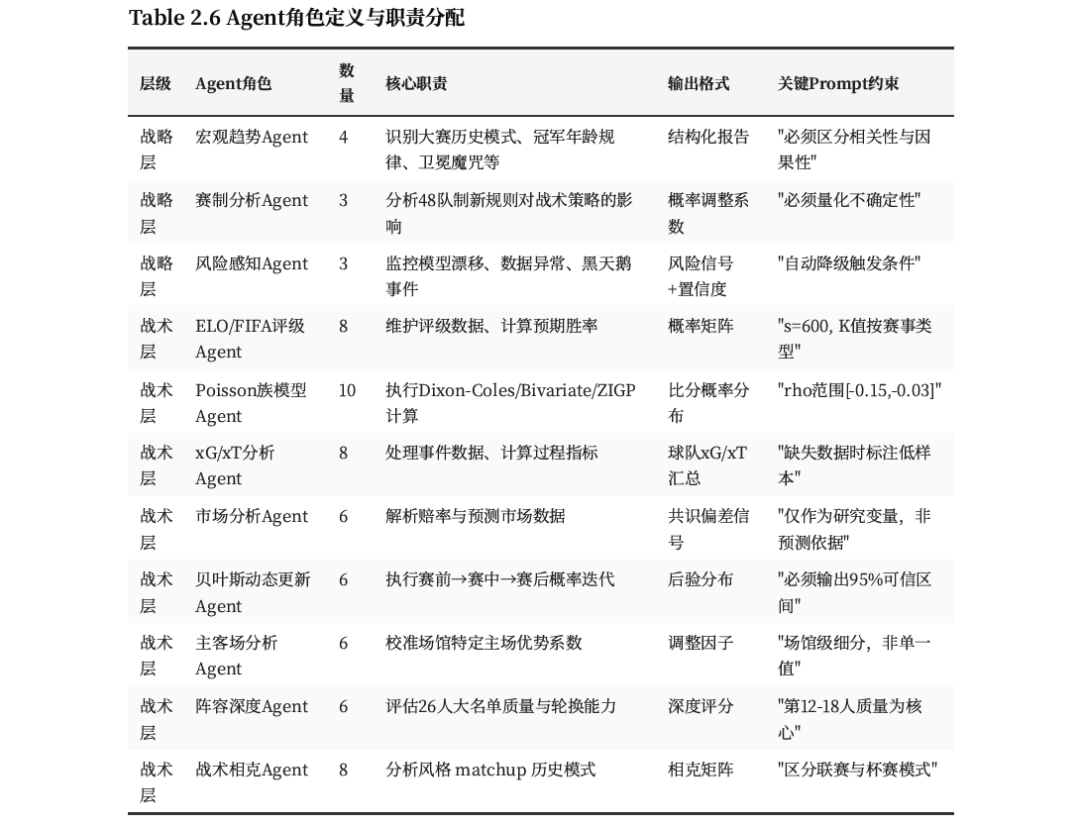
Therefore, Kimi assembled over 300 agents to form a research team with clear divisions:
Strategic Layer: Responsible for macro perspectives, identifying phenomena like the 'champion's curse' and age cycles for winning.
Tactical Layer: Handles vertical domains, calculating quantitative metrics like expected goals and expected threats.
Executive Layer: Quantifies external factors, assessing geographical and climatic impacts across 16 venues.
Division of labor alone isn't enough—these 300 agents must also communicate and collaborate within the swarm. Thus, handling disagreements between agent predictions becomes core.
To address this, Kimi introduced an 'Agent Debate Protocol.'
For example, when the market odds agent argues that Germany is 'systematically underestimated,' the historical data agent might rebut from a recency bias perspective ('eliminated in group stages twice consecutively'). The system automatically triggers debate levels from 1 to 4, even bringing in specialized arbitration agents for final rulings.
This human-like working mode likely surpasses FIFA in operational efficiency. The commercial metaphor behind this architecture is also noteworthy: In complex decisions, AI's 'sophistication' lies in transparently displaying its thought correction process—whether it can give a single correct answer matters less.
When Kimi automatically identifies disagreements between agents and quantifies their confidence levels, even triggering downgrade signals when disagreements become excessive, this 'honest' algorithm proves far more valuable than black-box models that hide their logic. It not only provides predictions but also perfectly demonstrates prediction boundaries and confidence intervals—the core of modern quantitative finance and complex decision systems.
03 AI is Redefining Probability and Value
Moonshot AI repeatedly emphasizes one point in the report:
Any model claiming 100% predictive accuracy is arrogant.
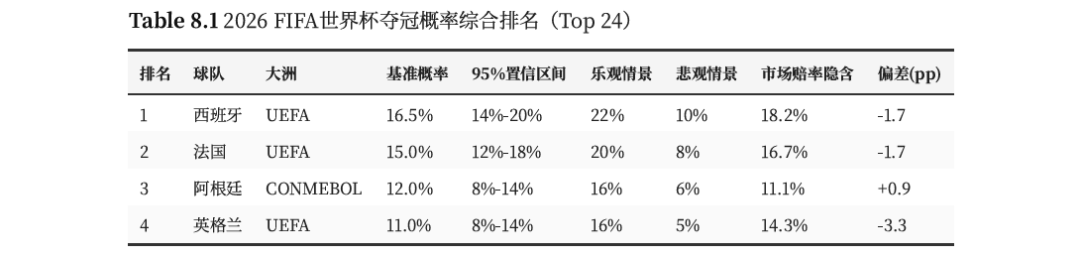
This cognitive humility isn't just scientific attitude but also savvy business narrative: They position complex market odds as 'consensus bias research variables' to identify irrational pricing caused by mass sentiment. The most memorable example is Germany's consecutive upset eliminations in the 2018 and 2022 World Cups.
This statement applies not just to the World Cup but to financial markets as well. Kimi's World Cup prediction provides a fresh commercial perspective: The core value of AI-assisted decision-making lies in 'identifying' markets rather than 'gambling' against them.
When the model determines that market odds have marked Germany as the 6th or 7th favorite but its tactical evolution and data models suggest a much higher true championship probability, Kimi is essentially performing a 'value investment' action. In other words, AI helps fans strip away market sentiment to see logical truths obscured by irrational pricing.
For corporate executives, this logic transfers perfectly: When everyone in the company reaches 'consensus' on a market prediction, maximum risk has arrived. Any enterprise needs a Kimi-like 'correction system' to promptly identify easily forgotten variables.
AI isn't meant to tell people 'what the market thinks' but 'what the market might be wrong about.'
04 Philosophy of Probability and 'Irreducible Randomness'
Redefining value doesn't negate the meaning of probability. Behind a series of match outcome and advancement predictions, Kimi demonstrates an organic integration of two top philosophies in probability theory:
First, frequentism symbolizes rigor: Through 100,000 Monte Carlo simulations, Kimi calculates each participating team's winning probability across millions of possible tournament outcomes—determinacy in the big data era.
Second, Bayesianism symbolizes flexibility: After each match, agents update prior probabilities in real-time based on latest on-field feedback, including player conditions, referee decision-making tendencies, and sudden weather changes.
Combining historical gravitas with real-time responsiveness perfectly aligns with decision science. Kimi's dynamic mechanism precisely addresses one of the biggest pain points in commercial decision-making: How models should correct course when environments abruptly change.
Moreover, Kimi's World Cup prediction model introduces an enlightening 'time-decay likelihood weighting'—assigning different weights to match data from different time points: A 90th-minute goal might carry far more weight than a 45th-minute goal.
Through this deep parsing of information noise, the model distinguishes actual trends from random fluctuations amidst massive data. The essence of decision-making lies in dynamically adjusting confidence distributions about the future based on constantly updating information flows. This applies to both World Cups and markets.
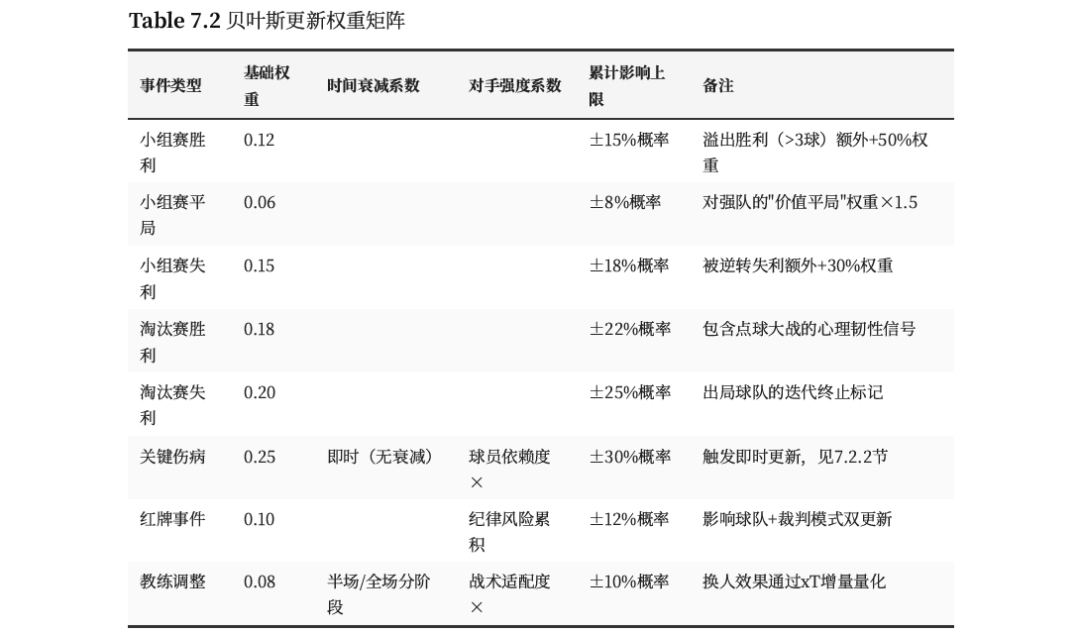
The most touching line in this 200+ page paper states:
35% of uncertainty belongs to 'unknown unknowns'—part of football's beauty and the final bastion of human competitive sports that algorithms cannot conquer.
In an era where technological change far outpaces transportation evolution, admitting AI's boundaries requires more courage than promoting its capabilities.
Kimi candidly presents a 'Model Downgrade Protocol': When sudden events like red cards, VAR errors, or even social media controversies occur, the system automatically marks predictions as 'highly uncertain,' stops making arbitrary quantitative forecasts, and awaits human intervention or data reflow (data reflow /data reflow).
This strategy brilliantly demonstrates Moonshot AI's commercial wisdom in China's current AI landscape. Building trust by acknowledging boundaries proves far more effective and reasonable than overpromising capabilities.
AI shouldn't be packaged as an always-correct 'God'—it should function as a reliable 'co-pilot': Providing ultimate (ultimate) computational support during normal, stable operations while sounding alarms during black swan events and returning control to human decision-makers.
This cognitive humility makes Kimi seem like a rational decision partner. The best decisions always result from collaboration between AI computational power and human judgment.
05 From World Cup to the Future of AI Commerce
Moonshot AI chose not to have Kimi participate in the Gaokao first but instead tackle the World Cup's green fields—processing injuries, combating heat, and calculating deviations between odds and probabilities.
Returning to last night, the event and article Kimi released likely ignited excitement among many users.
Programmers thrilled about free tokens, fans excited about World Cup predictions—and behind this technical demonstration, everyone should feel inspired by this preview of future AI decision-making paradigms.
Future commercial decisions must no longer rely on single-point experiences but on holographic models that structurally process fragmented data across politics, climate, physiology, psychology, and more through agent swarms.
AGI is not a goal that can be achieved overnight, and humanity is still far from the so-called era of omnipotent decision-making. However, Kimi's World Cup prediction undoubtedly represents the most solid step forward in this era.
Therefore, whether we are programmers or football fans, we will all realize one thing in the game of intelligent agents: what we need to learn is not how to use AI to win a single game, but how to use AI's perspective to see the probabilities and truths hidden behind complexity.

The charm of football lies in breaking conventions; the value of AI lies in helping humanity explore the boundaries that lead to truth.
When AI begins to learn humility in facing the future, it will not be far from truly transforming the business world and even the underlying logic of human decision-making.

-
![]()
American Cars: A Move Towards Global Isolation?
-
![]()
After a 280 Billion Yuan Market Value Plunge, Can Seres Ditch Its Huawei Dependence and Soar?
-
![]()
New Policy for Commercial Pilot of Intelligent Connected Vehicles in Tianjin: Safety Officers in Place, RMB 5 Million Insurance Coverage as Guarantee, Autonomous Driving Robotaxi is About to Hit the R
-
![]()
Interview with Li Hongsheng from Daxiao Robotics: Instead of Waiting for Data, Why Not Create an Infinite 'Chinese Home Training Ground' for Robots
-
![]()
A Staggering 2 Trillion USD Market Cap! How SpaceX, with Its Relentless Launches and Occasional Explosions, Became the Largest IPO in History
-
![]()
Bridging the 'Reality-Virtuality Gap' in VLA: China's Embodied AI Large Models Grow 'New Brains'
-
![]()
Executives Exit in Style: Alibaba's AI Doesn't Need a 'Top Dog'
-
![]()
From 'Daydream' to 'Inestimable Wealth': Is SpaceX Truly So 'Sci-Fi'?