Will Complaints About BBA Models Decrease Within Three Years? Analysis of BBA Complaint Index for the First Five Months of 2026
 06/15 2026
 551
551
Since the start of this year, the market penetration of new energy vehicles has been on a continuous upward trajectory. According to the latest data from the China Passenger Car Association, in May, the market penetration rate of new energy vehicles soared to a record 62.9%, while that of fuel-powered vehicles dipped below 40%. Amidst the relentless rise of new energy vehicles, overseas brands that still rely heavily on fuel-powered vehicles for sales have uniformly witnessed a decline. The downturn is particularly evident among luxury brands. In the first quarter of this year, the combined sales of new cars from four German luxury brands—BMW, Mercedes-Benz, Audi, and Porsche—in the Chinese market amounted to just 380,000 units, marking a 17% year-on-year decrease. In April, Mercedes-Benz sold 32,000 units, a 33.3% year-on-year decline; BMW sold 34,000 units, down 24.4% year-on-year; and Audi sold only 29,000 units, a 25.6% year-on-year decrease. More strikingly, in April, no BBA model managed to sell over 10,000 units. However, the challenges for BBA brands do not stop there. According to feedback data from Qichemen.com, as sales decline, product and service issues among BBA brands are on the rise. 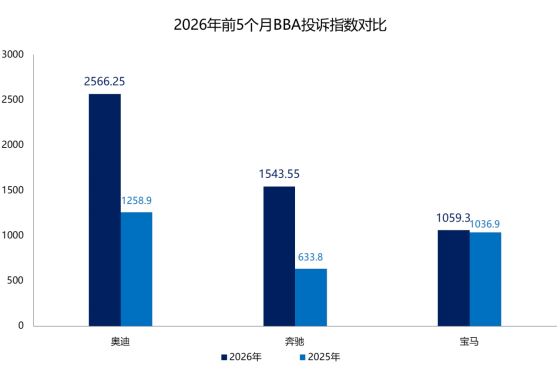
Data reveals that in the first five months of this year, the complaint indices for Mercedes-Benz, BMW, and Audi have all increased to varying degrees compared to the same period last year. Among them, Audi tops the list of luxury brand complaints, with a cumulative complaint index of 2,566.25 for the first five months, doubling that of the same period last year and nearly matching the combined complaint index of Mercedes-Benz and BMW. Mercedes-Benz's cumulative complaint index for the first five months has surged nearly 1.5 times, reaching 1,543.55, surpassing BMW. BMW's complaint index, meanwhile, remains largely unchanged from the same period last year. 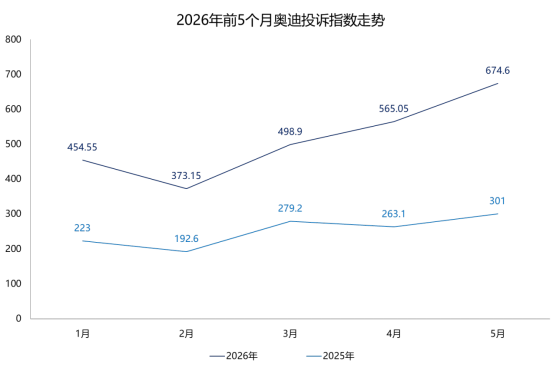
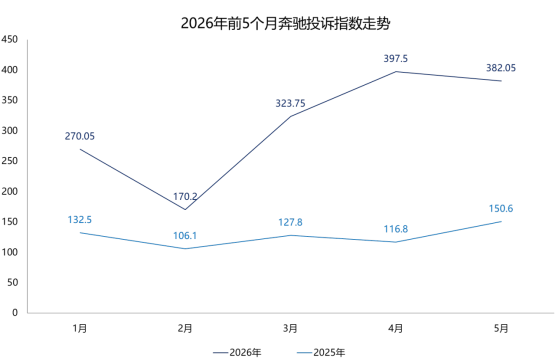
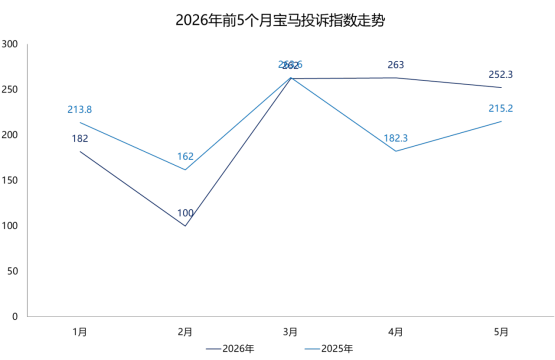
From a monthly trend perspective, in the first five months of 2026, the monthly complaint indices for Audi and Mercedes-Benz have been notably higher than those of the same period last year. Furthermore, in the past three months, the complaint indices for these two luxury brands have exhibited an upward trend. In contrast, BMW's monthly complaint index is significantly lower than those of Audi and Mercedes-Benz. Additionally, in the first two months of this year, BMW's complaint index was consistently lower than that of the same period last year. However, in the past two months, BMW's complaint index has suddenly risen, significantly surpassing that of the same period last year. Of course, BMW's complaint index has also seen a sharp increase in the past three months. 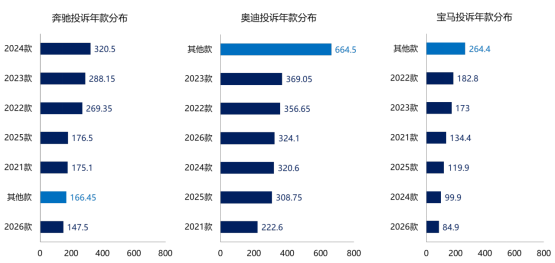
Regarding the distribution of complained models, the proportion of complaint indices for models within three years among the three major luxury brands is decreasing. Mercedes-Benz has the highest proportion of complaints for models within three years, at 42%; Audi's proportion of complaints for new cars within three years is only 37%; and BMW's is even lower at 29%. Meanwhile, Audi and BMW have a significant proportion of complaints for models over six years old. The decrease in the proportion of complaints for new cars, to a certain extent, reflects the decline in BBA's new car sales. It is worth noting that the proportion of Audi's 2026 models accounts for nearly 30%. However, issues such as dealers not refunding deposits and unfulfilled promises have become major sources of complaints. 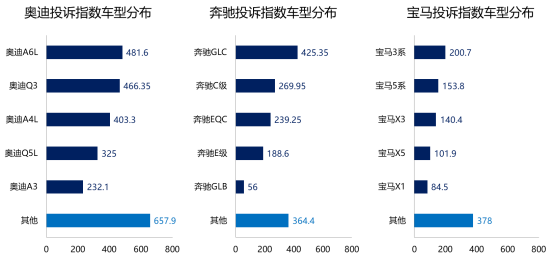
From a model distribution perspective, the hotspot models for BBA complaints are also the best-selling models of their respective brands. The difference lies in the fact that the complaint indices for Audi models are mostly higher than those of Mercedes-Benz and BMW models in the same class. For instance, the complaint index for the Audi A6L is much higher than that of the Mercedes-Benz E-Class and BMW 5 Series; the complaint index for the Audi A4L is much higher than that of the Mercedes-Benz C-Class and BMW 3 Series; the complaint index for the Audi Q3 is significantly higher than that of the Mercedes-Benz GLB and BMW X1; and the Audi A3 is much higher than the Mercedes-Benz A-Class and BMW 1 Series. Of course, the complaint index for the Mercedes-Benz GLC is higher than that of the Audi A5L and BMW X3. 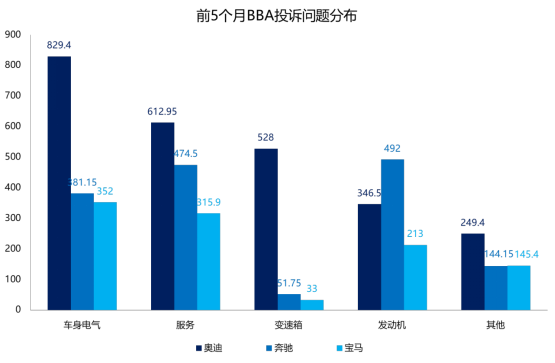
From the perspective of complaint issue composition, vehicle electrical systems and services are two major issues with high complaint rates across the three brands. In comparison, Audi's complaint indices for vehicle electrical systems, services, and transmission issues are all higher than those of Mercedes-Benz and BMW, with transmission complaints being particularly notable. Meanwhile, Mercedes-Benz has more prominent engine issues. Over the past few years, Audi's dual-clutch transmission issues have been a source of complaints from owners. In the first five months of this year, complaints about Audi's transmissions have been constant, leading to a consistently high complaint index for Audi's transmissions. 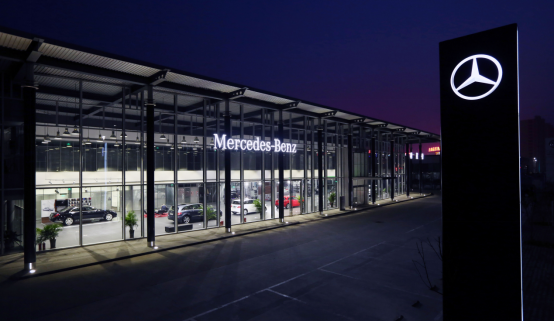
The significantly high complaint index for Mercedes-Benz engine issues can be attributed to a concentrated wave of complaints. In April and May of this year, owners of the 2023 and 2024 Mercedes-Benz C-Class and Mercedes-Benz GLC collectively complained about potential issues with the camshaft screw filter screen in their vehicles, which could detach. It is reported that this batch of models has a design defect in the camshaft screw filter screen, making it prone to detachment, but subsequent models have been improved. Therefore, many owners are demanding that Mercedes-Benz replace the parts to eliminate the potential hazard. 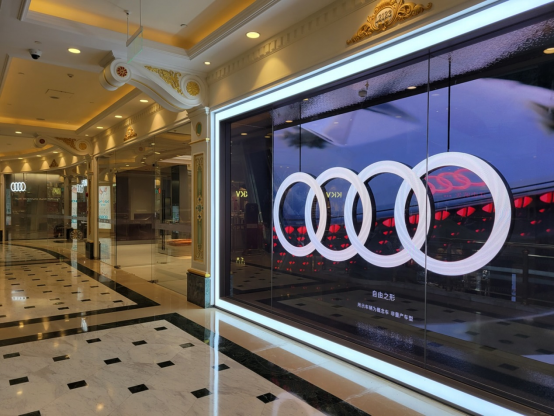
Of course, vehicle electrical system issues remain a major focus of complaints for the three brands in the first five months of this year. Complaint feedback shows that since the beginning of this year, there have been multiple small-scale concentrated complaints about Audi's vehicle electrical system issues, with many owners pointing out problems such as cracked and deformed light covers, non-functioning air conditioning, cracked body panels, inability to connect to the internet via the infotainment system, infotainment system lag and black screens, and sunroof leaks. Mercedes-Benz has had far fewer concentrated complaints about vehicle electrical system issues, with only a small number of concentrated complaints about the infotainment system not connecting to the internet and battery drainage. BMW has also had a relatively high number of complaints about vehicle electrical system issues, including multiple complaints about non-functioning air conditioning, cracked taillights, battery failures, and repeated complaints about non-functioning air conditioning, but the concentration of complaints is lower than that of Audi. From another perspective, vehicle electrical system issues are inherently diverse and involve a wide range of problems. In reality, owners' complaints are more concentrated on specific issues. 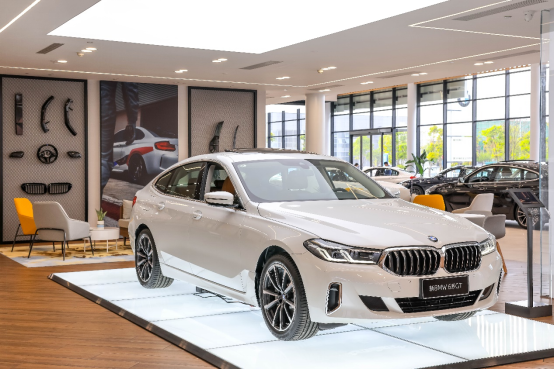
-
AI Asset Spin-offs at Tech Giants: Is Kling Paving the Way for ByteDance and Alibaba?
-
![]()
Why Zhang Xue? Why HONOR?
-
![]()
Exclusive! Tencent’s ‘Tencent Drive’ with AI-Powered Asset Backup in the Works—A Game-Changing Move
-
![]()
Internal Upheaval in Initial Listing Days: SpaceX's AI Division Faces Accelerated Talent Loss, with 50+ R&D Staff Exiting in 2026
-
![]()
Price War Fails, Chinese Automakers Have No Retreat
-
![]()
Still in the Red but Outpacing Tesla: What Lies Behind SpaceX's $2.1 Trillion Valuation?
-
![]()
Humanoid Robots Go Global: From 'Actors' to 'Workers'
-
![]()
Still Incurring Losses Yet Outpacing Tesla: What Does SpaceX's $2.1 Trillion Valuation Signify?