Ideal Has No Technology? Li Xiang Fires Back: Launching the World's Most Powerful AI Chip, Aligning Intelligent Driving with FSD by Year-End | MIRROR Pro
 06/16 2026
 538
538
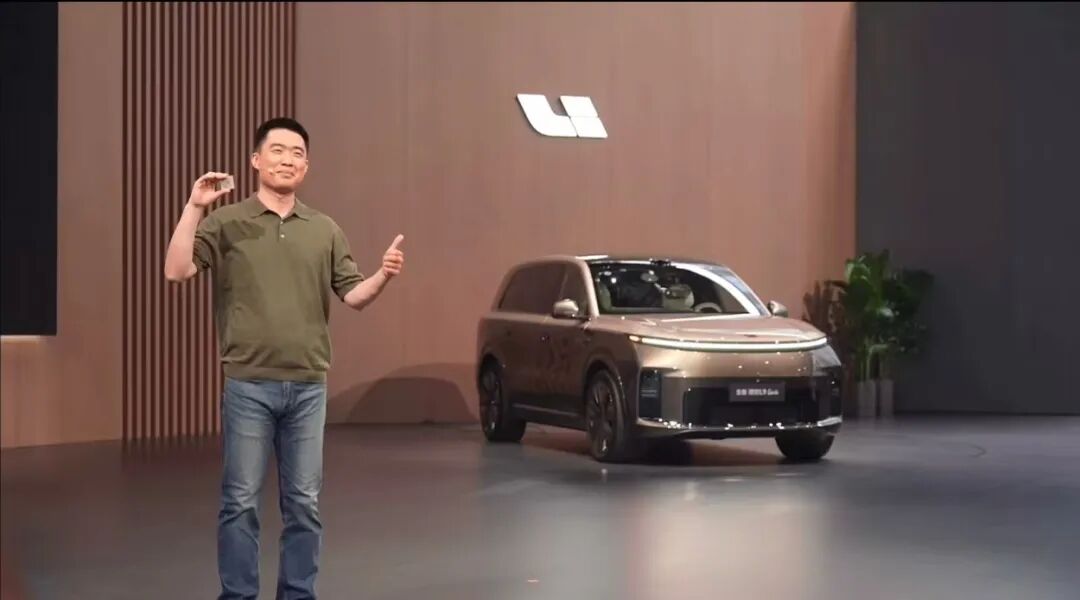
“Many say we automakers aren’t focused on building cars and that discussing AI is a distraction. After today’s Livis Day event, everyone will understand that we are ‘extremely focused’ on our core mission.” At Li Auto’s June 15 "Livis Day" software and AI event, Chairman Li Xiang once again addressed accusations of being "off track." During the event, Li Auto unveiled full-stack technological achievements, including the Embodied Intelligence Standard, self-developed chip Mach M100, Mach Mind large model, and VLA Intelligent Driving System. The company also declared cars as humanity’s first embodied intelligent robots in the physical world.
Interestingly, even for the strategic launch of the L9 Livis, Li Auto previously opted for a cost-saving online approach. However, this event was unexpectedly held offline, underscoring its significance. Since last year, Li Auto has faced substantial scrutiny over its development, manifesting in three key areas:
First, Li Auto’s core extended-range electric vehicle (EREV) L series has faced significant challenges, with declining market share and average transaction prices. By 2025, Li Auto’s EREV sales reached 334,000 units, with market share dropping to 28.2%, falling to second place. While the lower-priced L6 excelled, the L7/L8/L9 models were outperformed by Seres M7/M8/M9, resulting in substantial market share loss in the premium six-seater segment. Numerous competitors emerged, marketing themselves as "half-price Li Auto alternatives." Meanwhile, Li Auto’s pure electric vehicle (BEV) segment, though performing well, fell short of expectations.
Second, as the most profitable new energy vehicle (NEV) player, Li Auto’s financial performance has weakened since Q4 2024, particularly in Q1 2025, when it swung from profit to loss. Q1 revenue totaled RMB 23 billion, down 11.4% YoY and 20.1% QoQ. Net loss reached RMB 2.3 billion, compared to a RMB 646.6 million profit in Q1 2024 and a narrowed RMB 20.2 million profit in Q4 2024.
Third, questions persist about Li Auto’s competitive moat and core technologies. Can it sustain advantages amid fierce competition? A notable incident occurred at the 2025 Ideal i8 launch, where Li Xiang lifted a detachable tray table from the trunk—a moment widely captured in memes as "Li Xiang lifting a table." This fueled perceptions that Li Auto lacked technological depth, contrasting with NIO and XPeng, whose CEOs showcased chips at their events.
These three issues demand serious answers from Li Auto, which directly addressed them at the event.
For instance, after CTO Xie Yan introduced the self-developed Mach M100 chip, Li Xiang took the stage holding it, joking, “Take a photo of me—otherwise, the internet will only remember me lifting that table. Label this as the world’s most powerful AI chip.” The Mach M100 is the globe’s first dataflow AI chip. Li Xiang then posed for photos from multiple angles, leaving little doubt about his intent.
Since last year, amid slowing growth, Li Xiang has sought to transform Li Auto, a decade-old automaker, into an embodied intelligence company. This year, the once-"Weibo King" has become active on social media, frequently discussing embodied intelligence. The new-generation L9 symbolizes more than a product upgrade—it’s Li Auto’s first flagship carrier (carrier) for embodied intelligence. As a precursor, Li Auto released its first AI glasses, Livis, late last year, with humanoid robots also in development.
In January, Li Auto overhauled its R&D structure, shifting from hardware/software/function-based teams to a "creating digital humans and embodied agents" model. Key adjustments include:
- Consolidating teams for chips ("heart"), datasets ("lungs"), and operating systems ("nervous system") to form the foundational hardware and capabilities for embodied intelligence.
These moves signal a strategic pivot. At Q1 earnings, Li Xiang explained his logic: competition in mid-to-high-end smart cars over the next 3–5 years will hinge on embodied intelligence, with technological barriers determining long-term competitiveness. Now, Li Auto is revealing its preparations.
Let’s examine the technologies unveiled:
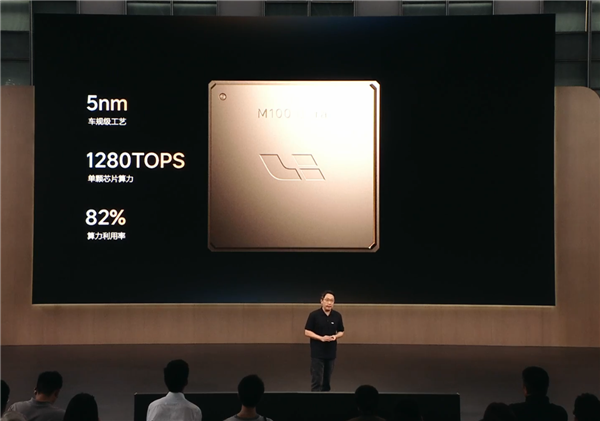
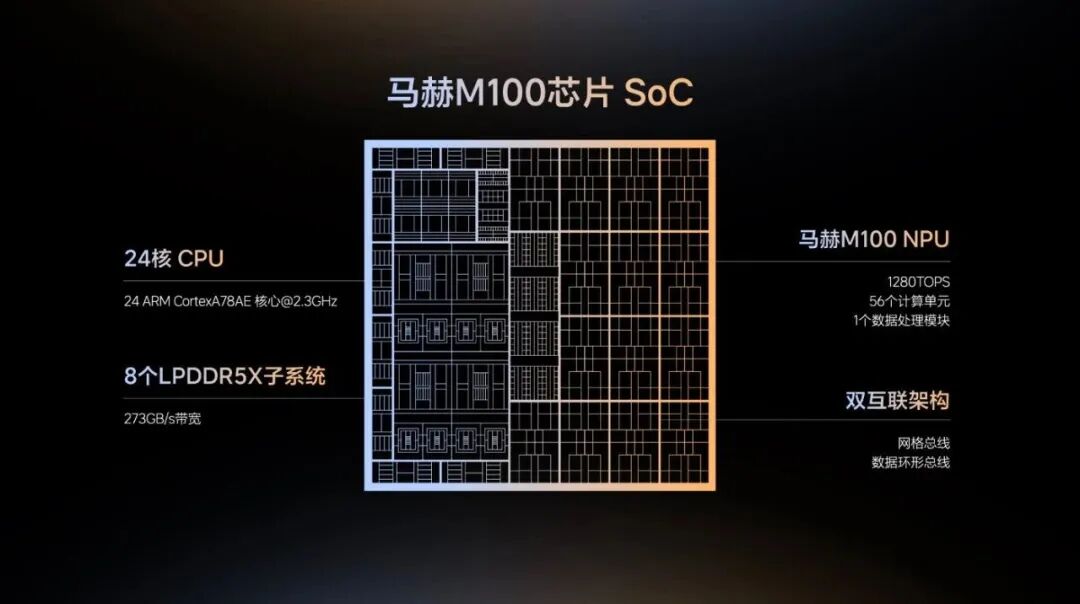
First, the self-developed chip. CTO Xie Yan stated that the Mach M100 is the world’s first dataflow AI chip, which eliminates centralized instruction queues and uses data flow to drive computation. Key specs: 5nm automotive-grade process, 1,280 TOPS per chip, over 82% operational efficiency (far higher than typical GPUs), over 50% of die area dedicated to NPU (56 compute units + data processing modules, dual interconnection via mesh bus + data ring bus), 24-core Arm A78AE@2.3GHz CPU for safety and system control, and 8x LPDDR5X with 273GB/s bandwidth.
Li Auto claims the chip delivers 3x the effective compute power of NVIDIA Thor-U in core models—a substantial lead, not marginal. Deploying the Qwen3.5-35B general large model on M100 achieves 2.7x prefill speed and 1.5x decode speed compared to a ~RMB 40,000 DGX Spark desktop supercomputer. Xie Yan emphasized the chip’s versatility beyond automotive applications.
Second, the self-developed foundation large model: Mach Mind-4 series, comprising Mach Mind-Pro and Mach Mind-Edge. Paired with Mach VLA, they form a "language + action" dual-brain system, creating a complete embodied intelligence compute base. Li Auto’s foundation model lead, Zhan Kun, stated that Mach Mind-Pro ranks top-tier in rigorous benchmarks like IFEval (instruction following), LongBench-v2 (ultra-long text understanding), AIME26 (advanced math reasoning), and BFCL-v4 (tool invocation). In Agent-specific evaluations (Claw series, PinchBench-v2 real-world tests), it outperforms most mainstream Agent models. Mach Mind-Pro now fully powers the L9 Livis’s in-car intelligence.
Mach Mind-Edge, claimed as the industry’s first mass-produced edge-native embodied agent, uses multimodal streaming temporal modeling to continuously interpret the dynamic physical world, enabling causal reasoning and autonomous decision-making. It directly outputs actions, activating vehicle hardware in real-time. Always-On perception, human-vehicle interaction, autonomous control, and multimodal Q&A occur locally onboard without data upload. Crucially, Mach Mind-Edge is not a cloud-model derivative but an edge-native design tailored for low-power scenarios (e.g., glasses, infotainment systems), supporting Livis AI glasses interaction and remote vehicle control.
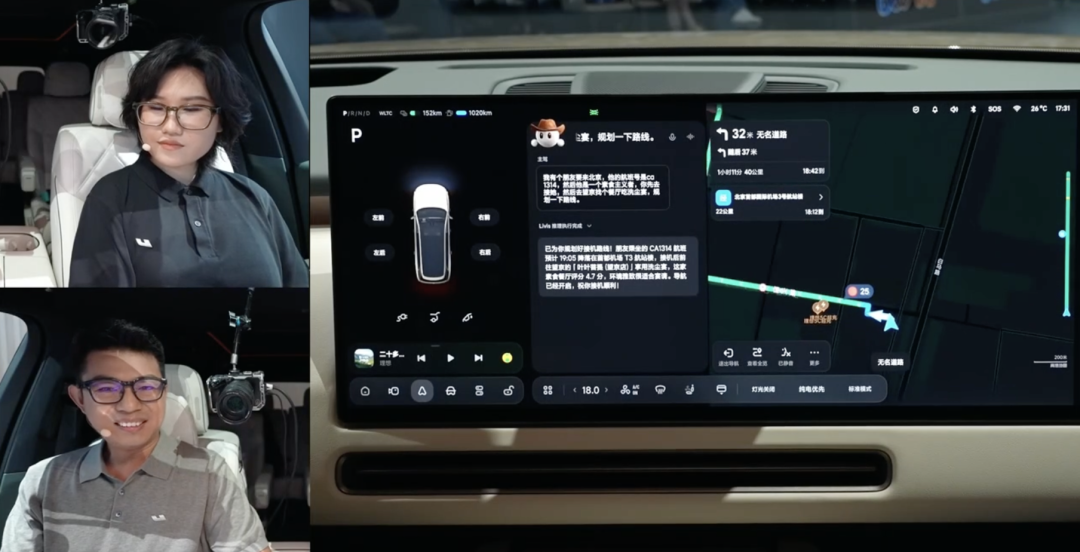
For the intelligent driving large model, Mach VLA 2.1, Li Auto introduced the 3D ViT omnidirectional vision model. This multi-sensor fusion solution (LiDAR + vision) extends forward perception to 300m, expands the visual field by 50%, and enables pixel-level 3D spatial modeling to accurately recognize traffic police gestures, construction equipment, irregular obstacles, and width/height restrictions. Zhan Kun noted that LiDAR improvements alone cannot fully resolve vehicle decision-making.
At the event, a new L9 Livis demonstrated its 3D model-based world perception under 3D ViT, clearly capturing gestures and expressions of onsite personnel. Li Xiang criticized the industry’s focus on LiDAR line counts (128→256→896), arguing that even high line counts fail to interpret traffic light colors, road signs, or security guard gestures. Li Auto’s 3D ViT enables the system to "see and understand," boosting visual range by 50%.
Key capabilities include a 0.28-second reaction latency (approaching human limits), braking 6 meters earlier than humans at 120km/h (critical for collision avoidance), and 10x model parameters/compute volume vs. predecessors. Reinforcement learning scales 15x, imitation learning 50x, closer to human driving logic.
For OTA updates, Zhan Kun said Mach VLA will evolve in H2 2025: Q3 will deploy a new model for AD Max, improving driving efficiency by 30%, enabling automatic navigation through narrow passages, and launching features like travel guides and in-car intercom Agents. Sentinel mode power consumption will drop to 1kWh/2 days. By Q4, Li Auto’s intelligent driving model aims to match Tesla FSD V14.
These technologies are underpinned by Li Auto’s self-developed vehicle OS, Xinghuan OS, which integrates Mach M100, Mind large models, VLA, and full drive-by-wire chassis for complete full-stack autonomy (chip-compiler-OS-algorithm-domain controller). It ensures vehicle safety through local closed-loop operation, independent of external systems.
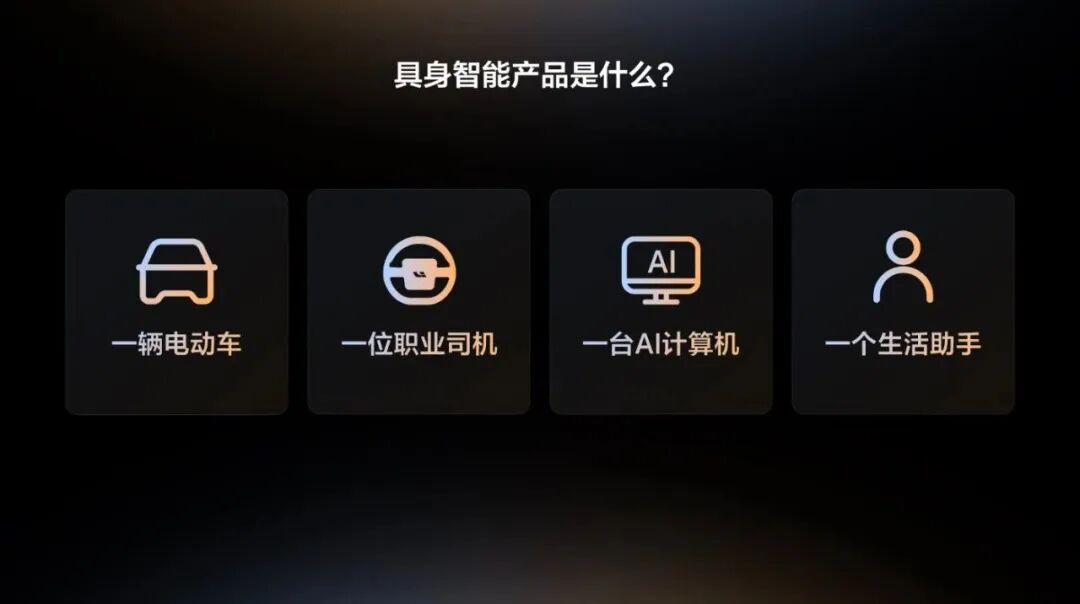
However, these technologies merely lay the groundwork for Li Auto’s vision of embodied intelligence. At the event, Li Xiang argued that traditional smart cars remain "function-driven" and fundamentally differ from embodied intelligent vehicles in safety, capability, and efficiency. He defined embodied intelligent vehicles as "four-in-one": an electric vehicle, a professional driver, an AI computer, and a life assistant. Here, the EV and AI computer form the "embodiment," while the driver and assistant represent "intelligence." Why link embodied intelligence to car-making? Li Xiang believes it enables building vehicles that protect human safety, complete tasks independently, and outperform humans in efficiency. Yet, aligning with FSD V14 by Q4 is an ambitious goal—its realization remains to be seen. If achieved, Li Auto could soar.
Moreover, Li Auto’s event revealed a broader ambition: the industry is shifting from "software-defined vehicles" to "AI-defined vehicles," and Li Auto aims to dominate this paradigm shift. Its moves pressure Horizon Robotics, NVIDIA, and Qualcomm while escalating the chip self-development arms race among automakers. Post-AI transformation, can Li Auto leverage its technological edge to create new growth engines?

-
![]()
Zhou Yuan's Second Half and Zhihu's New Positioning
-
![]()
Behind DeepSeek's Financing Buzz: China's AI Giants Revalued as Strategic Assets
-
![]()
A Flurry of Small and Medium-sized Ride-hailing Platforms Go Public, AutoNavi Emerges as the Biggest Winner
-
![]()
Market Rectification Still Hinges on Xiaomi; 15-Minute Vacuum Pumping Now Mandatory Across the Air Conditioning Industry
-
![]()
The Battle for AI-Powered Payments is Ready to Ignite: Alipay and WeChat Both Draw Their Swords
-
![]()
A 3.2% Profit Margin: The Last Vestige of Dignity in the Auto Industry
-
![]()
Why Is Zhihu Unable to Launch Its Own 'Doubao' Like Zhou Yuan Envisions?
-
![]()
Lin Junyang’s Startup Secures $20 Million in First-Round Financing, with Tencent as Investor