Why Is Zhihu Unable to Launch Its Own 'Doubao' Like Zhou Yuan Envisions?
 06/16 2026
 559
559
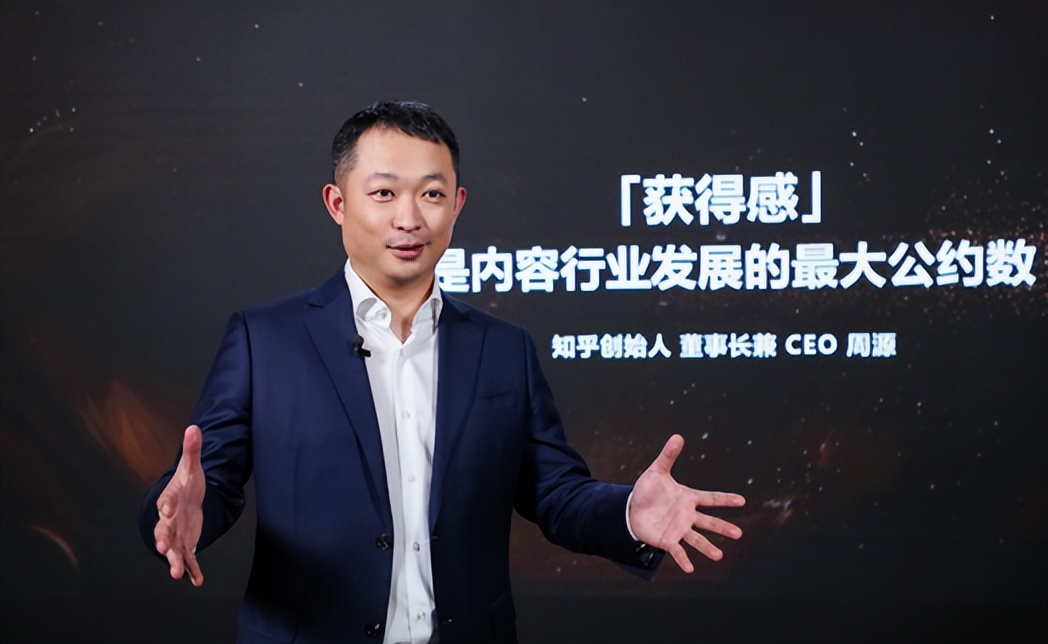
Zhihu is currently riding high.
Founder and CEO Zhou Yuan declared in the earnings report that the first quarter had "got off to a strong start" and that the "community ecosystem is continuously improving."
CFO Wang Han was equally candid, announcing an adjusted net profit of 17.16 million yuan, marking a return to profitability from the previous quarter.
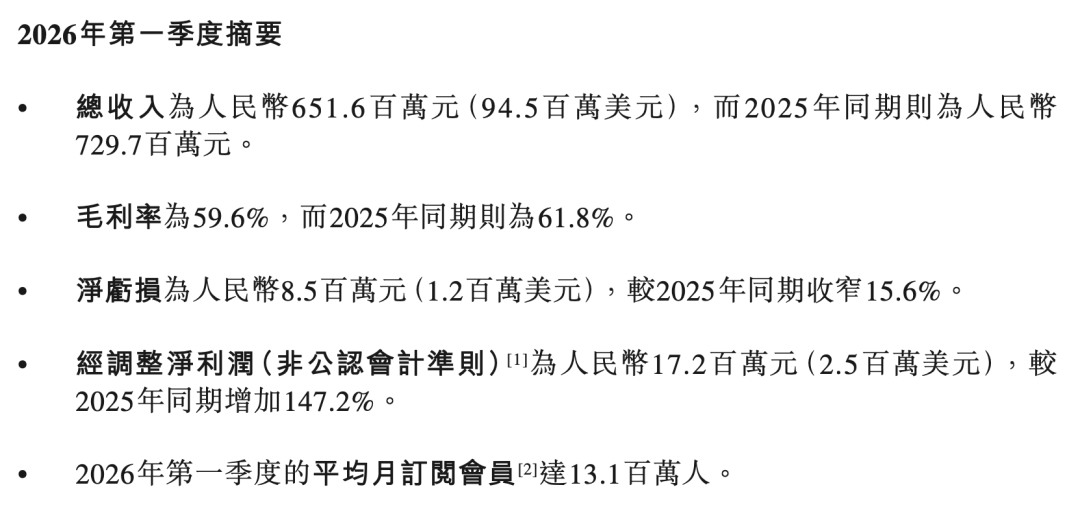
(Source: Zhihu's Q1 2026 Earnings Report)
With cash, time deposits, and short-term investments totaling 4.49 billion yuan, Zhihu's financial health is indeed robust.
However, behind these figures lies a question that warrants attention.
While ByteDance's Doubao has emerged as the first Chinese AI application to exceed 300 million monthly active users, Zhihu still relies on 13.1 million members for 61.7% of its revenue.
One is a nationally recognized AI application, while the other is a niche product with just over 10 million AI search users.
The door to the AI era is wide open. Why is Zhihu, under Zhou Yuan's leadership, unable to create its own 'Doubao'?
01
Let's first explore ByteDance's strategy.
At the 2026 company-wide meeting, CEO Liang Rubo proclaimed that the keyword for the year is "scaling new heights," with an immediate focus on excelling with Doubao and Dola Assistant applications.
This is no mere rhetoric.
ByteDance is discussing a staggering 70 billion USD (approximately 475.9 billion yuan) expenditure in 2026 on data centers and AI infrastructure, directly procuring millions of AI-specific chips from Qualcomm.
The scale of investment is in the "tens of billions."
The result? Doubao has achieved 200 million daily active users and 345 million monthly active users, surpassing the combined MAU of the industry's second and third-ranked players.
Now, let's turn our attention to Zhihu's AI journey.
Zhou Yuan stated in the Q1 earnings report: "We are steadily advancing AI-related commercialization explorations, continuously unlocking the unique value of our authentic community in the AI era."
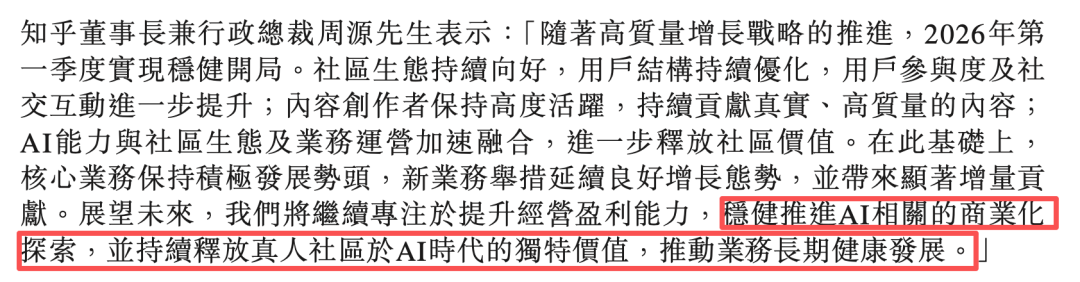
(Source: Zhihu's Q1 2026 Earnings Report)
How much was spent on R&D in the same quarter? A mere 110 million yuan, representing a 22.4% year-on-year decrease.
AI short dramas, comic adaptations, and AI data services are commendable initiatives, but this level of investment barely constitutes direct competition against ByteDance's ecosystem.
Zhou Yuan advocates for an AI development model "anchored in human value."
Yet, the reality is that ByteDance is investing hundreds of billions of dollars in computing power and talent, pushing market competition to unprecedented levels.
02
Zhihu's Zhida also possesses its own strengths.
It boasts a unique advantage: search results directly trace back to the authentic creations of answerers, bridging AI tools with a content pool to ensure every AI response is "source-verifiable and professionally trustworthy."
In an era where many are concerned about AI's propensity to fabricate information, this "human endorsement" holds significant value.

(Zhihu Zhida)
With over 10 million cumulative users, the latest version supports Agentic upgrades, evolving from an AI search tool toward a personal assistant.
However, the scale gap remains vast. For Zhida to become a nationally recognized application, it faces not only product experience issues but also brand recognition and market positioning challenges.
When users seek a human-endorsed, reliable AI application, they may not even be aware that Zhihu Zhida exists as an option.
Zhihu's decade-plus accumulation of data barriers and cultural depth has the potential to amplify in the AI era.
But this amplification cannot rely solely on increasing Zhida's user base; it also lacks a landmark moment to capture nationwide attention.
03
The fundamental difference lies in their DNA.
ByteDance's strategy is "go big or go home," utilizing massive resources to acquire users and replicating the user growth logic of Toutiao and Douyin in the new field of AI applications.
Zhihu's strategy is "decentralized exploration," developing its large model "Zhihai Tu AI," integrating Zhida into the community ecosystem, and attempting to provide professional data services at scale through its data open platform.
Both paths have their merits and drawbacks.
But in terms of user scale, the results are clear.
ByteDance can propel Yuanbao's DAU to 10 million in two months, although user churn can occur just as swiftly.
Yet, Doubao averages 54.8 monthly uses per user with a 33.5% active rate.
These aren't short-term metrics boosted by burning money; users genuinely engage with it.
For Zhou Yuan and Zhihu, this may be the truly vexing question:
It's not about losing to resources but that users don't perceive Zhihu as indispensable in the AI era.
04
But Zhihu isn't without opportunities.
Its greatest strength is the "trust capital" accumulated over a decade. While AI makes information infinitely accessible, it also lowers the cost and raises the value of human curation and professional endorsement.
Here's a point many overlook:
Zhou Yuan can't create Doubao not because he isn't trying hard enough but because he's "trapped" by what he values most.
He cares too much about the "authentic community's" value and insists that knowledge must be validated by human experts to count.
In the AI era, this is nearly idealistic.
ByteDance's logic is brutally simple:
First, acquire users, let the model iterate wildly through hundreds of millions of interactions, and then refine precision after AI strengthens.
Neither philosophy is absolutely right or wrong. But during the user acquisition phase, idealism often loses to pragmatism.
While you spend six months optimizing an expert validation chain, ByteDance has already embedded AI assistants into hundreds of millions of phones.
Once user habits are locked in first, reclaiming them requires exponentially higher costs.
Zhou Yuan talks about "steadily advancing AI commercialization," but the real reason may be that Zhihu simply can't afford ByteDance's "all-or-nothing" approach.
As a company that endured years of revenue decline and only recently returned to profitability through "cost-cutting," Zhihu cannot withstand ByteDance's level of risk.
The 22.4% year-on-year decrease in R&D spending isn't just about saving money; it reflects a strategic retreat.
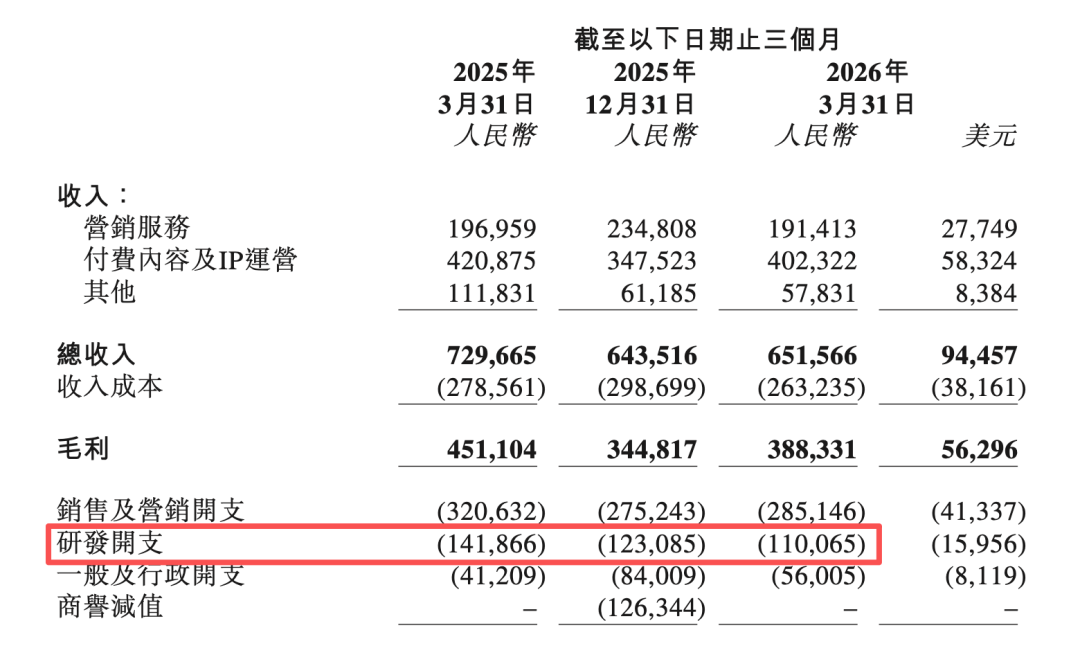
(Source: Zhihu's Q1 2026 Earnings Report)
This is both commercial reality and possibly Zhou Yuan's "secret worry" he least wants to admit publicly.
05
Zhihu founder, chairman, and CEO Zhou Yuan emphasizes an ideal model where "humans produce new knowledge to feed AI, and AI reciprocates to humanity." The core idea isn't wrong.
But to truly realize this ideal, the AI assistant must first reach a sufficient number of people for them to use it.
Otherwise, no matter how much high-quality content the community aggregates or how much expert wisdom it gathers, it remains just untapped resources in a data mine rather than a "product" perceived and habitually used by hundreds of millions.
Zhihu can't replicate Doubao. But the cognitive and search value of "browsing Zhihu" is its strongest asset in the AI era.
If Zhihu can build Zhida into a nationally recognized "traceable and trustworthy" AI search platform, making users believe AI doesn't fabricate answers, it will create a genuine competitive advantage.
This requires firmer strategic resolve and demands the core team make genuine trade-offs against existing path dependencies.
Not all quality content must be promoted through old methods.
If Zhou Yuan wants to stay in the AI competition's second half, perhaps Zhihu should first become the shortest path for users to access trustworthy knowledge.
As for the final outcome of the AI assistant wars, the voting window remains open.
Users are choosing an "AI friend" to accompany them for the next decade.
Zhihu and Doubao may not compete in the same arena, but who knows if Zhou Yuan might carve out a completely different path?
If not the "AI King," at least becoming the "King of Trustworthiness" isn't a bad position.
-
![]()
Proposed to Raise 955 Million Yuan through Private Placement! Huicheng Vacuum Boosts Localization of Ultra-Precision Optical Coating Equipment
-
![]()
Cash Flow Soars 13-Fold! What Major Strategic Move is Wuhan Five Square Optoelectronics Planning?
-
![]()
Leaked Design of vivo X500: Reverts to Circular Camera Module in Top-Left Corner, Pays Homage to Classic X90 Aesthetic
-
![]()
DeepSeek Shows Signs of Foraying into Code Agents, Launches WeChat Official Account Focused on Harness
-
![]()
Auto Companies Deny Claims That ‘Cooperation with Huawei Is Non-Essential’, as Huawei Transforms into a ‘Public Platform’
-
![]()
Starship to Independently 'Return to the Launch Tower': SpaceX's Ambitions Extend Beyond Rocket Building to Dominating Space Transportation
-
![]()
Starship Set to Independently 'Return to the Launch Tower': SpaceX is Revolutionizing Space Transportation, Not Just Building Rockets
-
![]()
Anthropic and OpenAI Face Off Against Deepseek