Qianli Technology Aims for Autonomy from Geely's Sphere: Why Does BAIC Initiate the Alliance First?
 06/24 2026
 477
477
A recent announcement has drawn significant attention across the automotive sector—Geely Holding's Qianli Technology is set to forge a joint venture with BAIC Group, with expectations of realization within the current year. Both parties have inked a framework memorandum, outlining plans for three series encompassing five models. Behind this strategic 'union' lie Qianli Technology's aspirations to shed its 'Geely-affiliated' image and BAIC's pursuit of a diversified intelligent vehicle strategy. This collaboration also epitomizes the shift of China's intelligent driving suppliers from 'dependence' to 'independence'.
From Lifan to Qianli: The Transition from 'Geelification' Reliance to Burden
Qianli Technology, formerly known as Lifan Shares, underwent bankruptcy restructuring in 2020, with Geely Group and Chongqing State-Owned Assets taking the helm. By 2024, Yin Qi, the founder of Megvii Technology, had acquired a stake and assumed the chairmanship, rebranding the company as 'Qianli Technology' and embarking on an 'AI + Vehicle' transformation journey. By 2025, the company had achieved nearly 10 billion yuan in revenue, turning a profit with cumulative intelligent driving system installations in 460,000 vehicles.
However, beneath this success story lie underlying concerns: net profit excluding non-recurring items has been negative for three consecutive years. In 2025, although the profit reached 84.4 million yuan, it heavily relied on 399 million yuan in government subsidies. The technology business (intelligent driving solutions) contributed only 350 million yuan in revenue, accounting for a mere 3.5% of total revenue. More critically, the company has dual dependencies on the Geely ecosystem. In 2025, 29.26% of Qianli Technology's revenue came from Geely, while 30.8% of its procurement also originated from Geely. Approximately 70% of intelligent driving installations were from Geely-affiliated brands like Zeekr and Lynk & Co.
'Qianli Technology's core strength lies in its reliance on the Geely ecosystem, providing a solid foundation for technological mass production. However, its single-client structure and lack of external expansion capabilities are significant drawbacks,' noted an industry analyst. Geely integrated its internal intelligent driving team into Qianli with the goal of building a 'second Huawei.' However, this deep integration has become a natural barrier for Qianli to expand its client base beyond Geely. Unlike Huawei, which has committed not to build cars, no automaker is willing to entrust its core intelligent capabilities to a company within the Geely ecosystem, which is also a competitor.
To address this, Qianli Technology is rushing to list on the Hong Kong Stock Exchange for an 'A+H' dual listing while planning to 'de-Geelify.' The joint venture with BAIC is a pivotal strategic move in this regard.

BAIC's 'Multi-Pronged Layout': Beyond Xiangjie
BAIC Group, a seasoned state-owned automaker, has been quietly advancing in the new energy vehicle (NEV) sector for years. In 2025, BAIC's NEV sales reached 209,600 units, up 84% year-on-year, but still lagged significantly behind competitors like BYD, Geely, and Changan. More critically, BAIC BluePark has long suffered losses and lacks brand premium, posing a core challenge for BAIC in the NEV race.
BAIC's collaboration with Huawei to create Xiangjie, one of the 'Five Realms' under Harmony Intelligent Mobility, marked a significant step in BAIC's NEV breakthrough. The Xiangjie S9 and S9T models have cumulatively delivered over 60,000 units, topping the sales charts for NEV sedans priced above 300,000 yuan for seven consecutive months.
In September 2025, BAIC's cooperation with Huawei officially upgraded to a 'Automaker + Huawei Tech Full Ecosystem' strategic community. The two sides plan to invest 20 billion yuan over three years to advance technological iterations in design, intelligent assisted driving, intelligent cockpit, and quality safety. This 'strategic community' model creates a cross-entity joint operational unit, achieving end-to-end collaboration from product design to terminal services.
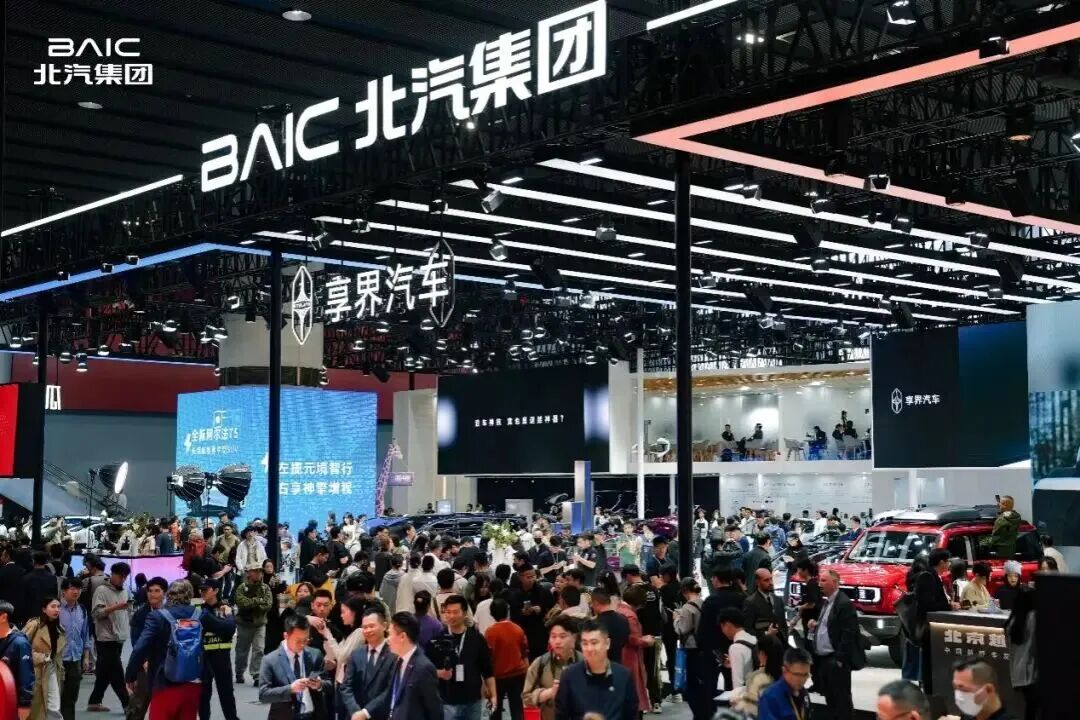
However, the Huawei model is not a panacea. While the Xiangjie brand has shown strong growth, its contribution to BAIC's overall NEV sales remains limited. The sales contribution from a single cooperation model is constrained within the group's overall portfolio, a reality BAIC Group must confront during its critical period of intelligent transformation.
Against this backdrop, BAIC's collaboration with Qianli Technology holds unique strategic significance. It is not a replacement for the Huawei model but a complement to it.
Unlike Huawei Xiangjie's 'strategic community' model, BAIC's cooperation with Qianli Technology adopts an intermediate route of 'technology empowerment + brand co-creation.' In terms of division of labor, BAIC leads vehicle product planning, styling design, and the three-electric systems (battery, motor, electronic control), while Qianli Technology focuses on intelligent core technologies, delivering AI cockpits, advanced intelligent driving, and other requirements.
This model shares similarities with Huawei's Harmony Intelligent Mobility Smart Selection car mode, where tech companies output intelligent capabilities and automakers handle vehicle manufacturing. However, there are clear distinctions. Huawei deeply intervenes in product definition, industrial design, user experience, and even sales channels across the entire chain. In contrast, Qianli Technology takes a step back, maintaining a technology supplier's boundary. Some analysts argue that BAIC's move essentially lays out a parallel intelligent pathway outside the Huawei model.
BAIC is no stranger to Chongqing. In 2010, BAIC and Chongqing Yinxiang established a joint venture, BAIC Yinxiang, to create a Southwest base and launch the sub-brand 'BAIC Senova.' However, it ultimately declined due to poor management. This episode reflects the limitations of traditional joint venture models. When cooperation remains at the level of 'capacity output' rather than 'technology empowerment,' it is difficult to sustain. Now, BAIC is once again eyeing Chongqing, but this time, its partner has shifted from a traditional manufacturing entity to an AI tech company, and the focus has moved from capacity expansion to intelligent technology co-construction—an evolution in itself.
The 'Youxin' Model: Replicating Huawei Yinwang or Forging a New Path?
Ahead of the Beijing Auto Show in April, Qianli Technology announced a joint launch with BAIC of the new brand 'Youxin' (PALLADE), priced between 200,000-400,000 yuan, with plans for three series and five models.
The 'key figure' in this collaboration is Wang Jun, the co-president who joined Qianli Technology in June last year. As the inaugural president of Huawei's Automotive BU, Wang Jun drove the implementation of the Huawei Inside model six years ago, with BAIC's Arcfox being the first partner under this model. Now, the partner remains BAIC, and the model's core is similar, except the technology supplier has shifted from Huawei to Qianli Technology.
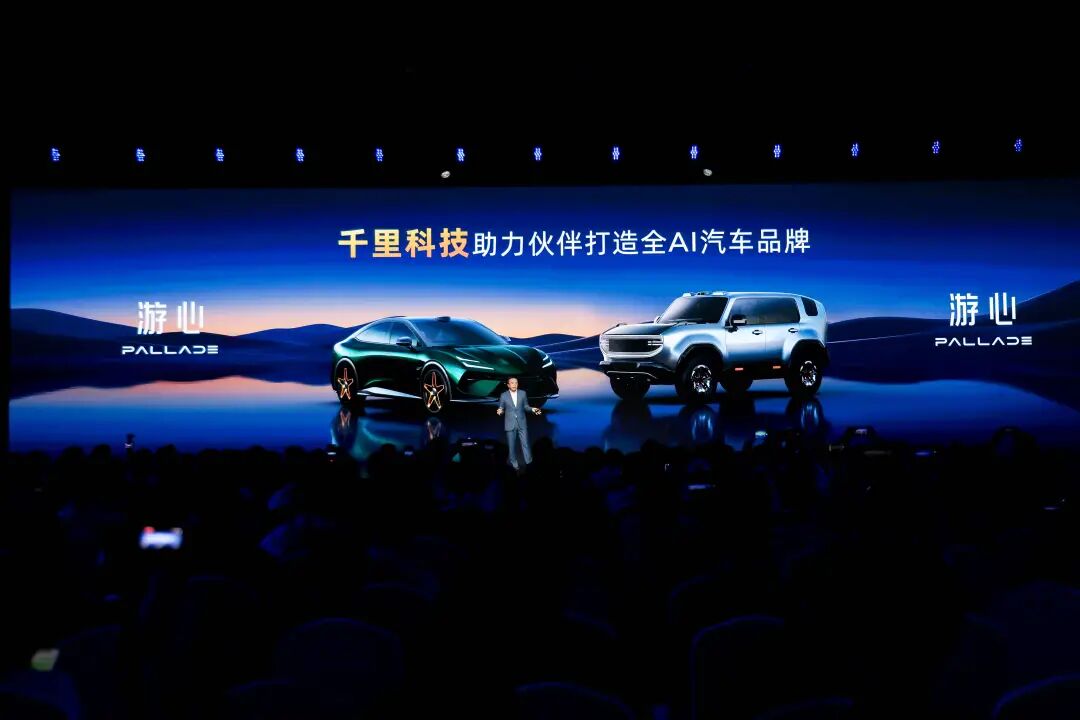
Zhao Ming, co-chairman of Qianli Technology, explicitly stated that the Youxin brand is not Qianli Technology's proprietary brand. Qianli Technology 'adheres to its rightful boundaries' and remains a Tier 2/Tier 1 supplier.
This model deeply aligns with Huawei Yinwang: Huawei spun off its Automotive BU into Yinwang Company, achieving neutral operation of technology and data through equity openness and collaboration with automakers. Qianli Intelligent Driving is likely to replicate this logic, establishing joint ventures with more automakers in the future.
BAIC's simultaneous partnerships with Huawei and Qianli Technology form a 'dual-track' intelligent layout, rare among Chinese automakers. One track is deep integration with Huawei, with the Xiangjie brand firmly established in the luxury market above 300,000 yuan. The other track is a 'light asset' cooperation with Qianli Technology, with the Youxin brand targeting the mid-to-high-end market of 200,000-400,000 yuan. Youxin will also become BAIC's fourth independent brand, with BAIC assembling a new management team for the joint venture and brand.
The two tracks overlap in price bands but complement each other in mode: the Huawei track pursues the depth of 'full ecosystem integration,' while the Qianli track pursues the flexibility of 'technology empowerment.' This dual-track layout reflects both a strategic consideration to hedge against single-supplier risks and BAIC's pragmatic choice to 'walk on multiple legs' during its critical period of intelligent transformation.
Bidirectional Impact: Each Seeking a More 'Autonomous' Game-Changer
This collaboration has profound implications for both sides.
For Qianli Technology, it marks a milestone in 'de-Geelifying.' If the Youxin brand successfully launches, it will have its first large-scale mass production case outside the Geely ecosystem, significantly aiding its expansion to third-party clients and persuading capital markets. However, risks are prominent, as the 200,000-400,000 yuan segment is fiercely competitive, making it extremely difficult for a new brand to break through.
For BAIC, Youxin represents another chess piece in its intelligent transformation following Xiangjie. But with Huawei's cooperation already opening up the high-end market for BAIC, why seek another 'technology partner'?
An industry analyst pointed out, 'BAIC is essentially making multiple preparations. While Huawei's Smart Selection car mode is successful, the discourse power rests more with Huawei. By cooperating with Qianli Technology, BAIC leads vehicle and three-electric systems, while Qianli only handles intelligent modules, giving BAIC stronger control.' This 'dual-track strategy' of 'deep integration with one hand while maintaining autonomy with the other' allows BAIC to share Huawei's technological dividends while preserving its strategic initiative—a pragmatic balancing act.
At the industry level, Qianli Technology's story reflects a universal proposition for intelligent driving suppliers: transitioning from dependence on a single automaker to seeking independence, moving from Tier 2 to Tier 1, and shifting from 'selling solutions' to 'co-building brands.' BAIC's 'dual-track' strategy, meanwhile, provides a noteworthy model for traditional automakers' intelligent transformation—not putting all eggs in one basket and seeking balance between deep cooperation and autonomous control.
The first step of a thousand-mile journey is to shed labels and prove independence. However, true independence should not be about urgently finding a new 'sponsor' but forging core technologies that the entire industry cannot refuse. This is the essence of Qianli Technology's 'independence.'
As of press time, Qianli Technology remains 'no comment' on the joint venture news. However, sources indicate that the joint venture is entering its final countdown. Qianli Technology is stepping out of Geely's comfort zone. This transformation from 'Lifan' to 'Qianli,' from 'Geely-exclusive' to 'industry-shared,' is destined to be anything but smooth sailing.
-
![]()
Total Investment Hits Nearly 3.28 Billion! Goertek Launches Mass Production of 12-Inch Transparent Substrate Wafer for AR Glasses’ Micro-Nano Optical Components
-
![]()
Why Is This Precision Optical Film Leader Worth Reevaluating with a Tens of Millions Procurement?
-
![]()
AI Costs Plummet by 90% Over Nine Years: Key Insights from Davos You Shouldn’t Miss
-
Doubao, Your Late-Night AI Companion, Now Eyes Profitability
-
![]()
SRC Empowers SEER Intelligence to Reach a Market Cap of Tens of Billions, Yet Fails to Sustain Profitability
-
![]()
China’s Embodied AI Industry Faces Fierce Domestic Competition, Making Overseas Expansion Essential for Survival
-
![]()
32.8 Billion Yuan Investment! Goertek’s 12-Inch AR Glasses Optical Wafer Base in Lingang Begins Operations
-
![]()
How Far is the All-New Li Auto L8 from Being the Best Five-Seat SUV with In-House Full-Stack Development?