Mercedes-Benz Withholds Year-End Bonuses for 90,000 Staff: Germany's Industry 4.0 Aspirations in Tatters
 06/30 2026
 471
471
It has been reported that Mercedes-Benz will not distribute the annual additional bonuses, previously scheduled for July, to around 90,000 employees in Germany.
This bonus, dubbed the 'transformation bonus,' equates to roughly 18.4% of a monthly salary.
It is estimated that this cost-cutting measure could save the company over ten million euros. Moreover, management is considering extending working hours without compensatory pay. Presently, Mercedes-Benz employees in Germany work a 35-hour week.
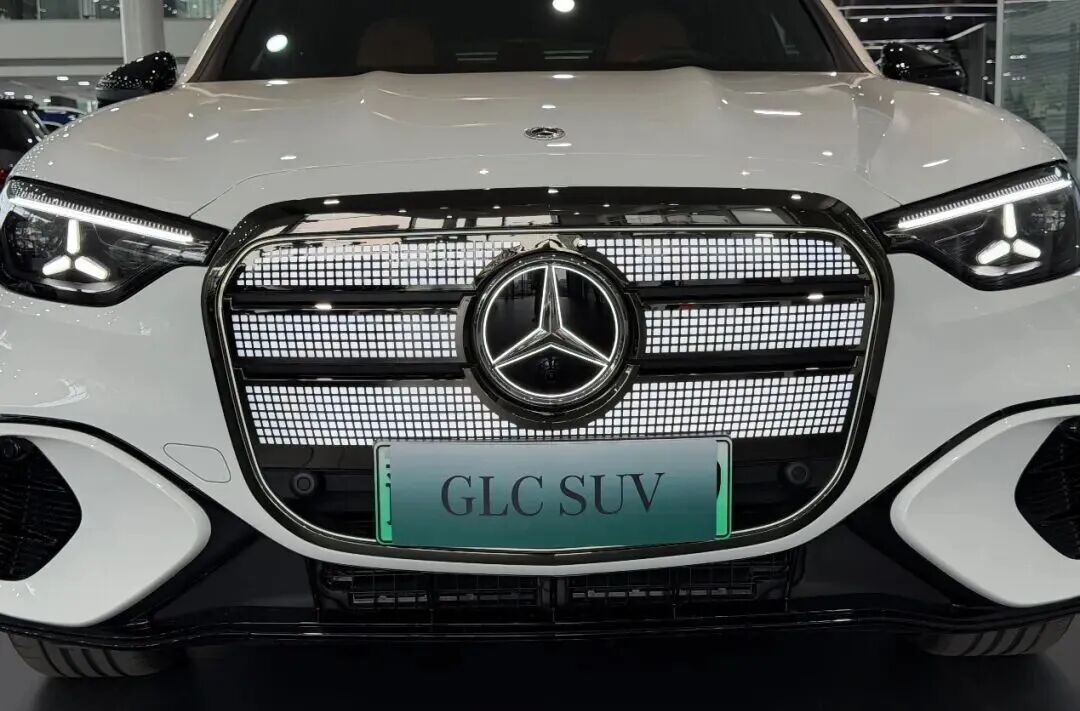
This venerable luxury car empire, credited with inventing the world's first automobile and boasting annual revenues exceeding 130 billion euros with a global workforce of over 170,000, is now resorting to withholding bonuses from 90,000 German workers to 'cut costs.'
Nonetheless, the income and working conditions of Mercedes-Benz employees still significantly outstrip those of their counterparts at Chinese automakers.
However, Xingkong Jun wishes to highlight a broader trend: the rise of the East and the decline of the West is an undeniable trajectory.
Simultaneously, Volkswagen has announced layoffs affecting 100,000 employees and the closure of four German factories, marking the largest-scale layoff in Volkswagen Group's history.
Volkswagen Group employs 700,000 people globally, with 70,000 in China and 300,000 in its home country. Its headquarters are in Wolfsburg, where it employs 60,000 people.
Notably, Wolfsburg is a small town with a population of just 120,000.
This implies that over half of the town's residents are Volkswagen employees, with the remaining half likely having some connection to them.
Xingkong Jun has long believed that this is the epitome of China's industrialization.
A county or township transforms into an industrial hub.
If China had a hundred BYDs and a hundred CATLs, this vision might become a reality.
If not, then adding a hundred Huaweis and a hundred Xiaomis would suffice.
According to Ningde Broadcasting and Television Station, at the CATL new energy battery base project construction site (Jinchui Phase I), workers are engaged in site leveling and earthwork excavation for supporting roads within the factory area, advancing construction in line with milestone targets.
The project spans approximately 900 acres and is located in Badu Town, Jiaocheng District. It involves constructing around 370,000 square meters of standard factories for intelligent new energy battery manufacturing and supporting facilities, with a total investment of about 2 billion euros. The factory land is slated for delivery by the end of April 2026.
Badu Town has a registered population of 24,000. This project alone, in its initial phase, is expected to create around 3,000 jobs. According to the plan, the subsequent second and third phases are anticipated to generate over 10,000 jobs.
This means that in the future, Badu Town will resemble Wolfsburg—a small town where about half of the population are employees of the same global giant.
The 2025 annual report reveals that CATL hired 40,000 junior college graduates in 2025, mostly in similar counties and townships.
If you could earn a monthly salary of 6,000 euros locally, would you still vie for a 10,000-euro job in Beijing, Shanghai, or Guangzhou?
Returning to Mercedes-Benz.
1. The Root Cause of Mercedes-Benz's Woes: Declining Performance
On April 29, 2026, Mercedes-Benz released its first-quarter 2026 financial report. Revenue was 31.602 billion euros, a year-on-year decrease of 4.9%. Net profit was 1.433 billion euros, a year-on-year decrease of 17.2%. Earnings before interest and taxes (EBIT) were 1.9 billion euros, a year-on-year decrease of 17%. The EBIT for the automotive business segment was 809 million euros, a year-on-year plunge of 54%. The adjusted profit margin for the automotive business was only 4.1%, compared to 7.3% in the same period last year.
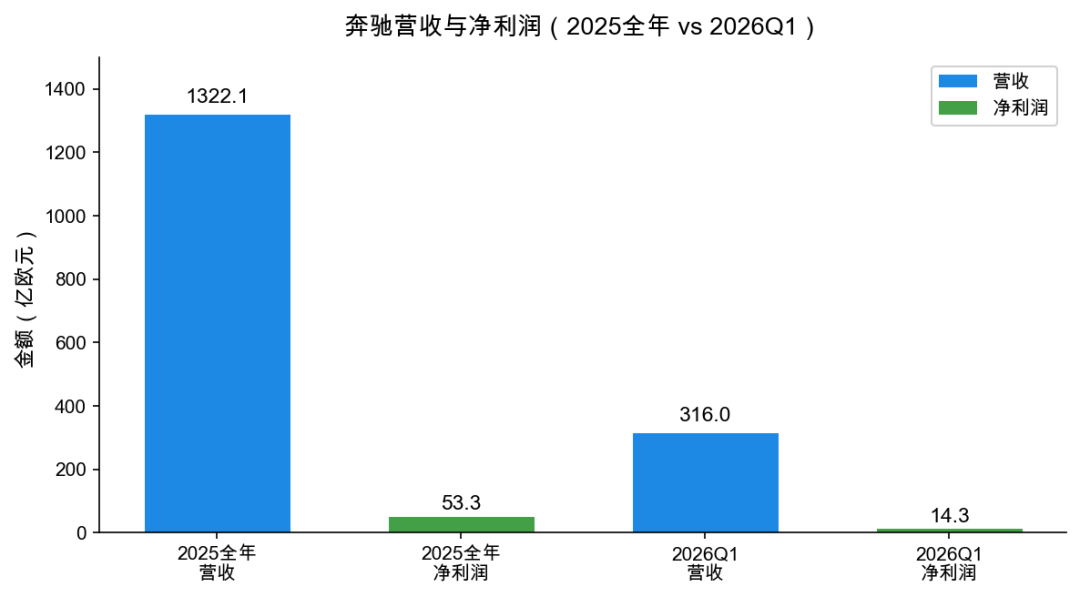
A profit margin of 4.1% barely meets the lower limit of Mercedes-Benz's full-year forecast range of 3% to 5%. Management described it as 'in line with expectations.' However, a longer-term view reveals a steeper decline curve.
In 2025, Mercedes-Benz's revenue was 132.214 billion euros, a year-on-year decrease of 9.2%. Net profit was 5.331 billion euros, a year-on-year decrease of 48.8%, nearly halved. Fourth-quarter revenue was 33.69 billion euros, a year-on-year decrease of 12.4%. Net profit was 1.453 billion euros, a year-on-year decrease of 44.2%. Revenue from the passenger car business was 96.407 billion euros, a year-on-year decrease of 10.5%. EBIT was 3.564 billion euros, a year-on-year plunge of 57.9%.
Within a year, Mercedes-Benz's profit plummeted from 10.4 billion euros to 5.3 billion euros, and then to an annualized rate of less than 6 billion euros in the first quarter of 2026.
This is not a quarterly fluctuation; it is a continuously accelerating downward trend.
2. Chinese Brands Mount a Major Offensive Against BBA
Xingkong Jun has a friend who works at a central enterprise and leads a research and development team in Hainan for a second venture (a recent trend among central enterprises). He was planning to buy a new car and had been considering BBA executive models.
However, when BYD's Tang model was released, he immediately paid a deposit without hesitation.
Domestic cars understand the pain points of these affluent individuals all too well.
While mid-to-high-end domestic cars are selling well, the market for BBA is shrinking.
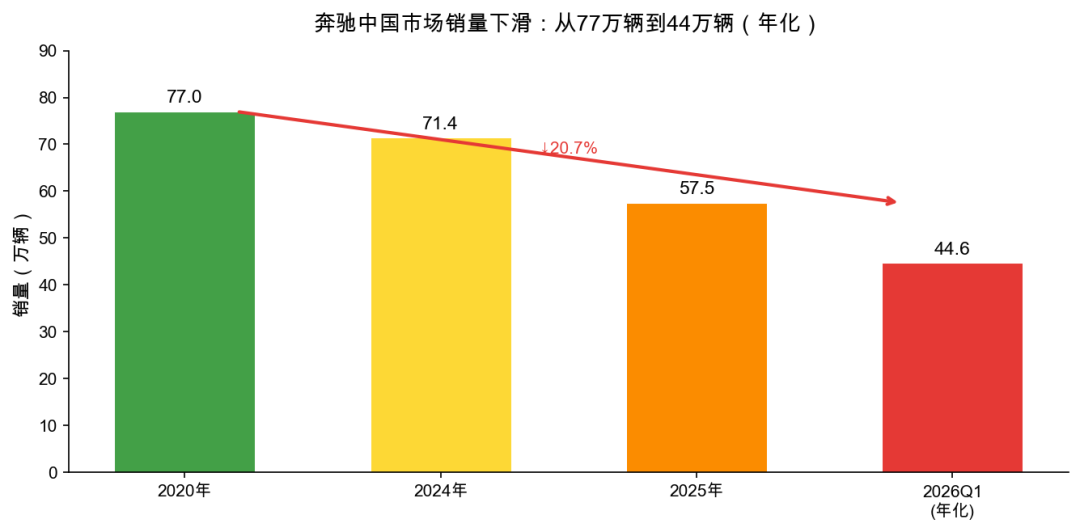
In the first quarter of 2026, Mercedes-Benz's global total sales were 499,700 vehicles, a year-on-year decrease of 6%. Among them, Mercedes-Benz brand passenger cars sold 419,400 vehicles, a year-on-year decrease of 6%.
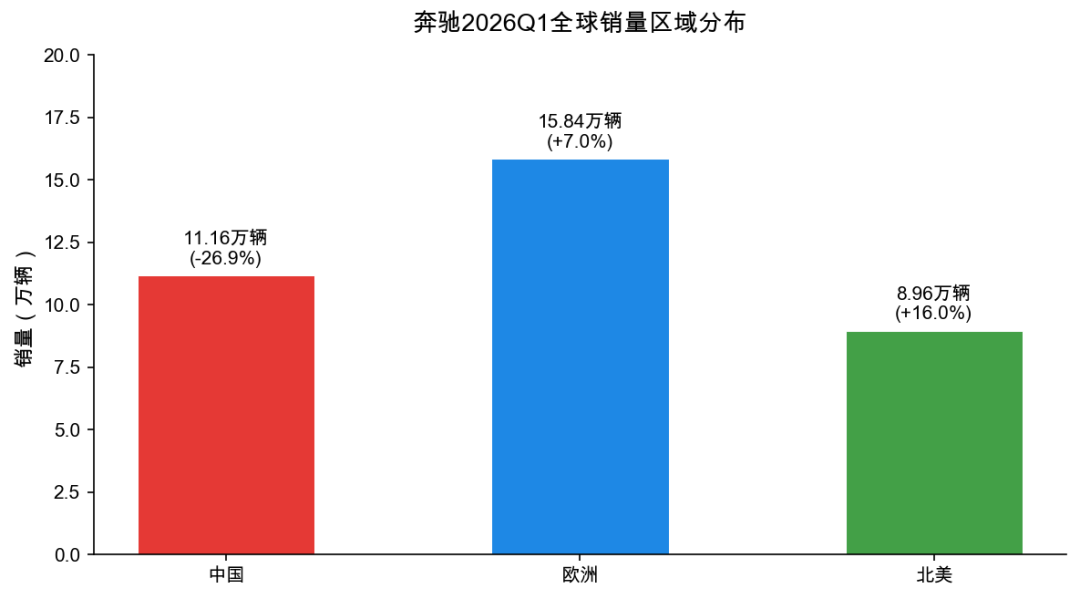
The most striking figure is that Mercedes-Benz sold approximately 30,000 fewer vehicles. And more than 80% of these 30,000 vehicles came from the same market.
Sales in China were 111,600 vehicles, a year-on-year plunge of 26.9%. Sales in Europe were 158,400 vehicles, a year-on-year increase of 7%. Sales in North America were 89,600 vehicles, a year-on-year increase of 16%. Sales in Asia (excluding China) are shrinking, but Europe and North America are growing.
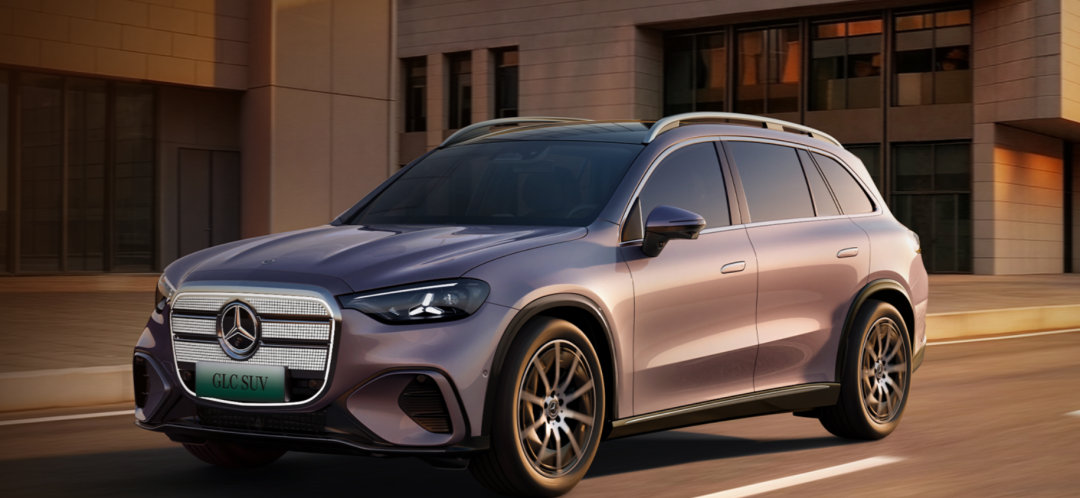
If you look only at specific regions, Mercedes-Benz's performance is not bad. Pure electric vehicle sales in Europe increased by 34%, in Germany by 36%, and in the U.S. by 20%. But the hemorrhage in the Chinese market is too rapid, so rapid that the growth in all other markets combined is insufficient to compensate for it.
From a product tier perspective, entry-level models (A-Class, B-Class, CLA, etc.) sold 109,800 vehicles, a year-on-year decrease of 6.7%, the largest decline. Core models (C-Class, E-Class, GLC, etc.) sold 248,000 vehicles, a year-on-year decrease of 5.8%. High-end models (S-Class, GLS, Maybach, AMG, etc.) sold 61,500 vehicles, a year-on-year decrease of 5.5%. Interestingly, although high-end models are also declining, the decline is the smallest. Mercedes-Benz still maintains a leading position in the market for models priced over 1 million euros. In an era of worsening wealth inequality, the wealthiest individuals are still buying Mercedes-Benz. But the middle class is switching to Chinese brands.
Moreover, with the entry of Zunjie, even models priced over 1 million euros are becoming unstable.
3. BAIC and Geely: From Saviors to Disruptors
Mercedes-Benz's shareholding structure is perhaps the most unique among all German automakers. The largest shareholder is BAIC Group, 100% controlled by the Beijing Municipal State-owned Assets Supervision and Administration Commission, holding 9.98%.
The second-largest shareholder is Li Shufu, the founder of Geely, who holds 9.69% through Tenaciou3 Prospect Investment.
The two Chinese shareholders hold a combined 19.67%, close to 20%. The institutional investors ranked behind them, including BlackRock and Vanguard, have single-shareholding ratios far lower than these two.
Since BAIC and Geely do not interfere in Mercedes-Benz's operations, this shareholding structure has had little impact. However, in 2026, the situation fundamentally changed.
The U.S. House of Representatives is pushing forward legislation titled the 'Connected Vehicle Security Act of 2026.' It stipulates that if an automaker is directly or indirectly controlled by a 'foreign adversarial country,' it will be prohibited from manufacturing, selling, or importing vehicles in the United States.
The definition of 'control' is that investors from specific countries collectively hold more than 15% of the shares. Mercedes-Benz's Chinese shareholding is 19.67%, far exceeding the 15% threshold. Once the bill passes, Mercedes-Benz will face extremely stringent compliance challenges. It must prove to the U.S. Department of Commerce that its in-vehicle technology is completely decoupled from the rights of its Chinese shareholders. Otherwise, it will face not only a sales ban but also a minimum civil penalty of 1.5 million euros per non-compliant vehicle.
Mercedes-Benz has factories in Tuscaloosa, Alabama (commissioned in 1995, with an annual production capacity of about 300,000 vehicles) and South Carolina in the United States.
Among them, the Tuscaloosa factory is Mercedes-Benz's first large-scale factory outside Germany, with two-thirds of its annual production destined for export.
In March 2026, Mercedes-Benz announced an investment of 4 billion euros in the Alabama factory by 2030 to expand SUV production capacity. If the U.S. market is banned, this 4 billion euro investment will be cast in a huge shadow.
Xingkong Jun believes that Mercedes-Benz is not without a way out.
Volkswagen has set an example for Mercedes-Benz: It acquired JAC Group and transformed into a Chinese enterprise, turning Hefei into a second Wolfsburg.
-END-
Disclaimer: This article is based on the public company attributes of listed companies and relies primarily on information disclosed by listed companies in accordance with their legal obligations (including but not limited to interim announcements, periodic reports, and official interaction platforms) as the core basis for analysis and research. Shiyu Xingkong strives to ensure the fairness of the content and views presented in the article but does not guarantee its accuracy, completeness, or timeliness. The information or opinions expressed in this article do not constitute any investment advice, and Shiyu Xingkong is not responsible for any actions taken based on this article. Copyright Notice: The content of this article is original to Shiyu Xingkong and may not be reproduced without authorization.
-
![]()
5G Standalone Private Network Policy Breaks the Ice, Creating an Exclusive 'Nervous System' for Physical AI in Industrial Scenarios
-
![]()
Two Investments Totaling 700 Million Yuan! Sunny Optical Sets Its Sights Beyond Lens Supply, Launching a Strategic Move in the XR Optics Arena
-
![]()
Xianyu Initiates Internal Testing of 'Yu Maimai' and 'Yu Maimai': Can AI Revolutionize Secondhand Transactions?
-
![]()
The Dullest 618 in History, with AI Being the Busiest
-
![]()
Shenzhen’s Most Mysterious Robot Startup Secures 1 Billion Yuan in Funding, Targeting a 150 Billion Yuan Market
-
![]()
Why Are Celebrities So Keen on Diving into the AI Realm?
-
Can WeChat AI Sidestep the Quandary Faced by Doubao Phone?
-
![]()
Luxury Lineup, Highly Anticipated! The Pioneer of Physical AI Gears Up for Hong Kong Stock Exchange Debut!