New Energy Vehicle Owners: How Much More Will You Pay in Vehicle and Vessel Tax?
 07/13 2026
 562
562
This marks the 87th original article from the Thinking AI Society.
Comprising approximately 1,580 characters, the estimated reading time is 5 minutes.
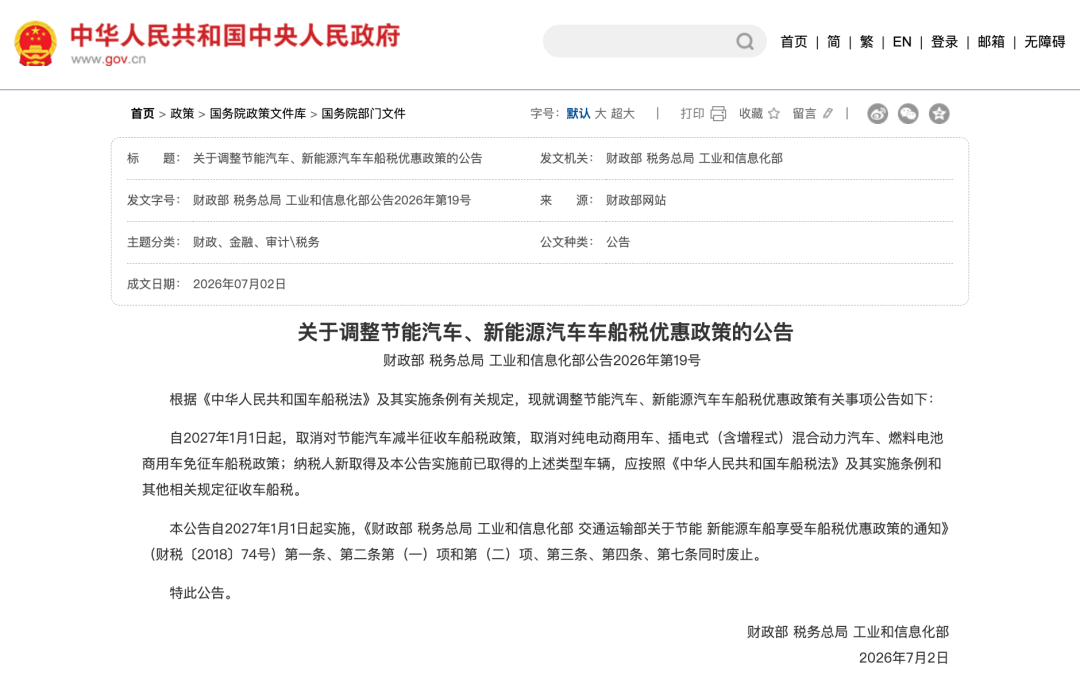
On July 2nd, the Ministry of Finance, the State Taxation Administration, and the Ministry of Industry and Information Technology jointly announced that, starting from January 1st, 2027, tax incentives for vehicle and vessel tax, including the 50% reduction for fuel-efficient vehicles and exemptions for new energy commercial vehicles, will be completely abolished.
As soon as this news surfaced, many individuals began to worry: Will purchasing a new energy vehicle become more expensive? Is there a shift in policy direction?
Take it easy. Let's delve into the details comprehensively.
Why the Abolition?
Firstly, it's crucial to clarify a fundamental point: Vehicle and vessel tax is not a new levy; it has always been a property tax that vehicle owners are required to pay annually. The preferential policies were introduced in 2012 to bolster the new energy vehicle industry by exempting or halving the tax.
The rationale behind the current abolition can be succinctly summarized: The 'child' has matured and no longer requires constant support.
Data speaks volumes. By 2025, China's new energy vehicle sales soared to 16.49 million units, accounting for over 50% of domestic new vehicle sales.
What does this signify? It means that one out of every two new vehicles on the road is a green-plated new energy vehicle.
Furthermore, the average price of plug-in hybrid and extended-range models has surged to 218,000 yuan, with some models fetching over a million yuan.
Let's be candid: For individuals who can afford vehicles costing between 200,000 and over a million yuan, saving a few hundred yuan annually on vehicle and vessel tax is hardly a decisive factor.
The official Q&A bluntly stated: "To promote tax fairness and enhance the role of taxation in regulating income distribution."
In simpler terms, new energy vehicles are no longer a niche market. Like fuel vehicles, they are now high-value assets that should contribute their fair share of taxes.
There's also an implicit message understood within the industry: The rollback of preferential policies aims to encourage companies to compete based on product strength.
With policy support, automakers could sell vehicles with minimal effort. Now that the support is withdrawn, consumers will make choices based on technology, cost control, and product competitiveness.
This isn't suppression; it's a weaning process. For an industry to truly flourish, it cannot indefinitely rely on policy crutches.
Fourteen Years of Incentives: A History of New Energy Vehicle Resurgence
You may not realize this, but the vehicle and vessel tax incentives for new energy vehicles have been in place for 14 years.
In 2012, when the policy was first introduced, what was the state of new energy vehicles? Annual sales were a mere 12,800 units, and green-plated vehicles were scarcely seen on the roads.
To encourage purchases, the state announced: Half-off vehicle and vessel tax for fuel-efficient vehicles, full exemption for new energy vehicles.
In 2018, the policy was updated (the now-repealed Finance and Taxation Document [2018] No. 74), clarifying the scope and standards of incentives—but the core logic remained unchanged: Encouragement.
From 2012 to 2026, spanning 14 years, new energy vehicle sales skyrocketed from 12,800 to 16.49 million units, a staggering 1,200-fold increase. This is a classic success story in industrial policy history.
However, precisely because of this success, the historical mission of the preferential policies has largely been accomplished.
Consider this: If an industry still relies on tax incentives to survive after 14 years of development and over 50% market penetration, the industry itself has underlying issues.
Conversely, the policy rollback reflects official confidence in the industry—it can thrive without incentives.
This isn't the first policy to be rolled back, nor will it be the last. Purchase tax exemptions have already undergone several rounds of reductions, and now vehicle and vessel tax follows suit. Next? A complete phase-out of subsidies is the general trend, as the industry must ultimately rely on market competition.
For automakers, the golden era may be over. But for consumers, a better era might just be beginning—because a fully competitive market always benefits buyers.
How Will This Affect Ordinary Car Buyers?
After all this, what most people are concerned about is: How much more will I have to pay?
The short answer: For most people, almost no impact.
Why? Because this affects four types of vehicles: fuel-efficient vehicles (a subset of fuel vehicles), pure electric commercial vehicles, plug-in hybrid/extended-range vehicles, and fuel cell commercial vehicles.
Pure electric passenger vehicles and fuel cell passenger vehicles are not subject to vehicle and vessel tax at all—they never were, and this policy doesn't change that.
Yes, you read that correctly. Pure electric family cars were exempt from vehicle and vessel tax before and will remain exempt.
Why? Because the Vehicle and Vessel Tax Law never included them—this is a legal exemption, not a policy incentive, so it's outside the scope of this adjustment.
So, who will be affected?
The most direct impact is on buyers of plug-in hybrid and extended-range vehicles. Previously exempt, they'll now have to pay. How much? Based on engine displacement, vehicles with 1.6-2.0L engines will pay 360 to 660 yuan annually, varying by province. On average, that's an extra 300-500 yuan per year.
What does 300-500 yuan mean? For a vehicle costing 200,000 to 300,000 yuan, it's roughly the cost of a meal or a fraction of a maintenance service. Hardly a deal-breaker.
Commercial vehicle companies will feel a more significant impact. Electric trucks, buses, and fuel cell commercial vehicles previously enjoyed full exemptions but will now have to pay.
For large fleets, this could add up to substantial annual expenses. Whether these costs will be passed on to freight rates remains to be seen.
One easily overlooked point: Even vehicles already purchased will no longer enjoy exemptions.
The announcement makes this clear: "Vehicles of the aforementioned types acquired before the implementation of this announcement" will also be subject to the tax starting in 2027.
In other words, if you buy a plug-in hybrid this year, you'll start paying vehicle and vessel tax in 2027.
But again, a few hundred yuan a year is hardly cause for alarm.
Finally, let's be realistic. The cancellation of vehicle and vessel tax incentives carries far more symbolic than practical significance.
It marks the official transition of the new energy vehicle industry from "policy-driven" to "market-driven"—the end of one era and the beginning of another.
For ordinary people, this shouldn't alter your car-buying plans. A difference of 300-500 yuan a year should not be a deciding factor in your choice of vehicle.

The article content is sourced from publicly available information and represents personal opinions only.
-
![]()
Even Li Auto Is Facing Challenges. Can Xiaomi Make a Mark in the Extended-Range Hybrid Vehicle Market?
-
![]()
Surplus Capacity Leasing vs. Aggressive Expansion: Is Meta's 'Dual Strategy' a Deliberate Move?
-
![]()
German Business Leaders Contemplate 'Embracing the 996 Culture,' While Chinese Auto Workers Simply Aspire to Clock Out On Time
-
Graduating with a Violin Serenade in a Luobo Kuaipao, Enjoying Yunba Rides, and Watching Football with Milu: Shenzhen's Seamless Integration of Driverless Cars into Daily Life
-
![]()
Shenzhen Unveils 331 Nighttime Autonomous Vehicle Routes in Three Months: Even Logistics Embrace Off-Peak Operations in the Vibrant City
-
![]()
Why Did the Lingguang App Lose Its Competitive Edge? A Strong Hand Played Poorly
-
![]()
Monthly Double Building Purchases for 3.8 Billion: Is Duan Yongping Still in Sync with Pinduoduo?
-
![]()
Tesla FSD’s China Debut: How Orbbec’s ‘AI Eyes’ Are Revolutionizing Intelligent Driving and Robotics