Tesla's FSD Launch in China: Orbbec's 'AI Vision' Revolutionizing Intelligent Driving and Robotics
 07/13 2026
 400
400
The timeline for Tesla's Full Self-Driving (FSD) system to enter the Chinese market has finally been clarified.
The domestic version of FSD is slated for approval in the third quarter of 2026. This development not only disrupts the intelligent driving sector but also reveals a significant technological trend: with the validation of vision-only solutions, the 3D vision industry is entering an era of unprecedented growth, with Orbbec emerging as a pivotal player in this technological revolution.
FSD's China Launch Sparks New Competition in Intelligent Driving
Tesla's ambitions for FSD in China extend far beyond merely entering the market.
As the intelligent driving industry transitions from hardware races to in-depth user experience battles, the rise of software subscription models is reshaping business paradigms. By 2030, global annual subscription revenue for FSD is projected to surpass $5 billion, marking a shift from one-time sales to sustainable, recurring revenue streams.
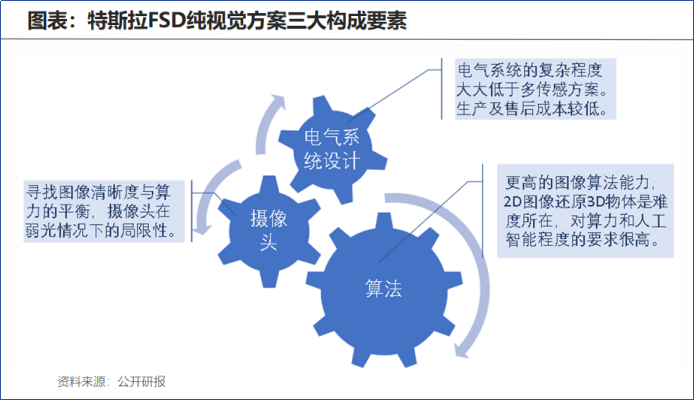
More crucially, Tesla has demonstrated the commercial viability of vision-only solutions. This approach eliminates the need for complex hardware configurations, focusing instead on the synergy between algorithms, electrical systems, and cameras, with 3D vision serving as the cornerstone of vision-only systems.
While the industry focuses on FSD's rollout, companies deeply invested in 3D vision technology have been quietly building momentum to reshape market dynamics.
The Powerhouse in the 3D Vision Arena
Orbbec may be a relatively unknown name, but this company, often referred to as China's "pioneer in 3D vision," has already made its mark on the global tech stage.
In 2015, Orbbec developed China's first 3D depth engine chip, the MX400, becoming one of the few companies worldwide with a comprehensive presence across six mainstream 3D vision perception technology routes. This technological foundation places it alongside industry giants like Apple, Microsoft, and Huawei in the global 3D vision sensor market.
While 2D vision captures flat images of the world, 3D vision equips AI with spatial perception capabilities, akin to "eyes." It not only captures planar information but also reconstructs 3D geometries, providing depth and positional data crucial for precise localization and scene reconstruction. These capabilities are indispensable for robotics, industrial automation, automotive electronics, and other fields. Orbbec's strength lies in its full-stack capabilities, from core chip R&D to algorithm development, making it a key global supplier of 3D vision sensors.
Bold R&D Investments: Fueled by Technological Passion and Commercial Success
Orbbec's growth trajectory is marked by audacious R&D investments.
In 2022, despite generating just RMB 350 million in revenue, the company allocated RMB 380 million to R&D, resulting in an R&D-to-revenue ratio of 108.73%. This near-reckless commitment reflects management's unwavering focus on technological advancement. Led by founder Huang Haoyuan, an MIT graduate, the team comprises experts from top global universities, embedding a deep technological DNA. They believe that mastering core chips and algorithms is essential for achieving true industry influence.
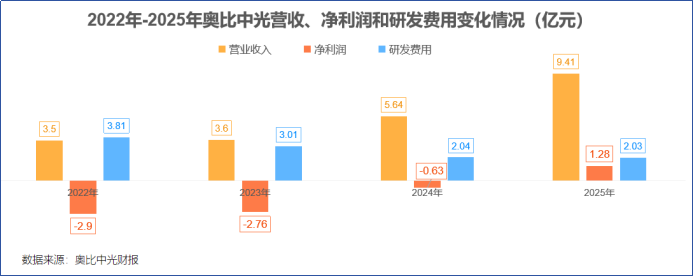
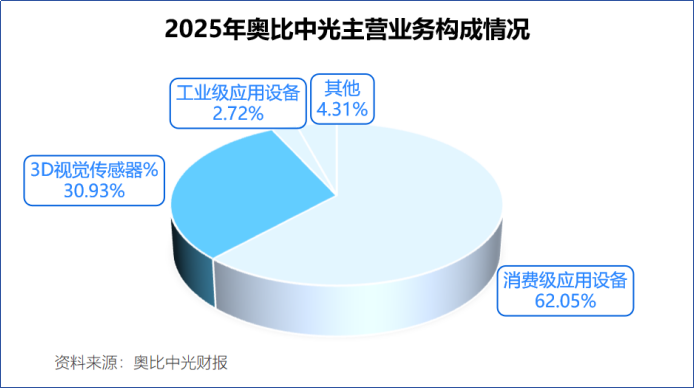
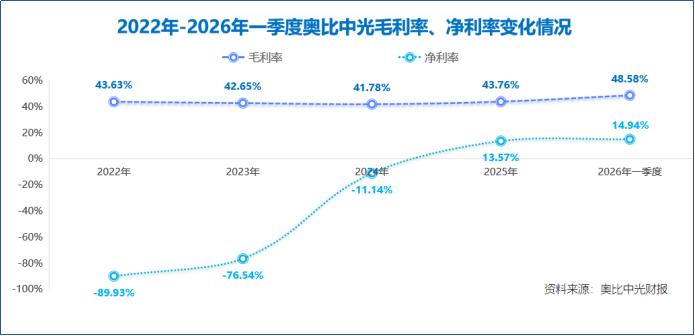
The returns on this intense R&D investment have been substantial and rapid. By 2025, Orbbec achieved its first post-IPO profit, with net income surging 303.33% year-over-year to RMB 128 million. Technological leadership translates to premium pricing, with gross margins consistently exceeding 40% since its 2022 IPO, reaching 48.58% in Q1 2026. Industrial-grade equipment margins soared to 66.8%, far surpassing those of most tech firms.
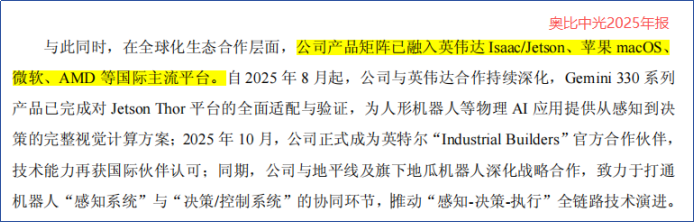
Partnerships with global tech leaders further validate Orbbec's position. Its products are integrated with NVIDIA Isaac/Jetson, Apple macOS, Microsoft, AMD, and other mainstream platforms. In 2025, its camera matrix fully supported NVIDIA's Thor advanced computing platform, and it became an official Intel "Industrial Builders" partner, solidifying its global competitive edge.
Preparing for Humanoid Robots: RMB 980 Million Fundraising Targets Next Growth Frontier
In May 2026, Orbbec announced plans to raise up to RMB 980 million (with total investment reaching RMB 1.99 billion) for a robotics AI vision and spatial perception R&D platform, timing its move with precision.
As humanoid robots approach mass production—with the global market projected to skyrocket from $2.3 billion in 2025 to $13 billion by 2029—3D vision becomes their core sensory system. Just as humans rely on vision for ~70% of their information, 3D vision serves as the "eyes" for robots.
Orbbec has already forged partnerships with over 100 robotics firms, including UBTECH, Roborock, and Zhiyuan Robotics. In April 2025, its 3D vision-equipped Tiangong robot won the world's first humanoid robot marathon, showcasing its technological prowess. This fundraising aims to secure a foothold in global humanoid robot supply chains, gaining a first-mover advantage before the industry explodes.
Technological Dividends Accelerate: The 3D Vision Boom Has Just Begun
As AI-powered devices deepen their interactions with the physical world, 3D vision applications expand beyond traditional industrial and consumer devices into automotive electronics, humanoid robots, and broader fields.
Tesla's FSD launch in China accelerates technological advancements in intelligent driving, while vision-only solutions further drive demand for 3D vision.
As China's "pioneer in 3D vision," Orbbec leads in technological deployment, mass production speed, and scale. From core chip R&D to full-stack capabilities, from profit turnaround to global tech ecosystem recognition, and now positioning for humanoid robots, this formidable company is riding the AI hardware upgrade wave to unlock industrial dividends.
As AI integrates deeply with the physical world, 3D vision becomes the critical bridge between virtual and real. Orbbec's journey reflects not just a tech company's breakthrough but also China's hard tech firms' evolution from technological catch-up to ecosystem co-creation.
Amid the dual trends of intelligent driving and humanoid robots, this "AI vision" company with core technologies may be scripting the next industrial legend.
Note: (Disclaimer: Content and data are for reference only and do not constitute investment advice. Investors act at their own risk.)
- End - Let's resonate together! 
Following and sharing is the greatest support!
-
![]()
Even Li Auto Is Facing Challenges. Can Xiaomi Make a Mark in the Extended-Range Hybrid Vehicle Market?
-
![]()
Surplus Capacity Leasing vs. Aggressive Expansion: Is Meta's 'Dual Strategy' a Deliberate Move?
-
![]()
German Business Leaders Contemplate 'Embracing the 996 Culture,' While Chinese Auto Workers Simply Aspire to Clock Out On Time
-
Graduating with a Violin Serenade in a Luobo Kuaipao, Enjoying Yunba Rides, and Watching Football with Milu: Shenzhen's Seamless Integration of Driverless Cars into Daily Life
-
![]()
Shenzhen Unveils 331 Nighttime Autonomous Vehicle Routes in Three Months: Even Logistics Embrace Off-Peak Operations in the Vibrant City
-
![]()
Why Did the Lingguang App Lose Its Competitive Edge? A Strong Hand Played Poorly
-
![]()
Monthly Double Building Purchases for 3.8 Billion: Is Duan Yongping Still in Sync with Pinduoduo?
-
![]()
Tesla FSD’s China Debut: How Orbbec’s ‘AI Eyes’ Are Revolutionizing Intelligent Driving and Robotics