Xiaomi Reportedly Laying Off Employees: Is Lei Jun’s Success Limited to Ventures He Oversees Personally?
 07/14 2026
 575
575
Produced by Leida Finance | Text by Zhou Hui | Edited by Meng Shuai
Following a halving of its first-quarter profits, Xiaomi is reportedly continuing to lay off employees in batches.
According to Caixin, several Xiaomi Group employees have stated that since March, the company has been conducting layoffs in waves across multiple business units, including smartphones, automotive, internet, and international divisions. These layoffs cover roles in R&D, testing, product development, marketing, and more, with varying layoff ratios.
In response to the layoff rumors, Xiaomi clarified that there have been normal business team adjustments but denied any large-scale layoffs.
Financial reports reveal that as of the end of the first quarter, Xiaomi Group had 55,994 full-time employees, a decrease of 537 from the end of the previous year. However, the company's R&D staff increased by 591 to 26,048.
It’s worth noting that the article "Inside Xiaomi," which recently circulated online, also discussed the issue of layoffs at Xiaomi. The author, claiming to be a former campus recruit who left the company, exposed how Xiaomi treated campus recruits during layoffs from their perspective.
Additionally, the article analyzed Xiaomi's "uneven development" and the challenges its smartphone business faces in moving upmarket. The author stated that Xiaomi founder Lei Jun is indeed a consistent winner, with product lines he personally oversees always becoming successful, but those he doesn't often encounter bottlenecks.
Leida Finance observed that since entering the automotive business in 2021, Xiaomi's smartphone revenue has generally been on a decline.
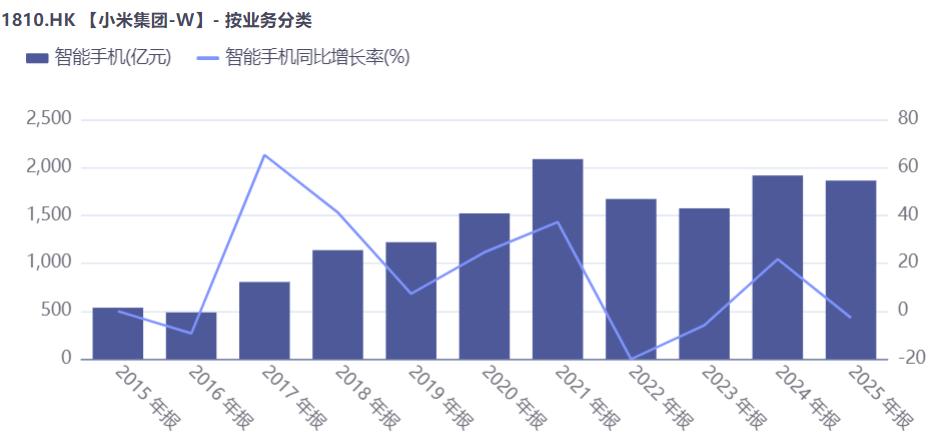
Data from iFinD shows that from 2022 to 2025, Xiaomi's smartphone business saw a year-over-year revenue increase only in 2024, with declines of 19.94%, 5.83%, and 2.77% in the other years.
In the first quarter of this year, Xiaomi Group's performance suffered a significant setback, with quarterly revenue reaching 99.142 billion yuan, a 10.92% year-over-year decrease. Net profit attributable to the parent company was 4.723 billion yuan, a staggering 56.77% year-over-year drop.
Of this, the smartphone business contributed 44.3 billion yuan in revenue, a 12.5% decrease from the same period last year. Meanwhile, the smart automotive and AI innovation businesses, which achieved annual profitability for the first time last year, reported an operating loss of 3.1 billion yuan for the quarter.
Xiaomi Reportedly Laying Off Employees in Batches, with Over 500 Reductions in the First Quarter
On July 10, Caixin quoted multiple Xiaomi Group employees as saying that since March, Xiaomi has been conducting layoffs in waves across multiple business departments, including smartphones, automotive, internet, and international divisions. These layoffs cover roles in R&D, testing, product development, marketing, and more, with varying layoff ratios.
A Xiaomi employee based in Beijing stated that starting in April this year, department leaders began discussing layoffs with employees, with those laid off mainly leaving in June. According to their understanding, the severance package is N (monthly salary based on years of service) + 1.
At the same time, the employee revealed that the layoff ratio in their department is about 20%. "The 20% ratio is not calculated per person but rather 20% of the entire department's labor costs," they explained.
In response, Xiaomi told Caixin that there have been normal business team adjustments but denied any large-scale layoffs.
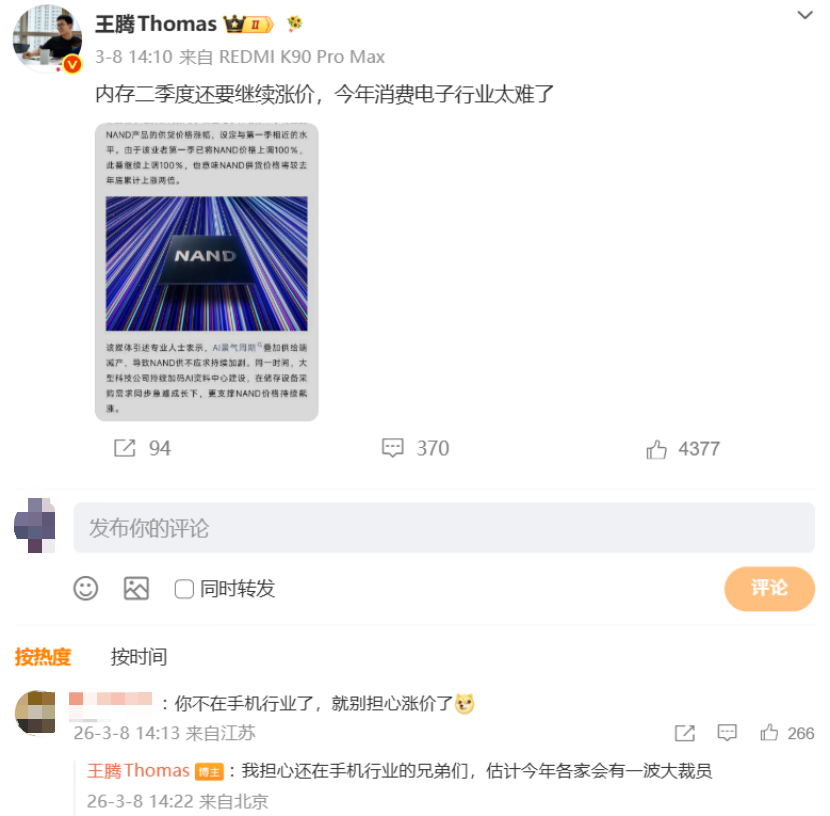
It’s worth mentioning that as early as March this year, due to continuous memory price increases, Wang Teng, the former general manager of Xiaomi's REDMI brand, commented in a Weibo post's comment section that "it is estimated that there will be a wave of major layoffs across the industry this year."
Leida Finance noticed that in its 2025 annual report, Xiaomi Group disclosed that as of December 31, 2025, the company had 56,531 full-time employees. However, in this year's first-quarter report, Xiaomi Group had 55,994 full-time employees, a decrease of 537 from the end of the previous year.
However, while the overall employee count has decreased, Xiaomi Group's R&D personnel increased by 591, from 25,457 at the end of 2025 to 26,048.
It’s worth mentioning that the article "Inside Xiaomi," which previously circulated online, also mentioned the issue of layoffs at Xiaomi.
According to reports from media outlets such as Jinzhao News and Caizhongshe, the author claimed to be a former Xiaomi employee who joined through campus recruitment in 2024 and has since left. From the perspective of a campus recruit, the author exposed some internal issues at Xiaomi.
It is reported that the article was published on Xiaomi Group's internal Feishu platform on June 24 and was subsequently urgently removed. As of now, Xiaomi has not responded to this article.
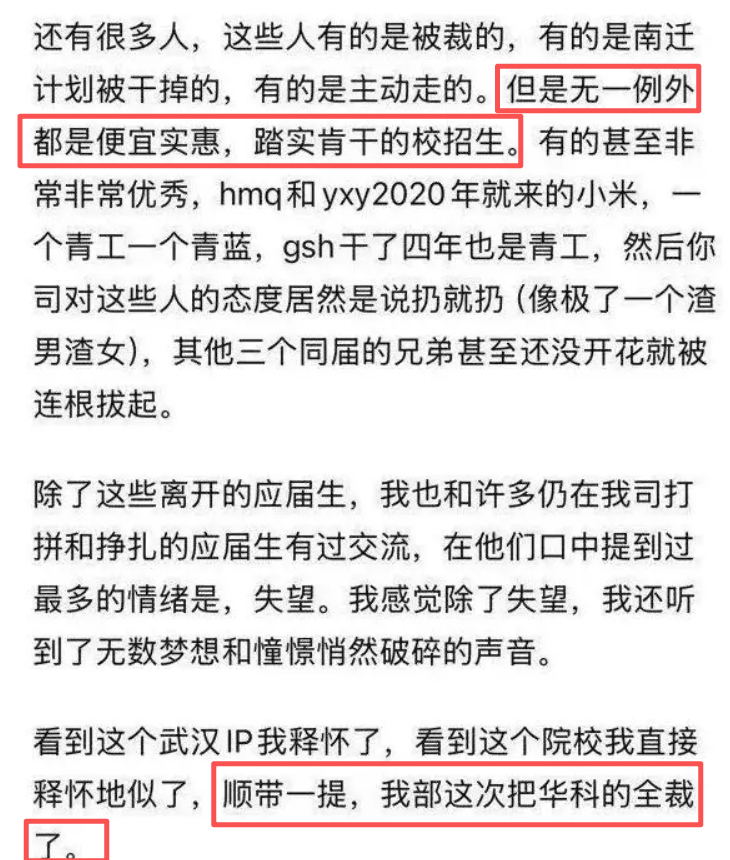
The author stated in the article that most Xiaomi employees are also subject to "cost-effectiveness," with many campus recruits reneging on their offers to join companies with better treatment.
Even if these "affordable and hardworking" campus recruits successfully join the company, they are "easily discarded" when layoffs occur. The author revealed that their department "laid off all employees from Huazhong University of Science and Technology."
At the end of the article, the author suggested that Xiaomi should hire more people rather than lay off more. "I have seen this phenomenon many times: an employee was originally allocated for research and development, but delivery tasks occupied 70% or more of their time, ultimately leading to the failure or abortion of R&D/scientific research projects." However, the author also admitted that this suggestion would be difficult to implement and would require significant investment.
Does Lei Jun Only Succeed in What He Personally Oversees?
In addition to Xiaomi's talent drainage, the author of "Inside Xiaomi" also discussed the challenges Xiaomi's smartphone business faces in moving upmarket and the company's "uneven development."
The author stated that they joined Xiaomi in 2024 based on the misjudgment that the success and popularity of Xiaomi's automotive business would boost its smartphone business and enable it to achieve a high-end breakthrough.
However, by 2026, with the release of the second-generation Xiaomi SU7, the success of YU7, and the emergence of Xuanjie chips, the goal of moving Xiaomi's smartphones upmarket remained elusive, with the company's domestic smartphone shipments even falling into the "others" category in the first quarter of this year.
According to the latest quarterly mobile phone tracking report by the International Data Corporation (IDC), in the first quarter of 2026, the domestic smartphone market shipped approximately 69.04 million units, a 3.3% year-over-year decrease.
Among these, Huawei ranked first with a 19.8% market share; Apple followed closely with an 18.9% market share; OPPO, vivo, and Honor ranked third to fifth, respectively.
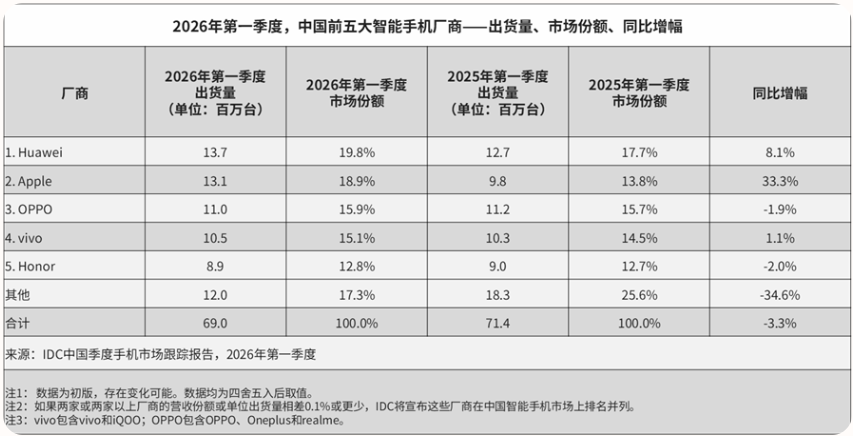
According to a CounterPoint report, in the first quarter of this year, Xiaomi's domestic smartphone shipments decreased by 35% year-over-year, falling out of the top five market rankings.
The author reflected in the article that Xiaomi's current dilemmas and issues are related to the company's founder, Lei Jun. The author acknowledged that Lei Jun is a true consistent winner but compared him to Xiang Yu, stating that he "can only win on the battlefronts he personally oversees."
"Whichever product line Mr. Lei personally oversees, that product line becomes a hit. However, no one's energy is unlimited, and the product lines he lets go of often encounter bottlenecks."
According to Xiaomi Group's official website, on March 30, 2021, Xiaomi announced its entry into the smart electric vehicle sector, with a planned investment of $10 billion over the next decade and an initial investment of 10 billion yuan. Lei Jun will personally lead the charge and fight for Xiaomi's automotive business.
Information from Tianyancha shows that on September 1 of the same year, Xiaomi Automobile Co., Ltd. was officially registered, with Lei Jun serving as the executive director, manager, and legal representative.
However, since Xiaomi entered the automotive business, its smartphone business has been on a decline.
Data from iFinD shows that in 2021, Xiaomi's smartphone business revenue increased by 37.24% year-over-year to 208.869 billion yuan, but it fell to 167.217 billion yuan the following year, a 19.94% year-over-year decrease.
In 2023, Xiaomi's smartphone business achieved revenue of 157.461 billion yuan, a further 5.83% year-over-year decrease. In 2024, revenue in this segment recovered to 191.759 billion yuan but still did not reach the level of 2021.
In 2025, Xiaomi's smartphone business revenue weakened again, decreasing by 2.77% year-over-year to 186.44 billion yuan.
In the author's view of "Inside Xiaomi," there are two main reasons for Xiaomi's "uneven development" and the crisis in its smartphone product line.
First, the incomplete construction of the talent echelon (generally meaning "succession" or "tier") and high talent drainage and turnover rates have affected the stability of R&D. Second, Xiaomi's initial choice of a low-end, consumer-friendly product line has made it difficult to transition to the high-end market.
Smartphone Business Under Significant Pressure, Automotive and AI Businesses Turn Loss-Making
Despite the aforementioned public sentiment, Xiaomi's latest financial report performance is also far from outstanding.
In the first quarter of 2026, Xiaomi Group achieved revenue of 99.142 billion yuan, a 10.92% year-over-year decrease. Net profit attributable to the parent company was 4.723 billion yuan, a staggering 56.77% year-over-year drop.
By business segment, Xiaomi Group's Smartphone × AIoT division recorded revenue of 79.3 billion yuan for the quarter, a 14.5% year-over-year decrease.
Of this, the smartphone business, as the main revenue contributor, generated 44.3 billion yuan in revenue, a 12.5% decrease from the same period last year, primarily due to a reduction in smartphone shipments, partially offset by an increase in the average selling price (ASP) of smartphones.
Financial reports show that in the first quarter of 2026, Xiaomi's smartphone shipments decreased by 19.2% year-over-year to 33.8 million units, mainly due to changes in the product matrix and a reduction in shipments of mid-to-low-end smartphones.
However, due to an increase in the proportion of high-end smartphone shipments, Xiaomi's smartphone ASP increased by 8.2% year-over-year to 1,310.1 yuan per unit, reaching a record high.
Nevertheless, Xiaomi's smartphone business gross profit margin did not improve as a result. In the first quarter of 2026, the company's smartphone business gross profit margin was 10.1%, a 2.3 percentage point year-over-year decrease, primarily due to rising prices of core components and increased competition in mainland China.
During the same period, Xiaomi Group's Smart Electric Vehicles and AI Innovation Business division achieved revenue of 19.9 billion yuan, a 6.9% year-over-year increase. Of this, smart electric vehicle revenue was 19 billion yuan, a 5.1% year-over-year increase.
In the first quarter of this year, Xiaomi delivered 80,900 vehicles, a 6.6% year-over-year increase, but its ASP decreased by 1.3% from 238,300 yuan per vehicle in the first quarter of 2025 to 235,100 yuan per vehicle.
Additionally, affected by a decrease in the delivery proportion of Xiaomi SU7 Ultra, vehicle purchase tax subsidies, and rising costs of core components, the gross profit margin of Xiaomi's Smart Electric Vehicles and AI Innovation Business division for the quarter decreased to 20.1%, a 3.1 percentage point year-over-year decrease.
Leida Finance noticed that this division only tasted profitability for the first time last year, with annual operating income of 900 million yuan. However, in the first quarter of this year, the division recorded an operating loss of 3.1 billion yuan for the quarter.
It’s worth mentioning that after successively launching the Xiaomi SU7 and Xiaomi YU7, Xiaomi Automobile is set to introduce a new product series, SkyNomad, with the Chinese name Xiaomi Pengcheng. On July 10, Xiaomi Pengcheng unveiled the name of its first SUV model—SkyNomad N90.
It is reported that Xiaomi Pengcheng and the Xiaomi SU7/YU7 series are parallel dual series. They simply have different product focuses, with the SU7/YU7 positioned as "driver-focused cars" and the Xiaomi Pengcheng series positioned as "smart, adaptable, spacious SUVs," providing users with more in-car space options.
However, before the new model was officially released, Xiaomi Pengcheng faced cross-temporal rumors: keywords such as "SkyNomad fire cause," "accident details," "owner rights protection," and "car explosion" have appeared in the search bars of some social media platforms, along with even car crash videos.
In response, relevant Xiaomi staff stated, "This has seriously affected the normal conduct of our work. We are continuously collecting and organizing similar situations and filing complaints and communicating with various platforms for resolution."
Leida Finance will continue to monitor further developments in Xiaomi's business.
-
![]()
Is Seres Truly Being 'Bled Dry' by Huawei?
-
![]()
Robot Brain: A Lucrative Business or a Challenging Pursuit?
-
It's Official! Shanghai's July AI Extravaganza: A Gateway to Future Industry Trends and Global Consensus
-
![]()
After the Demise of the Big Factory Bot, I Leveraged AI to Craft an Interactive 'Haaland'
-
Anticipated Losses Reach Nearly 2.3 Billion Yuan! How Long Can Seres Sustain Its 'Contract Manufacturing' Predicament?
-
Wu Jianjun Steps In: Konka’s Fight for Efficiency and Revival
-
![]()
Hainan Sets 2030 Deadline for Phasing Out Fuel Vehicle Sales: Which Regions Will Be Next to Follow Suit?
-
Huabei Outage: System Failure Challenges User Trust